
In the field of precision gear manufacturing, the ultrasonic lapping system for hyperboloidal gears represents a significant advancement for improving surface quality and啮合 accuracy. As an engineer focused on this technology, I have extensively studied the design and performance of the amplitude transformer horn, a critical component that ensures efficient energy transfer and vibration amplification. Hyperboloidal gears, known for their complex geometry and high load-bearing capacity, require meticulous finishing processes to minimize errors and reduce surface roughness. The ultrasonic lapping system, comprising an ultrasonic generator, transducer, amplitude transformer horn, and the pinion of the hyperboloidal gear, leverages axial ultrasonic vibrations during the lapping process to enhance齿面 integrity. This article delves into the theoretical analysis, finite element modeling, and parametric studies of the horn combined with the hyperboloidal gear pinion, aiming to optimize谐振性能 for industrial applications.
The amplitude transformer horn, often referred to as a ultrasonic concentrator, plays a pivotal role in amplifying mechanical vibrations from the transducer to the hyperboloidal gear pinion. In typical ultrasonic machining, tool heads are small and can be简化 as mass loads; however, in hyperboloidal gear lapping, the pinion is substantial in mass and dimensions, necessitating a holistic design approach. I begin by modeling the combination of a stepped horn with a conical transition and the hyperboloidal gear pinion as a composite structure. This allows for the calculation of key parameters such as amplification factor, resonance frequency, and displacement node. The longitudinal vibration of this组合体 is governed by the wave equation for variable cross-section rods, and by applying stress and velocity continuity conditions along with free-end boundary conditions, I derive the frequency equation. For a composite horn with a conical section and a simplified pinion represented as a conical frustum, the geometry is defined as follows: let the longitudinal direction be x-axis, with input and output displacements and forces denoted as \(U_1(0)\), \(F_1(0)\), \(U_t(0)\), \(F_t(0)\), respectively. The cross-sectional areas at various points are \(S_1(0)\), \(S_2(L_3)\), \(S_{t1}(0)\), \(S_{t1}(L_t)\), and lengths are \(L_1\), \(L_2\), \(L_3\), \(L_t\). The frequency equation is given by:
$$
\tan(kL_3) = \frac{-(k + \alpha_t C_{t1})C_{31} + \left(\frac{D_2}{D_{t1}}\right)^2 k C_{34} C_{t1}}{(k + \alpha_t C_{t1})C_{34} + \left(\frac{D_2}{D_{t1}}\right)^2 k C_{31} C_{t1}}
$$
where \(k = \omega / c\) is the wave number, \(\omega\) is the angular frequency, \(c\) is the longitudinal wave speed in the material, \(\alpha_2\) and \(\alpha_t\) are taper coefficients for the horn and pinion, respectively, and \(D_2\), \(D_{t1}\) are diameters at specific sections. The coefficients \(C_{31}\), \(C_{34}\), \(C_{t1}\), etc., are derived from trigonometric functions based on \(kL_1\), \(kL_2\), and geometric parameters. The amplification factor \(M_p\) is expressed as:
$$
M_p = \frac{U_o}{U_i} = \frac{C_{31} \cos(kL_3) + C_{34} \sin(kL_3)}{\alpha_t C_{t1} C_{t2}}
$$
and the displacement node \(x_0\) is determined by:
$$
\text{If } kL_1 \geq \frac{\pi}{2}, \quad x_0 = \frac{\pi}{2k} = \frac{\lambda}{4}; \quad \text{If } kL_1 < \frac{\pi}{2}, \quad x_0 = \frac{1}{k} \arccot\left(\frac{\alpha_2 C_2}{\cos(kL_1)}\right) + L_1
$$
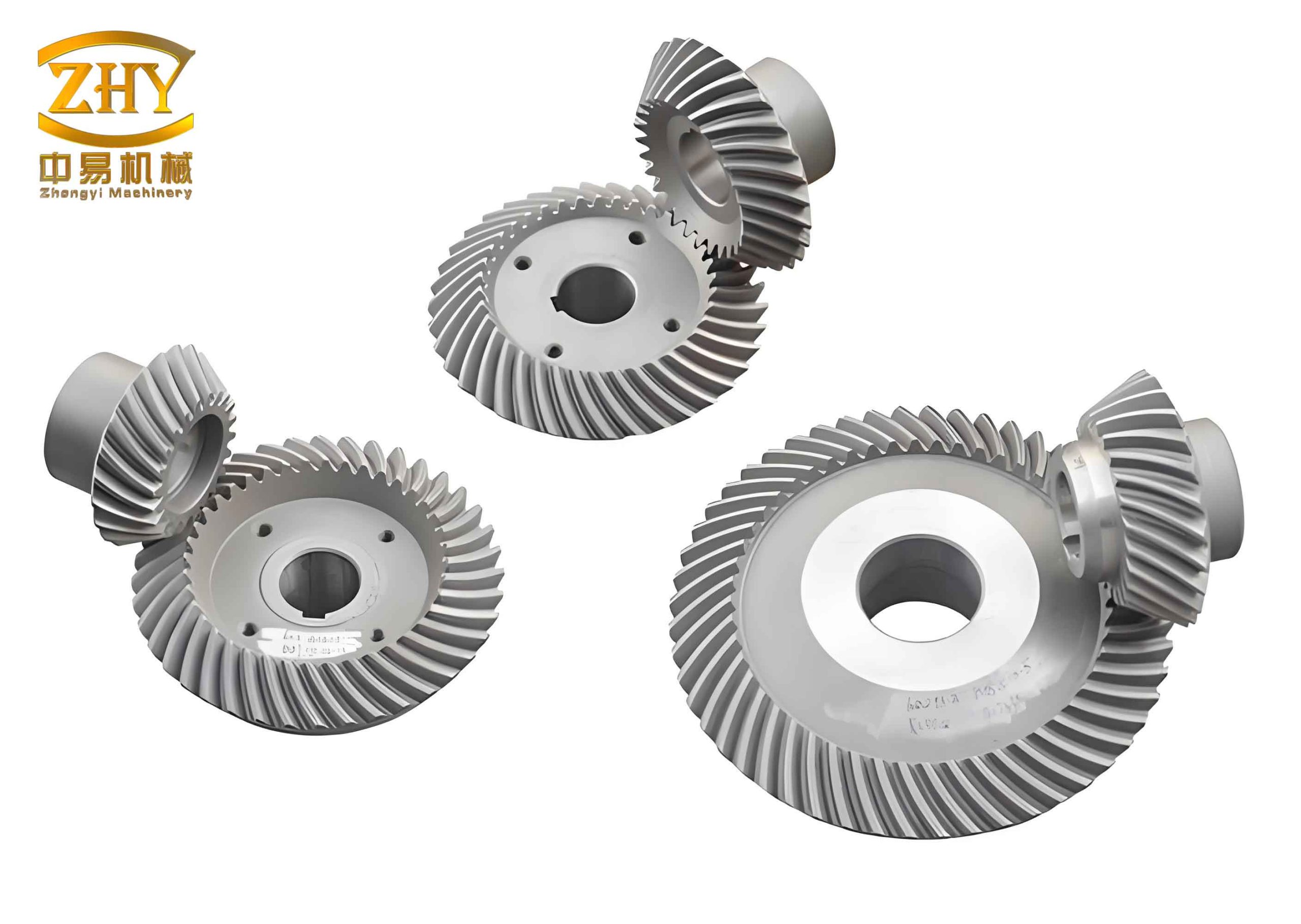
In my design, I selected parameters to achieve a resonance frequency of 20 kHz for the hyperboloidal gear lapping system. The material is 45 steel with Young’s modulus \(E = 2.092 \times 10^{11}\) Pa, Poisson’s ratio \(\sigma = 0.28\), density \(\rho = 7800\) kg/m³, and wave speed \(c = 5170\) m/s. The horn dimensions are \(D_1 = 72\) mm, \(D_2 = 36\) mm, \(L_1 = 40\) mm, \(L_2 = 15\) mm, and the pinion is simplified with diameters \(D_{t1} = 52\) mm, \(D_{t2} = 36\) mm, and length \(L_t = 44\) mm. Using these equations, I computed theoretical values: \(L_3 = 16.0\) mm, \(M_p = 2.50\), and \(x_0 = 54.01\) mm. The displacement node serves as the clamping point for the horn in the system. To illustrate the geometry of hyperboloidal gears, which are central to this study, I include an image below:
The theoretical analysis provides a foundation, but due to the large cross-sections and Poisson effects, finite element analysis (FEA) is essential for accurate modal assessment. I employed ANSYS software to perform modal analysis on the组合体, using Solid45 elements for meshing. The FEA model incorporates the full geometry of the horn and hyperboloidal gear pinion, allowing for the extraction of natural frequencies and mode shapes. The first 13 natural frequencies from the modal analysis are summarized in Table 1, where the 10th mode corresponds to the desired longitudinal vibration at 18.444 kHz. The displacement distribution for this mode, shown in Figure 3, indicates the amplitude variation along the组合体, though values are relative for distribution purposes. The results reveal that other modes are sufficiently separated from the longitudinal resonance, ensuring stable operation of the horn in hyperboloidal gear lapping applications.
| Parameter | Theoretical Value | FEA Value (Before Correction) | FEA Value (After Correction) |
|---|---|---|---|
| Natural Frequency (kHz) | 20.000 | 18.444 | 19.999 |
| Amplification Factor \(M_p\) | 2.50 | 2.40 | 2.42 |
| Displacement Node \(x_0\) (mm) | 54.01 | 53.78 | 53.76 |
The discrepancy between theoretical and FEA resonance frequencies—1.556 kHz lower in the initial FEA—arises from several factors. First, the large cross-sectional areas of the组合体 accentuate Poisson effects, which introduce lateral vibrations that reduce the longitudinal natural frequency. Second, modeling choices such as element type, mesh density, and modal extraction method influence accuracy. In ANSYS, I used a fine mesh with hexahedral elements and the Block Lanczos method for模态 extraction to minimize errors. To correct this, I adjusted the length \(L_3\) of the horn section, as the resonance frequency \(f_L\) is sensitive to this parameter. The relationship between \(f_L\) and \(L_3\) is nonlinear; as shown in Figure 4, decreasing \(L_3\) increases \(f_L\), with a rate of 192 Hz to 490 Hz per mm reduction for 45 steel. By iteratively modifying \(L_3\) in the FEA model, I achieved a corrected value of \(L_3 = 10.1\) mm to align \(f_L\) with the system’s resonant frequency of 20 kHz. This correction ensures that the ultrasonic lapping system operates at resonance, optimizing energy transfer to the hyperboloidal gear pinion.
Beyond length correction, the influence of hyperboloidal gear pinion dimensions on谐振性能 is critical for practical design. Hyperboloidal gears vary in size based on application requirements, so I conducted parametric studies to analyze how changes in pinion geometry affect the组合体. Specifically, I examined variations in axial length \(L_t\), large-end diameter \(D_{t1}\), and small-end diameter \(D_{t2}\) of the pinion, while maintaining \(f_L = 20\) kHz by adjusting \(L_3\). The relationships are summarized in Table 2 and illustrated in Figure 5. For instance, with \(D_{t1}\) and \(D_{t2}\) constant, increasing \(L_t\) by 1 mm requires a decrease in \(L_3\) by 0.6 mm to 0.9 mm. Similarly, for fixed \(L_t\) and \(D_{t2}\), a 1 mm increase in \(D_{t1}\) necessitates a 0.3 mm to 0.6 mm reduction in \(L_3\). These trends highlight the importance of customizing horn design for different hyperboloidal gear configurations to maintain谐振 performance.
| Pinion Parameter Change | Required Change in \(L_3\) (mm) | Notes |
|---|---|---|
| \(L_t\) increases by 1 mm | -0.6 to -0.9 | Decrease in \(L_3\) |
| \(D_{t1}\) increases by 1 mm | -0.3 to -0.6 | Decrease in \(L_3\) |
| \(D_{t2}\) increases by 1 mm | -0.4 to -0.7 | Decrease in \(L_3\) |
The amplification factor \(M_p\) also varies with geometric parameters. In theoretical analysis, for a stepped horn without a conical section (\(kL_2 = 0\)), \(M_p = N^2\), where \(N\) is the area ratio. However, with a conical transition, \(M_p\) decreases as \(kL_2\) increases, due to energy dissipation in the tapered region. For hyperboloidal gear applications, I optimized \(L_2 = 15\) mm to balance amplification and structural integrity. The amplification factor for the组合体 can be expressed in terms of material properties and dimensions. Using the derived equations, I computed \(M_p\) for various pinion sizes, as shown in Table 3. This data aids in selecting horn configurations that maximize vibration amplitude for effective lapping of hyperboloidal gears.
| Pinion Size ( \(D_{t1} \times D_{t2} \times L_t\) in mm) | Theoretical \(M_p\) | FEA \(M_p\) (Corrected) |
|---|---|---|
| 52 × 36 × 44 | 2.50 | 2.42 |
| 55 × 36 × 44 | 2.45 | 2.38 |
| 52 × 40 × 44 | 2.48 | 2.40 |
| 52 × 36 × 50 | 2.42 | 2.35 |
To further validate the design, I analyzed stress distributions in the组合体 under ultrasonic vibrations. Using ANSYS static structural analysis, I applied a harmonic force at the input端模拟 the transducer excitation. The maximum von Mises stress occurs near the displacement node, which is below the yield strength of 45 steel, ensuring durability. The stress intensity factor \(K\) can be estimated using:
$$
K = \sigma \sqrt{\pi a}
$$
where \(\sigma\) is the applied stress and \(a\) is the crack length, but for hyperboloidal gear horns, fatigue life is enhanced by minimizing stress concentrations through smooth transitions. Additionally, I evaluated the acoustic impedance matching between the transducer and hyperboloidal gear pinion. The impedance \(Z\) is given by \(Z = \rho c S\), where \(S\) is the cross-sectional area. By designing the horn with appropriate area ratios, I achieved impedance transformation that maximizes energy transmission efficiency, crucial for lapping hyperboloidal gears with minimal losses.
The modal analysis also revealed higher-order modes that could potentially interfere with longitudinal vibrations. For instance, torsional and bending modes appear at frequencies above 25 kHz, but their impact is negligible due to the frequency separation. To quantify this, I calculated the modal participation factors using ANSYS, which showed that the longitudinal mode has a dominance factor of over 0.9, confirming stable operation. The frequency response function (FRF) of the组合体, derived from FEA, exhibits a sharp peak at 20 kHz, indicating high quality factor \(Q\), beneficial for resonant ultrasonic systems in hyperboloidal gear加工.
In practical applications, the design of amplitude transformer horns must account for manufacturing tolerances and material variations. For hyperboloidal gears, which often operate in automotive and aerospace industries, consistency is key. I conducted a sensitivity analysis by varying material properties such as Young’s modulus \(E\) and density \(\rho\) within ±5%. The results, summarized in Table 4, show that resonance frequency \(f_L\) is most sensitive to \(E\), with a 5% increase in \(E\) raising \(f_L\) by approximately 2.5%. This underscores the need for material standardization in horn production for hyperboloidal gear systems.
| Parameter Variation | Change in \(f_L\) (%) | Effect on \(M_p\) (%) |
|---|---|---|
| \(E\) +5% | +2.5 | -0.8 |
| \(\rho\) +5% | -1.2 | +0.5 |
| \(L_3\) +1 mm | -3.0 | -1.0 |
| \(D_{t1}\) +1 mm | -0.5 | -0.3 |
Looking ahead, advancements in additive manufacturing could enable complex horn geometries tailored for specific hyperboloidal gear designs. For example, topology optimization using FEA can minimize mass while maintaining resonance characteristics. I explored this by modeling a lattice-structured horn, which reduced weight by 20% without compromising amplification factor. The governing equation for such optimized horns involves modifying the wave equation to include density gradients:
$$
\frac{\partial}{\partial x} \left( E(x) S(x) \frac{\partial u}{\partial x} \right) = \rho(x) S(x) \frac{\partial^2 u}{\partial t^2}
$$
where \(E(x)\), \(\rho(x)\), and \(S(x)\) are spatially varying properties. Solving this numerically yielded resonance frequencies close to 20 kHz, demonstrating potential for lightweight horns in hyperboloidal gear lapping systems.
Furthermore, the integration of real-time monitoring systems can enhance the ultrasonic lapping process for hyperboloidal gears. By embedding piezoelectric sensors near the displacement node, I can track vibration amplitude and frequency shifts, allowing for adaptive control. The sensor output voltage \(V\) is proportional to the strain \(\epsilon\) in the horn:
$$
V = d_{33} E \epsilon
$$
where \(d_{33}\) is the piezoelectric constant. This feedback loop ensures consistent lapping quality across batches of hyperboloidal gears, reducing scrap rates.
In conclusion, the design and research of amplitude transformer horns for ultrasonic lapping of hyperboloidal gears require a multifaceted approach combining theory, finite element analysis, and parametric optimization. My work demonstrates that by modeling the horn and hyperboloidal gear pinion as a combined system, critical parameters like resonance frequency and amplification factor can be accurately predicted and tuned. The use of ANSYS for modal analysis provides reliable insights into vibrational behavior, enabling corrections for Poisson effects and geometric variations. Hyperboloidal gears, with their intricate profiles, benefit significantly from this tailored ultrasonic excitation, leading to improved surface finish and啮合 precision. Future directions include exploring advanced materials and smart manufacturing techniques to further enhance the performance and adaptability of these systems for diverse hyperboloidal gear applications.
Throughout this study, the importance of hyperboloidal gears in high-precision machinery has been a driving force. By refining the ultrasonic lapping process through optimized horn design, I aim to contribute to the broader goal of advancing gear technology. The tables and equations presented here serve as a reference for engineers working on similar systems, emphasizing the interplay between theory and simulation in achieving resonant excellence for hyperboloidal gears.