
In this study, I investigate the intricate relationship between machine tool adjustment parameters and the meshing performance of hyperboloidal gears. Hyperboloidal gears, also known as hypoid gears, are crucial components in power transmission systems for automotive, aerospace, and industrial applications due to their high load capacity, smooth operation, and ability to transmit motion between non-intersecting axes. The precise control of their meshing characteristics, such as contact patterns and transmission errors, is essential for minimizing noise, vibration, and wear, thereby extending service life. However, the manufacturing of hyperboloidal gears involves numerous adjustable machine parameters, making it challenging to optimize meshing performance. Therefore, understanding how these parameters influence gear behavior is vital for improving design and production processes. This paper aims to develop comprehensive mathematical models for tooth surface generation and tooth contact analysis (TCA), and systematically analyze the impact of various machine tool adjustments on contact trajectories, transmission errors, and tooth profile geometry. By employing first-person perspective, I will detail the methodology, derivations, and results, incorporating multiple tables and formulas to summarize key findings.
The foundation of this analysis lies in the mathematical modeling of hyperboloidal gear tooth surfaces based on machining principles. Hyperboloidal gears are typically manufactured using methods like the duplex helical method, which involves complex spatial motions on five-axis machine tools. To derive the tooth surface equation, I establish a series of coordinate systems representing the machine tool, cutter, and gear blank. For the pinion (small gear), the cutting process involves a rotating cutter that generates the tooth surface as an envelope of the tool surface family. Let me define the coordinate systems: \( S_p \) is attached to the cutter, \( S_{m1} \) to the machine, and \( S_1 \) to the pinion. The cutter surface, often a conical surface formed by straight cutting edges, can be expressed in \( S_p \) as:
$$ \mathbf{r}_p = \begin{bmatrix} (r_{g1} + u_1 \sin \alpha_1) \cos \beta_1 \\ (r_{g1} + u_1 \sin \alpha_1) \sin \beta_1 \\ -u_1 \cos \alpha_1 \end{bmatrix} $$
where \( u_1 \) and \( \beta_1 \) are surface parameters, \( \alpha_1 \) is the cutter blade angle, and \( r_{g1} \) is the cutter point radius. The unit normal vector \( \mathbf{n}_p \) is:
$$ \mathbf{n}_p = \begin{bmatrix} \cos \alpha_1 \cos \beta_1 \\ \cos \alpha_1 \sin \beta_1 \\ \sin \alpha_1 \end{bmatrix} $$
Through coordinate transformations from \( S_p \) to \( S_1 \), considering machine motions such as rotation, translation, and helical movement, the pinion tooth surface equation \( \mathbf{r}_1 \) and its unit normal \( \mathbf{n}_1 \) in the pinion coordinate system are obtained. The transformation matrix \( \mathbf{M}_{1p} \) and its rotational submatrix \( \mathbf{L}_{1p} \) are used:
$$ \mathbf{r}_1(u_1, \beta_1, \phi) = \mathbf{M}_{1p} \mathbf{r}_p(u_1, \beta_1) $$
$$ \mathbf{n}_1(u_1, \beta_1, \phi) = \mathbf{L}_{1p} \mathbf{n}_p(u_1, \beta_1) $$
Here, \( \phi \) represents the motion parameter during generation. The meshing equation for the pinion is derived from the condition that the relative velocity between the cutter and gear blank is perpendicular to the surface normal:
$$ f_1(u_1, \beta_1, \phi) = \mathbf{n}_1 \cdot \frac{\partial \mathbf{r}_1}{\partial \phi} = 0 $$
This equation ensures that the generated surface is the envelope of the cutter positions. For practical machining, machine tool adjustment parameters are subject to errors. If \( \mathbf{X} \) denotes the nominal adjustment parameters and \( \Delta \mathbf{X} \) the errors, the actual parameters are \( \mathbf{X}’ = \mathbf{X} + \Delta \mathbf{X} \). Thus, the tooth surface equation incorporating errors becomes:
$$ \mathbf{r}_1 = \mathbf{r}_1(u_1, \beta_1, \phi, \mathbf{X}’) $$
Key machine adjustment parameters include displacement parameters like vertical offset \( S_r \), axial offset \( x_g \), radial distance \( e \), and helical motion coefficient \( H_l \), as well as angular parameters like cutter tilt angle \( i \), cutter swing angle \( j \), machine root angle \( \gamma_m \), and angular position \( q \). These parameters critically influence the geometry of hyperboloidal gears. For the gear (large wheel), which is often cut by a forming method, the tooth surface equation \( \mathbf{r}_2 \) and normal \( \mathbf{n}_2 \) are derived similarly based on its own machining setup.
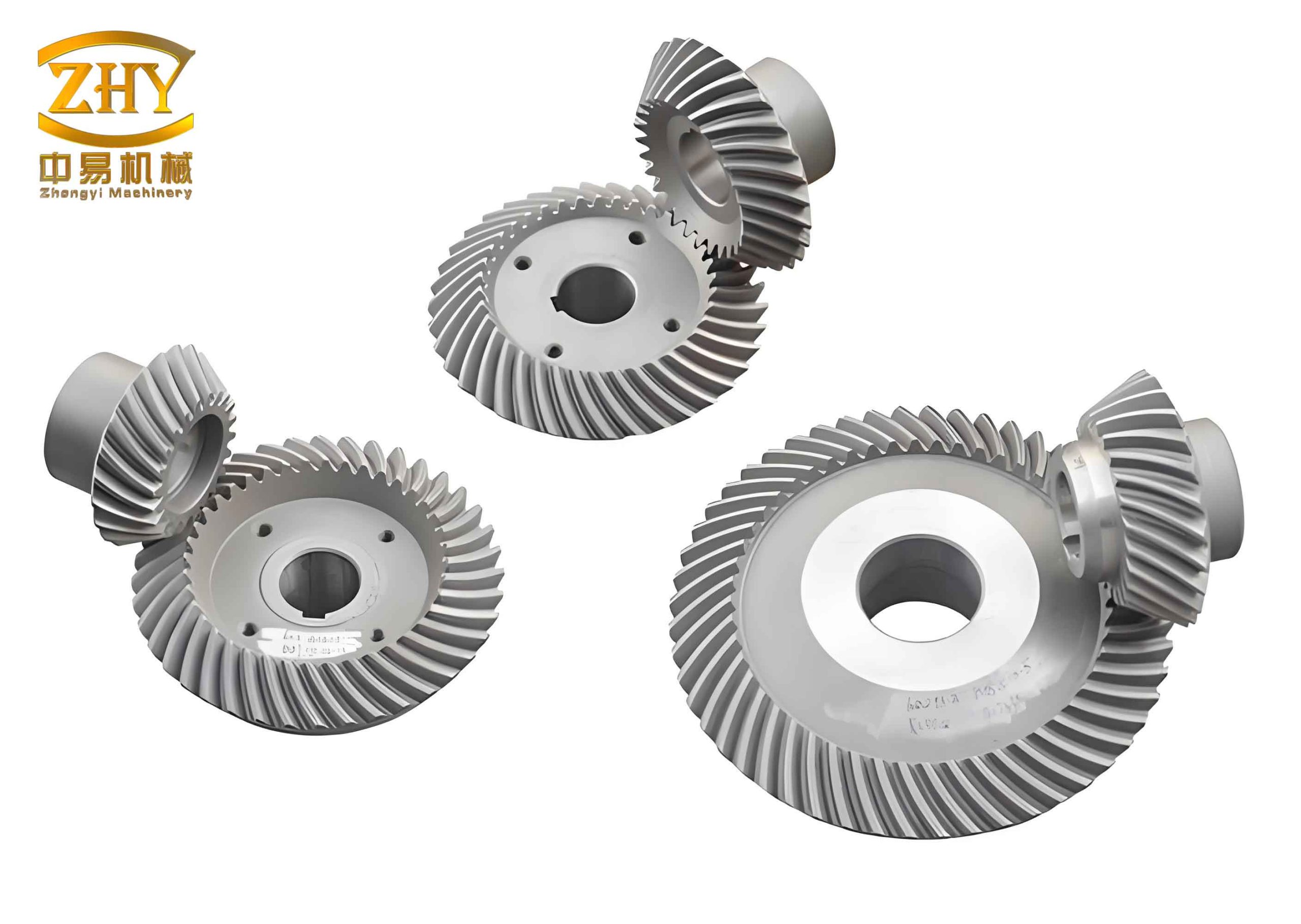
To analyze the meshing performance of hyperboloidal gears, I develop a tooth contact analysis (TCA) model. TCA simulates the engagement between pinion and gear tooth surfaces under no-load conditions, predicting contact patterns and transmission errors. I define mating coordinate systems: \( S_1 \) and \( S_2 \) are attached to the pinion and gear, respectively, while \( S_h \) is a fixed assembly frame. The pinion and gear surfaces are transformed into \( S_h \) using transformation matrices \( \mathbf{M}_{h1} \) and \( \mathbf{M}_{h2} \), which account for assembly settings such as offset distance \( E \) and shaft angle \( \Sigma \). The conditions for contact are that the position vectors and unit normals of both surfaces coincide at the contact point:
$$ \mathbf{r}_{h1}(u_1, \beta_1, \phi, \varphi_1, \mathbf{X}’) = \mathbf{r}_{h2}(u_2, \beta_2, \varphi_2, E) $$
$$ \mathbf{n}_{h1}(\beta_1, \phi, \varphi_1, \mathbf{X}’) = \mathbf{n}_{h2}(\beta_2, \varphi_2, E) $$
$$ f(u_1, \beta_1, \phi) = 0 $$
Here, \( \varphi_1 \) and \( \varphi_2 \) are rotation angles of the pinion and gear, and \( u_2, \beta_2 \) are parameters for the gear surface. This system comprises seven unknowns (\( u_1, \beta_1, \phi, \varphi_1, u_2, \beta_2, \varphi_2 \)) and six independent scalar equations. By fixing one variable, such as \( \varphi_1 \), and solving numerically, I obtain a set of parameters that define a contact point on the gear tooth surface. Varying \( \varphi_1 \) yields a series of points forming the contact path. Additionally, based on curvature relationships, the contact ellipse dimensions can be computed. Transmission error (TE) is defined as the deviation from ideal motion transfer and is calculated as:
$$ \text{TE}(\varphi_1) = \varphi_2 – \frac{N_1}{N_2} \varphi_1 $$
where \( N_1 \) and \( N_2 \) are tooth numbers of pinion and gear, respectively. TE curves provide insights into kinematic accuracy and noise potential. To systematically study parameter effects, I consider a hyperboloidal gear pair with specifications listed in Table 1.
| Parameter | Pinion | Gear |
|---|---|---|
| Number of Teeth | 7 | 43 |
| Outer Pitch Diameter (mm) | 150.1349 | 150.3843 |
| Mean Pressure Angle (°) | 22.5 | |
| Offset Distance (mm) | 25.4 | |
| Face Width (mm) | 43.7299 | 40 |
| Shaft Angle (°) | 90 | |
| Spiral Angle (°) | 45 | 33.45 |
| Face Cone Angle (°) | 11 | 78.46 |
| Pitch Cone Angle (°) | 14.44 | 79.21 |
| Root Cone Angle (°) | 10.26 | 75 |
| Hand of Spiral | Left | Right |
The machine tool adjustment parameters for manufacturing this hyperboloidal gear pair are given in Table 2. In practice, these parameters are set during cutting, but errors may occur. I analyze the effects of variations in these parameters on contact trajectories and transmission errors, focusing on both displacement and angular parameters. For displacement parameters, I introduce changes of ±0.1 mm, and for angular parameters, ±0.1°. The TCA is performed using numerical methods implemented in MATLAB, and results are summarized below.
| Parameter | Pinion | Gear |
|---|---|---|
| Cutter Blade Angle (°) | 20 | 30 |
| Cutter Point Radius (mm) | 114.8409 | 116.1 |
| Vertical Offset (mm) | 27.3700 | 111.0757 |
| Radial Distance (mm) | 117.1353 | 0 |
| Axial Offset (mm) | 0.0730 | 9.6518 |
| Angular Position (°) | 65.6224 | 0 |
| Cutter Tilt Angle (°) | 16.3882 | 0 |
| Cutter Swing Angle (°) | -25.6862 | 0 |
| Machine Root Angle (°) | -6.4576 | 70.2509 |
| Ratio of Roll | 6.0615 | 0 |
| Helical Motion Coefficient (mm/rad) | 7.1860 | 0 |
First, I examine displacement parameters: vertical offset \( S_r \), axial offset \( x_g \), radial distance \( e \), and helical motion coefficient \( H_l \). The contact paths on the gear tooth surface are plotted for nominal and perturbed parameters. For instance, a positive change in vertical offset shifts the contact path toward the toe on the drive side and toward the heel on the coast side, while a negative change does the opposite. This is because vertical offset alters the relative position between cutter and blank, affecting tooth thickness and pressure angle. The transmission error values at the mesh point are computed, and deviations from nominal are calculated. To quantify impacts, I define sensitivity coefficients. For vertical offset, the change in TE magnitude is less than 1% for a 0.1 mm variation, indicating moderate sensitivity. In contrast, radial distance changes show higher sensitivity, with TE deviations up to 12% for the drive side. The effects are summarized in Table 3.
| Parameter | Change | Drive Side TE (μrad) | Coast Side TE (μrad) | Drive Side Deviation (%) | Coast Side Deviation (%) |
|---|---|---|---|---|---|
| Vertical Offset | +0.1 mm | -12.05 | -12.42 | 0.42 | 0.64 |
| -0.1 mm | -11.96 | -12.54 | 0.33 | 0.32 | |
| Axial Offset | +0.1 mm | -12.13 | -12.34 | 1.08 | 1.28 |
| -0.1 mm | -11.86 | -12.50 | 1.20 | 0.00 | |
| Radial Distance | +0.1 mm | -11.99 | -9.55 | 0.08 | 23.6 |
| -0.1 mm | -10.55 | -14.30 | 12.08 | 14.4 | |
| Cutter Blade Angle | +0.1° | -11.90 | -7.30 | 0.83 | 41.6 |
| -0.1° | -10.80 | -14.30 | 10.00 | 14.4 | |
| Cutter Tilt Angle | +0.1° | -12.04 | -15.35 | 0.33 | 22.8 |
| -0.1° | -11.22 | -9.10 | 6.50 | 27.2 | |
| Machine Root Angle | +0.1° | — | -11.00 | — | 12.0 |
| -0.1° | -11.66 | -13.20 | 2.88 | 5.6 |
From Table 3, it is evident that radial distance and cutter blade angle have the most significant impact on TE, especially for the coast side of hyperboloidal gears. Displacement parameters primarily affect the contact path along the tooth length direction, while angular parameters influence both length and height directions. For example, a positive change in cutter blade angle shifts the contact path toward the toe and top on the drive side, but toward the heel and root on the coast side. This is due to alterations in pressure angle and tooth curvature. Angular parameters like cutter tilt angle and machine root angle also show substantial effects, with TE deviations exceeding 20% in some cases. The sensitivity ranking for contact path influence is: radial distance > vertical offset > axial offset for displacement parameters, and machine root angle > cutter blade angle > cutter tilt angle > cutter swing angle > angular position for angular parameters. These findings highlight the need for tight tolerances in critical parameters during the manufacturing of hyperboloidal gears.
To further understand the effects on tooth geometry, I analyze tooth profile deviations using a mismatch map. The mismatch, or ease-off, quantifies the normal distance between a reference tooth surface and a modified surface due to parameter errors. For a grid of points on the tooth surface, the mismatch \( m_{ij} \) is computed as:
$$ m_{ij} = (\mathbf{r}_{ij}^k – \mathbf{r}_{ij}^0) \cdot \mathbf{n}_{ij}^0 $$
where \( \mathbf{r}_{ij}^0 \) and \( \mathbf{n}_{ij}^0 \) are position and normal vectors of the reference surface, and \( \mathbf{r}_{ij}^k \) is for the modified surface. I consider parameters such as cutter blade angle, radial distance, and machine root angle, with changes of ±0.1° or ±0.1 mm. The mismatch distributions reveal that positive changes in cutter blade angle cause thinning of the tooth tip and thickening of the root on the drive side, leading to contact shifts toward the top. For radial distance, positive changes increase tooth curvature, moving contact toward the toe. Machine root angle changes alter both spiral angle and pressure angle, affecting contact in both length and height directions. The mismatch magnitude is larger at the toe than at the heel, indicating higher sensitivity in that region. These profile changes correlate directly with the contact path shifts observed in TCA, confirming the consistency of the models.
The mathematical formulation for mismatch analysis can be extended to optimize tooth surfaces. For instance, by adjusting machine parameters, I can introduce controlled mismatch to improve load distribution and reduce stress concentrations. The relationship between parameter changes and mismatch can be linearized using sensitivity matrices. Let \( \Delta \mathbf{X} \) be a vector of parameter changes, and \( \mathbf{m} \) the vector of mismatch values at grid points. Then, a sensitivity matrix \( \mathbf{S} \) exists such that:
$$ \mathbf{m} \approx \mathbf{S} \Delta \mathbf{X} $$
This matrix can be derived from partial derivatives of the tooth surface equation with respect to parameters. For hyperboloidal gears, \( \mathbf{S} \) is typically sparse, with non-zero elements corresponding to parameters that influence local curvature. Using this approach, I can solve inverse problems to determine parameter adjustments needed to achieve desired mismatch patterns. This is crucial for designing hyperboloidal gears with enhanced performance, such as reduced transmission error or localized contact for noise reduction.
In addition to TCA and mismatch analysis, I consider the implications for manufacturing and quality control. The sensitivity of hyperboloidal gears to machine tool adjustments necessitates precise calibration of five-axis machines. Modern CNC systems allow real-time compensation, but understanding parameter effects is key to implementing effective corrections. For example, if inspection reveals contact patterns shifted toward the toe, Table 3 suggests that reducing radial distance or adjusting cutter blade angle might correct it. However, interactions between parameters must be accounted for. To address this, I develop a comprehensive model that incorporates multiple parameters simultaneously. The combined effect of parameter errors can be expressed as:
$$ \Delta \text{TE} = \sum_{i=1}^{n} \frac{\partial \text{TE}}{\partial X_i} \Delta X_i + \frac{1}{2} \sum_{i=1}^{n} \sum_{j=1}^{n} \frac{\partial^2 \text{TE}}{\partial X_i \partial X_j} \Delta X_i \Delta X_j + \cdots $$
where \( X_i \) are machine adjustment parameters. For small errors, linear terms dominate, but for larger variations, second-order terms become significant, especially for hyperboloidal gears due to their complex geometry. I compute these derivatives numerically through finite differences in my MATLAB code. The results show that cross-coupling between parameters, such as between radial distance and cutter tilt angle, can amplify deviations, underscoring the importance of holistic tolerance analysis.
Moreover, the study of hyperboloidal gears extends to dynamic behavior under load. While this paper focuses on no-load TCA, the insights form a basis for loaded tooth contact analysis (LTCA). Under load, tooth deflections alter contact patterns, and transmission errors may change. The initial contact path from TCA serves as a starting point for LTCA simulations. By integrating the parameter sensitivity findings, I can predict how manufacturing errors affect loaded performance. For instance, a positive error in machine root angle might reduce contact area under load, increasing stress and risk of failure. Therefore, controlling these parameters is essential for durability of hyperboloidal gears in applications like automotive differentials.
To summarize, I have systematically investigated the influence of machine tool adjustment parameters on the meshing performance of hyperboloidal gears. Through mathematical modeling of tooth surfaces and TCA, I quantified the effects of displacement and angular parameters on contact trajectories and transmission errors. The results indicate that parameters like radial distance, cutter blade angle, and machine root angle have pronounced impacts, with TE deviations up to 40% for small changes. Mismatch analysis further elucidated how these parameters alter tooth profiles, aligning with TCA outcomes. These findings provide a theoretical foundation for optimizing hyperboloidal gear design and manufacturing. By adjusting parameters based on sensitivity data, engineers can achieve desired contact patterns, minimize transmission errors, and enhance gear performance. Future work could explore the effects under loaded conditions, incorporate material properties, and investigate thermal effects during machining. Nonetheless, this study advances the understanding of hyperboloidal gears and supports the production of high-quality gears for demanding applications.
In conclusion, hyperboloidal gears are complex components whose performance hinges on precise manufacturing. The analysis presented here, from first-principles models to detailed parameter studies, underscores the critical role of machine tool adjustments. By leveraging these insights, manufacturers can improve the accuracy and reliability of hyperboloidal gears, contributing to more efficient and quiet transmission systems. The methodologies developed, including TCA and mismatch mapping, are applicable not only to hyperboloidal gears but also to other gear types, such as spiral bevel gears, expanding their utility in gear engineering. As technology advances, integrating these models with AI-driven optimization could further revolutionize gear design, making hyperboloidal gears even more vital in modern machinery.