
In the field of gear transmission systems, hyperboloidal gears, also known as hypoid gears, play a critical role in applications requiring high torque and smooth motion transfer, such as automotive differentials and aerospace mechanisms. The complexity of their geometry, especially when including transition surfaces or fillets, poses significant challenges for precise modeling. Traditional methods often rely on approximations, which can lead to inaccuracies in dynamic contact analysis and finite element simulations. In this article, I present a comprehensive approach to deriving exact mathematical models for hyperboloidal gears manufactured using the HFT (Hypoid Gear Formatet Tilt) method, based on actual machining processes and meshing theory. By employing homogeneous coordinate transformations of traditional cradle-type machine tools, I derive explicit equations for both the tooth surfaces and transition surfaces. Furthermore, I explore a virtual manufacturing technique using commercial software like CATIA to simulate the gear-cutting process, enabling the construction of accurate 3D geometric models. This work aims to bridge the gap between theoretical derivations and practical applications, providing a robust foundation for advanced analyses of hyperboloidal gears.
The importance of hyperboloidal gears stems from their ability to transmit motion between non-intersecting, non-parallel shafts with high efficiency and minimal noise. However, the intricate geometry of these gears, particularly the transition surfaces that connect the tooth flanks to the root, necessitates precise modeling to ensure reliable performance. In my research, I focus on the HFT machining method, which is widely used in industry due to its flexibility in controlling tooth surface modifications. The core of my approach lies in understanding the kinematics of the machining process, where a hypothetical generating gear, represented by a cutter head, engages with the workpiece to form the gear teeth. By dissecting this process into coordinate transformations, I can derive mathematical expressions that accurately describe the entire tooth surface, including the often-neglected transition zones.
To begin, let me outline the fundamental concepts behind the HFT method. In this process, a cutter head with tilted and rotated blades is mounted on a cradle-type machine, such as the Gleason No. 116. The machine components—including the cradle, sliding guides, and workpiece setup—undergo coordinated movements to generate the desired gear geometry. The cutter head simulates the teeth of a generating gear, and as it moves relative to the gear blank, it envelopes the tooth surfaces. The key innovation in HFT machining is the introduction of blade tilt and rotation adjustments, which allow for localized modifications to the tooth surfaces, improving meshing characteristics. However, this also complicates the mathematical description of the surfaces, especially the transition areas where the tooth flank meets the fillet. My goal is to derive explicit equations for these surfaces, enabling precise 3D modeling.
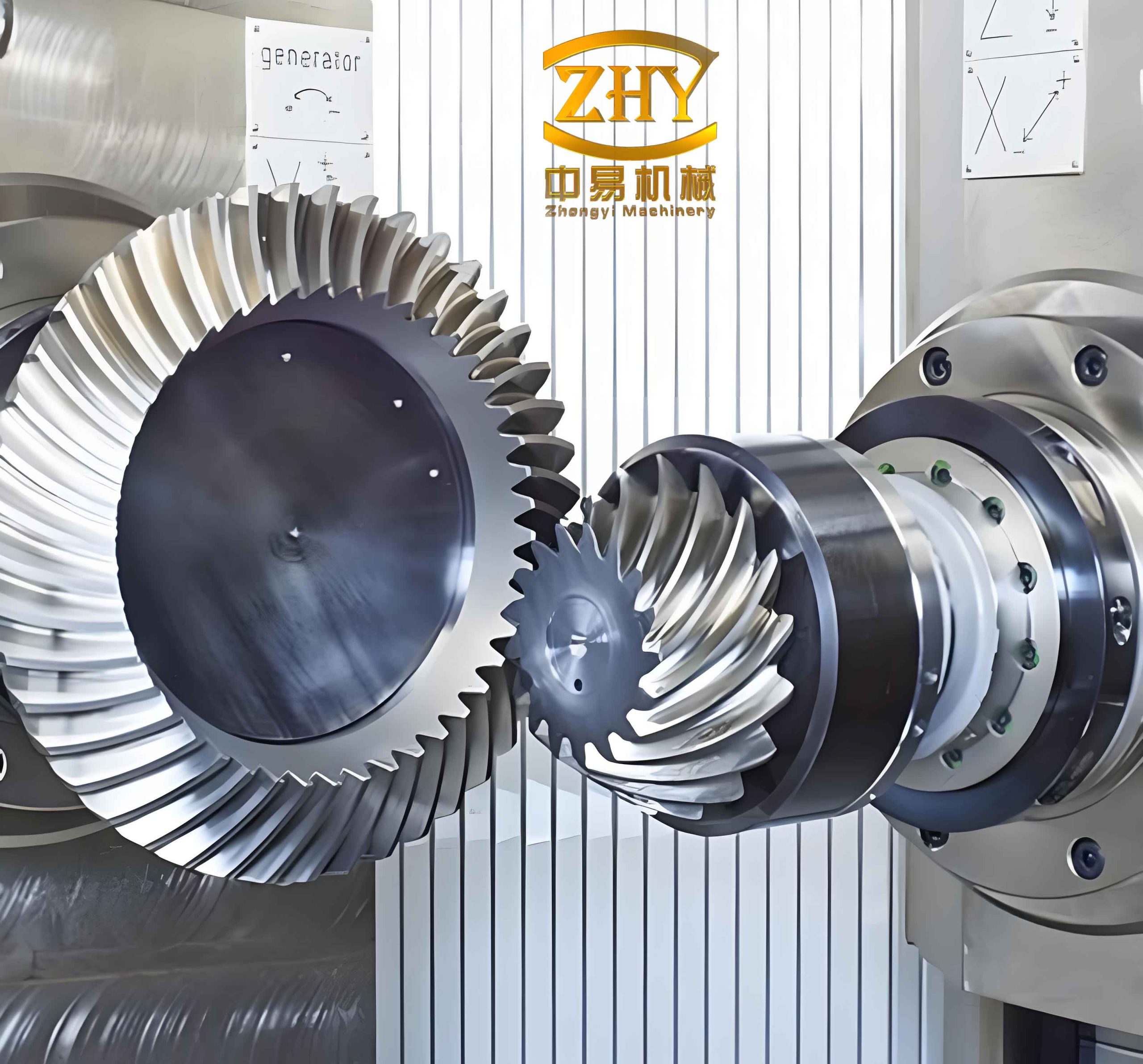
The first step in my derivation is to establish the equations for the cutter blades. The cutter consists of side blades and a tip radius, with the transition between them being smoothly tangential to enhance durability and bending strength. For the tip radius or fillet portion, the parametric equations can be expressed in terms of parameters $\lambda_f$ (the fillet angle) and $\theta$ (the rotation angle around the cutter axis). Let $R_p$ be the cutter point radius, $\rho_f$ the fillet radius, and $\alpha_p$ the blade pressure angle. The position vector for a point on the fillet is given by:
$$ \mathbf{r}^{(b)}_p(\lambda_f, \theta) = \begin{bmatrix} (X_f – \rho_f \sin(\lambda_f)) \cos\theta \\ (X_f – \rho_f \sin(\lambda_f)) \sin\theta \\ -\rho_f (1 – \cos(\lambda_f)) \end{bmatrix} $$
where $X_f = R_p \pm \rho_f \frac{1 – \sin \alpha_p}{\cos \alpha_p}$, with the sign depending on whether it’s a convex or concave side (positive for concave, negative for convex). The normal vector at this point is:
$$ \mathbf{n}_1 = \begin{bmatrix} \sin(\lambda_f) \cos\theta \\ \sin(\lambda_f) \sin\theta \\ \cos(\lambda_f) \end{bmatrix} $$
For the side blade, which is essentially a conical surface, the equations are parameterized by $S_p$ (the distance from the blade tip along the blade) and $\theta$:
$$ \mathbf{r}^{(a)}_p(S_p, \theta) = \begin{bmatrix} (R_p – S_p \sin \alpha_p) \cos\theta \\ (R_p – S_p \sin \alpha_p) \sin\theta \\ -S_p \cos \alpha_p \end{bmatrix} $$
with the normal vector:
$$ \mathbf{n}_2 = \begin{bmatrix} \cos \alpha_p \cos\theta \\ \cos \alpha_p \sin\theta \\ \sin \alpha_p \end{bmatrix} $$
These equations describe the geometry of the cutter blades, which serve as the generating tools for the hyperboloidal gears. The complexity arises when we account for the machine kinematics, which involve multiple coordinate systems and movements. To model this, I define a series of coordinate frames attached to key components of the Gleason No. 116 machine. Let me list these frames for clarity:
- Cutter coordinate system $\{O_d; X_d, Y_d, Z_d\}$ fixed to the cutter head.
- Cradle coordinate system $\{O_y; X_y, Y_y, Z_y\}$ fixed to the cradle.
- Machine fixed coordinate system $\{O_g; X_g, Y_g, Z_g\}$ at the machine center.
- Workpiece setup coordinate systems, including $\{O_{Bg}; X_{Bg}, Y_{Bg}, Z_{Bg}\}$ attached to the workpiece base and $\{O_{B}; X_{B}, Y_{B}, Z_{B}\}$ associated with the sliding guides.
- Gear blank coordinate systems: a fixed frame $\{O_{Lg}; X_{Lg}, Y_{Lg}, Z_{Lg}\}$ at the gear apex and a moving frame $\{O_{Ld}; X_{Ld}, Y_{Ld}, Z_{Ld}\}$ that rotates with the blank.
The relative motions between these frames are captured using homogeneous transformation matrices. For instance, the transformation from the cutter frame to the cradle frame involves adjustments for blade tilt ($I$), blade rotation ($J$), eccentric drum rotation ($\beta$), and cradle rotation ($Q$). The combined matrix is:
$$ \mathbf{M}_{yd} = \mathbf{M}_{Q} \mathbf{M}_{\beta} \mathbf{M}_{J} \mathbf{M}_{I} $$
where each component matrix represents a rotation or translation. Specifically, the blade tilt matrix $\mathbf{M}_{I}$ accounts for the tilt angle $I$ relative to the cutter axis. If $\alpha$ is the angle between the blade tilt axis and the cutter axis, it can be expressed as:
$$ \mathbf{M}_{I} = \begin{bmatrix} \sin^2 \alpha + \cos I \cos^2 \alpha & -\cos \alpha \sin I & \sin \alpha \cos \alpha (1 – \cos I) & 0 \\ \cos \alpha \sin I & \cos I & -\sin \alpha \sin I & 0 \\ \sin \alpha \cos \alpha (1 – \cos I) & \sin \alpha \sin I & \cos^2 \alpha + \cos I \sin^2 \alpha & 0 \\ 0 & 0 & 0 & 1 \end{bmatrix} $$
The blade rotation matrix $\mathbf{M}_{J}$ for rotation by angle $J$ is:
$$ \mathbf{M}_{J} = \begin{bmatrix} \cos J & \sin J & 0 & 0 \\ -\sin J & \cos J & 0 & 0 \\ 0 & 0 & 1 & 0 \\ 0 & 0 & 0 & 1 \end{bmatrix} $$
The eccentric drum rotation matrix $\mathbf{M}_{\beta}$, with offset $H$, is:
$$ \mathbf{M}_{\beta} = \begin{bmatrix} \cos \beta & \sin \beta & 0 & -H \cos \beta \\ -\sin \beta & \cos \beta & 0 & H \sin \beta \\ 0 & 0 & 1 & 0 \\ 0 & 0 & 0 & 1 \end{bmatrix} $$
And the cradle rotation matrix $\mathbf{M}_{Q}$ for angle $Q$ is:
$$ \mathbf{M}_{Q} = \begin{bmatrix} \cos Q & \sin Q & 0 & H \cos Q \\ -\sin Q & \cos Q & 0 & -H \sin Q \\ 0 & 0 & 1 & 0 \\ 0 & 0 & 0 & 1 \end{bmatrix} $$
Similarly, transformations for the machine slides and workpiece are defined. For example, the cradle rotation during machining is represented by a matrix $\mathbf{M}_{q}$ for angle $q = \omega_1 t$, where $\omega_1$ is the cradle angular velocity. The workpiece setup involves adjustments for machine root angle ($d$), vertical offset ($E_1$), and sliding distance ($X_b$), combined into a matrix $\mathbf{M}_{d}$. The overall transformation from the cradle frame to the workpiece moving frame is:
$$ \mathbf{M}_{Ld B} = \mathbf{M}_{L} \mathbf{M}_{x} \mathbf{M}_{d} \mathbf{M}_{q} $$
where $\mathbf{M}_{L}$ accounts for workpiece rotation by angle $\phi = i_{02} \omega_1 t$ (with $i_{02}$ as the roll ratio), and $\mathbf{M}_{x}$ includes horizontal offset $X_1$. By concatenating these transformations, I can express a point on the cutter blade in the workpiece moving frame as:
$$ \mathbf{R}_2 = \mathbf{M}_{Ld B} \mathbf{M}_{By} \mathbf{M}_{yd} \mathbf{r}_1 $$
where $\mathbf{r}_1$ is the point vector in the cutter frame, and $\mathbf{M}_{By}$ is the transformation from the cradle to the sliding guide frame. This equation encapsulates the relative positioning during machining, but to derive the tooth surface, I must also consider the meshing condition, which ensures that the cutter envelope generates a continuous surface on the gear blank.
The meshing condition is based on the principle that at the point of contact between the generating surface (cutter) and the generated surface (gear tooth), the relative velocity must be orthogonal to the common normal vector. In mathematical terms, if $\mathbf{n}$ is the normal vector of the cutter surface in the fixed frame and $\mathbf{v}^{(12)}$ is the relative velocity between the cutter and workpiece, then the meshing equation is:
$$ \mathbf{n} \cdot \mathbf{v}^{(12)} = 0 $$
To compute $\mathbf{v}^{(12)}$, I consider the kinematics of the system. Let $\boldsymbol{\omega}_1$ and $\boldsymbol{\omega}_2$ be the angular velocities of the cutter and workpiece, respectively. Since the cutter rotation does not affect the generating process in this context (as the cutter surface is symmetric), I set $\boldsymbol{\omega}_1 = 0$. The workpiece rotates with angular velocity $\boldsymbol{\omega}_2 = [0, 0, i_{02} \omega_1]^T$ relative to the fixed frame. The relative velocity at a point $\mathbf{r}_1$ on the cutter is then:
$$ \mathbf{v}^{(12)} = -\boldsymbol{\omega}_2 \times \mathbf{r}_1 + \frac{d\boldsymbol{\xi}}{dt} – \boldsymbol{\omega}_2 \times \boldsymbol{\xi} $$
where $\boldsymbol{\xi}$ is the vector from the workpiece origin to the cutter origin in the fixed frame, given by $\boldsymbol{\xi} = \mathbf{M}_{q} \mathbf{M}_{yd} \mathbf{E} – \mathbf{M}_{d}^{-1} \mathbf{M}_{LdB}^{-1} \mathbf{E}$, with $\mathbf{E} = [0,0,0,1]^T$. The normal vector in the fixed frame is $\mathbf{n} = \mathbf{M}_{q} \mathbf{M}_{yd} \mathbf{n}_1$, where $\mathbf{n}_1$ is the normal in the cutter frame. Substituting these into the meshing equation yields a function $F(\lambda_f, \theta, t) = 0$ (for the fillet portion) or a similar function for the side blade. Solving this equation allows me to express one parameter in terms of the others, say $\lambda_f = G(\theta, t)$, which when plugged back into the surface equation gives an explicit representation of the generated surface.
For the transition surface of the pinion (the smaller hyperboloidal gear), the derived equation takes the form $\mathbf{R}_2 = \mathbf{g}(\theta, t)$, which describes the surface as a function of two parameters. This explicit representation, though complex, enables precise calculation of points on the transition zone. Similarly, equations for the gear tooth flank and the gear transition surfaces can be derived. The mathematical model provides a foundation for numerical computation and analysis.
To illustrate the parameters involved in typical hyperboloidal gears, I summarize key gear and machine settings in the following tables. These parameters are essential for implementing the derived equations and for virtual modeling.
| Gear | Number of Teeth | Pitch Diameter | Outer Diameter | Pitch Cone Angle | Face Cone Angle | Root Cone Angle | Circular Tooth Height | Normal Circular Thickness | Face Width |
|---|---|---|---|---|---|---|---|---|---|
| Pinion | 6 | 72.93 mm | 99.29 mm | 10.08° | 13.72° | 9.63° | 9.58 mm | 15.12 mm | 67.46 mm |
| Gear | 41 | 416.76 mm | 417.35 mm | 79.73° | 80.18° | 54.15° | 76.02 mm | 6.98 mm | 62.00 mm |
| Gear | Root Angle | Horizontal Offset | Sliding Distance | Vertical Offset | Eccentric Drum Angle | Cradle Angle | Roll Ratio | Cutter Tip Diameter | Blade Pressure Angle | Fillet Radius |
|---|---|---|---|---|---|---|---|---|---|---|
| Pinion (Concave) | -2° | -7.98 mm | 17.08 mm | 29.12 mm | 81.90° | 112.20° | 6.33912 | 285.52 mm | 20° | 2.59° |
| Pinion (Convex) | -3.98° | 9.76 mm | 22.61 mm | 42.62 mm | 102.13° | 104.93° | 7.26721 | 328.94 mm | 25° | 2.59° |
| Gear | 76.40° | -1.10 mm | 100.09 mm | 122.43 mm | N/A | N/A | N/A | 304.80 mm | 22.5° (outer), 22.5° (inner) | 2.29 mm |
Note: Additional parameters include gear module (10.36), shaft angle (90°), pinion hand (left), and offset distance (35 mm). These tables highlight the intricate settings required for machining hyperboloidal gears, underscoring the need for precise modeling.
With the mathematical framework in place, I turn to the virtual manufacturing approach for building 3D geometric models of hyperboloidal gears. This method simulates the actual cutting process in software like CATIA, where I define the cutter geometry, machine kinematics, and workpiece as digital counterparts. By programming the relative motions using transformation matrices, I can generate the envelope of cutter positions over time, which forms the tooth surfaces. Specifically, I create a virtual environment replicating the Gleason No. 116 machine, set the initial positions based on machine settings, and perform Boolean operations to subtract the cutter volume from the gear blank at discrete time steps. Through automation via VBA scripts, this process iterates to produce a family of enveloping curves, which are then fitted using NURBS (Non-Uniform Rational B-Spline) surfaces to reconstruct the complete tooth geometry, including transition surfaces.
The advantage of this virtual method is its ability to visually inspect the gear model and verify its accuracy against theoretical calculations. In CATIA, I can analyze surface continuity using tools like “zebra stripes,” which reveal smooth curvature transitions across the tooth flank and fillet. This ensures that the modeled hyperboloidal gears meet design specifications without physical prototyping. Moreover, the virtual model can be directly used for downstream applications such as finite element analysis or dynamic simulation, saving time and resources.
To validate the accuracy of both the mathematical derivations and virtual models, I compare points computed from the explicit equations in MATLAB with those extracted from the CATIA model. Using the gear parameters from Table 1 and machine settings from Table 2, I implement the equations in MATLAB to calculate discrete points on the tooth surfaces, particularly focusing on the transition zones. The algorithm involves solving the meshing equation numerically for parameters $\theta$ and $t$, then evaluating the surface equations. For example, for the pinion transition surface, I discretize $\theta$ from 0 to 2$\pi$ and $t$ over the machining cycle, computing points $\mathbf{R}_2$ as per the derived expressions. These points are exported and compared to the corresponding locations on the CATIA model by measuring normal distances.
The results are summarized in Table 3, which shows the normal errors at selected points across the tooth surface of the hyperboloidal gear pinion. The points are indexed along the profile direction (from root to tip, index $i$) and the lengthwise direction (from heel to toe, index $j$). The errors are in micrometers, demonstrating that the virtual model aligns closely with the theoretical calculations.
| $i$ \ $j$ | 1 | 2 | 3 | 4 | 5 | 6 | 7 | 8 | 9 |
|---|---|---|---|---|---|---|---|---|---|
| 1 | -0.1 | -0.062 | -0.097 | -0.930 | -0.009 | 0.096 | 0.074 | 0.058 | 0.065 |
| 2 | -0.087 | -0.074 | -0.085 | -0.075 | -0.007 | 0.093 | 0.042 | 0.045 | 0.050 |
| 3 | -0.080 | -0.085 | -0.074 | -0.020 | 0.000 | 0.091 | 0.013 | 0.056 | 0.044 |
| 4 | -0.078 | -0.097 | -0.062 | 0.038 | -0.004 | 0.089 | 0.094 | 0.037 | 0.039 |
| 5 | -0.081 | -0.099 | -0.051 | 0.099 | 0.010 | 0.085 | 0.083 | 0.028 | 0.038 |
As seen, the maximum error is within ±0.1 μm, which is negligible for most engineering applications. This high precision confirms the effectiveness of both the mathematical model and the virtual manufacturing approach. The small discrepancies may arise from numerical approximations in solving the meshing equation or from the NURBS fitting process in CATIA, but they do not compromise the model’s utility for analysis. This validation step is crucial for ensuring that the hyperboloidal gears modeled can be reliably used in simulations of contact patterns, stress distributions, and dynamic behavior.
Beyond validation, the derived equations offer insights into the sensitivity of hyperboloidal gear geometry to machine settings. For instance, by analyzing partial derivatives of the surface equations with respect to parameters like blade tilt $I$ or cradle angle $Q$, I can predict how modifications affect tooth contact and root stresses. This is particularly valuable for optimizing gear designs for specific applications. Moreover, the explicit mathematical form allows for direct integration into custom software tools for gear design and analysis, enhancing the digital workflow in manufacturing hyperboloidal gears.
In terms of practical implementation, the virtual manufacturing method using CATIA provides a user-friendly alternative to complex coding. Engineers can set up the machining simulation with graphical interfaces, adjusting parameters visually and immediately seeing the resulting gear geometry. This interactive approach facilitates rapid prototyping and design iterations. Additionally, the CATIA model can be exported in standard formats (e.g., STEP or IGES) for use in other CAE software, making it versatile for collaborative projects. The ability to include transition surfaces in the model is a significant advantage, as these areas are often critical for fatigue resistance and noise reduction in hyperboloidal gears.
To further elaborate on the mathematical derivations, let me discuss the meshing equation in more detail. For the fillet portion of the cutter, the equation $F(\lambda_f, \theta, t) = 0$ can be expanded using the expressions for $\mathbf{n}$ and $\mathbf{v}^{(12)}$. Since $\mathbf{n} = \mathbf{M}_{q} \mathbf{M}_{yd} \mathbf{n}_1$ and $\mathbf{v}^{(12)}$ depends on $\boldsymbol{\omega}_2$ and $\boldsymbol{\xi}$, the equation becomes a transcendental function involving trigonometric terms. Solving it analytically is challenging, so I employ numerical methods such as Newton-Raphson iteration in MATLAB. For a given $\theta$ and $t$, I solve for $\lambda_f$, ensuring the solution lies within valid bounds (e.g., $\lambda_f$ from 0 to the blade angle). This process is repeated across a grid of $\theta$ and $t$ values to generate point clouds for the transition surface.
Similarly, for the side blade, the meshing condition leads to an equation involving $S_p$, $\theta$, and $t$. In this case, the surface is a ruled surface, and the equation can often be simplified due to the conical nature. However, with blade tilt and rotation adjustments in HFT machining, the complexity increases, requiring careful handling of the coordinate transformations. The derived explicit equations, though lengthy, are programmable and yield accurate results. For example, the tooth flank of the hyperboloidal gear pinion can be represented as $\mathbf{R}_2 = \mathbf{h}(S_p, \theta, t)$ after solving the meshing condition for $S_p$.
The transition surface, being a blend between the fillet and the tooth flank, requires special attention. In my approach, I treat it as a continuous extension of the fillet, parameterized by $\lambda_f$ and $\theta$, with the meshing equation ensuring tangency to the adjacent surfaces. This guarantees smooth transitions, which are essential for preventing stress concentrations in hyperboloidal gears. The mathematical model ensures that the transition surface is exactly generated according to the cutter geometry and machine kinematics, without ad-hoc approximations.
In the context of industry applications, the ability to accurately model hyperboloidal gears with transition surfaces has far-reaching implications. For example, in automotive drivetrains, hyperboloidal gears are used in rear axles to provide torque transmission while accommodating shaft offsets. Precise models enable better prediction of gear noise, vibration, and harshness (NVH) characteristics, leading to quieter and more efficient vehicles. Similarly, in aerospace, where weight and reliability are paramount, accurate gear models support optimization for strength and durability. The methods I present here contribute to these goals by providing a rigorous foundation for digital twin technologies, where virtual gears can be tested under various operating conditions before physical manufacture.
Looking ahead, there are opportunities to extend this work. For instance, integrating the mathematical models with real-time simulation platforms could enable adaptive machining of hyperboloidal gears, where corrections are made on-the-fly based on sensor feedback. Additionally, the use of advanced materials, such as composites or high-strength alloys, may require updated models that account for material behavior during cutting. The principles of coordinate transformation and meshing theory, however, remain universally applicable, making this approach adaptable to future innovations in gear manufacturing.
In conclusion, through a combination of analytical derivations and virtual manufacturing techniques, I have developed a method for accurate 3D geometric modeling of hyperboloidal gears, including transition surfaces. The key steps involve deriving explicit tooth surface equations using homogeneous coordinate transformations based on HFT machining kinematics, and simulating the cutting process in CATIA to generate digital models. Validation against MATLAB-calculated points shows errors within ±0.1 μm, confirming the precision of the approach. This work not only advances the theoretical understanding of hyperboloidal gear geometry but also provides practical tools for design and analysis. By enabling precise modeling of transition zones, it supports improved performance and reliability of hyperboloidal gears in demanding applications. As the industry moves towards digitalization, such methods will become increasingly vital for optimizing gear systems and reducing development cycles. The insights gained here underscore the importance of integrating mathematical rigor with modern CAD/CAE tools for the advancement of gear technology.