
In the contemporary era, the rapid development of society has escalated energy consumption, leading to significant resource constraints that pose a critical challenge to sustainable growth. As an engineer and researcher in the field, I have observed that thermal and power engineering, particularly its application in thermal power plants, offers a promising avenue to alleviate energy shortages. This discipline is pivotal in enhancing energy efficiency and reducing environmental impact. The core of technological innovation in thermal and power engineering lies in optimizing real-world applications for higher efficiency and lower energy consumption, with a focus on developing new products and technologies that minimize能耗. In this article, I will delve into the research directions, existing problems, and future prospects of thermal and power engineering, aiming to foster further optimization of thermal power plant operations and elevate energy utilization rates. Throughout this discussion, I will emphasize the role of mechanical components such as spur and pinion gears in improving system performance, as these elements are integral to power transmission and efficiency gains in various equipment.
The field of thermal and power engineering is fundamentally grounded in engineering thermophysics, with a primary focus on internal combustion engines and emerging新型动力机械及 systems. It integrates knowledge from disciplines like engineering mechanics, mechanical engineering, automatic control, computer science, environmental science, and microelectronics to study the safe, efficient, and low- or zero-pollution conversion of chemical energy from fuels and kinetic energy from fluids into power. This involves investigating the basic laws and processes of energy conversion, along with the自动控制技术 for systems and equipment during transformation. A key aspect is the transmission of power through mechanical means, where spur and pinion gears play a crucial role in ensuring smooth energy transfer in turbines, pumps, and fans. For instance, in a汽轮机, the precise engagement of spur and pinion gears can reduce friction losses and enhance overall efficiency. The research方向 encompasses optimizing these conversions to achieve higher thermal efficiencies, often expressed through formulas like the thermal efficiency equation: $$ \eta_{th} = \frac{W_{net}}{Q_{in}} $$ where \( \eta_{th} \) is the thermal efficiency, \( W_{net} \) is the net work output, and \( Q_{in} \) is the heat input. Additionally, the use of spur and pinion gears in auxiliary systems, such as boiler feed pumps, contributes to reducing parasitic losses, thereby supporting the broader goal of innovation.
However, despite its potential, thermal and power engineering faces several challenges in technological innovation. In terms of energy, China, as a major energy consumer, accounts for a significant portion of global oil and coal consumption, with coal-fired power plants contributing substantially to electricity generation. Currently, thermal power constitutes over 80% of China’s total发电量, with coal-based generation dominating. During power generation, substantial amounts of heat and residual pressure are lost through cooling water and steam discharge, leading to energy wastage. The average energy utilization rate in thermal power plants is only around 30-40%, highlighting the urgent need for节能降耗. Equipment like fans, which are major electricity consumers in plants, exemplify this issue;送风机,引风机, and冷烟风机 in boilers require optimization to lower their power consumption rates. Here, innovations in gear systems, such as implementing high-efficiency spur and pinion gears in fan drives, can minimize mechanical losses and improve energy efficiency. The table below summarizes key energy-related problems and potential solutions involving spur and pinion gear enhancements:
| Problem Area | Description | Innovation with Spur and Pinion Gears |
|---|---|---|
| High Energy Consumption in Fans | Fans account for significant electrical load in plants, reducing overall efficiency. | Using precision-engineered spur and pinion gears to optimize torque transmission and reduce slippage in fan motors, leading to lower power draws. |
| Heat Loss in Turbines | Substantial thermal energy is wasted during steam expansion and condensation. | Integrating spur and pinion gears in turbine control systems to fine-tune valve operations, minimizing leakage and improving heat recovery. |
| Low Overall Plant Efficiency | Energy utilization rates are suboptimal due to inefficiencies in multiple components. | Implementing spur and pinion gear-based variable speed drives for pumps and compressors, allowing adaptive control and energy savings. |
In environmental方面, coal-fired power plants are often termed “environmental killers” due to emissions of sulfur dioxide, nitrogen oxides, and particulate matter. As the power industry expands, these pollutants pose increasing threats to ecosystems and human health. The concentrated and单一 nature of emissions from thermal plants exacerbates environmental degradation, interfering with居民的生活 and endangering public well-being. Technological innovations must address this by integrating cleaner combustion technologies and advanced emission control systems. In this context, spur and pinion gears can contribute by enabling more precise control of flue gas desulfurization equipment or electrostatic precipitators, ensuring optimal operation and higher removal efficiencies. For example, the gear mechanisms in actuator systems for damper controls can be refined using durable spur and pinion sets to reduce maintenance and enhance reliability, thereby supporting continuous environmental compliance.
Safety is another critical concern, especially as power plants evolve toward larger capacity, higher转速, and greater automation. Equipment like boiler fans are prone to failures such as motor burnout, shaft misalignment, impeller damage, and bearing issues, which can lead to severe accidents and economic losses. The demand for higher安全可靠性 necessitates robust design and monitoring. Innovations in mechanical components, including spur and pinion gears, can mitigate these risks by improving the durability and alignment of rotating parts. For instance, in turbine-generator sets, the use of hardened spur and pinion gears in coupling systems can prevent unexpected failures and extend equipment lifespan. The relationship between gear design parameters and safety can be expressed through formulas like the bending stress equation for gear teeth: $$ \sigma_b = \frac{F_t}{b m} Y $$ where \( \sigma_b \) is the bending stress, \( F_t \) is the tangential force, \( b \) is the face width, \( m \) is the module, and \( Y \) is the Lewis form factor. By optimizing these parameters, engineers can enhance the safety margins of critical machinery.
On the positive side, thermal and power engineering offers significant advantages through technological innovations. One key concept is the Flügel formula (often referred to as沸留格尔公式 in some contexts), which is used in steam turbine analysis to relate flow rates and pressures under varying conditions. When any stage in a turbine group reaches critical状态, the maximum back pressure of the group decreases as the number of stages increases, implying a smaller critical pressure ratio. The Flügel formula applies when the number of stages is at least 3-4, with constant flow area across stages under different operating conditions. Mathematically, it can be represented as: $$ \frac{G_1}{G_2} = \sqrt{\frac{P_{1}^2 – P_{2}^2}{P_{10}^2 – P_{20}^2}} $$ where \( G \) is the mass flow rate, \( P_1 \) and \( P_2 \) are pressures at the inlet and outlet of the stage group, and the subscript 0 denotes design conditions. This formula allows engineers to推算 pressures and enthalpy drops at different flows, determining power output, efficiency, and component stresses. It aids in monitoring the turbine’s flow path for abnormalities, ensuring optimal performance. In practice, the integration of spur and pinion gears in control mechanisms can facilitate precise adjustments based on Flügel-derived insights, enhancing operational stability.
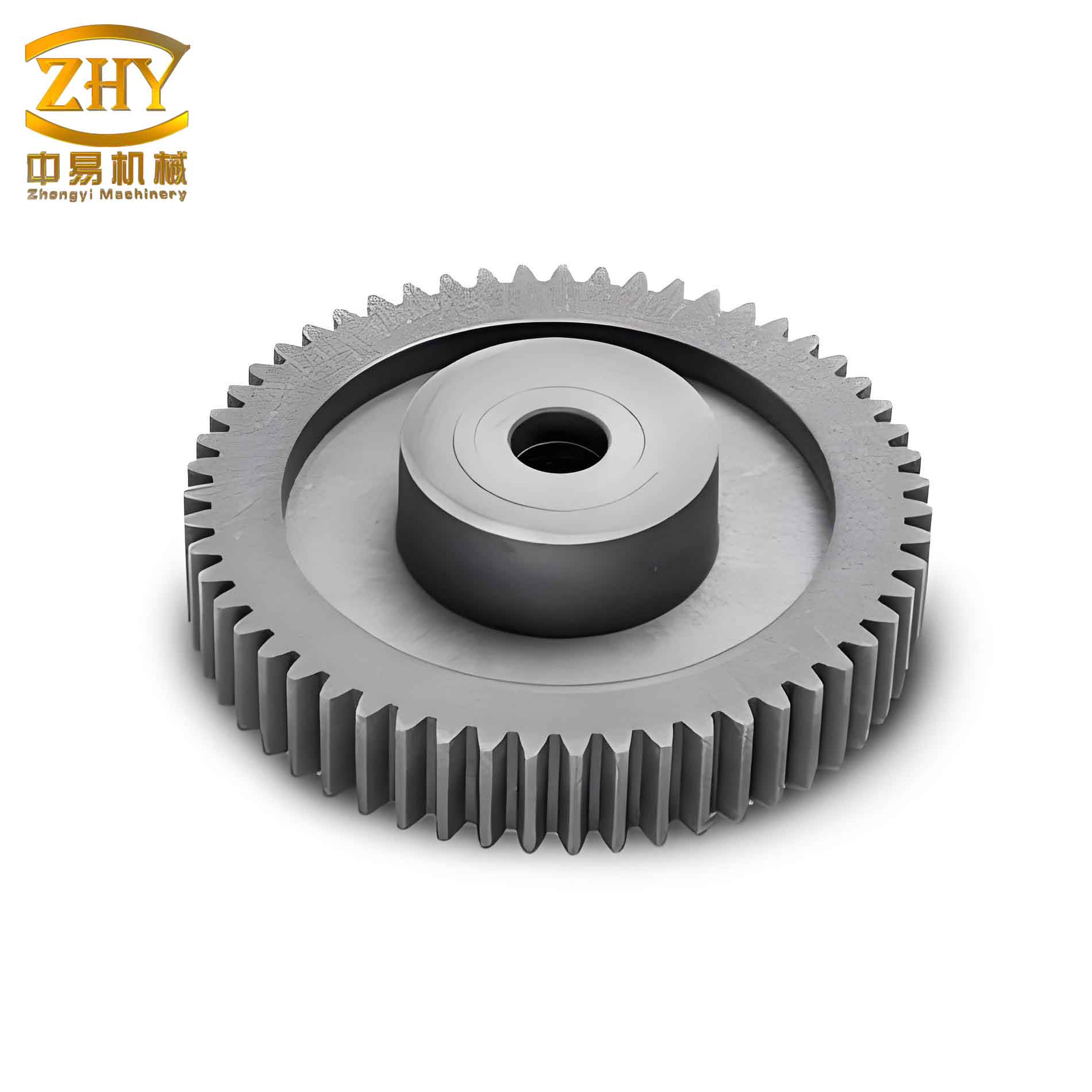
Pressure regulation, or调压调节, is another innovative area that increases机组运行的可靠性和对负荷的适应性 while improving partial-load economy. However, it may be less economical at high loads. In steam turbines, after steam expands in the moving blades, it exits with余速动能, representing a loss if not converted to mechanical work. This is termed余速损失. The degree of partial admission, denoted by the ratio of the nozzle arc length to the circumference, affects efficiency. Additionally, in the axial间隙 between stationary and moving parts, stagnant steam exists, leading to鼓风损失 when blades move through non-working arcs, and斥汽损失 when蒸汽须首先排斥停滞蒸汽 in working arcs. Technological advancements, such as optimizing spur and pinion gear systems in valve actuators, can minimize these losses by enabling smoother steam flow control and reducing parasitic能耗. For example, in variable几何 turbines, spur and pinion gears adjust nozzle angles dynamically, enhancing efficiency across load ranges.
In the context of节流调节 in thermal power plants, proper management is essential to ensure effectiveness. During throttle governing, since there is no classification of regulating stages, alternative measures are needed. When the first stage of a turbine achieves full圆周进汽, temperature changes should show a decreasing trend across stages. For well-operating units, small-capacity机组 and large base-load units can be used, though economic性 may suffer due to throttling losses. The Flügel formula plays a role here by allowing the determination of power efficiency and component stresses under known flow conditions, enabling close monitoring of turbine状态. By analyzing pressure variations against the formula, changes in flow area can be detected, ensuring the有效性 of throttle regulation. Incorporating spur and pinion gears in throttle valve controls can further refine this process, as precise gear movements allow for incremental adjustments that reduce节流损失 and enhance overall system efficiency.
Reducing湿气损失 is crucial for improving turbine efficiency and advancing thermal and power engineering applications. Wetness losses occur due to steam expansion and condensation in turbines, where temperature differences cause partial凝结, reducing steam量. Moreover, the higher velocity of steam compared to water droplets leads to动能消耗 through droplet drag, and supercooling of wet steam exacerbates losses. Mechanical losses also arise from overcoming轴承 friction and powering auxiliary devices like oil pumps and governors. To mitigate these, axial-flow turbines can be employed, where high-pressure steam is introduced at one end and low-pressure steam is exhausted at the other, creating a pressure gradient that lowers energy consumption. In such designs, spur and pinion gears are vital for coordinating blade pitch adjustments and seal controls, minimizing leakage and湿气 accumulation. The efficiency gain can be quantified using the wetness correction factor: $$ \eta_{wet} = \eta_{dry} (1 – k x) $$ where \( \eta_{wet} \) is the efficiency with wet steam, \( \eta_{dry} \) is the dry steam efficiency, \( k \) is a constant, and \( x \) is the steam wetness fraction. By leveraging spur and pinion gear mechanisms in moisture removal systems, these losses can be substantially reduced.
Looking toward the future, the goal of building a resource-saving and environmentally friendly society—often called the “two-type society”—is a central tenet of sustainable development, aligning with scientific outlooks and social harmony. Thermal power plants must prioritize节能减排改造 in thermal equipment and systems. While I have outlined several measures, numerous effective strategies exist, such as adopting液态排渣, low-nitrogen combustion, fly ash recirculation, and electrostatic precipitators with over 99% efficiency. These require dedicated research and implementation. In all these endeavors, spur and pinion gears will continue to play a pivotal role due to their reliability in power transmission and control. For instance, in advanced boiler systems, spur and pinion gears drive soot blowers and air preheaters, enhancing heat recovery and reducing emissions. The table below highlights future innovations and the integration of spur and pinion gears:
| Innovation Area | Description | Role of Spur and Pinion Gears |
|---|---|---|
| Advanced Combustion Technologies | Techniques like oxy-fuel combustion and carbon capture to reduce emissions. | Gears enable precise control of fuel and oxidizer valves, ensuring optimal combustion conditions and efficiency. |
| Waste Heat Recovery Systems | Systems to capture and reuse waste heat from exhaust streams for power or heating. | Spur and pinion gears drive pumps and compressors in organic Rankine cycles, improving energy conversion rates. |
| Smart Grid Integration | Linking thermal plants with renewable sources for flexible power dispatch. | Gears in turbine governors allow rapid load changes, facilitating grid stability and responsiveness. |
| Predictive Maintenance | Using IoT and sensors to monitor equipment health and prevent failures. | Spur and pinion gears equipped with vibration sensors provide data for early fault detection in rotating machinery. |
In conclusion, technological innovations in thermal and power engineering are essential for addressing global energy and environmental challenges. From optimizing fundamental processes like pressure regulation and wetness reduction to integrating advanced mechanical components such as spur and pinion gears, the field holds immense potential for progress. As we move forward, continuous research into高效节能 solutions, coupled with the strategic use of gear systems for enhanced control and efficiency, will be key to achieving sustainable thermal power generation. I am confident that through collaborative efforts and innovation, we can significantly improve plant operations and contribute to a greener future, where spur and pinion gears remain indispensable in driving efficiency gains across the energy sector.