
The pursuit of efficient, high-strength, and cost-effective manufacturing methods for power transmission components remains a central theme in mechanical engineering. Among these components, spur gears hold a position of critical importance due to their simplicity, reliability, and effectiveness in transmitting motion and power between parallel shafts. The traditional method of manufacturing these gears through machining—processes like hobbing or shaping—inevitably cuts through the material’s grain flow, potentially creating stress concentrators and limiting the component’s ultimate performance. Cold precision forging has emerged as a transformative alternative, promising near-net-shape production of spur and pinion gears with superior mechanical properties.
This metal-forming process involves plastically deforming a metallic blank at room temperature within a closed-die cavity that replicates the final gear tooth geometry. The significant advantages are threefold: firstly, it induces a continuous, favorable grain flow along the tooth profile, dramatically enhancing fatigue resistance, bending strength, and impact toughness. Secondly, it offers remarkable material savings and high production rates by minimizing or eliminating subsequent machining. Thirdly, it improves dimensional consistency and reduces heat treatment distortion. However, the primary challenge in cold forging complex shapes like a spur and pinion gear lies in achieving complete die filling, especially at the tooth tips and corners, without subjecting the tooling to prohibitively high forming pressures that lead to premature failure or necessitate excessively large and expensive presses.
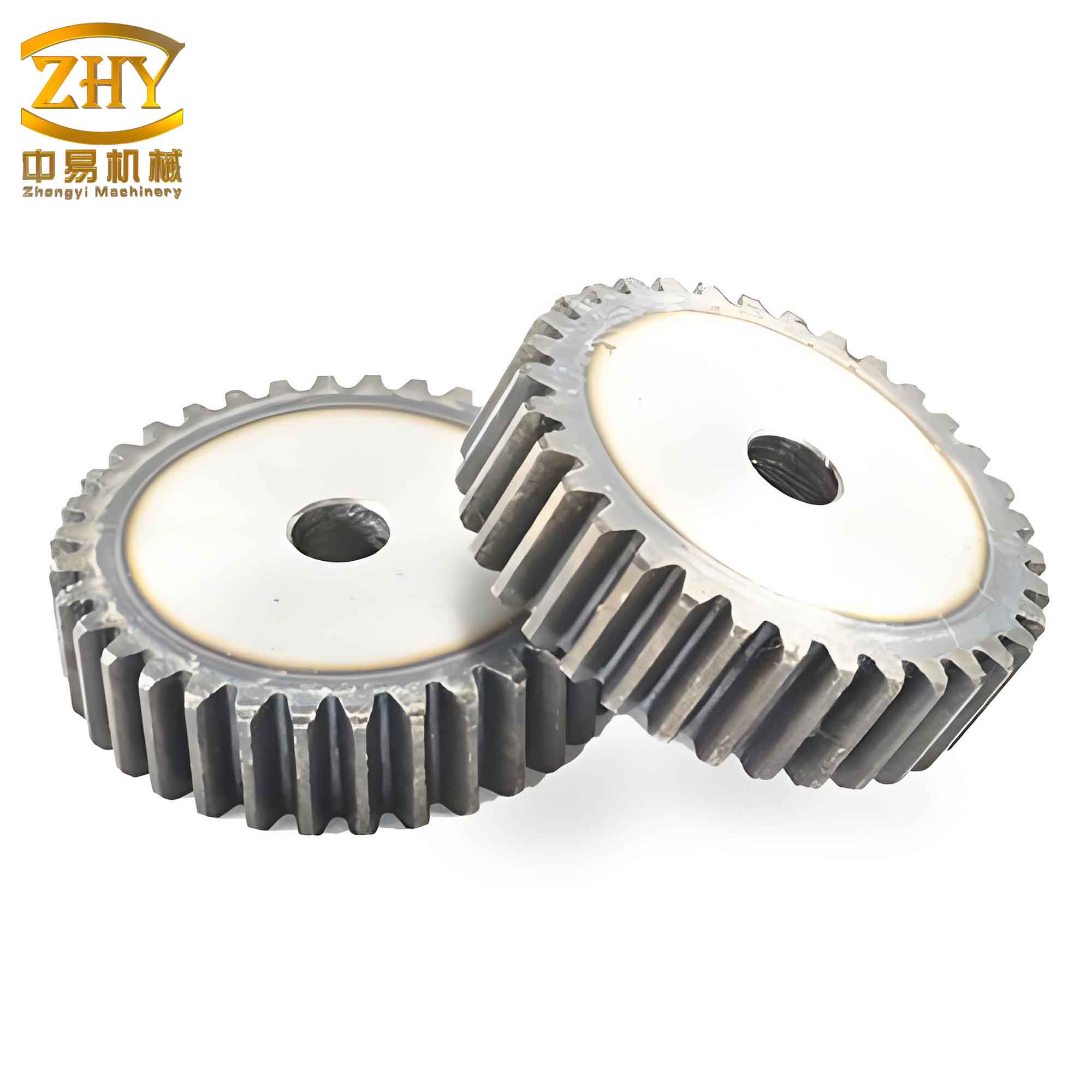
The core of this challenge is managing metal flow. In a simple axial compression process, the material predominantly flows upward along the punch face and outward along the die wall, with insufficient radial flow into the intricate tooth cavities. This results in incomplete filling or requires extreme force. Researchers have long focused on “flow division” or “stress relief” techniques to guide material more effectively into the desired regions. The fundamental principle is to create alternative, easier paths for the material to flow, thereby reducing the pressure required to force it into the most difficult-to-fill areas—the gear teeth. This article synthesizes previous research and proposes an optimized, multi-stage cold precision forging process designed specifically to enhance radial flow and drastically reduce the necessary forming load for a standard spur and pinion component.
Foundational Principles and Prior Art in Gear Forging
The plasticity of metals during cold forging can be described by constitutive models. A commonly used model is the power law relation between flow stress ($\sigma_f$), strain ($\varepsilon$), strain rate ($\dot{\varepsilon}$), and temperature (T), though for isothermal cold forging, temperature effects are often neglected:
$$\sigma_f = K \cdot \varepsilon^n \cdot \dot{\varepsilon}^m$$
Where $K$ is the strength coefficient, $n$ is the strain-hardening exponent, and $m$ is the strain-rate sensitivity coefficient. For typical forging steels like AISI 1045 or similar grades used for spur and pinion gears, $n$ is significant, indicating considerable work-hardening during the process.
The total forming force ($F$) is the integral of the flow stress over the contact area ($A$) with the tooling, modified by friction and shape complexity:
$$F \approx \sigma_f \cdot A \cdot Q$$
Here, $Q$ is a multiplying factor (>1) that accounts for shape complexity and friction. The objective of process optimization is to minimize $Q$ for a given final geometry.
Historical approaches to manage metal flow in gear forging include:
- Floating Die Principle: The die containing the tooth cavity is allowed to move axially, synchronized with the main punch. This reduces frictional resistance along the die wall, promoting more uniform axial flow which indirectly aids lateral filling.
- Relief-Hole/Axis Technique: Introducing a central hole in the blank or a mandrel in the die creates an internal free surface. Material flows both radially outward into the teeth and radially inward into the hole, effectively “dividing” the flow and lowering the overall pressure peak.
- Multi-Step Forging: Breaking the final shape into a sequence of simpler preforms that gradually approximate the final gear geometry. This controls work-hardening and manages forming energy.
The table below summarizes the typical effect of these techniques on the forming pressure for a standard gear:
| Technique | Primary Flow Direction Enhanced | Mechanism | Estimated Pressure Reduction |
|---|---|---|---|
| Conventional Axial Compression | Axial (along punch) | N/A (Baseline) | 0% |
| Floating Die | Axial | Reduces wall friction | 10-15% |
| Central Relief Hole | Radial (inward & outward) | Flow division | 20-30% |
| Two-Step Forging (Preform + Finish) | Controlled | Manages strain distribution | 15-25% |
Despite these advances, achieving complete fill for larger module gears (e.g., module > 2.5 mm) with a single operation often required forces that pushed the limits of conventional tool steels and press capacities. The analysis of plastic deformation streams, as visualized in finite element simulations, showed that even with relief features, the dominant flow in the peripheral region was not sufficiently radial towards the tooth tips. This insight led to the development of the optimized process described herein.
Proposed Optimized Multi-Stage Forging Strategy
The proposed strategy is a synergistic integration of several advanced principles, sequenced to maximize radial flow during the critical final filling stage. The target is a standard spur and pinion gear with a module (m) of 3 mm, 19 teeth, and a face width (B) of 28 mm, manufactured from AISI 1045 steel. The process consists of two distinct forging stages performed in the same die set.
Stage 1: Axial Upsetting with Assisted Radial Flow. The die assembly comprises an upper punch, a segmented or reinforced container die (acting as the tooth cavity), and a lower punch/ejector. The key innovation in this stage is the design of the upper punch face. Instead of being flat, it features a central, tapered protrusion or “nested boss.” The initial cylindrical blank is placed in the die cavity.
$$ \text{Initial Blank Volume} = V_{blank} = \frac{\pi}{4} d_{blank}^2 \cdot h_{blank} $$
The blank dimensions are calculated to satisfy volume constancy with the final forged gear, accounting for flash or a small overflow chamber.
When the upper punch descends, this boss intrudes into the center of the blank. The deformation mechanics change fundamentally. The material is not only compressed axially but is also pushed radially outwards by the inclined faces of the boss. This actively drives material toward the tooth cavities from the very beginning of the stroke. The boss acts as an internal “wedge.” The pressure distribution is no longer uniform; a higher hydrostatic pressure zone is created under the boss, promoting outward flow. This stage is terminated when the axial height of the workpiece reaches the final gear width (28 mm), but the tooth cavities, particularly at the tips, are only partially filled. The forming force in this stage is significant but moderated by the assisted radial flow.
Stage 2: Mandrel Extrusion for Dominant Radial Divertion. After Stage 1, the upper punch is retracted. A separate, solid mandrel (core rod) with a carefully radiused tip then advances axially into the center of the preformed workpiece. The geometry at this point is crucial: the preform has a central recess from the boss in Stage 1 and its periphery is partially formed into teeth. The mandrel’s function is to extrude the material in the central web radially outward. Since the axial escape is now heavily restricted by the nearly full gear width and the closed die, and the tooth cavities present the path of least resistance, the plastic deformation is forced to divert almost entirely in the radial direction.
$$ \text{Volumetric Flow Rate Ratio: } \frac{\dot{V}_{radial}}{\dot{V}_{axial}} \rightarrow \infty $$
This intense, focused radial flow efficiently fills the remaining volume at the tooth roots and tips. The radius on the mandrel tip prevents shear localization and material defect formation. The force required for this second stage is substantially lower than that needed for a single-stage fill, as it is only displacing a small volume of material over a short distance, leveraging the high hydrostatic stress state.
Finite Element Simulation and Result Analysis
The process was modeled and analyzed using DEFORM-3D, a commercial finite element method (FEM) software specialized for metal forming. A quarter-symmetry model was employed to save computational time. The material model for AISI 1045 included strain hardening. A constant shear friction factor (m) of 0.12 was used at all tool-workpiece interfaces.
Simulation Results and Force Analysis: The FEM results vividly illustrate the material flow patterns. During Stage 1, the streamlines show a strong outward component from the center due to the nested boss. In Stage 2, the flow vectors around the mandrel are almost purely horizontal, confirming the successful diversion of flow into the radial direction to complete the tooth fill.
The most critical output is the forging load history. The graphs below summarize the load comparison:
| Forging Method | Maximum Forming Force (Z-Load) | Stage / Note |
|---|---|---|
| Conventional Flat Punch Forging | ~4.86 MN (4860 kN) | Single stage to full fill |
| Punch with Nested Boss Only | ~4.54 MN (4540 kN) | Single stage to full fill |
| Proposed 2-Stage Process: Stage 1 | ~1.84 MN (1840 kN) | Upsetting to final width |
| Proposed 2-Stage Process: Stage 2 | ~0.71 MN (710 kN) | Mandrel extrusion to full fill |
| Proposed Process Total Press Capacity Required | ~2.55 MN (2550 kN) | Sum of peak forces (non-concurrent) |
The data reveals a revolutionary reduction in required press capacity. The proposed process cuts the peak load by approximately 47% compared to the best single-stage advanced method (boss-only) and by over 65% compared to the conventional method. Crucially, the peak force never exceeds 1.84 MN, meaning a standard 2000 kN (200-ton) hydraulic press could forge this spur and pinion gear, whereas previous methods required a 4000-5000 kN press. This has profound implications for equipment cost, tool life, and energy consumption.
The complete workflow for manufacturing a high-performance spur and pinion gear via this optimized cold forging route is therefore:
- Blank Preparation: Cut and machine billet to precise volume.
- Softening Anneal: Spheroidize the microstructure to enhance cold workability.
- Surface Preparation & Lubrication: Phosphate-coat and soap lubricate to minimize friction.
- Optimized Two-Stage Forging: Execute Stage 1 (boss upsetting) followed immediately by Stage 2 (mandrel extrusion).
- Stress Relieving/Heat Treatment: Perform low-temperature annealing to relieve residual stresses or proceed to carburizing/quenching as needed.
- Final Finishing: Minimal skiving or grinding only on functional surfaces if required by highest accuracy classes.
Tooling Considerations and Technological Integration
The success of this high-pressure process is contingent on robust tooling design. The die, particularly the tooth cavity insert, experiences enormous tensile hoop stresses. A mono-block die would quickly fail. Therefore, a prestressed multi-ring (compound) die assembly is mandatory. A typical design uses two or three containment rings shrunk-fit over the inner die insert, creating compressive pre-stresses that counteract the operational tensile stresses.
$$ \sigma_{\theta, total} = \sigma_{\theta, pre-stress} + \sigma_{\theta, operational} $$
The design goal is to keep $\sigma_{\theta, total}$ well below the fatigue strength of the insert material (e.g., powder metallurgy high-speed steel or cemented carbide).
Furthermore, the entire process chain must be considered. The severe cold work induces significant strain hardening, described by the earlier power law. For a spur and pinion gear destined for high-cycle fatigue applications, this is beneficial for core strength. However, controlled heat treatment after forging is essential to achieve the desired surface hardness and residual stress profile without distorting the precision-forged tooth geometry.
Conclusion and Future Directions
This in-depth analysis presents a comprehensively optimized cold precision forging process for spur and pinion gears. By strategically combining a nested boss design for initial radial flow assistance and a subsequent mandrel extrusion stage to force dominant radial diversion, the process successfully addresses the core challenge of die filling under reduced load. Finite element simulation validates that this approach can lower the required forming pressure by more than 65%, enabling the production of larger-module gears on smaller, more economical presses.
The implications are significant for industries relying on high-performance gearing, such as automotive transmissions, industrial machinery, and aerospace systems. The superior mechanical properties of cold-forged gears—stemming from the uninterrupted grain flow—combined with the economic and precision advantages of this optimized low-force process, create a compelling case for its adoption.
Future research directions will focus on further refining the preform geometry and the transition between stages using generative design and AI-driven optimization algorithms. Extending this principle to helical gears and bevel gears presents a more complex but valuable challenge. Additionally, integrating in-die sensing for real-time process control and exploring the use of advanced, tougher tooling materials will push the boundaries of what is possible in the precision forging of spur and pinion components, solidifying this manufacturing route as a cornerstone of modern, efficient power transmission design.