
The reliable transmission of rotational motion and power is fundamental to countless mechanical systems, from industrial machinery to everyday devices. Among the various gear types, the spur and pinion gear pair stands out for its simplicity, efficiency, and widespread use. Producing high-quality spur and pinion gears, characterized by precise tooth form and spacing, is therefore a critical manufacturing task. This article delves into the application of advanced macro programming techniques on CNC milling centers equipped with a rotary indexer to machine these essential components, offering a flexible and powerful alternative to both manual methods and dedicated gear-cutting machines.
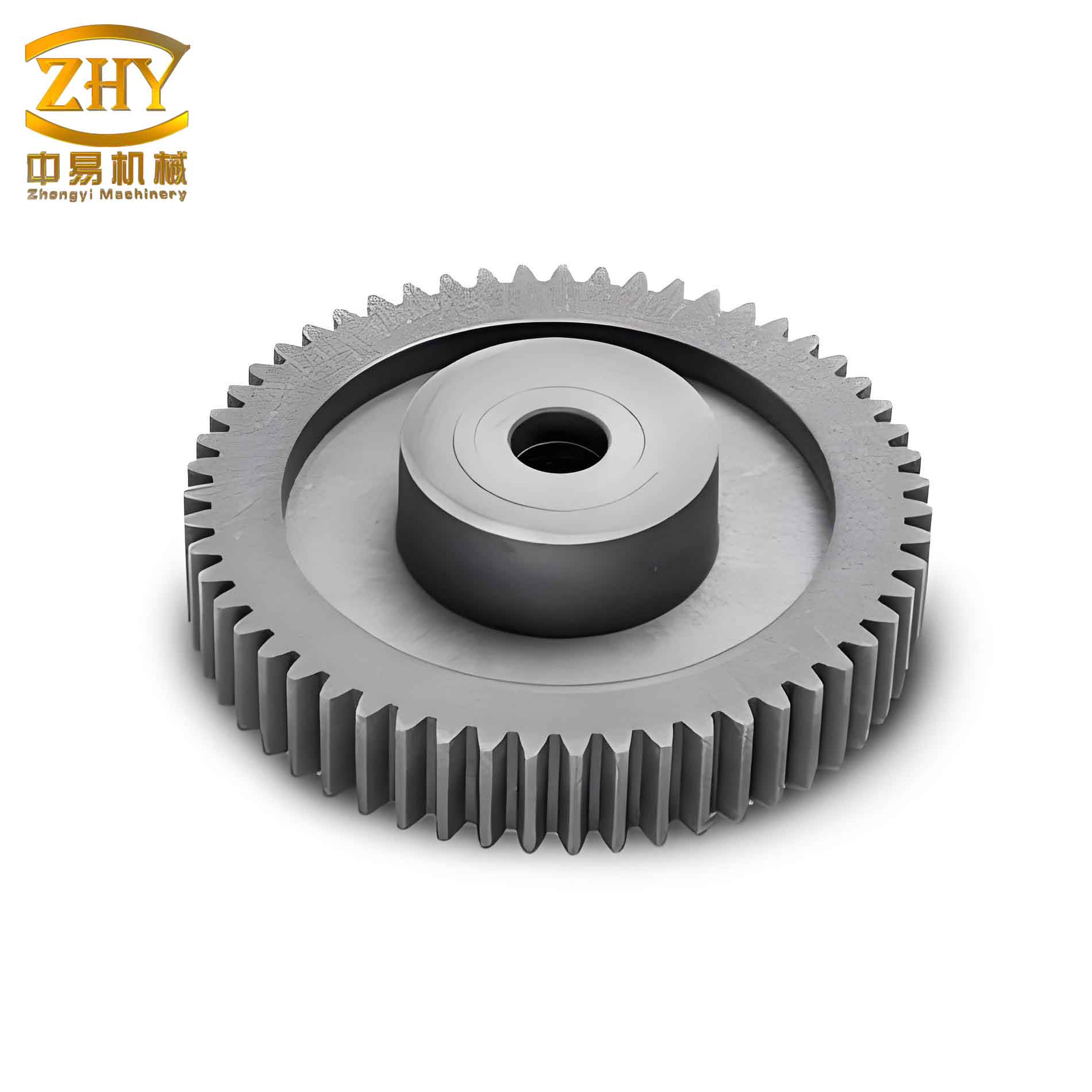
Traditionally, machining a spur and pinion gear on a manual mill involves using an indexing head and a formed cutter—a method known as form cutting. This process requires meticulous manual calculations for indexing, repeated manual operations for each tooth, and offers limited flexibility. While CNC programming with CAM software automates path generation, it can be cumbersome for parametric changes; altering a single parameter like the number of teeth on a spur and pinion gear often necessitates regenerating the entire, often lengthy, toolpath. This is where macro programming, or parametric programming, demonstrates its significant advantages for machining families of parts like different spur and pinion gear sets.
Understanding Macro Programming Fundamentals
Macro programming elevates CNC code by introducing variables, arithmetic, logic operations, and control flow statements. Instead of hard-coded coordinate values, a macro program uses variables (e.g., #1, #100) that can be assigned values, calculated, or modified during runtime. This allows a single program to machine a spur and pinion gear of any module, number of teeth, or face width by simply changing a few variable assignments at the program’s start.
The core constructs include:
- Variables: Local (#1-#33) and global (#100-#199) variables store data like tooth count, module, cutter diameter, etc.
- Arithmetic and Logic: Operations such as addition (#1=#2+5), conditional checks (IF [#10 GT 20] THEN…).
- Looping: WHILE…DO…END loops are crucial for repeating the tooth-cutting cycle for a spur and pinion gear.
- System Variables: These read/write CNC system states, like the current rotary axis position.
The power of a macro lies in its parameterization. For a spur and pinion gear, key defining parameters are the module (m), number of teeth (Z), and pressure angle (α). From these, all other geometric dimensions for the spur and pinion gear can be calculated within the program itself.
The basic gear geometry formulas for a standard spur and pinion gear are:
$$ \text{Pitch Diameter (d)} = m \times Z $$
$$ \text{Addendum (h_a)} = m $$
$$ \text{Dedendum (h_f)} = 1.25m $$
$$ \text{Total Depth (h)} = h_a + h_f = 2.25m $$
$$ \text{Tooth Thickness on Pitch Circle (s)} \approx \frac{\pi m}{2} $$
Process Analysis for Milling a Spur and Pinion Gear on a CNC Indexer
The process involves securing the gear blank on a precision CNC rotary indexer (4th or 5th axis), using an end mill or a gear form cutter, and coordinating linear axes (X, Y, Z) with the rotary axis (A or C). The sequence is as follows:
| Step | Description | Key Considerations for Spur and Pinion Gear |
|---|---|---|
| 1. Workpiece Preparation & Setup | Machine the gear blank to the correct outer diameter. Mount it concentrically on the indexer using a chuck or mandrel. Indicate to ensure runout is minimized. | Accurate outer diameter is critical for setting the correct cutting depth to achieve the proper tooth depth on the final spur and pinion gear. |
| 2. Tool Selection & Setup | Select a cutter slightly narrower than the tooth space at its base. A standard end mill can be used for prototyping or wide tooth spaces. A gear hob or form cutter is ideal for production. | Cutter diameter must be less than the space width of the spur and pinion gear to avoid gouging the adjacent tooth flank. |
| 3. Machining Strategy Definition | Plan the toolpath: roughing passes, finishing passes, and the indexing logic. Calculate the angular increment between teeth: $ \Delta A = \frac{360}{Z} $. | For a high-quality spur and pinion gear, a finishing pass with minimal stock is essential for good surface finish and accuracy. |
| 4. Macro Program Development | Write the parametric program using variables for module (m), teeth (Z), cutter diameter (Dc), etc. The program will loop for each tooth. | The macro automates the indexing and cutting cycle, making it adaptable for any spur and pinion gear specification. |
| 5. Trial Cut & Depth Adjustment | Perform a light trial cut on a scrap area or the edge of the blank to verify toolpath and calculate final depth of cut. | Ensures the tooth profile of the spur and pinion gear is correctly located relative to the blank’s center. |
| 6. Production Run | Execute the macro program. The CNC will machine one tooth space, index by $ \Delta A $, and repeat until all teeth of the spur and pinion gear are complete. | Consistency is guaranteed by the CNC and macro, unlike manual indexing. |
Quality Control in Macro-Based Gear Milling
Even with an advanced macro, process control is vital for manufacturing a precision spur and pinion gear. Key checks include:
- Pre-Cut Verification: Using the macro to machine a very shallow “witness” pattern on the blank confirms correct indexing and alignment before committing to the full depth cut for the spur and pinion gear.
- Tooth Thickness Measurement: Using gear tooth calipers or pins to measure the chordal thickness over several teeth ensures the macro’s calculated toolpath correctly produced the tooth form of the spur and pinion gear.
- Runout Inspection: Checking the pitch circle runout of the finished spur and pinion gear verifies the accuracy of the initial setup and indexer.
The cutting depth (DOC) for a full-depth tooth is primarily a function of the module. However, to account for tool deflection and achieve a better finish, a roughing and finishing pass is recommended. The macro can manage this logic:
$$ \text{Roughing DOC} = 2.0m $$
$$ \text{Finishing DOC} = 2.25m $$
$$ \text{Finishing Stock} = 0.25m $$
A Detailed Macro Programming Example
Let’s develop a macro to machine a steel spur and pinion gear with 24 teeth, a module of 2.5 mm, and a 20° pressure angle, using an 8mm diameter end mill on a vertical machining center with a rotary ‘A’ axis indexer.
Initial Calculations & Setup:
Pitch Diameter: $ d = mZ = 2.5 \times 24 = 60.0 \text{ mm} $
Outer Diameter: $ d_a = m(Z+2) = 2.5 \times 26 = 65.0 \text{ mm} $
Tooth Depth: $ h = 2.25m = 5.625 \text{ mm} $
Angular Index: $ \Delta A = 360 / 24 = 15.0° $
Cutter Compensation: The tool path must offset inward from the theoretical tooth space edge by (Cutter Radius).
O1000 (SPUR AND PINION GEAR MACRO)
(User sets these variables at the machine or in the program header)
#100 = 2.5 (Module, m)
#101 = 24 (Number of Teeth, Z)
#102 = 8.0 (Cutter Diameter, Dc)
#103 = 65.0 (Blank Outer Diameter, OD)
#104 = 15.0 (Angular Index, ΔA)
#105 = 5.625 (Full Tooth Depth, h)
#106 = 4.5 (Roughing Depth, ~2.0m)
#107 = 0.2 (Finishing Stock per side)
#108 = 0 (Loop Counter, i)
G54 G90 G40 G49 G80 G21 (Safety line)
M06 T01 (Call 8mm End Mill)
G00 G90 G54 X0 Y0
G43 H01 Z50.0 S2500 M03
G00 A0. (Position to start angle)
Z5.0 M08
—— Calculate and move to start position for first tooth space ——
#109 = [#103 / 2] + 3.0 (Start X pos: Half of OD + clearance)
#110 = 0 (Current Angle)
—— LOOP: Roughing Pass for all teeth ——
WHILE [#108 LT #101] DO1
G00 X#109 A#110 (Position to tooth start)
Z2.0
G01 Z-#106 F150. (Plunge to roughing depth)
G01 Y-[#100*1.5] F300. (Machine tooth space width, Y-motion)
G00 Z2.0
#108 = #108 + 1 (Increment tooth counter)
#110 = #110 + #104 (Increment angle for next spur and pinion gear tooth)
END1
—— Reset and prepare for finishing pass ——
#108 = 0
#110 = 0
#111 = #105 + #107 (Finishing cut total depth)
—— LOOP: Finishing Pass for all teeth ——
WHILE [#108 LT #101] DO2
G00 X#109 A#110
Z2.0
G01 Z-#111 F100.
G01 Y-[#100*1.5] F250. (Slow feed for finish on spur and pinion gear)
G00 Z2.0
#108 = #108 + 1
#110 = #110 + #104
END2
G00 Z100.0 M09
G91 G28 Z0.
G91 G28 Y0.
M30
This macro demonstrates the core principle: the `WHILE` loop repeats the cutting motion for each tooth of the spur and pinion gear. Changing #101 (tooth count) and #100 (module) will automatically adjust all related calculations and machine a completely different spur and pinion gear without rewriting the toolpath logic. This parametric nature is the key advantage for job shops and prototyping.
Comparative Analysis: Manual, CAM, and Macro Methods
| Aspect | Manual Indexing & Milling | CAM Software Programming | Macro Programming |
|---|---|---|---|
| Setup/Programming Time | Very High (manual calc, setup for each gear) | Medium (CAD model, toolpath generation, post-processing) | Low (Write once, modify parameters for any spur and pinion gear) |
| Flexibility for Design Changes | Very Low (completely new setup) | Low-Medium (requires model update & reposting) | Very High (change a few variables in the macro header) |
| Program Length & Complexity | N/A (manual process) | Very High (thousands of lines of point-to-point code) | Very Low (compact, logic-based code, typically < 100 lines) |
| Skill Requirement | High (manual machining & indexing skills) | High (3D CAD/CAM proficiency) | High (CNC macro programming knowledge) |
| Optimal Use Case | Single, one-off spur and pinion gear repair. | Complex gears, 3D contours, or high-volume production. | Small batches, prototypes, families of similar spur and pinion gears, on-the-fly adjustments. |
Conclusion
The integration of macro programming with a CNC milling center and rotary indexer presents a remarkably efficient, accurate, and flexible method for producing spur and pinion gears. It successfully bridges the gap between the inflexibility of dedicated gear cutting machines and the inefficiency of fully manual or CAM-dependent processes for small batches. By encapsulating the geometric logic and machining sequence into a parametric program, manufacturers gain the ability to produce a wide range of spur and pinion gear specifications from a single, robust program. This methodology emphasizes adaptability, reduces programming lead time for design iterations, and ensures consistent quality. For any environment involved in prototyping, maintenance, or low-volume production of power transmission components, mastering macro programming for spur and pinion gear manufacture is a highly valuable technical capability.