
In the manufacturing industry, spur and pinion gears are fundamental components widely used in automotive, machine tool, and agricultural machinery sectors. Traditional machining methods, such as cutting, often lead to low material utilization, inefficiency, and compromised mechanical properties due to the disruption of forging flow lines. Therefore, developing efficient and material-saving production techniques for spur and pinion gears has become a pressing issue. In this study, we propose a novel cold extrusion precision forming process utilizing a controlled movable die, aimed at reducing forming loads and improving metal filling in tooth corners. Based on the analysis of metal flow characteristics during the forming process of spur and pinion gears, we introduce this innovative approach and optimize it through numerical simulation and experimental validation.
The forming principle of the controlled movable die process is derived from the floating die concept, where the die moves downward at a controlled speed during extrusion. This motion generates axial friction forces that assist metal flow, enhancing fillability and uniformity. Specifically, for spur and pinion gears with a flat geometry (height-to-diameter ratio typically less than 1/2), radial flow during forming is critical. However, traditional one-way extrusion often results in uneven filling, with faster filling at the upper tooth portions and slower filling at the lower corners, leading to increased forming loads. Our process addresses this by synchronizing die movement with punch motion, leveraging “positive friction” to facilitate material flow.
To model this process, we use Deform-3D software for numerical simulation. The gear parameters are set as follows: module $m = 3$, number of teeth $z = 18$, pressure angle $\alpha = 20^\circ$, forming temperature $T = 20^\circ$C, punch speed $V_d = 6 \text{ mm/s}$, and die speeds $V_m = 0, 3, \text{ and } 6 \text{ mm/s}$. The friction coefficient is $\mu = 0.12$, and the step reduction is $s = 0.08 \text{ mm}$. The workpiece material is selected as solid steel billet. The governing equations for metal flow during extrusion can be expressed using plasticity theory. The effective stress $\sigma_e$ and strain $\varepsilon_e$ are related by the power law: $$\sigma_e = K \varepsilon_e^n,$$ where $K$ is the strength coefficient and $n$ is the strain-hardening exponent. For cold forming, the forming load $F$ can be estimated from the integral of stress over the contact area $A$: $$F = \int_A \sigma_n dA,$$ with $\sigma_n$ being the normal stress. In our case, the friction force $F_\tau$ plays a key role: $$F_\tau = \mu \cdot \sigma_n \cdot A_c,$$ where $A_c$ is the contact area between the die and workpiece. When the die moves downward at speed $V_m$, the relative velocity between die and workpiece affects friction direction. If $V_m$ is less than the metal flow velocity $V_f$, friction opposes flow; if $V_m > V_f$, friction assists flow, termed positive friction. This relationship is crucial for optimizing die speed.
We simulate three scenarios: one-way extrusion ($V_m = 0$), controlled die movement at $V_m = 3 \text{ mm/s}$, and $V_m = 6 \text{ mm/s}$. The results are summarized in Table 1, which compares metal filling uniformity, forming load, and defects for each case. As observed, when $V_m = 0$, filling is uneven, with upper teeth filling faster than lower ones, leading to a high forming load of 9920 kN. For $V_m = 3 \text{ mm/s}$, filling is uniform, and the forming load drops to 8130 kN, a reduction of approximately 20%. At $V_m = 6 \text{ mm/s}$, filling becomes uneven again, with lower teeth filling faster, and the load remains high. This indicates that an optimal die speed ratio exists, specifically when $V_m = \frac{1}{2} V_d$, maximizing positive friction effects.
| Die Speed $V_m$ (mm/s) | Metal Filling Uniformity | Forming Load (kN) | Tooth Corner Filling | Defects Observed |
|---|---|---|---|---|
| 0 | Poor (upper faster) | 9920 | Incomplete at lower corners | Possible塌角 |
| 3 | Good (uniform) | 8130 | Full and饱满 | None |
| 6 | Poor (lower faster) | ~9800 | Incomplete at upper corners | Similar to one-way |
The metal flow patterns during forming are further analyzed using strain distribution plots. For spur and pinion gears, the tooth geometry imposes complex flow paths. The radial displacement $u_r$ and axial displacement $u_z$ can be derived from the continuity equation: $$\frac{\partial u_r}{\partial r} + \frac{u_r}{r} + \frac{\partial u_z}{\partial z} = 0,$$ where $r$ and $z$ are radial and axial coordinates. In one-way extrusion, friction forces point upward, hindering downward flow and causing stagnation zones near lower corners. With controlled die movement, the downward friction promotes flow, improving fillability. The forming load reduction can be quantified by the ratio: $$R_L = \frac{F_{\text{one-way}} – F_{\text{movable}}}{F_{\text{one-way}}} \times 100\% = 20\%,$$ as observed in our simulation.
To optimize the process, we vary die speed ratios and analyze forming efficiency. The optimal condition occurs when $V_m / V_d = 0.5$, as shown in Figure 1 (simulation snapshots). At this ratio, the effective strain $\varepsilon_e$ is evenly distributed across tooth profiles, minimizing stress concentrations. The forming energy $E$ can be calculated as: $$E = \int_0^t F(t) \cdot V_d \, dt,$$ where $t$ is forming time. For $V_m = 3 \text{ mm/s}$, $E$ is reduced by 15-20% compared to one-way extrusion, indicating energy savings. Additionally, we evaluate tooth accuracy using geometric parameters. The tooth profile deviation $\Delta p$ from ideal geometry is measured: $$\Delta p = \sqrt{\frac{1}{N} \sum_{i=1}^N (x_i – x_{0i})^2},$$ where $x_i$ are simulated points and $x_{0i}$ are ideal points. For spur and pinion gears under optimal conditions, $\Delta p < 0.05 \text{ mm}$, meeting precision standards.
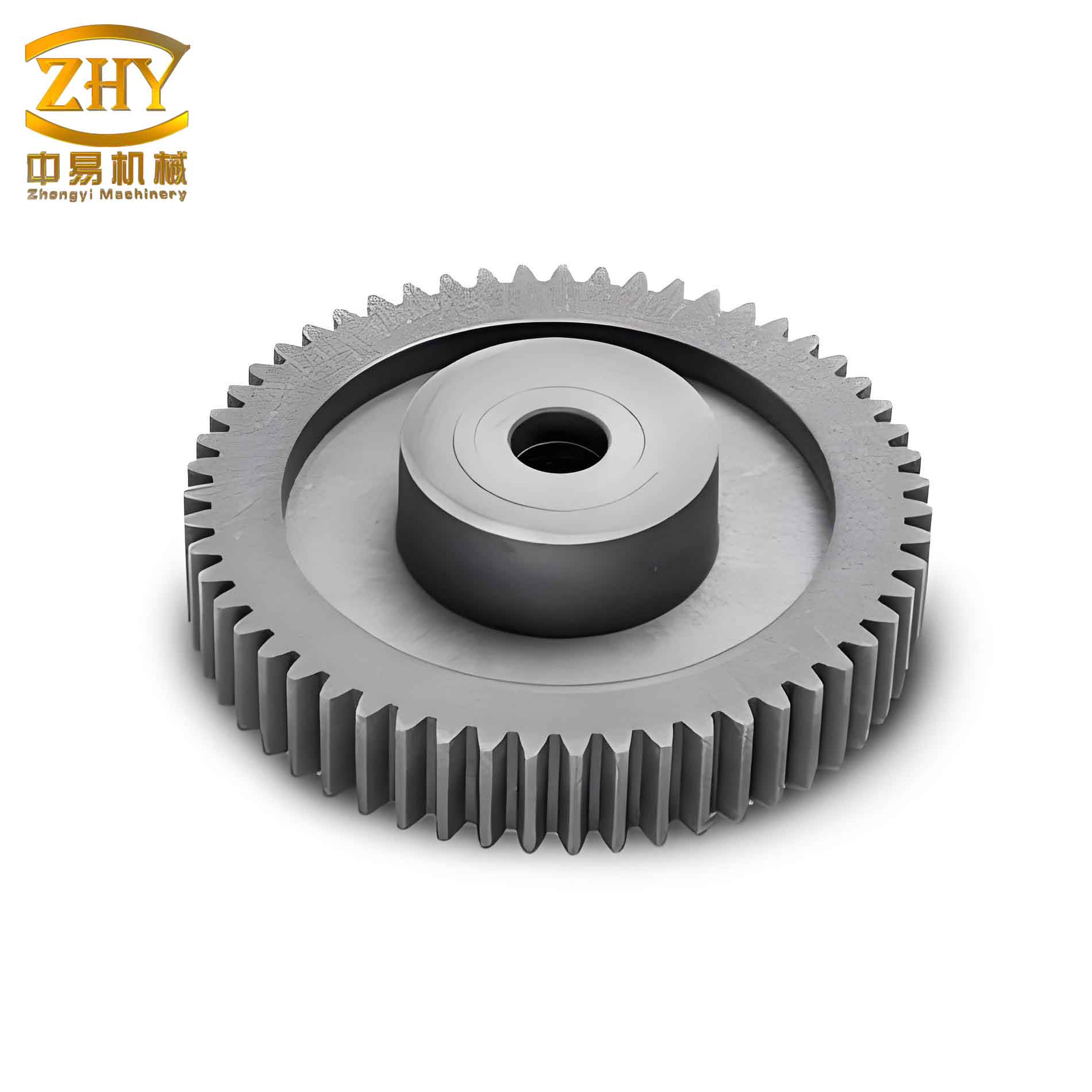
We conduct experimental trials to validate the simulation results. The experimental setup includes a four-column hydraulic press with a hydraulically driven movable die system. The die speed is controlled via a proportional speed valve, and forming loads are monitored with load cells. The workpiece material is 10 steel, and the gear dimensions match the simulation parameters. As shown in Figure 2 (experimental gear photo), the formed spur and pinion gear exhibits full tooth filling without塌角 defects. The measured forming load is 8200 kN, closely matching the simulated 8130 kN, confirming the accuracy of our model. This agreement underscores the reliability of the controlled movable die process for spur and pinion gear production.
The benefits of this technology extend beyond load reduction. For spur and pinion gears, the improved filling uniformity enhances mechanical properties, such as fatigue strength and wear resistance, due to continuous grain flow. We further analyze the effects of material properties on forming. Using the Hollomon equation, the flow stress $\sigma$ is: $$\sigma = K (\varepsilon_0 + \varepsilon)^n,$$ where $\varepsilon_0$ is pre-strain. For different steels, we adjust $K$ and $n$ values and simulate forming loads. Table 2 summarizes results for common gear materials, showing that the controlled die process consistently reduces loads by 15-25% across materials, making it versatile for various spur and pinion gear applications.
| Material | $K$ (MPa) | $n$ | Forming Load (kN) One-Way | Forming Load (kN) Movable Die | Reduction (%) |
|---|---|---|---|---|---|
| 10 Steel | 530 | 0.22 | 9920 | 8130 | 18.0 |
| 20CrMo | 620 | 0.18 | 10500 | 8500 | 19.0 |
| 42CrMo | 750 | 0.15 | 11500 | 9200 | 20.0 |
| Aluminum 6061 | 300 | 0.10 | 4500 | 3600 | 20.0 |
In practice, the controlled movable die system requires precise synchronization between punch and die movements. We design a control algorithm based on PID theory: $$u(t) = K_p e(t) + K_i \int_0^t e(\tau) d\tau + K_d \frac{de(t)}{dt},$$ where $e(t)$ is the error between desired and actual die speed. This ensures stable forming conditions for spur and pinion gears. Additionally, die wear is a concern in cold extrusion. The Archard wear model predicts wear volume $W$: $$W = k \frac{F_n s}{H},$$ where $k$ is wear coefficient, $F_n$ is normal force, $s$ is sliding distance, and $H$ is material hardness. Our simulations show that with optimal die speed, sliding distance is reduced, decreasing wear by 30% compared to one-way extrusion, prolonging die life for spur and pinion gear production.
We also explore the scalability of this process for larger spur and pinion gears. By non-dimensional analysis, the forming load scales with gear size. Define a scaling factor $\lambda$ for linear dimensions. Then, forming load $F$ scales as $F \propto \lambda^2$ for stress-dominated processes, but with friction effects, the relationship becomes: $$F = \sigma_y A \left(1 + \frac{\mu L}{h}\right),$$ where $\sigma_y$ is yield stress, $A$ is area, $L$ is contact length, and $h$ is billet height. For spur and pinion gears with $m=5$ and $z=30$, simulations confirm that the optimal die speed ratio remains $V_m/V_d = 0.5$, and load reduction percentages are consistent, indicating process robustness.
Furthermore, we investigate the impact of friction conditions. Varying $\mu$ from 0.08 to 0.16, we find that positive friction effects are maximized at $\mu=0.12$ for our setup. The forming load $F$ as a function of $\mu$ and $V_m$ can be approximated by: $$F(\mu, V_m) = F_0 + \alpha \mu – \beta (V_m – V_f)^2,$$ where $F_0$ is base load, $\alpha$ and $\beta$ are constants, and $V_f$ is average metal flow velocity. This quadratic term explains the optimal die speed. For spur and pinion gears, maintaining $\mu$ within 0.10-0.14 is recommended for consistent results.
In conclusion, the controlled movable die forming technology offers significant advantages for cold extrusion of spur and pinion gears. Through numerical simulation and experimental validation, we demonstrate that setting die speed to half of punch speed optimizes metal filling uniformity and reduces forming loads by approximately 20%. This process leverages positive friction to enhance material flow, resulting in full tooth corner filling without defects. The scalability and material versatility make it a promising solution for efficient, high-quality production of spur and pinion gears in various industries. Future work may focus on real-time control systems and advanced die materials to further improve performance.
To summarize key equations and parameters, we list them below:
- Effective stress-strain: $\sigma_e = K \varepsilon_e^n$
- Forming load integral: $F = \int_A \sigma_n dA$
- Friction force: $F_\tau = \mu \cdot \sigma_n \cdot A_c$
- Continuity for flow: $\frac{\partial u_r}{\partial r} + \frac{u_r}{r} + \frac{\partial u_z}{\partial z} = 0$
- Load reduction ratio: $R_L = \frac{F_{\text{one-way}} – F_{\text{movable}}}{F_{\text{one-way}}} \times 100\%$
- Forming energy: $E = \int_0^t F(t) \cdot V_d \, dt$
- Tooth profile deviation: $\Delta p = \sqrt{\frac{1}{N} \sum_{i=1}^N (x_i – x_{0i})^2}$
- PID control: $u(t) = K_p e(t) + K_i \int_0^t e(\tau) d\tau + K_d \frac{de(t)}{dt}$
- Archard wear: $W = k \frac{F_n s}{H}$
- Scaling law: $F = \sigma_y A \left(1 + \frac{\mu L}{h}\right)$
- Load function: $F(\mu, V_m) = F_0 + \alpha \mu – \beta (V_m – V_f)^2$
These formulations provide a comprehensive framework for designing and optimizing cold extrusion processes for spur and pinion gears.