
In my extensive research on gear manufacturing, I have focused on the cold precision forging process for spur and pinion gears. These components are critical in mechanical transmission systems due to their compact structure, high power transmission efficiency, long lifespan, reliability, and accurate gear ratios. The cold precision forging technology, which involves directly forming gear teeth from billets without or with minimal subsequent machining, offers significant advantages over traditional cutting methods. It improves the mechanical properties by aligning the metal fiber organization along the tooth profile, enhancing bending strength, contact fatigue resistance, and impact toughness. Additionally, it boosts production efficiency and material utilization, reduces heat treatment distortions, and increases gear durability. However, a major challenge in cold forging spur and pinion gears is the high forming pressure required to fully fill the die cavity, which can lead to模具开裂 and shortened tool life. Therefore, my work aims to optimize the forging process to reduce forming pressure while ensuring complete tooth filling.
Previous studies have explored various techniques to address this issue. For instance, researchers like Kyoichi Ohga and Kazuyoshi Kondo investigated split-flow methods in precision die forging, applying principles to spur gear forming. Others, including Lin Zhiping, Tian Fuxiang, Kou Shuqing, and Fang Quanshui, conducted related research on cold precision forging. Key approaches involve reducing friction阻力 through floating die designs, improving material flow via core rod forging, and optimizing heat treatment processes. In conventional upsetting processes, material deformation flows axially and radially, but with inadequate radial flow, high pressures are needed. My analysis of prior work indicates that enhancing radial plastic deformation分流 can significantly improve filling efficiency. For example, using a flat die for forging requires pressures up to 4.86 MN for complete filling, whereas incorporating嵌套凸台 reduces this to 4.54 MN by promoting radial flow. Despite these advancements, further optimization is necessary for large模数 spur and pinion gears to mitigate die stress and achieve economical production.
Based on these insights, I propose a novel segmented forging process that combines floating die,套嵌, and core rod pressing technologies. This approach aims to lower forming pressure by strategically managing plastic deformation分流. The process involves two stages: first, a套嵌 upper die compresses the billet to the required gear width height without fully filling the cavity; second, a core rod is used to press downward, inducing predominant radial flow in the periphery due to die confinement. This method leverages split-flow theory, where material is directed to fill the tooth cavities more efficiently. The mathematical representation of plastic deformation during forging can be described using flow stress models. For instance, the effective stress in metal forming is given by:
$$ \sigma_{eff} = \sqrt{\frac{3}{2} \sigma_{ij}’ \sigma_{ij}’} $$
where $\sigma_{ij}’$ is the deviatoric stress tensor. In cold forging, the material behavior often follows a power-law hardening model:
$$ \sigma = K \varepsilon^n $$
where $\sigma$ is the flow stress, $\varepsilon$ is the strain, $K$ is the strength coefficient, and $n$ is the hardening exponent. For 45 steel, typical values are $K = 600$ MPa and $n = 0.2$. The pressure required for forging can be estimated from the yield criterion and friction conditions. Using the slab method for axisymmetric forging, the average pressure $P_{avg}$ is:
$$ P_{avg} = Y \left(1 + \frac{\mu D}{3h}\right) $$
where $Y$ is the yield strength, $\mu$ is the friction coefficient, $D$ is the diameter, and $h$ is the height. However, for complex spur and pinion gear geometries, finite element simulation is essential. I employed DEFORM-3D software to analyze the process, as it allows for detailed modeling of plastic deformation分流 and stress distribution.
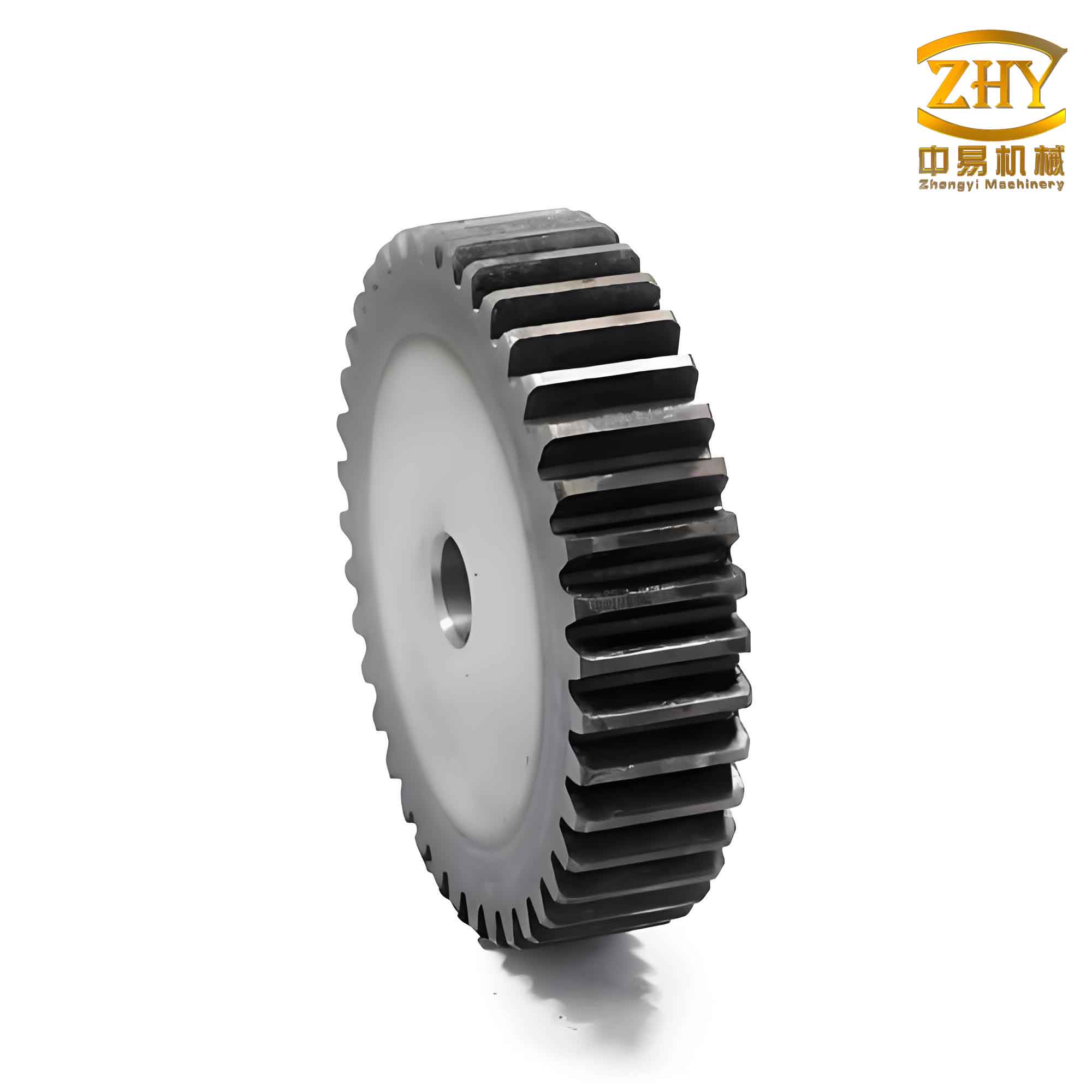
The experimental setup in my study targets large模数 spur and pinion gears, specifically a standard spur gear with module $m = 3$, tooth number $z = 19$, and width $B = 28$ mm. The billet material is medium-strength 45 steel, and the die assembly includes an upper die, lower die, outer die, and core rod. Friction coefficient is set at 0.12. To save computational resources, a quarter-model is used in DEFORM-3D simulation. The optimization involves die structure modifications: the upper die has a套嵌 feature to increase radial flow during initial pressing, and the core rod has a rounded tip to prevent material shearing and enhance durability. The segmented process ensures that in the first stage, the billet is compressed axially with some radial expansion, while in the second stage, the core rod promotes further radial分流 to fill the tooth cavities completely. This is crucial for spur and pinion gears, as tooth accuracy directly affects performance.
Results from the simulation demonstrate significant pressure reduction. In the first stage, the upper die reaches a maximum forming force of 1.84 MN, much lower than conventional methods. In the second stage, the core rod requires only 0.71 MN. Thus, the total forming pressure is substantially decreased, enabling the forging of large spur and pinion gears on hydraulic presses with capacities under 200 tons. The plastic deformation分流 patterns show improved material flow toward the die periphery, as illustrated in the simulation snapshots. The effectiveness of this optimization can be summarized using the following table comparing different forging processes for spur and pinion gears:
| Forging Process | Maximum Forming Pressure (MN) | Radial Flow Enhancement | Tooth Filling Quality |
|---|---|---|---|
| Conventional Flat Die | 4.86 | Low | Incomplete at high pressure |
| 套嵌 Upper Die | 4.54 | Moderate | Improved but still high pressure |
| Proposed Segmented Process | 2.55 (total: 1.84 + 0.71) | High | Complete at lower pressure |
The pressure reduction can be attributed to better control of plastic deformation分流. The radial flow component is maximized through die design, reducing the axial resistance. From a mechanics perspective, the stress state in the billet shifts from predominantly hydrostatic pressure to include more deviatoric stresses that facilitate shape change. The split-flow ratio, defined as the volume of material flowing radially versus axially, increases in the optimized process. This ratio $R_{sf}$ can be expressed as:
$$ R_{sf} = \frac{V_r}{V_a} $$
where $V_r$ is the radial flow volume and $V_a$ is the axial flow volume. In my process, $R_{sf} > 1$ during the core rod stage, ensuring efficient cavity filling. Additionally, the use of floating die minimizes friction at the die-billet interface, further lowering pressure. The friction work $W_f$ per unit volume is:
$$ W_f = \int \tau \, d\gamma $$
where $\tau$ is the shear stress and $\gamma$ is the shear strain. By reducing $\tau$ through floating action, $W_f$ decreases, contributing to overall energy savings.
Further analysis involves the effect of die geometry on forming pressure. For spur and pinion gears, the tooth profile complexity requires precise flow control. The optimization of套嵌 dimensions and core rod curvature is critical. I conducted parameter studies using DEFORM-3D to determine optimal values. The key parameters include套嵌 height $h_s$, core rod tip radius $r_c$, and initial billet height $h_0$. The relationship between forming pressure $P$ and these parameters can be approximated by:
$$ P = f(h_s, r_c, h_0, \mu, K, n) $$
Through regression analysis of simulation data, I derived an empirical formula for the total forming force $F_t$ in newtons:
$$ F_t = 1.2 \times 10^6 \left( \frac{h_s}{10} \right)^{-0.3} + 5.0 \times 10^5 \left( \frac{r_c}{5} \right)^{0.4} $$
where $h_s$ and $r_c$ are in millimeters. This formula highlights that increasing套嵌 height reduces pressure, while a larger core rod radius slightly increases it but improves durability. For the specific gear in this study, the optimal $h_s$ is 15 mm and $r_c$ is 3 mm.
Another aspect is material behavior during cold forging. Spur and pinion gears made from 45 steel may experience strain hardening, which affects formability. The true stress-strain curve from simulation shows that after a strain of 0.5, the flow stress rises to 800 MPa. To mitigate excessive hardening, intermediate annealing could be incorporated, but in my process, the segmented approach reduces cumulative strain per stage. The total equivalent strain $\varepsilon_{eq}$ is distributed as:
$$ \varepsilon_{eq} = \varepsilon_1 + \varepsilon_2 $$
where $\varepsilon_1$ is from the upper die stage and $\varepsilon_2$ from the core rod stage. Simulation results indicate $\varepsilon_1 \approx 0.3$ and $\varepsilon_2 \approx 0.4$, both below the critical strain for cracking in 45 steel. This ensures good formability for spur and pinion gears without additional heat treatment during forging.
Die strength is also a concern in cold precision forging. High pressures can cause die fatigue or fracture. To address this, I recommend using multi-layer combined dies, such as three-layer structures, to enhance stress distribution. The die stress $\sigma_d$ can be calculated using Lamé’s equation for thick-walled cylinders:
$$ \sigma_d = \frac{p r_i^2}{r_o^2 – r_i^2} \left(1 + \frac{r_o^2}{r^2}\right) $$
where $p$ is the internal pressure, $r_i$ and $r_o$ are inner and outer radii, and $r$ is the radial position. By employing prestressed dies, the effective stress on the inner die is reduced, prolonging tool life for producing spur and pinion gears.
In terms of industrial application, this optimized process offers economic benefits. Lower forming pressure allows the use of smaller presses, reducing capital investment. The segmented operation may slightly increase cycle time, but the improvement in gear quality and die longevity compensates for it. For mass production of spur and pinion gears, automation can be integrated to handle the two-stage pressing. Additionally, the process is adaptable to various gear sizes and materials. Future work could explore applications to helical gears or bevel gears, but the core principles remain relevant.
To summarize, my research presents a comprehensive optimization of cold precision forging for spur and pinion gears. By combining floating die,套嵌, and core rod technologies in a segmented process, forming pressure is significantly lowered while ensuring complete tooth filling. The DEFORM-3D simulations validate the effectiveness, showing pressure reductions from over 4.86 MN to under 2.55 MN for a sample gear. This advancement contributes to sustainable manufacturing by saving energy and reducing material waste. The key formulas and tables provided here offer practical guidance for engineers designing similar processes. As demand for high-performance spur and pinion gears grows in industries like automotive and aerospace, such optimized forging methods will play a vital role in meeting quality and efficiency standards.