
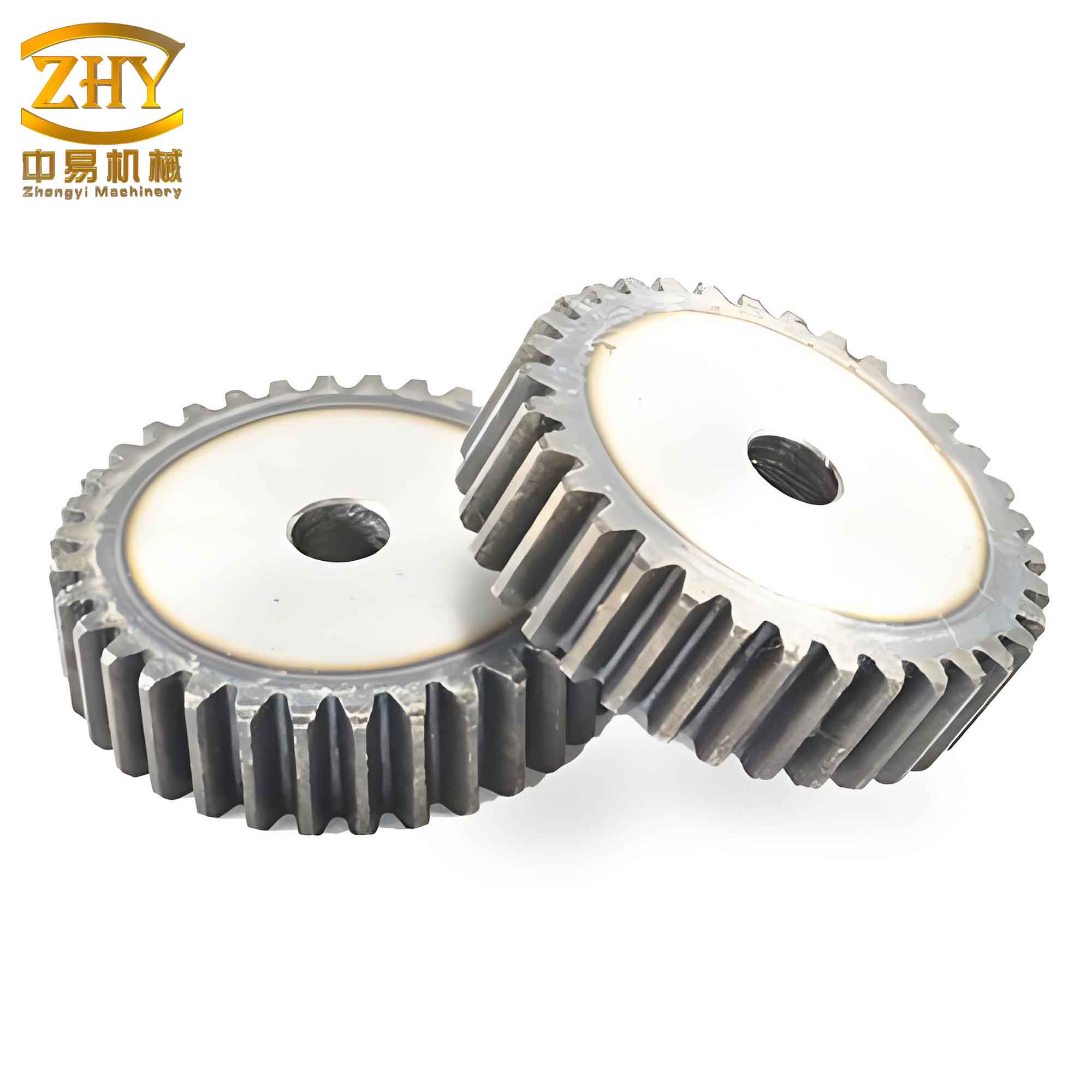
As a researcher deeply involved in the field of precision forming, I have always been fascinated by the quest for more efficient and robust manufacturing methods for critical mechanical components. Among these, the spur and pinion gear stands out due to its fundamental role in power transmission across countless industries, from automotive drivetrains to heavy machinery. The traditional method of manufacturing these spur and pinion gears through machining—whether hobbing, shaping, or milling—presents several inherent drawbacks. These include significant material waste in the form of chips, relatively low production rates, and, crucially, the cutting of the material’s continuous grain flow, which can compromise the part’s fatigue strength and overall durability.
Cold forging, a near-net-shape forming process conducted at room temperature, offers a compelling alternative for producing spur and pinion gears. This process promises remarkable benefits: material utilization can increase by over 30%, the strength of the forged spur and pinion gear can be enhanced by more than 20% due to work hardening and uninterrupted grain structure, and production efficiency can see a boost of approximately 40%. However, despite these advantages, the widespread industrial adoption of cold forging for complex parts like spur and pinion gears has been hindered by two primary technical challenges: the difficulty in completely filling sharp tooth corners (fillet areas) and the exceptionally high forming loads required, which demand costly, high-capacity presses and can lead to accelerated tool wear or failure.
My focus, therefore, has been on developing and analyzing process strategies that directly address these limitations. One particularly promising approach is based on the principle of radial divided-flow. The core idea is to intentionally design a controlled flow path for the material, diverting a portion of it away from the main cavity to alleviate pressure. In the context of forging a spur and pinion gear, this is implemented by incorporating a central through-hole in the workpiece and employing a floating die system. During forming, as the upper punch descends, the floating die section containing the gear cavity also moves, creating a condition where metal can flow both radially outward into the intricate tooth profiles and radially inward into the central hole. This “pressure relief valve” effect prevents the drastic pressure spike typically encountered in the final stages of solid forging when trying to fill the last corners, thereby significantly reducing the maximum forming load. This paper presents a detailed numerical investigation into this radial divided-flow cold forging process for a standard spur and pinion gear, with the aim of quantifying the influence of key process parameters on the forming load and establishing guidelines for process optimization.
Numerical Simulation Framework and Model Setup
To systematically study this complex three-dimensional forming process, I employed a robust 3D rigid-plastic finite element method (FEM). This approach is well-suited for simulating large plastic deformation while neglecting the elastic effects, which is a valid assumption for bulk metal forming analysis. The specific spur and pinion gear model used in this study has the following specifications: number of teeth, Z = 20; module, m = 3 mm; pressure angle, α = 20°; and a profile shift coefficient of x = 0. The workpiece material was defined as AISI-1010 steel in a cold-worked state, modeled as an isotropic, rigid-plastic material obeying the following flow stress equation:
$$
\overline{\sigma} = K \cdot (\overline{\varepsilon})^n \cdot (\dot{\overline{\varepsilon}})^m
$$
where $\overline{\sigma}$ is the flow stress, $\overline{\varepsilon}$ is the equivalent strain, $\dot{\overline{\varepsilon}}$ is the equivalent strain rate, and K, n, and m are material constants. For simplicity in this isothermal simulation (set at 20°C), the strain rate sensitivity ‘m’ was considered low. The dies (punch, floating die, and counter punch) were modeled as perfectly rigid bodies.
The interaction between the deforming workpiece and the rigid dies is governed by friction. I utilized the shear friction model, which is common in bulk forming simulations, defined as:
$$
\tau_f = m_k \cdot k
$$
where $\tau_f$ is the frictional shear stress, $m_k$ is the friction factor (ranging from 0 for frictionless to 1 for perfect sticking), and $k$ is the shear yield strength of the workpiece material ($k = \overline{\sigma} / \sqrt{3}$). A baseline friction factor of $m_k = 0.12$ was used.
To maximize computational efficiency without sacrificing the accuracy of the symmetric process, only one-quarter of the full spur and pinion gear and die assembly was modeled, with appropriate symmetry boundary conditions applied. The initial billet was designed as a cylinder with an outer diameter close to the gear’s root diameter to aid in centering and initial filling. The presence of the radial divided-flow hole is central to the process. The initial billet dimensions and key simulation parameters are summarized in the table below.
| Parameter | Value / Description |
|---|---|
| Gear Model | Spur Gear, Z=20, m=3mm, α=20° |
| Workpiece Material | AISI-1010 (Cold) |
| Initial Billet Diameter | 52 mm (Near root circle) |
| Initial Billet Height | 37.5 mm (Calculated for volume constancy) |
| Divided-Flow Hole Diameter (Baseline) | 16 mm |
| Die Tooth Root Fillet Radius (Baseline) | 0.5 mm |
| Punch Speed | 10 mm/s |
| Friction Model | Shear Friction, factor m_k = 0.12 |
| Simulation Type | 3D Rigid-Plastic, Isothermal |
| Model Symmetry | 1/4 Model |
The finite element mesh for the workpiece consisted of tetrahedral elements, with automatic remeshing capabilities activated to handle the severe deformation without excessive mesh distortion. The primary output variable of interest for this study was the total forming load on the punch as a function of its stroke, which directly correlates with press tonnage requirement and process feasibility.
Parametric Analysis and Influence on Forming Load
The core of my investigation revolved around a systematic parametric study. I varied one parameter at a time from the baseline model to isolate its effect on the forming load curve. The parameters studied were: (1) Friction Factor ($m_k$), (2) Die Tooth Root Fillet Radius ($r_f$), (3) Diameter of the Radial Divided-Flow Hole ($d_h$), and (4) Punch Forming Speed ($v$). The range of values simulated for each parameter is listed below.
| Process Parameter | Symbol | Values Investigated |
|---|---|---|
| Friction Factor | $m_k$ | 0.1, 0.3, 0.5, 0.7 |
| Tooth Root Fillet Radius (mm) | $r_f$ | 0, 0.5, 1.0, 1.5 |
| Divided-Flow Hole Diameter (mm) | $d_h$ | 0 (solid), 5, 10, 15 |
| Punch Forming Speed (mm/s) | $v$ | 10, 100, 200, 300 |
1. The Pronounced Effect of Friction
The simulation results clearly demonstrated that friction is a dominant factor influencing the load required to forge the spur and pinion gear. As the friction factor $m_k$ increased from a well-lubricated condition (0.1) to a high-friction condition (0.7), the total forming load increased substantially across the entire stroke. The difference was most pronounced in the intermediate to late stages of the stroke (approximately 60% to 95% of completion).
This can be explained by the evolving contact mechanics. In the early stage, material flows over the root fillet and begins to fill the tooth cavity. The contact area with the die sidewalls is limited. However, as filling progresses past the pitch circle, the tooth thickness decreases, forcing material to not only flow upward but also undergo additional lateral deformation to conform to the die cavity’s tapered shape. This dramatically increases the contact area between the workpiece and the die tooth flanks. According to the friction model, the total frictional force resisting material flow is integrated over this contact area. Therefore, a higher friction factor exerts a much greater resistive force during this high-contact-phase, leading to the significant load increase observed. Optimizing lubrication to minimize $m_k$ is thus absolutely critical for the successful cold forging of a spur and pinion gear.
| Friction Factor ($m_k$) | Relative Forming Load | Key Observation |
|---|---|---|
| 0.1 (Low) | Lowest | Ideal condition, minimal resistance to material flow into teeth. |
| 0.3 (Moderate) | Moderately Higher | Represents a typical well-lubricated industrial condition. |
| 0.5 (High) | Significantly Higher | Load increases sharply in the final filling stage. |
| 0.7 (Very High) | Highest | Risk of incomplete filling and excessively high press tonnage requirement. |
2. The Role of Die Tooth Root Fillet Radius
The radius at the root of the die tooth cavity ($r_f$) guides the initial metal flow from the billet into the tooth space. Intuitively, a sharper corner (smaller $r_f$) should create a greater restriction. My simulations confirmed this, showing that a smaller fillet radius (e.g., $r_f = 0$ mm, a sharp corner) resulted in a slightly higher forming load compared to larger radii (e.g., $r_f = 1.5$ mm) during the intermediate filling stage. The load curves, however, tended to converge at the very end of the stroke.
The reasoning is two-fold. First, a larger fillet radius reduces the bending and shearing severity as metal turns to enter the tooth, lowering the local deformation resistance. Second, and more importantly for the final stage, once the tooth cavity is nearly full, the material flowing into the last corner is being “pulled” from the central region and the filled portions of the tooth. At this point, the influence of the initial entry fillet geometry becomes secondary to the overall stress state and the availability of material from the divided-flow hole. Therefore, while a generous fillet radius is beneficial for reducing load and improving die life, its impact is not as dramatic as that of friction or the divided-flow hole itself. An optimal $r_f$ balances easy metal entry with the final required tooth profile geometry of the spur and pinion gear.
3. The Decisive Impact of the Radial Divided-Flow Hole
This parameter is the cornerstone of the investigated technology. The diameter of the central hole ($d_h$) proved to have the most significant and beneficial effect on controlling the forming load for the spur and pinion gear. The simulation with $d_h = 0$ mm represents conventional solid forging, which exhibited the characteristic steep, almost vertical, rise in load at the end of the stroke as the last corners were being filled under high pressure.
Introducing and increasing the size of the divided-flow hole dramatically altered this behavior. With a hole diameter of 10 mm or 15 mm, the final sharp load spike was completely eliminated. The load curve rose more gradually and reached a plateau. This is the direct result of the radial divided-flow principle in action. Throughout the process, the central hole acts as an alternative, low-resistance deformation zone. When pressure builds up in the tooth cavities, material can flow inward to expand the hole, effectively regulating the pressure. The larger the hole, the greater its capacity to absorb excess material volume and mitigate pressure peaks. The relationship between the hole area and its pressure-relief effect can be conceptually linked to a simplified model where the pressure $P$ in the cavity is balanced by the flow stress and the geometry:
$$
P \approx \overline{\sigma} \cdot \left(1 + \frac{\mu \cdot A_{contact}}{A_{hole} + A_{tooth}}\right)
$$
where $A_{contact}$ is the frictional contact area, $A_{hole}$ is the cross-sectional area of the divided-flow hole, and $A_{tooth}$ is the effective load-bearing area of the forming teeth. This illustrates how increasing $A_{hole}$ directly reduces the multiplicative pressure term. For a high-quality spur and pinion gear, the hole must be large enough to effectively lower loads but small enough to be easily machined out in a subsequent operation without wasting excessive material.
| Hole Diameter, $d_h$ (mm) | Final Load Characteristic | Corner Filling | Process Implication |
|---|---|---|---|
| 0 (Solid) | Very high, sharp final spike | Difficult, high pressure needed | Requires very high-tonnage press; high die stress. |
| 5 | High, attenuated spike | Improved but still challenging | Significant load reduction compared to solid forging. |
| 10 | Moderate, smooth plateau | Good | Optimal for load reduction and complete filling. |
| 15 | Lowest, smooth plateau | Excellent | Maximum load reduction, but post-machining volume is largest. |
4. The Insignificant Effect of Forming Speed
Within the range of typical mechanical press speeds (10 to 300 mm/s) simulated under isothermal conditions, the variation in the forming load curve was negligible. The curves for different speeds were virtually superimposed. This indicates that, for the cold forging of this steel spur and pinion gear, strain rate sensitivity (the ‘m’ value in the flow stress equation) is low enough that speed is not a critical parameter for load calculation. This is a favorable finding as it provides flexibility in selecting press equipment without majorly affecting process loads. The primary considerations for speed selection would therefore be productivity and the dynamic capabilities of the press, rather than force limitations.
Synthesis and Practical Guidelines for Process Design
Based on the comprehensive numerical analysis, I can synthesize clear guidelines for designing a radial divided-flow cold forging process for a spur and pinion gear. The goal is to minimize forming load while ensuring complete die filling and dimensional accuracy.
Hierarchy of Parameter Importance:
1. Divided-Flow Hole Diameter ($d_h$): This is the most powerful control variable. A hole must be implemented, and its size should be maximized within the constraints of the final part design and post-forging machining allowance. It is the primary mechanism for eliminating the terminal load spike.
2. Friction Factor ($m_k$): This is the most critical interfacial condition. Extreme emphasis must be placed on developing and maintaining an excellent lubrication system to achieve the lowest possible friction factor. This directly reduces load across all stages.
3. Die Tooth Root Fillet Radius ($r_f$): This is a secondary but beneficial geometric parameter. The fillet should be made as large as the final gear profile specification allows to facilitate smooth metal entry.
4. Forming Speed ($v$): This is a non-critical parameter for load within the practical range. It can be chosen based on equipment availability and cycle time requirements.
A successful process for a high-strength spur and pinion gear will therefore strategically combine a sufficiently large radial divided-flow hole with state-of-the-art lubrication technology. The floating die mechanism is essential to enable the bidirectional material flow that makes this principle work effectively. The sequence of deformation, visualized in the simulations, shows material flowing smoothly into the teeth while the central hole expands in a controlled manner, maintaining a more hydrostatic stress state and preventing localized pressure locking.
Conclusion and Future Outlook
In this investigation, I have demonstrated through systematic finite element analysis that the radial divided-flow principle, implemented via a floating die system with a central hole, is a highly effective strategy for overcoming the major barriers to the cold forging of spur and pinion gears. The numerical models have quantitatively revealed the influence of key process parameters:
- Friction is a major contributor to forming load, underscoring the necessity for superior lubrication.
- The diameter of the divided-flow hole is the most significant design parameter for load reduction, capable of completely eliminating the destructive final load spike associated with solid forging.
- Die fillet radius has a moderate, beneficial effect, while forming speed has a negligible impact on load under typical cold forging conditions.
This research provides a validated roadmap for process engineers aiming to industrialize the cold forging of spur and pinion gears. By optimizing the combination of a radial divided-flow design and interfacial conditions, it is possible to achieve complete tooth filling on presses with significantly lower tonnage capacities than previously thought necessary. This translates to lower capital investment, reduced energy consumption, longer tool life, and the production of stronger, more reliable gear components. The future work lies in experimental validation of these simulations, extension of the analysis to other gear geometries (like helical or bevel gears), and the integration of this forging process with subsequent finishing operations to create a fully optimized manufacturing chain for high-performance spur and pinion gears. The potential for this technology to revolutionize the production of these ubiquitous power transmission elements is substantial, promising gains in efficiency, performance, and sustainability for the entire mechanical engineering sector.