
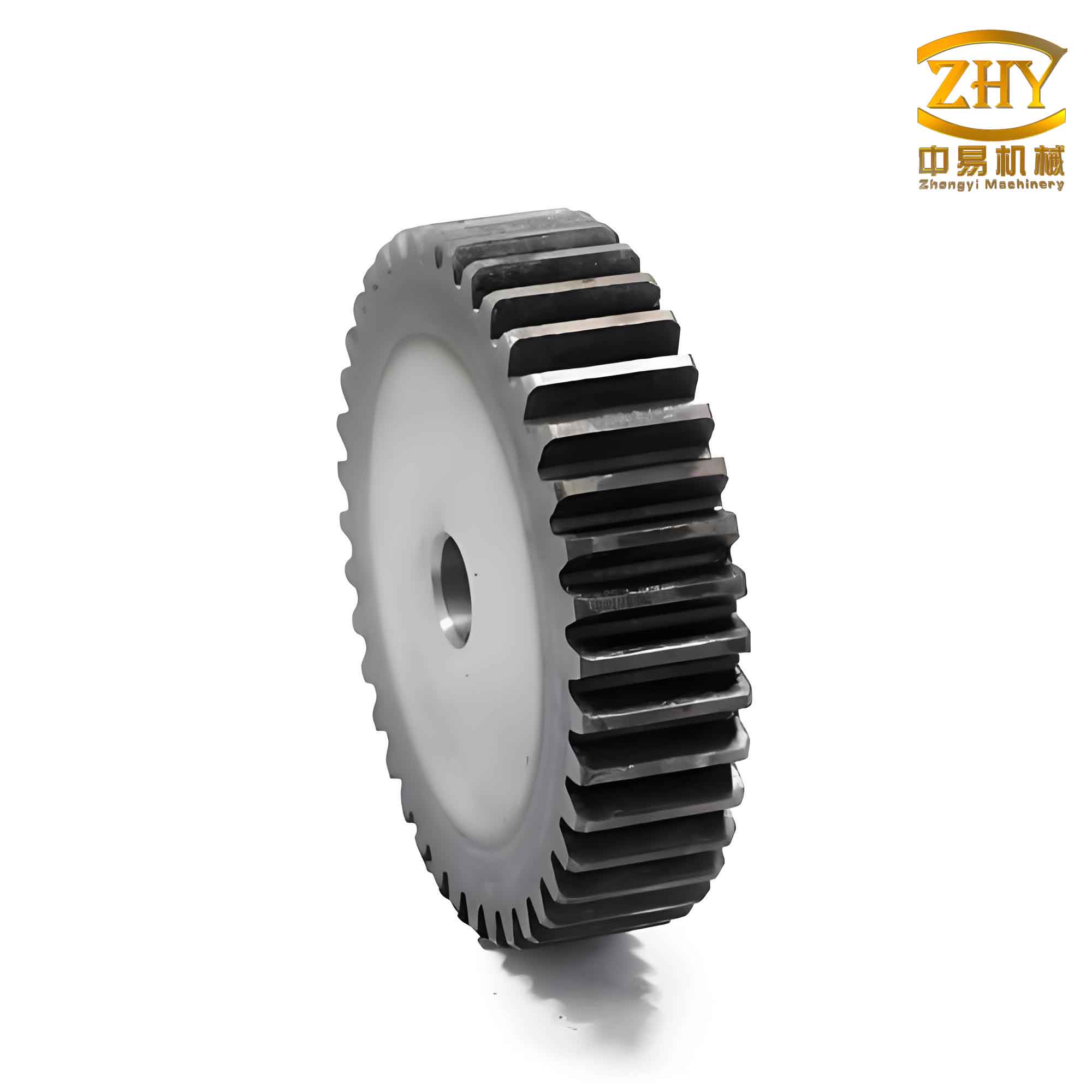
Gears are fundamental components in mechanical power transmission systems, found in applications ranging from industrial machinery to everyday consumer products. Among the various types, the spur and pinion gear is one of the most common due to its simple construction and efficiency in transmitting motion between parallel shafts. While modern methods like hobbing or shaping are prevalent for mass production, milling remains a vital process for prototyping, repair jobs, or small-batch manufacturing. This article explores the application of user-defined macro programming on CNC milling centers equipped with a rotary axis (or indexing head) to machine a spur and pinion gear. Macro programming offers unparalleled flexibility and efficiency compared to long, static CAM-generated code, especially when dealing with parametric changes or in-process adjustments.
1. Introduction to Macro Programming
Macro programming, or parametric programming, is an advanced feature of modern CNC systems that allows the use of variables, arithmetic and logical operations, and control flow statements (like loops and conditional branches) within a part program. It effectively turns the CNC into a programmable calculator, enabling the creation of highly adaptable and compact code. There are two primary applications:
- In-line Variable Use: Direct substitution of numeric values in the program with variables or expressions (e.g.,
G01 X#1). - Custom Cycle Calls: Defining a subroutine (macro) that can be called with arguments, mimicking a custom G-code cycle (e.g., a dedicated gear milling cycle).
For machining a spur and pinion gear, the first method is exceptionally powerful. It allows us to write a single, generic program where critical parameters like the number of teeth, module, and face width are defined as variables. Changing these variables instantly regenerates the toolpath for a different spur and pinion gear without requiring any CAM re-computation. This approach offers significant advantages in adaptability, error control, and program management.
2. Geometric Parameters of a Spur Gear
To program the machining process, one must understand the key dimensions of a standard spur and pinion gear. These are derived from the module (m) and the number of teeth (Z). The following formulas and table summarize these relationships:
$$ d = m \cdot Z $$
$$ d_a = m \cdot (Z + 2) $$
$$ d_f = m \cdot (Z – 2.5) $$
$$ p = \pi \cdot m $$
$$ h_a = m $$
$$ h_f = 1.25m $$
Where:
$d$ = Pitch Diameter
$d_a$ = Addendum (Outside) Diameter
$d_f$ = Dedendum (Root) Diameter
$p$ = Circular Pitch
$h_a$ = Addendum
$h_f$ = Dedendum
| Parameter | Symbol | Formula |
|---|---|---|
| Module | m | Given |
| Number of Teeth | Z | Given |
| Pitch Diameter | d | $m \times Z$ |
| Addendum Diameter | $d_a$ | $m \times (Z + 2)$ |
| Dedendum Diameter | $d_f$ | $m \times (Z – 2.5)$ |
| Tooth Depth | $h_t$ | $2.25 \times m$ |
3. Macro Programming Fundamentals
Before delving into the gear machining algorithm, let’s establish the macro variable conventions and control structures. Variables are typically denoted as #1, #2, #3,… or #100, #101,… etc. Common operations include assignment (#1=5), arithmetic (#2=#1*SIN[45]), and logical comparison. The primary control structure used for repetitive tasks like cutting multiple teeth is the WHILE loop:
#1 = 0 (Initialize Counter)
WHILE [#1 LT Z] DO1 (Loop while counter is less than number of teeth)
    ... (Machining operations for one tooth space)
    #1 = #1 + 1 (Increment counter)
END1
For our spur and pinion gear program, we will define key parameters as variables at the program’s start, making it a fully parametric template.
| Variable | Description | Example Value |
|---|---|---|
| #100 | Number of Teeth (Z) | 32 |
| #101 | Module (m) | 2.5 |
| #102 | Face Width (B) | 20.0 |
| #103 | Cutter Diameter (Dc) | 3.0 (for slotting) |
| #104 | Indexing Angle (θ) | 360 / #100 |
4. CNC Milling Process Analysis for a Spur Gear
The process involves using an end mill on a vertical machining center, with the gear blank mounted on a CNC rotary axis (4th axis, often the A-axis). The basic steps are:
- Workpiece Setup & Alignment: The gear blank must be precisely centered on the rotary axis. Runout must be minimized to ensure uniform tooth depth. The axis of the rotary table must be parallel to the machine’s X-axis for a straight spur and pinion gear.
- Tool Selection: A standard end mill with a diameter slightly smaller than the width of the tooth space at the dedendum (root) circle is used. For roughing, a smaller tool can be used, followed by a finishing pass with the correct size.
- Tool Path Strategy: The fundamental operation is to mill one tooth space (the groove between two teeth), then index the rotary axis by the precise angular pitch, and repeat. The tooth space profile is approximated by the end mill’s circular path. For higher accuracy, a toolpath that follows a more exact involute form can be generated using macro calculations, but for many applications, the circular approximation is sufficient.
- Depth of Cut: The full tooth depth ($h_t = 2.25m$) is achieved in multiple passes (e.g., roughing and finishing) to manage cutting forces and ensure accuracy.
5. Core Macro Program Algorithm
The core logic for machining a single tooth space involves coordinated linear movement in Y (or Z, depending on setup) and circular interpolation in the X-Y plane to form the walls of the tooth space. The rotary axis (A) is indexed after each space is completed. The following pseudo-code outlines the algorithm, with key formulas.
Calculations:
Pitch Circle Radius: $ R_p = \frac{(#101 * #100)}{2} $
Tooth Depth: $ H_t = 2.25 * #101 $
Approximate Cutter Path Radius (for circular interpolation): $ R_{cut} = \sqrt{R_p^2 – (R_p \cdot \sin(90/#100))^2} – (#103/2) $
This approximates the location where the cutter should be tangent to the pitch circle.
The macro program structure is as follows:
O8000 (MAIN SPUR GEAR MACRO)
#100=32 (Z - NUMBER OF TEETH)
#101=2.5 (m - MODULE)
#102=20.0 (B - FACE WIDTH)
#103=3.0 (Dc - CUTTER DIA)
#104=360/#100 (θ - INDEX ANGLE)

(Calculate Depths and Radii)
#110=#101*#100/2 (Rp - Pitch Radius)
#111=2.25*#101 (Ht - Full Tooth Depth)
#112=SQRT[#110*#110 - [#110*SIN[90/#100]]*[#110*SIN[90/#100]]] - #103/2 (R_cut)

(Setup)
G54 G90 G40 G49 G80
G0 G90 A0.
M3 S6000
G43 H01 Z10.

(Initial Position)
X#112 Y0. (Position cutter at start point of arc)
Z2.

(#1 = Loop Counter / Current Tooth Index)
#1=0

WHILE [#1 LT #100] DO1
    G1 Z-#111 F100. (Plunge to full depth)
    G3 X-#112 Y0. R#112 F500. (Machine one side of tooth space - 180 deg arc)
    G1 Y-#102 F600. (Machine along face width)
    G3 X#112 Y-#102 R#112 (Machine bottom of space)
    G1 Y0. (Return to front)
    G3 X-#112 Y0. R#112 (Machine other side of space)
    G1 Z2. F1000. (Retract)

    (Index to next tooth space)
    #1=#1+1
    G0 A[#1*#104]
END1

G0 Z100.
M5
M30
%
This program demonstrates the parametric power of macro programming for a spur and pinion gear. Changing #100 and #101 will instantly generate the correct toolpath for a different gear.
6. Advanced Technique: Involute Approximation and Indexing Macro
For more accurate tooth forms, the cutter path can be derived from the involute equation. The involute of a circle is given by:
$$ x = R_b (\cos(\theta) + \theta \sin(\theta)) $$
$$ y = R_b (\sin(\theta) – \theta \cos(\theta)) $$
Where $R_b$ is the base circle radius ($R_b = R_p \cdot \cos(\phi)$, with $\phi$ being the pressure angle, typically 20°) and $\theta$ is the involute roll angle. A macro can be written to calculate discrete points along this curve to guide the cutter, creating a more precise spur and pinion gear profile than the simple circular arc method.
Furthermore, a dedicated indexing macro can be created as a subprogram. This is useful for ensuring precise angular positioning, especially when dealing with a large number of teeth where cumulative error from repeated G0 A[#1*#104] commands could become significant. The indexing macro would calculate the absolute angle based on a master reference.
| Subprogram | Purpose | Logic |
|---|---|---|
| O9001 | Indexing Macro | Calculates absolute angle from a fixed work zero, minimizing rounding error accumulation. Accepts tooth number as an argument (#20).#30 = #20 * 360.0 / #100;G90 G0 A#30;M99; |
7. Conclusion
The application of macro programming for milling a spur and pinion gear on a CNC machining center offers a powerful, flexible, and efficient alternative to traditional CAM programming. The key advantages are:
- Extreme Adaptability: A single program can machine any standard spur and pinion gear by simply changing a few parameter variables (#100 for teeth, #101 for module).
- Program Compactness: Replaces thousands of lines of linear code with a concise, logical loop structure.
- In-Process Control: Allows for easy integration of logic for roughing/finishing passes, depth adjustments based on actual stock size, and error checking.
- Foundation for Complexity: The principles used for a simple spur and pinion gear can be extended to more complex gears like helical gears or custom profiles using advanced mathematical models within the macro.
By mastering macro programming, machinists and programmers can significantly enhance their capability to handle custom, prototype, and small-batch gear manufacturing with precision and agility. The parametric nature of the code future-proofs the process, making it simple to adapt to new designs of spur and pinion gear components.