
In mechanical transmission systems, spur and pinion gears play a pivotal role in transmitting motion and power between prime movers and working machines. They enable uniform motion or motion that follows predetermined laws, and can alter the form of motion, such as converting rotation into linear displacement or vice versa. Gear transmission is the most widely used drive mechanism in machinery. To enhance surface wear resistance and hardness, spur and pinion gears typically undergo surface heat treatment, with carburizing and quenching being a common industrial practice. While this process improves mechanical properties, it also introduces risks of component failure. During the heating and cooling cycles of heat treatment, the combined action of thermal stress and transformation stress inevitably leads to gear deformation, crack initiation, and even fracture. Such distortions directly impact the precision and performance of spur and pinion gears. Therefore, a deep understanding of the thermal and mechanical behaviors during quenching is essential for optimizing heat treatment processes and ensuring gear reliability.
This study focuses on the finite element analysis of the temperature and stress fields during the quenching process of a spur and pinion gear. Using Ansys software, I simulate the transient thermal and structural responses, with particular attention to the influence of different initial quenching medium temperatures on the gear’s performance. The objective is to provide insights that aid in controlling distortion and residual stresses, thereby improving the manufacturing quality of spur and pinion gears.
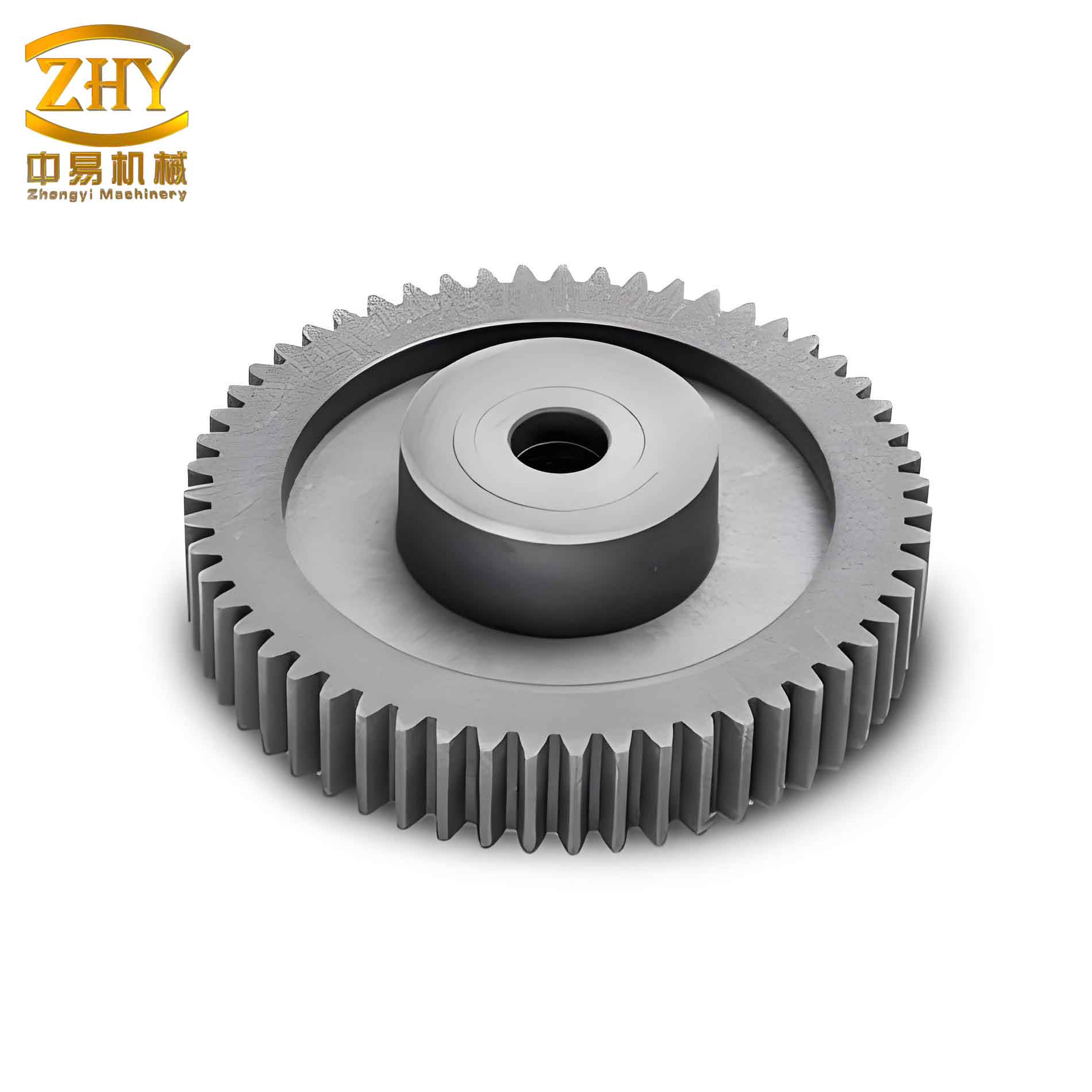
The quenching of spur and pinion gears involves complex coupled phenomena: transient heat transfer, phase transformations with latent heat release, and elastic-plastic deformation. Accurately modeling these interactions is crucial for predicting the final state of the gear. The core of the thermal analysis lies in solving the non-linear heat conduction equation that accounts for internal heat generation due to phase changes. For a three-dimensional Cartesian coordinate system, the governing differential equation based on Fourier’s law and energy conservation is expressed as:
$$ \lambda \left( \frac{\partial^2 T}{\partial x^2} + \frac{\partial^2 T}{\partial y^2} + \frac{\partial^2 T}{\partial z^2} \right) + q_v = \rho c_p \frac{\partial T}{\partial t} $$
where \( \lambda \) is the thermal conductivity (W/m·K), \( \rho \) is the density (kg/m³), \( c_p \) is the specific heat capacity at constant pressure (J/kg·K), \( T \) is the temperature (K), \( t \) is time (s), \( x, y, z \) are spatial coordinates, and \( q_v \) is the volumetric heat generation rate due to latent heat release during phase transformations (W/m³). The latent heat term introduces significant non-linearity, as the transformation kinetics depend on temperature and cooling rate. For the spur and pinion gear, this equation must be solved over its complex geometry with appropriate boundary conditions representing convective heat transfer with the quenching medium.
The finite element method (FEM) discretizes this continuous problem. The transient heat transfer equation in matrix form for the finite element model is:
$$ [C]\{\dot{T}\} + [K]\{T\} = \{Q\} $$
Here, \([K]\) is the conductivity matrix, incorporating thermal conductivity and surface heat transfer coefficients; \([C]\) is the specific heat capacity matrix; \(\{\dot{T}\}\) is the vector of nodal temperature time derivatives; and \(\{Q\}\) is the nodal heat flux vector, which includes contributions from boundary conditions and the internal heat source \(q_v\). For the quenching simulation of the spur and pinion gear, the boundary condition on the gear surfaces is convection, described by Newton’s law of cooling:
$$ q = h (T_s – T_{\infty}) $$
where \( q \) is the heat flux (W/m²), \( h \) is the convective heat transfer coefficient (W/m²·K), \( T_s \) is the surface temperature, and \( T_{\infty} \) is the bulk temperature of the quenching medium (water). The coefficient \( h \) is itself a function of surface temperature and medium flow conditions, adding another layer of complexity to the simulation of spur and pinion gear quenching.
Following the thermal analysis, the computed transient temperature history is applied as a thermal load in a subsequent structural analysis to determine stress and deformation. The total strain rate \( \dot{\epsilon} \) can be decomposed into elastic, plastic, and thermal components:
$$ \dot{\epsilon} = \dot{\epsilon}^{el} + \dot{\epsilon}^{pl} + \dot{\epsilon}^{th} $$
The thermal strain is given by \( \epsilon^{th} = \alpha (T – T_{ref}) \), where \( \alpha \) is the coefficient of thermal expansion. The stress evolution is governed by the constitutive relations and equilibrium equations. For the spur and pinion gear material, an elastic-plastic model with isotropic hardening is often employed. The von Mises yield criterion is used to determine the onset of plastic yielding:
$$ \sigma_{vm} = \sqrt{\frac{3}{2} \mathbf{s}:\mathbf{s}} $$
where \( \sigma_{vm} \) is the von Mises stress and \( \mathbf{s} \) is the deviatoric stress tensor. Yielding occurs when \( \sigma_{vm} \ge \sigma_y(T) \), where \( \sigma_y(T) \) is the temperature-dependent yield strength. The simulation of the spur and pinion gear must account for these material non-linearities across a wide temperature range.
To perform the simulation, I first established the geometric model of a standard spur and pinion gear. The primary gear modeled is a spur gear with the following key parameters, representative of common power transmission applications for spur and pinion gears:
| Gear Parameter | Symbol | Value | Unit |
|---|---|---|---|
| Module | m | 4 | mm |
| Number of Teeth | z | 24 | – |
| Pressure Angle | α | 20 | ° |
| Face Width | b | 40 | mm |
| Pitch Diameter | d | 96 | mm |
| Addendum Diameter | d_a | 104 | mm |
| Dedendum Diameter | d_f | 86 | mm |
The three-dimensional solid model was created using CAD software and imported into Ansys for meshing. A high-quality tetrahedral mesh was generated, with refinement in the tooth root and flank regions where high stress gradients are expected. The total number of elements exceeded 500,000 to ensure solution accuracy for this complex spur and pinion gear geometry.
The material selected for the spur and pinion gear is AISI 1045 medium carbon steel (equivalent to Chinese grade 45 steel), commonly used for its good balance of strength and toughness. Its thermophysical and mechanical properties are highly temperature-dependent, which is critical for an accurate quenching simulation. The following tables compile the essential data used in the model for the spur and pinion gear.
| Temperature (°C) | Density, ρ (kg/m³) | Specific Heat, c_p (J/kg·K) | Thermal Conductivity, λ (W/m·K) | Coefficient of Thermal Expansion, α (1/K × 10⁻⁶) |
|---|---|---|---|---|
| 20 | 7850 | 460 | 14.7 | 11.5 |
| 100 | 7830 | 480 | 16.6 | 12.2 |
| 200 | 7800 | 500 | 18.0 | 12.9 |
| 400 | 7750 | 560 | 20.8 | 13.8 |
| 600 | 7700 | 620 | 23.5 | 14.5 |
| 800 | 7650 | 680 | 26.3 | 15.1 |
| 1000 | 7600 | 750 | 28.2 | 15.5 |
| Temperature (°C) | Young’s Modulus, E (GPa) | Yield Strength, σ_y (MPa) | Tangent Modulus, E_t (GPa) | Poisson’s Ratio, ν |
|---|---|---|---|---|
| 20 | 193 | 200 | 19.3 | 0.28 |
| 500 | 150 | 93.3 | 15.0 | 0.30 |
| 1000 | 70 | 43.5 | 7.0 | 0.33 |
| 1500 | 10 | 7.0 | 1.0 | 0.35 |
The phase transformation behavior for the spur and pinion gear material was modeled using continuous cooling transformation (CCT) data. The latent heat release associated with the austenite decomposition into ferrite, pearlite, bainite, and martensite was incorporated using the enthalpy method, where the effective specific heat is modified to include the transformation enthalpy:
$$ c_{p,eff} = c_p + L \frac{df}{dT} $$
Here, \( L \) is the latent heat of transformation (J/kg) and \( f \) is the transformed fraction. For martensitic transformation, which is athermal and depends primarily on temperature below the martensite start (Ms) temperature, the Koistinen-Marburger equation was used:
$$ f_M = 1 – \exp[-\beta(M_s – T)] $$
where \( f_M \) is the martensite volume fraction, \( \beta \) is a material constant, and \( M_s \) is the martensite start temperature, taken as 350°C for the spur and pinion gear steel.
The quenching process simulated for the spur and pinion gear involves heating the gear to a uniform austenitizing temperature of 850°C, followed by rapid immersion in a water bath. The convective heat transfer coefficient \( h \) at the gear-water interface is a critical parameter. Based on typical quenching conditions for spur and pinion gears, a temperature-dependent \( h \) was employed, capturing the stages of film boiling, nucleate boiling, and convective cooling. The following relation approximates the behavior:
$$ h(T_s) = \begin{cases}
h_{film} & T_s > T_{Leid} \\
h_{nuc} \left( \frac{T_{Leid} – T_s}{T_{Leid} – T_{sat}} \right)^n + h_{conv} & T_{sat} < T_s \le T_{Leid} \\
h_{conv} & T_s \le T_{sat}
\end{cases} $$
where \( T_{Leid} \) is the Leidenfrost temperature (~300°C), \( T_{sat} \) is the saturation temperature of water (100°C at 1 atm), \( h_{film} \), \( h_{nuc} \), and \( h_{conv} \) are coefficients for the respective regimes, and \( n \) is an exponent. Typical values used for water quenching of a spur and pinion gear are \( h_{film} = 500 \, \text{W/m}²\text{K} \), \( h_{nuc} = 10000 \, \text{W/m}²\text{K} \), \( h_{conv} = 2000 \, \text{W/m}²\text{K} \), and \( n = 2 \). The bulk water temperature \( T_{\infty} \) was varied as a key study parameter: 20°C, 25°C, 30°C, and 35°C. The total simulated quenching time was 1800 seconds (30 minutes), though the most critical phase for property development is within the first few seconds to minutes.
The Ansys Transient Thermal module was used to solve the heat conduction problem. The simulation results for the temperature field of the spur and pinion gear at different initial water temperatures provide profound insights. The cooling curves at strategic locations—tooth tip (addendum), tooth root (dedendum), and tooth core (center of the gear body)—were extracted. The temperature distribution within the spur and pinion gear is highly non-uniform due to geometric factors and the rapid heat extraction from the surfaces.
At the very initial stage (e.g., 10 seconds), a steep temperature gradient establishes from the surface to the core. The tooth tip, having the largest surface-to-volume ratio, cools the fastest. The tooth root, though also on the surface, is slightly shielded geometrically, leading to a marginally slower cooling rate compared to the tip. The core, being farthest from any quenching surface, remains at an elevated temperature for a much longer duration. This creates significant thermal stresses. The following table summarizes the temperature differences (\(\Delta T = T_{core} – T_{tip}\)) at key time intervals for different initial water temperatures, highlighting the thermal shock experienced by the spur and pinion gear.
| Initial Water Temp., T∞ (°C) | ΔT at t=10s (°C) | ΔT at t=100s (°C) | ΔT at t=1000s (°C) | Maximum ΔT during process (°C) |
|---|---|---|---|---|
| 20 | ~810 | ~730 | ~410 | 815 |
| 25 | ~805 | ~725 | ~415 | 810 |
| 30 | ~800 | ~720 | ~420 | 805 |
| 35 | ~795 | ~715 | ~425 | 800 |
As evident, a lower initial water temperature induces a slightly larger temperature gradient, especially in the critical first few seconds. This is because the driving force for heat transfer, \( (T_s – T_{\infty}) \), is greater. The cooling front progressively penetrates from the tooth surfaces inward. By 1000 seconds, the entire spur and pinion gear approaches the water temperature, but the core remains the warmest region. The evolution of the temperature field can be visualized through isothermal contours. For instance, at t=100s with T∞=20°C, the 400°C isotherm (near the Ms temperature) might be located several millimeters below the tooth surface, indicating the depth of the martensitic layer. The martensite fraction distribution is directly derived from the temperature history using the transformation kinetics model. The hardness profile of the quenched spur and pinion gear can then be estimated based on the mixture of microconstituents.
The transient temperature results were then imported as a thermal load into the Ansys Static Structural module for stress analysis. The thermal strains, calculated from the temperature field and the coefficient of thermal expansion, act as the primary driver for stress generation. As the surface layers of the spur and pinion gear contract rapidly upon cooling, they are restrained by the hotter, expanding core. This induces tensile stresses on the surface and compressive stresses in the core during the early stages. Later, as the core cools and contracts, the stress state may reverse, leaving residual compressive stresses on the surface and tensile stresses in the core—a desirable outcome for fatigue resistance if controlled properly.
The simulated stress fields reveal complex patterns. The highest stress concentrations consistently appear at the tooth root fillets of the spur and pinion gear, which are natural stress risers due to geometric discontinuity. The von Mises stress distribution at the end of the quenching process (t=1800s) shows this clearly. For the case with T∞=20°C, the maximum residual von Mises stress is approximately 114 MPa at the tooth root, while the tooth tip exhibits minimal stress (~0.5 MPa). The stress on the tooth flanks is intermediate, forming a band of elevated stress that decays from the root towards the tip. The following table compares the maximum von Mises stress at the tooth root for the different quenching conditions at t=1800s, along with the predicted radial displacement (distortion) of the tooth tip.
| Initial Water Temp., T∞ (°C) | Max. Residual von Mises Stress at Root (MPa) | Tooth Tip Radial Displacement* (mm) | Nature of Residual Stress at Surface (Tooth Flank) |
|---|---|---|---|
| 20 | 114 | -0.052 | Compressive |
| 25 | 110 | -0.048 | Compressive |
| 30 | 106 | -0.045 | Compressive |
| 35 | 102 | -0.041 | Compressive |
*Negative displacement indicates contraction inward towards the gear center.
The results indicate that a lower initial water temperature leads to higher residual stresses and slightly greater contraction of the teeth on the spur and pinion gear. This is consistent with the more severe thermal gradients. The residual stresses are predominantly compressive on the surface, which is beneficial for resisting contact fatigue and bending fatigue in service. However, excessive compressive stress can also be detrimental if it promotes subsurface crack initiation. The stress evolution during the process is dynamic. The maximum principal stress, which is critical for crack opening, was also monitored. In the initial cooling phase, tensile principal stresses can appear on the surface of the spur and pinion gear, posing a risk for quench cracking. The magnitude and duration of these tensile stresses are reduced when using a warmer quenching medium.
The distortion of the spur and pinion gear is another critical output. The non-uniform cooling causes not only radial shrinkage but also potential changes in tooth profile, helix angle (for helical gears, but here for spur), and out-of-plane bending. The simulated radial displacement field shows that the teeth tend to bend slightly towards the gear center. The cumulative distortion across the entire gear body can lead to runout errors. The distortion is a consequence of the integrated plastic strain accumulated during the process. The equivalent plastic strain distribution shows that yielding occurs primarily in the surface and subsurface layers of the spur and pinion gear teeth during the period of maximum thermal stress.
To generalize the findings, the effect of initial water temperature \( T_{\infty} \) on the key response variables can be correlated through simple empirical relations derived from the simulation data for this specific spur and pinion gear geometry and material. For example, the maximum temperature gradient \( (\Delta T_{max}) \) shows an approximately linear decrease with increasing \( T_{\infty} \):
$$ \Delta T_{max} \approx 820 – 0.5 \times (T_{\infty} – 20) \, \text{°C} $$
Similarly, the maximum residual von Mises stress \( \sigma_{max}^{res} \) at the root follows:
$$ \sigma_{max}^{res} \approx 114 – 0.4 \times (T_{\infty} – 20) \, \text{MPa} $$
These trends underscore the sensitivity of the quenching outcome for spur and pinion gears to the initial medium temperature, even within the typical recommended range of 20-35°C.
The finite element simulation also allows for a detailed investigation of the cooling rate, a parameter directly linked to the resulting microstructure. The cooling rate at 700°C (a common reference for pearlite transformation) and at 300°C (near martensite formation) was calculated for points at various depths below the tooth surface of the spur and pinion gear. This data can be used to construct simulated CCT diagrams for specific locations, predicting the microstructure gradient. For instance, at a depth of 2 mm below the tooth flank with T∞=20°C, the cooling rate through 700°C might be 45°C/s, sufficient to avoid the pearlite nose and form bainite or martensite, while at a depth of 10 mm (core), the rate might be only 5°C/s, leading to predominantly ferrite-pearlite structures. This microstructural prediction is vital for assessing the case depth and core toughness of the spur and pinion gear.
In addition to the initial water temperature, other process parameters for quenching spur and pinion gears can be explored via simulation. These include the austenitizing temperature, the type of quenching medium (oil, polymer, gas), the agitation rate (affecting ‘h’), and the preheating of the gear. Each factor alters the heat extraction dynamics and consequently the stress and distortion outcomes. For example, oil quenching with a lower severity would produce smaller thermal gradients, reducing stresses but also potentially resulting in a shallower hardened case on the spur and pinion gear. The FEM approach provides a virtual testing ground for optimizing these parameters without costly and time-consuming physical trials.
The validation of the simulation model is an important aspect. While direct experimental validation for the specific spur and pinion gear in this study is beyond the scope of this text, the modeling methodology aligns with established practices in the literature. Comparisons of predicted cooling curves with thermocouple data from instrumented gears, hardness profile matching, and distortion measurements are standard validation steps. The model’s accuracy hinges on the fidelity of the material properties, boundary conditions, and phase transformation models. For spur and pinion gears made of different steel grades (e.g., alloy steels for case hardening), the material database must be updated accordingly.
The implications of this simulation study for the design and manufacturing of spur and pinion gears are significant. By predicting distortion patterns, machining allowances can be adjusted in the preceding rough machining stages to ensure the final ground dimensions fall within tolerance after heat treatment. The identification of high-stress regions, like the tooth root, informs the design process; perhaps a larger root fillet radius could be employed to mitigate stress concentration in the spur and pinion gear. Furthermore, the simulation can guide the development of tailored quenching strategies, such as interrupted quenching or differential cooling, to achieve desired residual stress profiles that enhance the gear’s load-bearing capacity and service life.
In conclusion, the finite element simulation of the quenching process for a spur and pinion gear provides a comprehensive understanding of the interrelated thermal, metallurgical, and mechanical phenomena. The model confirms that during quenching, the tooth core remains the hottest region while the tooth tip cools fastest, creating substantial thermal gradients. These gradients are the primary source of thermal stress, which culminates in residual stress concentrated at the tooth root fillets of the spur and pinion gear. The initial temperature of the water quenching medium exerts a measurable influence: lower temperatures increase the thermal gradient, resulting in higher residual stresses and slightly greater distortion. While this may enhance surface hardening depth, it also elevates the risk of cracking and distortion. Therefore, for the spur and pinion gear made of AISI 1045 steel, an initial water temperature towards the higher end of the typical range (e.g., 30-35°C) might offer a better compromise between achieving sufficient hardness and controlling residual stresses and distortion, depending on the specific application requirements. The methodologies and insights presented here form a valuable foundation for optimizing heat treatment processes for spur and pinion gears, ultimately contributing to the production of more reliable and efficient power transmission components.
Future work could involve coupling the thermal-stress analysis with a more detailed microstructural evolution model, including carbide precipitation and grain growth. Additionally, simulating the entire process sequence for a spur and pinion gear—forging, machining, carburizing, quenching, and tempering—would provide a holistic view of the accumulated residual stress state and distortion. The integration of this simulation data with gear contact analysis under load would further bridge the gap between manufacturing quality and in-service performance of spur and pinion gears.