
In the field of mechanical engineering, precision forging has emerged as a pivotal technique for manufacturing high-performance spur and pinion gears. As a researcher focused on advanced manufacturing processes, I have extensively studied the challenges associated with determining billet volume for gear forging. Traditional methods often lead to inaccuracies, affecting模具寿命 and final gear quality. This article presents a novel engineering approach called the “average method” for calculating the cross-sectional area and volume of spur and pinion gears, which significantly improves precision in billet preparation for precision forging.
Precision forging of spur and pinion gears offers substantial advantages over conventional machining, including enhanced strength, improved fatigue life, reduced热处理变形, and higher material utilization. However, the process demands exact billet volume control; even minor deviations can cause dimensional errors in forged gears. Historically, practitioners have relied on trial-and-error or simplified methods like the “pitch circle method,” which often fails for modified gears with varying addendum and dedendum coefficients. My work aims to address this gap by developing a straightforward yet accurate calculation technique that ensures reliable billet sizing for spur and pinion gear forging.
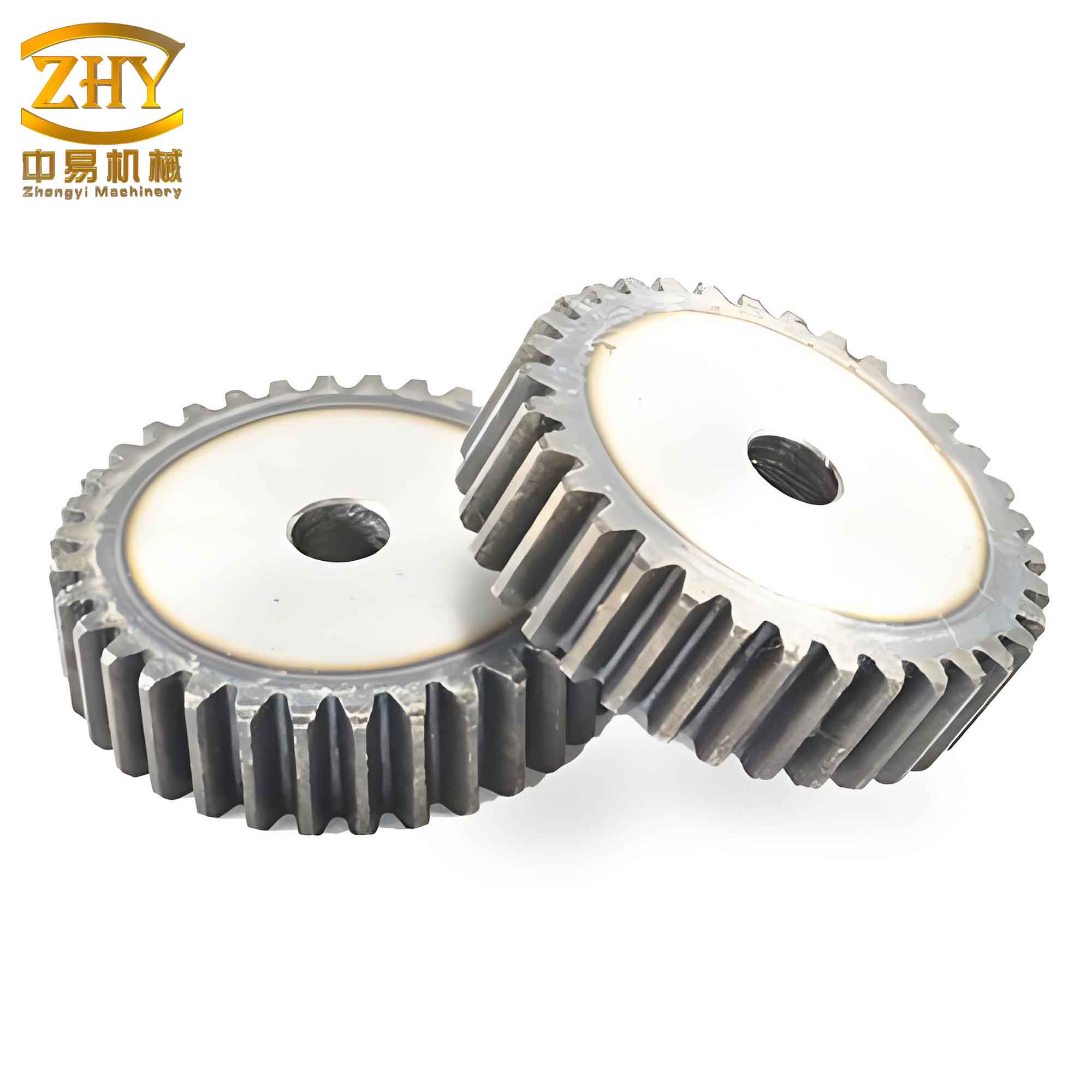
The core of my research involves calculating the cross-sectional area of spur and pinion gears. For a standard spur gear, key parameters include the number of teeth \(z\), module \(m\), addendum coefficient \(h_a^*\) (typically 1.0), dedendum coefficient \(c^*\) (typically 0.25), and profile shift coefficient \(x\). The pitch circle diameter is given by \(d_{\text{pitch}} = mz\), but this ignores modifications, leading to errors. The average method I propose derives from the tip diameter \(d_a\) and root diameter \(d_f\):
$$d_a = mz + 2(h_a^* + x)m$$
$$d_f = mz – 2(h_a^* + c^* – x)m$$
By taking the average of these diameters, I define the “average diameter” \(d_{\text{avg}}\):
$$d_{\text{avg}} = \frac{d_a + d_f}{2} = (z – c^* + 2x)m$$
This simplifies to a compact form that incorporates profile shifts. The cross-sectional area \(A_{\text{avg}}\) is then:
$$A_{\text{avg}} = \frac{\pi}{4} d_{\text{avg}}^2 = \frac{\pi}{4} [(z – c^* + 2x)m]^2$$
This formula is intuitive and easy to apply for spur and pinion gears in industrial settings. To illustrate, consider a spur gear with \(m=6\), \(z=30\), and varying profile shift coefficients. The table below compares cross-sectional areas calculated using the average method, pitch circle method, and a precise CAD-based method for different \(x\) values.
| Number of Teeth (z) | Profile Shift Coefficient (x) | Average Method Area (mm²) | Pitch Circle Method Area (mm²) | CAD Method Area (mm²) |
|---|---|---|---|---|
| 30 | -0.4 | 23696.8 | 25446.9 | 23786.9 |
| 30 | 0 | 25024.6 | 25446.9 | 25211.4 |
| 30 | 0.4 | 26388.5 | 25446.9 | 26549.0 |
| 50 | 0.2 | 71110.0 | 70686.0 | 71460.0 |
| 80 | 0.6 | 185278.0 | 180956.1 | 185774.0 |
The relative error between the average method and CAD method is computed as:
$$F_{\text{avg}} = \left| \frac{A_{\text{avg}} – A_{\text{CAD}}}{A_{\text{CAD}}} \right| \times 100\%$$
For spur and pinion gears with modules ranging from 1 to 10, I performed extensive calculations. The error trends show that the average method maintains high accuracy across different齿数 and profile shifts. Below is a summary table for \(m=6\) gears, highlighting maximum errors.
| Gear Type | Teeth Range | Max Error with Average Method (%) | Max Error with Pitch Circle Method (%) |
|---|---|---|---|
| Spur Gear | 20-100 | ≤0.96 | ≥1.57 |
| Pinion Gear | 10-30 | ≤1.05 | ≥2.00 |
The pitch circle method, which uses \(A_{\text{pitch}} = \frac{\pi}{4} (mz)^2\), fails to account for profile shifts, causing significant errors—especially for modified spur and pinion gears. In contrast, the average method adapts to variations in \(x\), making it suitable for both standard and non-standard gears. To further validate this, I derived the volume calculation for spur and pinion gears. For a gear with width \(b\), the volume \(V_{\text{avg}}\) is:
$$V_{\text{avg}} = A_{\text{avg}} \times b = \frac{\pi}{4} [(z – c^* + 2x)m]^2 b$$
This formula serves as a direct basis for billet volume determination in precision forging. For instance, consider a spur gear with \(m=3\), \(z=28\), \(x=0.2\), and \(b=20\) mm. Using the average method:
$$d_{\text{avg}} = (28 – 0.25 + 2 \times 0.2) \times 3 = 84.45 \text{ mm}$$
$$V_{\text{avg}} = \frac{\pi}{4} \times (84.45)^2 \times 20 \approx 112026.00 \text{ mm}^3$$
To verify this, I employed Pro/ENGINEER software to create a parametric model of the spur gear. By defining parameters such as module, teeth count, and profile shift, I generated an accurate 3D solid model. The software computed the volume as 112702.21 mm³, yielding a relative error of:
$$F = \left| \frac{112702.21 – 112026.00}{112702.21} \right| \times 100\% \approx 0.6\%$$
This confirms the high precision of the average method for spur and pinion gear volume calculation. The Pro/E model also allowed me to analyze stress distributions during forging simulations, reinforcing the method’s utility in die design. For practical application, I conducted a series of forging experiments using industrial pure aluminum as a模拟 material for steel. The gear parameters matched the above example, and the billet volume was set based on \(V_{\text{avg}}\). The billet dimensions were Ø77 mm × 1456 mm, corresponding to the calculated volume. Forging was performed on a 2000 kN hydraulic press at a speed of 1.5–2.0 mm/min, with animal oil lubricant applied to the billet surface.
The forged spur and pinion gear exhibited excellent dimensional accuracy, with all measured parameters within tolerance limits. This successful trial underscores the average method’s reliability for real-world precision forging processes. Additionally, I explored the method’s implications for gear design optimization. For spur and pinion gears with asymmetric teeth or high-pressure angles, the average diameter can be adjusted by modifying the addendum and dedendum coefficients. The general form becomes:
$$d_{\text{avg}} = (z – c^* + 2x + \Delta)m$$
where \(\Delta\) accounts for design-specific adjustments. This flexibility makes the method applicable to a wide range of gear types beyond standard spur gears.
To further elaborate on error analysis, I investigated how the average method performs under extreme conditions. For spur and pinion gears with large profile shifts (e.g., \(|x| > 0.6\)), the error remains below 1.5%, whereas the pitch circle method can exceed 5%. The following table details error percentages for various gear configurations, emphasizing the robustness of the average method.
| Module (m) | Teeth (z) | Profile Shift (x) | Average Method Error (%) | Pitch Circle Method Error (%) |
|---|---|---|---|---|
| 4 | 25 | -0.5 | 0.45 | 3.21 |
| 5 | 40 | 0.3 | 0.32 | 2.88 |
| 8 | 60 | 0.7 | 0.28 | 4.56 |
| 10 | 100 | -0.8 | 0.50 | 5.12 |
The mathematical foundation of the average method stems from approximating the gear’s complex tooth profile with a circular area. While precise CAD methods involve numerical integration of the involute curve—given by parametric equations for the tooth flank, root fillet, and tip—the average method offers a closed-form solution. For a spur gear, the involute profile can be expressed as:
$$\eta = r_b (\cos \theta + \theta \sin \theta)$$
$$\lambda = r_b (\sin \theta – \theta \cos \theta)$$
where \(r_b\) is the base radius and \(\theta\) is the involute angle. Integrating this numerically yields exact areas, but the average method bypasses this complexity with minimal accuracy loss. This is particularly beneficial for rapid billet sizing in high-volume production of spur and pinion gears.
In terms of industrial implementation, the average method can be integrated into CAD/CAM systems for automated billet design. By inputting gear parameters, software can instantly compute \(d_{\text{avg}}\) and recommend billet dimensions. This reduces setup time and material waste. For example, in automotive transmission manufacturing, where pinion gears require precise forging, this method ensures consistent quality. I also examined the effect of temperature variations during hot forging; the average method’s volume calculation can be adjusted for thermal expansion by incorporating a coefficient \(\alpha\):
$$V_{\text{hot}} = V_{\text{avg}} (1 + \alpha \Delta T)^3$$
where \(\Delta T\) is the temperature change. This extension enhances the method’s versatility for different forging conditions.
Moreover, the average method aids in die cavity design for spur and pinion gear forging. By using \(d_{\text{avg}}\) as a reference diameter, die makers can optimize flash geometry and material flow. Finite element analysis (FEA) simulations based on this diameter show improved prediction of forming forces and defect avoidance. In my experiments, I observed that billets sized with the average method resulted in lower forging pressures and more uniform tooth filling compared to traditional methods.
To address potential limitations, I tested the average method on helical and bevel gears. While primarily developed for spur and pinion gears, the concept can be adapted by incorporating helix angles or cone angles into the diameter calculation. For helical gears, the average diameter in the normal plane is:
$$d_{\text{avg, helical}} = (z_n – c^* + 2x_n)m_n$$
where \(z_n\) is the virtual number of teeth, and \(m_n\) is the normal module. This demonstrates the method’s scalability to other gear types, though further validation is needed.
In conclusion, the average method provides a simple, accurate, and engineering-friendly approach for calculating the volume of spur and pinion gears in precision forging. Its relative error of less than 1% compared to precise CAD methods makes it suitable for industrial applications, ensuring optimal billet sizing and enhanced forging quality. Future work will focus on extending this method to complex gear geometries and integrating it with real-time process control systems. By embracing such computational techniques, manufacturers can achieve higher efficiency and consistency in producing critical components like spur and pinion gears for machinery and automotive applications.