
As an engineer specializing in mechanical transmissions, I have always been fascinated by the intricate dynamics of gear systems, particularly the ubiquitous spur and pinion gear arrangements. These components are the workhorses of countless industrial applications, from automotive transmissions to wind turbine gearboxes. Their efficiency directly impacts energy consumption, operational costs, and system reliability. In this comprehensive analysis, I will delve into the critical factors affecting the meshing efficiency of involute spur and pinion gears. The primary focus will be on establishing mathematical models for instantaneous and average efficiency, examining the influence of design parameters such as transmission ratio, pressure angle, and friction coefficient, and providing insights for optimal spur and pinion gear design. The spur and pinion gear pair, with its parallel axes and straightforward tooth engagement, serves as an ideal foundation for understanding fundamental power loss mechanisms in gear transmissions.
The pursuit of higher efficiency in spur and pinion gear drives is not merely an academic exercise; it is a pressing industrial necessity. In an era demanding greater fuel economy and reduced carbon footprints, every fractional percentage gain in gear transmission efficiency translates to significant energy savings and lower thermal loads, thereby enhancing durability. The overall efficiency of a spur and pinion gear system is a composite of several loss components: friction losses at the meshing tooth interfaces, bearing friction losses, churning and windage losses from lubricant agitation, and losses in auxiliary components. Among these, the power loss due to sliding and rolling friction between the engaging teeth of the spur and pinion gear is often the most substantial and complex to model accurately. This analysis will concentrate on this core aspect—the meshing efficiency—which is defined as the ratio of output power to input power across the contacting tooth flanks of a spur gear and its mating pinion.
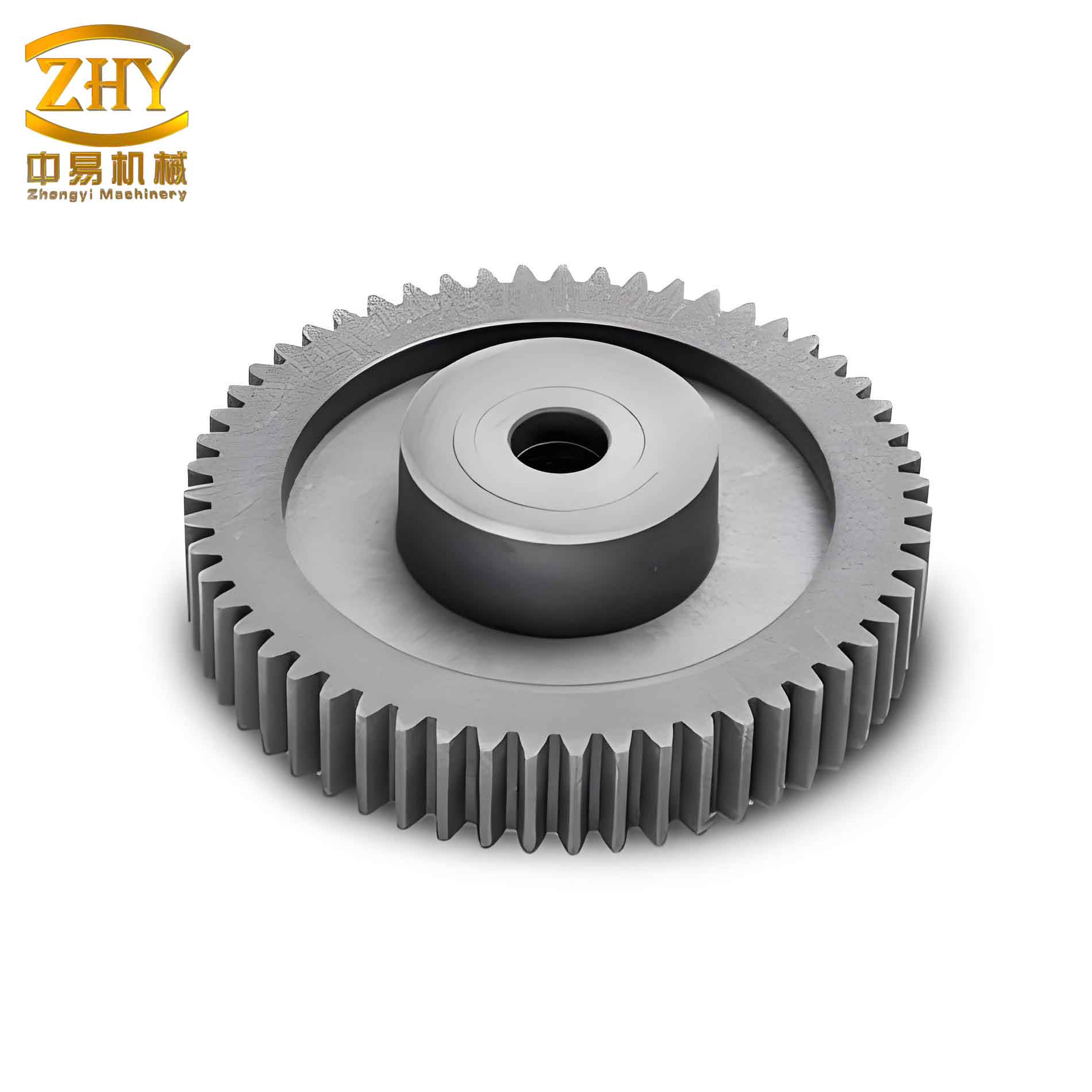
To build a predictive model for the efficiency of a spur and pinion gear set, one must first confront the challenge of characterizing the friction between the tooth surfaces. The friction coefficient is not a constant; it is a transient variable influenced by a confluence of factors inherent to the spur and pinion gear meshing process. These include the instantaneous radii of curvature at the contact point, the relative sliding and rolling velocities, the applied load, surface roughness, and most critically, the lubrication regime. The lubrication state in a spur and pinion gear contact can range from boundary lubrication (with significant asperity contact) to full elastohydrodynamic lubrication (EHL), governed by the film thickness ratio. Consequently, several empirical and semi-empirical models for friction coefficient exist, each with its domain of applicability. For the purpose of developing a general efficiency model applicable to a wide range of spur and pinion gear designs, it is pragmatic to consider an average, constant friction coefficient. This simplification is common in preliminary design stages. However, it is instructive to review the landscape of friction models to appreciate the underlying complexity.
| Model Name | Key Formula / Description | Typical Application Range | Remarks for Spur and Pinion Gear |
|---|---|---|---|
| Coulomb Friction | $$f = \text{constant}$$ | Simplified efficiency calculations | Assumes constant friction, independent of sliding speed or load; often used as a first approximation for spur and pinion gear efficiency studies. |
| Benedict-Kelley | $$f = 0.127 \log\left( \frac{0.02966 F_n}{b \rho v_{Hm} v_{Tm}} \right)$$ | Mixed lubrication (film thickness ratio ~1-4) | Accounts for load (F_n), face width (b), lubricant viscosity (ρ), and mean sliding (v_Hm) and rolling (v_Tm) velocities. Relevant for many operational spur and pinion gear sets. |
| Xu-Kahraman | Empirical relation based on extensive test data | Full EHL regime (film thickness ratio >4) | More suitable for high-speed, well-lubricated spur and pinion gear applications. |
| Composite Model | Switches between models based on film thickness ratio (Λ) | All regimes | Λ<1: Smooth Coulomb; 1≤Λ≤4: Benedict-Kelley; Λ>4: Xu-Kahraman. Provides a comprehensive approach for spur and pinion gear analysis. |
In the expressions above, typical parameters for a spur and pinion gear include: \(F_n\) as the normal load, \(b\) as the face width, \(\rho\) as the dynamic viscosity, \(v_{Hm}\) as the mean sliding velocity, and \(v_{Tm}\) as the mean rolling velocity. For a spur and pinion gear pair with pinion tooth count \(z_1\), gear tooth count \(z_2\), module \(m\), and pinion speed \(n_1\), these velocities can be approximated. However, for the derivation of meshing efficiency, adopting a constant average friction coefficient \(f\) within a practical range (e.g., 0.03 to 0.09) is a standard and effective simplification that allows for closed-form analytical solutions. The friction angle \(\phi\) is then defined as \(\phi = \arctan(f)\). This parameter is central to the force analysis at the tooth contact of a spur and pinion gear.
The instantaneous meshing efficiency of a spur and pinion gear pair can be derived by analyzing the forces and velocities at the point of contact. Consider an involute spur gear and pinion in mesh, as illustrated in the force diagram. Let \(P\) be the pitch point, \(N_1N_2\) the line of action, and \(S_1S_2\) the actual segment of the line of action where contact occurs. At any point \(D_1\) on the line of action, the contact force between the pinion (gear 1) and the spur gear (gear 2) is the reaction force \(\vec{R}_{21}\) (on gear 2 from gear 1) or \(\vec{R}_{12}\) (on gear 1 from gear 2), with \(\vec{R}_{21} = -\vec{R}_{12}\). This force is inclined relative to the common normal (the line of action) by the friction angle \(\phi\). The direction of this inclination depends on whether the contact point is before or after the pitch point \(P\), as the relative sliding velocity changes direction. Let \(\alpha_1\) and \(\alpha_2\) be the angles between the velocity vectors of the pinion and spur gear at the contact point and the line of action, respectively.
Assuming the pinion is the driving member (input), the input power \(P_{in}\) and output power \(P_{out}\) at the instant of contact at point \(D_1\) are:
$$P_{in} = R_{12} v_1 \cos(\alpha_1 – \phi)$$
$$P_{out} = R_{21} v_2 \cos(\alpha_2 – \phi)$$
Since \(R_{12} = R_{21}\) and from the fundamental law of gearing, the velocity components along the common normal must be equal (\(v_1 \cos\alpha_1 = v_2 \cos\alpha_2\)), the instantaneous efficiency \(\eta_{inst}\) for a spur and pinion gear pair is derived as:
$$\eta_{inst} = \frac{P_{out}}{P_{in}} = \frac{1 \pm \tan\phi \tan\alpha_2}{1 \pm \tan\phi \tan\alpha_1}$$
The sign in the numerator and denominator depends on the location of the contact point relative to the pitch point. For a point on the approach path (between \(S_1\) and \(P\), where the pinion drives the spur gear), the correct form is:
$$\eta_1 = \frac{1 + \tan\phi \tan\alpha_2}{1 + \tan\phi \tan\alpha_1}$$
For a point on the recess path (between \(P\) and \(S_2\)), the form is:
$$\eta_2 = \frac{1 – \tan\phi \tan\alpha_2}{1 – \tan\phi \tan\alpha_1}$$
This elegant formulation clearly shows that the instantaneous efficiency of a spur and pinion gear mesh is a function of the friction angle \(\phi\) and the pressure angles at the specific contact point on the pinion and spur gear teeth. At the pitch point \(P\), \(\alpha_1 = \alpha_2 = \alpha\) (the standard pressure angle), and thus \(\eta_{inst} = 1\), indicating theoretically no sliding friction loss at that exact instant—only rolling. However, at all other points along the line of action, sliding occurs, and efficiency deviates from unity. To make this model practical for a standard spur and pinion gear, we need to express \(\alpha_1\) and \(\alpha_2\) in terms of basic gear parameters and the position along the line of action.
Let us define the basic parameters for our spur and pinion gear analysis: pinion tooth number \(z_1\), spur gear tooth number \(z_2\), module \(m\), standard pressure angle \(\alpha\), addendum coefficient \(h_a^* = 1\), and dedendum coefficient \(c^* = 0.25\). The pitch radii are \(r_1 = m z_1 / 2\) and \(r_2 = m z_2 / 2\). The base circle radii are \(r_{b1} = r_1 \cos\alpha\) and \(r_{b2} = r_2 \cos\alpha\). The addendum circle radii are \(r_{a1} = r_1 + m\) and \(r_{a2} = r_2 + m\). The operating pressure angle \(\alpha’\) is equal to \(\alpha\) for standard center distance. The angles \(\alpha_{a1}\) and \(\alpha_{a2}\) are the pressure angles at the addendum circles of the pinion and spur gear, respectively, calculated as:
$$\alpha_{a1} = \arccos\left( \frac{r_{b1}}{r_{a1}} \right) = \arccos\left( \frac{z_1 \cos\alpha}{z_1 + 2} \right)$$
$$\alpha_{a2} = \arccos\left( \frac{r_{b2}}{r_{a2}} \right) = \arccos\left( \frac{z_2 \cos\alpha}{z_2 + 2} \right)$$
Using geometric relations on the line of action, the angles \(\alpha_1\) and \(\alpha_2\) at any contact point can be related. A more convenient variable is the distance \(x\) from the pitch point \(P\) along the line of action. For a point on the approach path (left of \(P\)), \(x\) is positive towards the pinion. The relation is \(\tan\alpha_1 = \tan\alpha + x / r_{b1}\) and \(\tan\alpha_2 = \tan\alpha – x / r_{b2}\). Substituting these into the efficiency formulas yields the instantaneous efficiency as a function of \(x\) for a spur and pinion gear set:
For the approach path (\(x\) from 0 to \(PS_1\), where \(PS_1 = r_{b1}(\tan\alpha_{a1} – \tan\alpha)\)):
$$\eta_1(x) = \frac{1 + \tan\phi \tan\alpha – \frac{\tan\phi}{r_{b2}} x}{1 + \tan\phi \tan\alpha + \frac{\tan\phi}{r_{b1}} x}$$
For the recess path (\(x\) from 0 to \(PS_2\), where \(PS_2 = r_{b2}(\tan\alpha – \tan\alpha_{a2})\); note \(x\) is measured from P towards S2):
$$\eta_2(x) = \frac{1 – \tan\phi \tan\alpha – \frac{\tan\phi}{r_{b2}} x}{1 – \tan\phi \tan\alpha + \frac{\tan\phi}{r_{b1}} x}$$
These equations explicitly show how the instantaneous efficiency of a spur and pinion gear pair varies linearly with the distance \(x\) from the pitch point. Efficiency is highest at \(x=0\) (pitch point, \(\eta=1\)) and decreases as the contact moves towards the tips of the teeth, where sliding velocity is greater. The rate of decrease depends on the friction coefficient and the base radii of the pinion and spur gear.
While instantaneous efficiency provides detailed insight, designers are often more interested in the average meshing efficiency over an entire engagement cycle for a spur and pinion gear pair. This is obtained by integrating the instantaneous efficiency along the entire path of contact \(S_1S_2\) and dividing by the total length of contact. The total length of contact is \(S_1S_2 = PS_1 + PS_2\). Therefore, the average meshing efficiency \(\bar{\eta}\) for a spur and pinion gear transmission is:
$$\bar{\eta} = \frac{ \int_{0}^{PS_1} \eta_1(x) \, dx + \int_{0}^{PS_2} \eta_2(x) \, dx }{ PS_1 + PS_2 }$$
Performing the integrations yields closed-form, albeit somewhat complex, expressions:
$$\eta’_1 = \int_{0}^{PS_1} \eta_1(x) \, dx = \frac{r_{b1}}{r_{b2}} \left[ r_{b1}(\tan\alpha – \tan\alpha_{a1}) – (r_{b1}+r_{b2}) \left( \frac{1}{\tan\phi} + \tan\alpha \right) \ln\left( \frac{1 + \tan\phi \tan\alpha}{1 + \tan\phi \tan\alpha_{a1}} \right) \right]$$
$$\eta’_2 = \int_{0}^{PS_2} \eta_2(x) \, dx = r_{b1} \left[ \frac{(1 – \tan\phi \tan\alpha_{a2})(r_{b1}+r_{b2})}{\tan\phi \, r_{b2}} \ln\left( 1 + \frac{\tan\phi \, r_{b2} (\tan\alpha_{a2} – \tan\alpha)}{r_{b1}(1 – \tan\phi \tan\alpha)} \right) + \tan\alpha – \tan\alpha_{a2} \right]$$
Finally, the average efficiency for the spur and pinion gear mesh is:
$$\bar{\eta} = \frac{\eta’_1 + \eta’_2}{ r_{b1}(\tan\alpha_{a1} – \tan\alpha) + r_{b2}(\tan\alpha – \tan\alpha_{a2}) }$$
This model allows for the direct computation of the average meshing efficiency given the basic parameters of any spur and pinion gear set (\(z_1, z_2, m, \alpha, f\)). Let us now employ this model to conduct a parametric study and reveal the influence of key design variables on the performance of a spur and pinion gear drive.
| Parameter | Symbol | Base Value | Range for Study |
|---|---|---|---|
| Pinion Tooth Number | \(z_1\) | 19 | Fixed (for primary cases) |
| Spur Gear Tooth Number | \(z_2\) | 52 | 19 to 99 |
| Module | \(m\) | 5 mm | Fixed (efficiency is independent of m) |
| Pressure Angle | \(\alpha\) | 20° | 14.5°, 15°, 20°, 22.5°, 25° |
| Friction Coefficient | \(f\) | 0.05 | 0.03 to 0.09 |
| Addendum Coefficient | \(h_a^*\) | 1 | Fixed |
First, let’s examine the instantaneous efficiency profile along the line of action for a specific spur and pinion gear pair with \(z_1=19\), \(z_2=52\), \(\alpha=20^\circ\), and \(f=0.05\). The graph of \(\eta_{inst}\) versus contact position would show a symmetric peak at the pitch point (\(\eta=1\)) for a frictionless case. With friction, the curve becomes asymmetric and dips more sharply in the recess region for a driving pinion. The average efficiency calculated using the derived formula for this减速 (speed reduction, pinion driving) spur and pinion gear arrangement is approximately 99.05%. For the same gear set used in a增速 (speed increase, spur gear driving) configuration, the roles of driver and driven are reversed, affecting the sign convention in the force analysis. The average efficiency for the增速 spur and pinion gear arrangement is slightly higher, around 99.12%. This indicates that, all else being equal, a spur and pinion gear system configured for speed increase exhibits marginally lower meshing losses than one configured for speed reduction. This finding has implications for applications like wind turbine gearboxes where the initial stage is often a speed-increasing spur and pinion gear set.
To generalize the effect of transmission ratio \(i = z_2 / z_1\) (for reduction) on average efficiency, we fix the pinion at \(z_1=19\) and vary the spur gear tooth count \(z_2\) from 19 to 99. The results for both reduction and increase modes are summarized below. The friction coefficient is held at 0.05, and pressure angle at 20°.
| Transmission Ratio \(i = z_2/z_1\) | Spur Gear Teeth \(z_2\) | Avg. Efficiency (Reduction, Pinion Driving) \(\bar{\eta}_{red}\) | Avg. Efficiency (Increase, Spur Gear Driving) \(\bar{\eta}_{inc}\) |
|---|---|---|---|
| 1.0 | 19 | 98.94% | 98.94% |
| 1.5 | 29 | 99.00% | 99.03% |
| 2.0 | 38 | 99.03% | 99.08% |
| 2.74 | 52 | 99.05% | 99.12% |
| 4.0 | 76 | 99.08% | 99.17% |
| 5.21 | 99 | 99.09% | 99.20% |
The table reveals two clear trends for spur and pinion gear systems: 1) For reduction drives, the average meshing efficiency increases monotonically, albeit slowly, with increasing transmission ratio. 2) For increase drives, the efficiency also increases with the ratio (i.e., as \(z_2\) increases relative to \(z_1\)), but the absolute values are consistently higher than those for the corresponding reduction drive. The physical explanation lies in the distribution of contact along the line of action and the relative magnitudes of sliding velocities on the pinion and spur gear teeth. The pinion, being smaller, experiences greater sliding at its tip. When the pinion drives (reduction), its tip is engaged during the recess action, where losses are generally higher. This asymmetry favors the increase mode for a given spur and pinion gear pair.
The influence of the friction coefficient is straightforward but critical. Using the base spur and pinion gear parameters (z1=19, z2=52, α=20°), we vary \(f\) from 0.03 to 0.09. The average efficiency for the reduction drive is calculated.
| Friction Coefficient \(f\) | Friction Angle \(\phi\) (degrees) | Average Efficiency \(\bar{\eta}\) (%) |
|---|---|---|
| 0.03 | 1.718 | 99.43 |
| 0.04 | 2.291 | 99.24 |
| 0.05 | 2.862 | 99.05 |
| 0.06 | 3.434 | 98.86 |
| 0.07 | 4.004 | 98.67 |
| 0.08 | 4.574 | 98.49 |
| 0.09 | 5.143 | 98.30 |
The relationship is clearly inverse and nearly linear within this range. A 50% increase in friction coefficient (from 0.06 to 0.09) causes a drop of about 0.56 percentage points in efficiency for this spur and pinion gear set. This underscores the paramount importance of effective lubrication and high-quality surface finishing in minimizing friction losses in spur and pinion gear applications.
Pressure angle \(\alpha\) is a fundamental design parameter for involute spur and pinion gears. Standard values are 20° and 14.5° (formerly common), but other angles like 25° are used in high-load applications. To isolate its effect, we fix z1=19, z2=52, f=0.05, and vary \(\alpha\). The average meshing efficiency for the reduction drive is computed.
| Pressure Angle \(\alpha\) (degrees) | Base Circle Radius Ratio \(r_{b1}/r_{b2}\) | Average Efficiency \(\bar{\eta}\) (%) | Change Relative to 20° |
|---|---|---|---|
| 14.5 | 0.3654 | 98.92 | -0.13 |
| 15.0 | 0.3654 | 98.94 | -0.11 |
| 20.0 | 0.3654 | 99.05 | 0.00 (ref) |
| 22.5 | 0.3654 | 99.10 | +0.05 |
| 25.0 | 0.3654 | 99.15 | +0.10 |
The results demonstrate that a larger pressure angle enhances the meshing efficiency of a spur and pinion gear system. This improvement stems from two geometric effects: first, a larger pressure angle reduces the length of the approach and recess paths relative to the base pitch, slightly altering the engagement; second, and more importantly, it increases the normal force component relative to the tangential force, which can influence the leverage and the sliding velocities at the contact points. While the efficiency gain per degree is modest, it is a consistent trend. However, a larger pressure angle also increases bearing loads and may reduce the contact ratio, so a balanced design approach for the spur and pinion gear is necessary.
It is worth noting that the module \(m\) does not appear in the final efficiency expressions once integrated over the path of contact. This is because scaling the gear size by module proportionally scales all linear dimensions (like base radii and path of contact length), and the efficiency integrals are normalized by the total contact length. Therefore, for geometrically similar spur and pinion gear pairs (same tooth numbers and pressure angle), the meshing efficiency is independent of module. This is a useful simplification for designers.
The models and analyses presented here focus on spur and pinion gears. For helical gears, the situation is more complex due to the presence of an axial force component and a gradually engaging contact line. The instantaneous efficiency derivation must account for the helix angle \(\beta\), the normal and transverse pressure angles (\(\alpha_n, \alpha_t\)), and the three-dimensional orientation of the contact force and friction. The general principle remains: efficiency is a function of the friction angle and the kinematics at the contact point. However, the formulas become more involved, often requiring numerical integration across the face width and the line of action. Nevertheless, the parametric trends observed for spur and pinion gears—such as the benefits of higher pressure angles and the detrimental effect of increased friction—generally hold for helical gears as well, though the quantitative values differ.
In conclusion, this detailed exploration into the meshing efficiency of involute spur and pinion gears has yielded several key insights and a practical mathematical framework. The instantaneous efficiency varies along the line of action, reaching a theoretical maximum of unity at the pitch point and decreasing towards the tooth tips due to increased sliding. The average meshing efficiency, which is of prime interest for system design, can be calculated using the closed-form integral solutions provided. The parametric studies clearly show that for a spur and pinion gear drive: 1) The friction coefficient is inversely proportional to meshing efficiency, highlighting the critical role of lubrication and surface treatment. 2) Larger pressure angles contribute to higher efficiency, offering a potential design lever, albeit with trade-offs against contact ratio and bearing load. 3) In reduction drives, a larger transmission ratio improves efficiency, whereas in increase drives, a smaller ratio (closer to 1) is more efficient, though increase drives consistently show higher efficiency than reduction drives for the same gear pair. 4) The physical size of the spur and pinion gear, dictated by the module, does not influence the fundamental meshing efficiency. These findings provide a solid theoretical foundation for engineers to make informed decisions when designing or selecting spur and pinion gear systems for optimal power transmission performance. Future work could integrate more advanced, variable friction models and extend the analysis to planetary spur and pinion gear systems, where multiple meshes interact.