
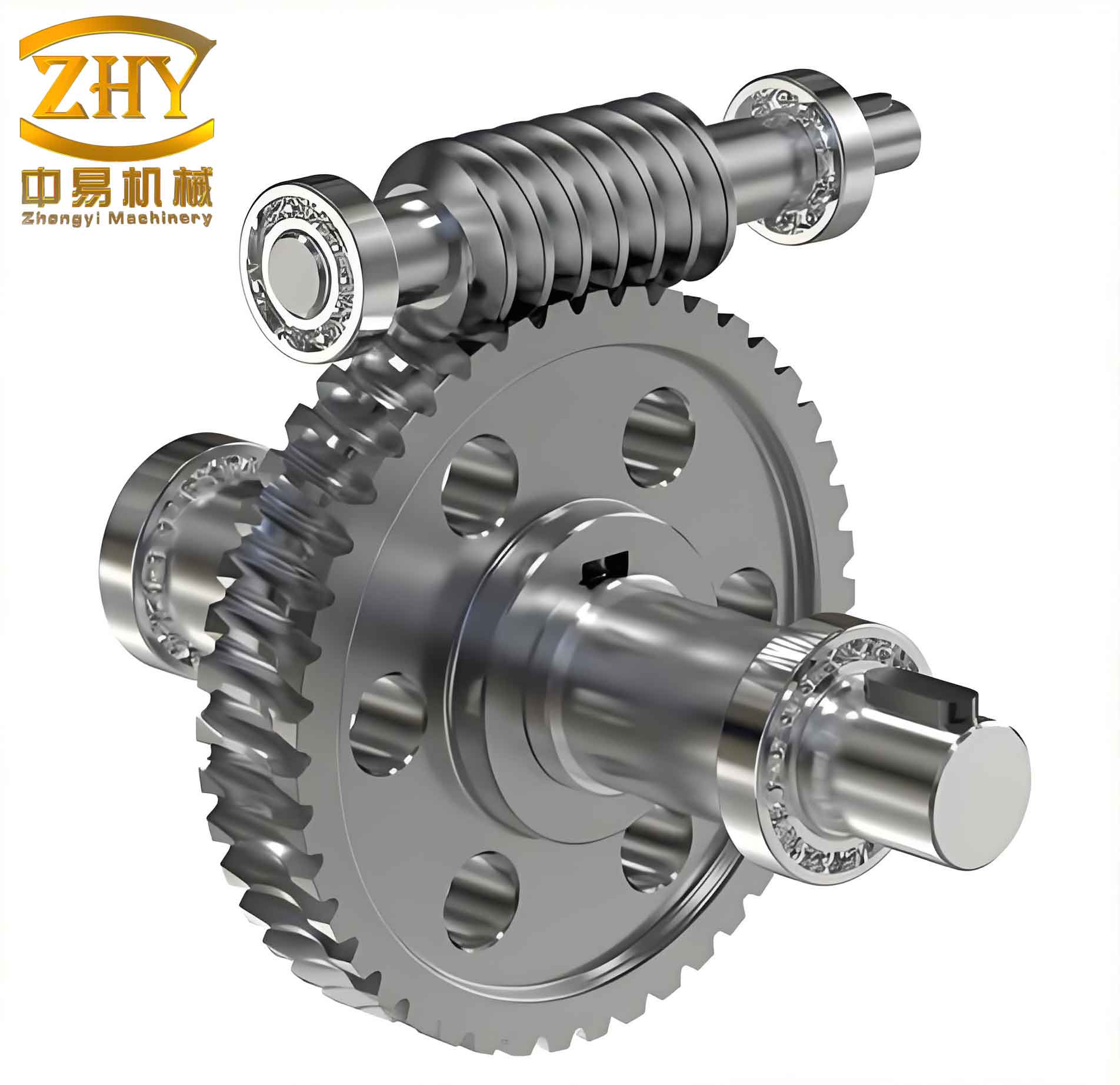
In modern mechanical transmission systems, worm gears are widely employed due to their compact structure, high single-stage reduction ratio, low noise, and self-locking capability. Among various types, the ZC1 torus envelope circular cylindrical worm pair stands out for its superior load capacity and efficiency, achieved through a convex circular arc grinding wheel that generates an improved tooth profile. My research focuses on the meshing characteristics of these worm gears, aiming to optimize key design parameters for enhanced performance. By combining gear meshing theory with numerical simulation, I investigate how changes in tooth profile angle, arc radius, and displacement coefficient affect the meshing zone and undercut boundary. This analysis provides a theoretical basis for the parametric optimal design of ZC1 worm gears.
The core of my study lies in establishing the mathematical model of the worm gear pair. Using the principles of gear meshing, I derive the helicoid equation of the worm, the instantaneous contact lines during meshing, and the boundary curves that define the effective meshing region and undercut limits. All derivations are based on coordinate transformations and envelope theory, which I will present in detail below.
Theoretical Foundation of ZC1 Worm Gears
I start by defining several coordinate systems essential for describing the geometry of the worm gear pair. Let \(s_u [o_u, x_u, y_u, z_u]\) be a coordinate system rigidly attached to the disk-shaped grinding wheel, with \(z_u\) along its rotational axis. The worm is attached to system \(s_1 [o_1, x_1, y_1, z_1]\), where \(z_1\) coincides with its axis. A fixed coordinate system \(s [o, x, y, z]\) serves as the global reference. The grinding wheel’s cutting edge has a circular arc profile with radius \(\rho\). During the grinding process, the wheel moves along a helical path relative to the worm blank, creating the worm’s helical surface as an envelope of the tool surface.
The worm helicoid equation is derived by imposing the condition of tangency between the tool and worm surfaces. The resulting parametric equation in system \(s_1\) is:
$$
\begin{aligned}
x_1 &= (\rho \sin\theta + d)(-\cos\beta\cos\psi + \sin\beta\sin\psi\cos\gamma_n) \\
&\quad – (\rho\cos\theta – a)\sin\psi\sin\gamma_n + A_u\cos\psi,\\
y_1 &= (\rho\sin\theta + d)(\cos\beta\sin\psi + \sin\beta\cos\psi\cos\gamma_n) \\
&\quad – (\rho\cos\theta – a)\cos\psi\sin\gamma_n – A_u\sin\psi,\\
z_1 &= (\rho\sin\theta + d)\sin\beta\sin\gamma_n + (\rho\cos\theta – a)\cos\gamma_n – p\psi,\\
\tan\theta &= \frac{A_u – p\cot\gamma_n – d\cos\beta}{a\cos\beta + (A_u\cot\gamma_n + p)\sin\beta}.
\end{aligned}
$$
Here, \(\rho\) is the arc radius of the tool profile, \(p = \frac{mz_1}{2}\) is the helix parameter, \(d\) and \(a\) are the coordinates of the arc center relative to the tool axis, \(\gamma_n\) is the angle between the worm and tool axes, \(\beta\) is the rotation angle of the tool profile, \(\psi\) is the rotation angle of the worm coordinate system, and \(A_u\) is the center distance between the worm and the tool. This equation is fundamental for further analysis of the meshing zone.
To analyze the meshing region, I define two critical boundary curves: curve a-a represents the path where the worm addendum begins to engage, while curve b-b corresponds to the worm wheel addendum engagement. The equations for these curves are obtained from the meshing condition and the geometry of the tooth tip cylinders. For curve a-a:
$$
\begin{aligned}
x &= r_a \cos(\theta_e + \zeta + \varphi_1),\\
y &= r_a \sin(\theta_e + \zeta + \varphi_1),\\
z &= \frac{r_a \left[ r_a \cos(\theta_e + \zeta + \varphi_1) + A_0 – \frac{p}{i_{21}} \right] \cos\mu_e}{p \sin(\theta_e + \zeta + \varphi_1 + \mu_e)}.
\end{aligned}
$$
In this expression, \(r_a\) is the worm addendum radius, \(\varphi_1\) is the worm rotation angle, \(\zeta\) is the helix rotation angle, \(\mu_e\) is the angle between the radius vector and the tangent at the tip, and \(\theta_e\) is the polar angle of the tip point. Similarly, the equation for curve b-b is:
$$
\begin{aligned}
x &= r \cos(\theta + \zeta + \varphi_1),\\
y &= r \sin(\theta + \zeta + \varphi_1),\\
z &= \frac{r \left[ r \cos(\theta + \zeta + \varphi_1) + A_0 – \frac{p}{i_{21}} \right] \cos\mu}{p \sin(\theta + \zeta + \varphi_1 + \mu)}.
\end{aligned}
$$
The region enclosed by these two curves defines the meshing zone, where effective load transmission occurs. Any contact outside this region leads to interference or loss of engagement.
Another important concept is the undercut boundary, also known as the first-type singular curve on the worm wheel tooth surface. The condition for undercut is given by:
$$
\begin{cases}
\vec{n} \cdot \vec{V}^{(12)} = 0,\\
\Psi^{(12)} = 0,
\end{cases}
$$
where \(\Psi^{(12)}\) is the first-type boundary function. Solving this system yields the coordinates of points where the worm wheel tooth surface starts to be cut off, reducing the usable tooth height. The parametric equations for the undercut curve are derived as:
$$
\begin{aligned}
r^{(1)} \left[ r^{(1)} \cos(\theta + \varphi_1 + \zeta) + A_0 – \frac{p}{i_{21}} \right] \cos\mu &= p^2 \zeta \sin\tau,\\
\Psi^{(12)} &= 0,\\
\vec{r}^{(1)} &= r^{(1)}(\theta)\cos(\theta+\zeta)\vec{i_1} + r^{(1)}(\theta)\sin(\theta+\zeta)\vec{j_1} + p\zeta \vec{k_1},\\
\vec{r}^{(2)} &= x_2 \vec{i_2} + y_2 \vec{j_2} + z_2 \vec{k_2},\\
x_2 &= x_1\cos\varphi_1\cos\varphi_2 – y_1\sin\varphi_1\cos\varphi_2 – z_1\sin\varphi_2 + A_0\cos\varphi_2,\\
y_2 &= -x_1\cos\varphi_1\sin\varphi_2 + y_1\sin\varphi_1\sin\varphi_2 – z_1\cos\varphi_2 – A_0\sin\varphi_2,\\
z_2 &= x_1\sin\varphi_1 + y_1\cos\varphi_1.
\end{aligned}
$$
These equations allow me to numerically compute the undercut boundary and superimpose it onto the meshing zone map.
To systematically study the influence of design parameters, I have compiled a reference table of key symbols used throughout this work:
| Symbol | Description | Unit |
|---|---|---|
| \(\alpha\) | Tooth profile angle (pressure angle at the pitch circle) | deg |
| \(\rho\) | Radius of the circular arc cutting edge of the grinding wheel | mm |
| \(x\) | Displacement (addendum modification) coefficient of the worm wheel | — |
| \(a\) | Center distance of the worm gear pair | mm |
| \(m\) | Axial module | mm |
| \(z_1\) | Number of worm threads (usually 1 for ZC1) | — |
| \(q\) | Diameter quotient of the worm (\(q = d_1 / m\)) | — |
| \(p\) | Helix parameter (\(p = m z_1 / 2\)) | mm |
| \(A_u\) | Center distance between worm and grinding wheel | mm |
| \(\gamma_n\) | Angle between worm axis and grinding wheel axis | deg |
| \(r_a\) | Worm addendum radius | mm |
| \(i_{21}\) | Gear ratio (\(i_{21} = z_2 / z_1\)) | — |
Parametric Study of Meshing Characteristics
I performed a series of numerical experiments using the developed mathematical model. The baseline parameters for the investigation are: center distance \(a = 180\) mm, module \(m = 8.7\) mm, number of worm threads \(z_1 = 1\), diameter quotient \(q = 10\), displacement coefficient \(x = 0.5\), and arc radius \(\rho = 48\) mm. I then vary one parameter at a time and observe the changes in the meshing zone shape and the undercut region. Below, I summarize the results for each parameter.
Effect of Tooth Profile Angle \(\alpha\)
I set the tooth profile angle to four values: 21°, 22°, 23°, and 24°, while keeping other parameters constant. Numerical calculations show that the meshing zone area decreases slightly as \(\alpha\) increases. Simultaneously, the undercut region diminishes, meaning that a larger \(\alpha\) helps avoid tooth root undercut. This trend is consistent with practical recommendations: authorities suggest an optimal range of \(21^\circ\) to \(25^\circ\), with \(23^\circ\) as a typical choice. Table 2 lists the observed qualitative changes.
| \(\alpha\) (deg) | Meshing Zone Area | Undercut Region |
|---|---|---|
| 21 | Relatively large | Significant |
| 22 | Slightly smaller | Reduced |
| 23 | Moderate | Small |
| 24 | Further reduced | Minimal |
These results indicate that increasing \(\alpha\) is beneficial for reducing undercut, but the penalty in active meshing area is minor. For ZC1 worm gears, a balanced choice like \(23^\circ\) is often recommended.
Effect of Arc Radius \(\rho\)
I then varied the grinding wheel arc radius: 45 mm, 48 mm, 50 mm, and 52 mm, while fixing \(\alpha = 23^\circ\) and other parameters. The meshing zone area changes only slightly with \(\rho\); a larger \(\rho\) leads to a slight reduction in meshing area. More importantly, the undercut boundary shifts, reducing the undercut region as \(\rho\) increases. Table 3 summarizes findings.
| \(\rho\) (mm) | Meshing Zone Area | Undercut Region |
|---|---|---|
| 45 | Relatively large | Appreciable |
| 48 | Moderate | Small |
| 50 | Slightly smaller | Very small |
| 52 | Smallest among tested | Almost none |
Hence, increasing \(\rho\) is an effective way to mitigate undercut without sacrificing much meshing area. However, an excessively large \(\rho\) may lead to other manufacturing constraints, so a value around 48–50 mm is often used in practice.
Effect of Displacement Coefficient \(x\)
Among the three parameters studied, the displacement coefficient \(x\) has the most pronounced influence on the meshing zone. I tested four values: 0.4, 0.5, 0.75, and 1.0. The results reveal that as \(x\) increases, the meshing zone area decreases sharply. At the same time, the undercut region shrinks dramatically, and for \(x = 0.75\) and above, undercut is virtually eliminated. Table 4 captures this trend.
| \(x\) | Meshing Zone Area | Undercut Region | Contact Line Shape |
|---|---|---|---|
| 0.4 | Very large | Extensive | Steep, poor lubrication |
| 0.5 | Large | Significant | Moderate |
| 0.75 | Moderate | Minimal | Favorable for oil film |
| 1.0 | Small | None | Excellent, lubricant wedge |
The dramatic reduction in undercut with increasing \(x\) means that the actual effective meshing area (excluding undercut regions) does not necessarily decrease; in fact, it may even increase because the unusable undercut portion is eliminated. Moreover, a larger \(x\) improves the contact line orientation, promoting hydrodynamic lubrication. Therefore, within allowable limits (to avoid excessive thinning of the worm wheel tooth), the displacement coefficient should be chosen as large as possible.
Synthesis and Design Recommendations
My comprehensive analysis of ZC1 worm gears demonstrates that the meshing characteristics are governed by a delicate interplay between the tooth profile angle, arc radius, and displacement coefficient. Using the derived equations and numerical simulations, I have established quantitative trends that guide parameter selection. The following table summarizes the recommended design directions based on the investigation:
| Parameter | Effect on Meshing Zone | Effect on Undercut | Recommended Value |
|---|---|---|---|
| Tooth profile angle \(\alpha\) | Decreases slightly as \(\alpha\) increases | Decreases with \(\alpha\) | 23° (typical) |
| Arc radius \(\rho\) | Decreases slightly as \(\rho\) increases | Decreases with \(\rho\) | About 5.5× module (e.g., 48 mm for m=8.7) |
| Displacement coefficient \(x\) | Decreases sharply as \(x\) increases | Eliminated for \(x \ge 0.75\) | As high as possible (e.g., 0.75–1.0) |
It is crucial to note that the improvement in undercut prevention often compensates for the reduction in raw meshing area. For instance, when \(x\) is increased from 0.5 to 0.75, the nominal meshing zone shrinks, but the undercut region disappears, resulting in a net gain of usable contact area. Hence, I advocate that designers prioritize the displacement coefficient while ensuring the worm wheel tooth thickness remains adequate.
Furthermore, the combination of a moderate tooth profile angle (23°) and a carefully selected arc radius (approximately 5.5 times the module) yields a robust design that balances load capacity, efficiency, and manufacturability. My parametric study also reveals that the undercut boundary curve moves away from the active meshing zone as any of the three parameters increase, which is beneficial for avoiding tooth failure.
In conclusion, this work provides a systematic approach to optimizing ZC1 worm gears by analyzing the meshing zone in conjunction with the undercut boundary. The mathematical framework and numerical results offer engineers a reliable tool for preliminary design. I hope that the insights presented here will contribute to the development of more efficient and durable worm gear transmissions, particularly in applications such as elevators, conveyors, and industrial machinery where ZC1 worm gears are prevalent.