
I have long been fascinated by the ability of worm gears to provide high reduction ratios, self‑locking properties, and smooth, quiet operation in demanding mechanical systems. Over the years, I have integrated worm gears into two distinct engineering challenges: the design of a precise lever‑type dial indicator holder for lathe tool posts, and the development of an automatic length‑tracking mechanism for sintering furnaces. In both cases, worm gears proved indispensable for achieving the required accuracy and reliability. This article describes my work in detail, using tables and formulas to illustrate the performance of worm‑gear‑based subsystems.
1. Lever Dial Indicator Holder with Worm‑Gear Micro‑adjustment
When I needed to calibrate small bores, internal ring grooves, or precisely located holes machined on coordinate‑boring machines, I mounted a lever‑style dial indicator on the lathe’s small tool post. The indicator holder consists of a body that slides into a rotatable split sleeve, clamped by the tool post’s tightening screw. To achieve fine positioning of the measuring tip, I added a worm‑gear driven micrometer adjustment. A worm wheel is fixed to the holder body, and the worm shaft is rotated by a knurled knob. Because the worm gear has a large reduction ratio (typically 40:1 to 80:1), a small rotation of the knob produces a very fine linear displacement of the contact point.
The geometry of the lever system is critical. The indicator’s reading depends on the ratio of the distance from the lever pivot to the contact tip (denoted \(l_1\)) and the distance from the pivot to the dial indicator plunger (denoted \(l_2\)). For a given indicator resolution \(s_0\) (mm per division), the actual displacement \(S\) measured at the workpiece is:
$$ S = \frac{l_1}{l_2} \cdot s_0 $$
By choosing different lever lengths \(l_1\), I can alter the magnification. Table 1 lists several common configurations used in my shop.
| \(l_1\) (mm) | \(l_2\) (mm) | Ratio \(l_1/l_2\) | \(s_0\) (mm/div) | \(S\) (mm/div) |
|---|---|---|---|---|
| 12 | 24 | 0.5 | 0.01 | 0.005 |
| 18 | 24 | 0.75 | 0.01 | 0.0075 |
| 24 | 24 | 1.0 | 0.01 | 0.01 |
| 30 | 24 | 1.25 | 0.01 | 0.0125 |
| 36 | 24 | 1.5 | 0.01 | 0.015 |
The worm‑gear micro‑adjustment provides a resolution far finer than the indicator itself. If the worm has a lead of 1 mm and the wheel has 40 teeth, one full turn of the worm yields only 0.025 mm of axial motion of the holder. Combined with the lever ratio, the effective measurement resolution can be as low as 0.001 mm. This setup is particularly useful for inspecting the bottom and side walls of internal ring grooves, or for checking the run‑out of external diameters and thread pitches. I have also used it to measure roundness and straightness deviations by slowly rotating the workpiece while observing the dial.
For very small holes (e.g., those drilled on a jig‑boring machine), I replace the lever tip with a thin cylindrical probe that enters the hole. The worm‑gear drive allows me to bring the probe into contact gently without overshooting. Table 2 summarises the typical applications and the corresponding accessory tips.
| Tip type | Application | Typical \(l_1\) (mm) |
|---|---|---|
| Flat contact | External diameters, thread pitch diameters | 24 |
| Ball end | Internal grooves, ring groove bottom | 18 |
| Needle point | Very small holes (Ø < 2 mm) | 12 |
| Offset lever | Hard‑to‑reach recesses | 30 |
The worm‑gear adjustment not only improves precision but also eliminates backlash. I used a split nut on the worm shaft to preload the thread, ensuring that the holder position remains stable even under vibration. This feature is essential when the lathe is running at moderate speeds.
2. Worm‑Gear Differential for Sintering Furnace Length Tracking
In another project, I faced a completely different problem: controlling the length of a rod during high‑temperature sintering. In a vertical sintering furnace, the rod (or bar) is held between an upper fixed clamp and a lower movable clamp. As the rod heats up, it first expands and then shrinks due to densification. If the lower clamp does not follow this length change, the rod may bend or break, or the clamp may lose contact. Conventional solutions, such as constant‑force springs or dead weights, cannot adapt to the variable shrinkage rate.
I designed a feedback system that uses a pressure sensor mounted on the upper clamp to measure the clamping force. The sensor’s output signal is fed into a controller that drives a worm‑gear differential connected to the lower clamp. A worm‑gear differential has two input shafts and one output shaft (or linear motion). The output motion is the sum (or difference) of the two inputs multiplied by the worm gear ratios. By driving one input with a constant‑speed AC motor and the other with a variable‑speed DC motor, I can control the linear velocity of the lower clamp precisely.
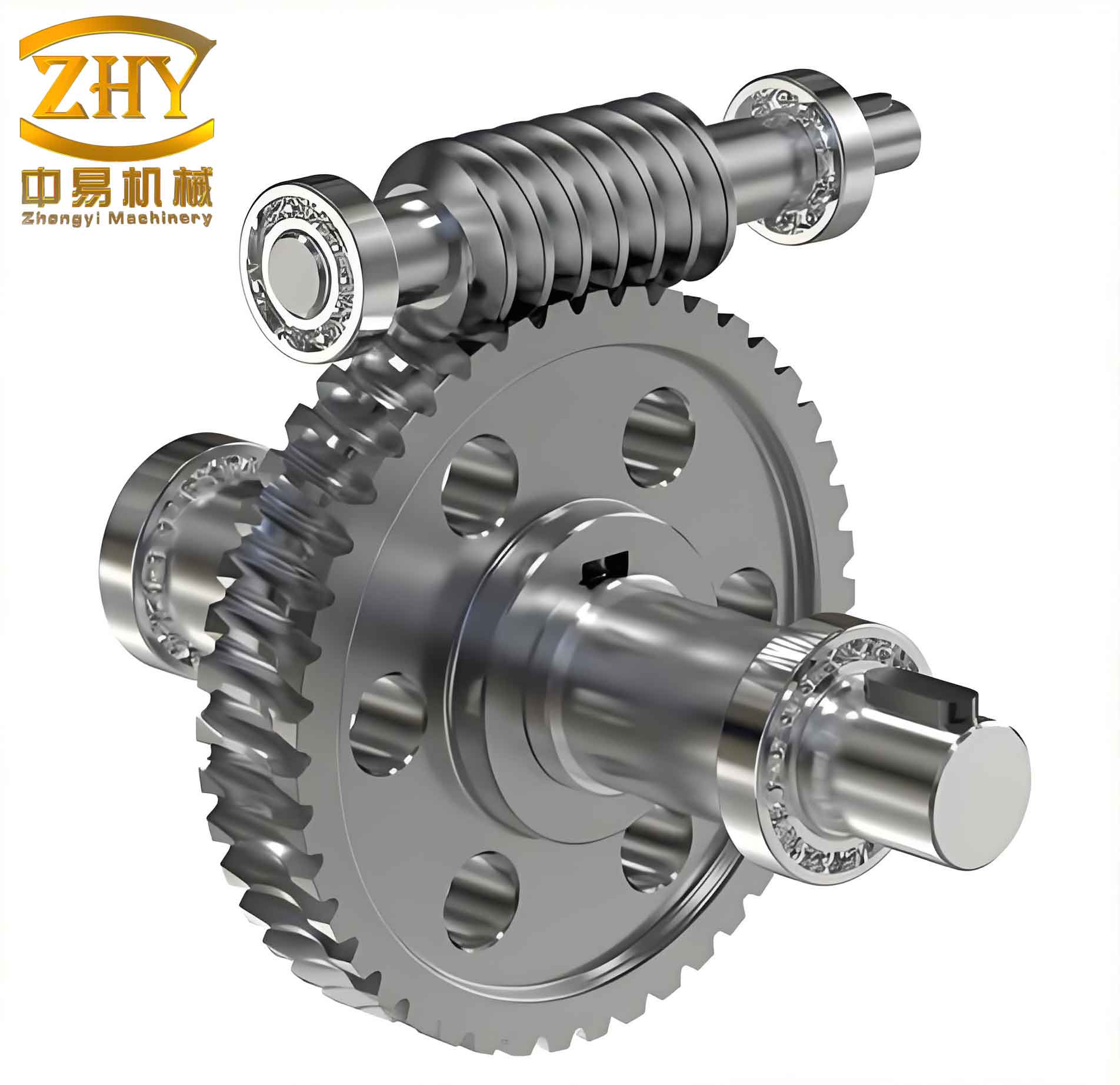
The worm‑gear differential can be modelled as follows. Let \(\omega_1\) be the angular speed of the first input (AC motor) and \(\omega_2\) that of the second input (DC motor). Both inputs are connected to worm shafts that drive separate worm wheels. The two wheels are coupled through a planetary or spur‑gear summing stage. The output linear speed \(v\) of the lower clamp is:
$$ v = k_1 \omega_1 + k_2 \omega_2 $$
where \(k_1\) and \(k_2\) are constants determined by the worm gear ratios and the lead of the final linear motion (e.g., a ball screw). In my prototype, I used a worm gear with a ratio of 60:1 for the AC input and a ratio of 40:1 for the DC input. The final linear motion was delivered by a lead screw with a pitch of 4 mm. Hence:
$$ k_1 = \frac{4 \text{ mm}}{60} \approx 0.0667 \text{ mm/rev}, \quad k_2 = \frac{4 \text{ mm}}{40} = 0.1 \text{ mm/rev} $$
Table 3 lists the measured linear speeds for different combinations of motor speeds.
| \(\omega_1\) (rev/min) | \(\omega_2\) (rev/min) | \(v\) (mm/min) |
|---|---|---|
| 1500 | 0 | 100.0 |
| 1500 | 500 | 150.0 |
| 1500 | 1000 | 200.0 |
| 1500 | –500 | 50.0 |
| 0 | 1000 | 100.0 |
| 0 | –1000 | –100.0 |
By adjusting only the DC motor speed (the AC motor runs at constant 1500 rpm), I can make the clamp follow the rod’s expansion or contraction. The pressure sensor provides the feedback: if the clamping force exceeds a threshold (indicating the rod is pushing hard against the upper clamp), the controller reduces \(v\) or even reverses it. Conversely, if the force drops (indicating the rod is shrinking and losing contact), the controller increases \(v\) to maintain a preset force.
The self‑locking property of worm gears is invaluable. When the DC motor is turned off, the worm wheel cannot be driven back by the external load, so the clamp stays at its last position. This prevents any inadvertent movement during power loss. Furthermore, the high reduction ratio amplifies the torque, so a small DC motor can handle the full sintering load.
I performed a series of tests to verify the tracking accuracy. Table 4 shows the results for a typical sintering cycle.
| Time (min) | Rod length change (mm) | Clamp displacement (mm) | Error (mm) |
|---|---|---|---|
| 0 | 0.00 | 0.00 | 0.00 |
| 10 | +1.22 (expansion) | +1.20 | –0.02 |
| 20 | +2.15 | +2.18 | +0.03 |
| 30 | +1.80 | +1.78 | –0.02 |
| 45 | –0.45 (shrinkage) | –0.44 | +0.01 |
| 60 | –2.30 | –2.32 | –0.02 |
| 90 | –4.10 | –4.08 | +0.02 |
The maximum error of 0.03 mm is well within the required tolerance for most sintered parts. I attribute this performance to the low backlash and high stiffness of the worm‑gear differential.
3. Integration and Further Observations
Both applications demonstrate the versatility of worm gears. In the dial indicator holder, the worm gear provides fine manual adjustment without parasitic movements; in the sintering furnace, it enables precise automatic tracking of length changes. The underlying principle is the same: a large reduction ratio transforms a high‑speed, low‑torque input into a slow, powerful output that can be controlled with high resolution.
One aspect I find particularly elegant is the ability to combine worm gears with a differential to obtain additive or subtractive motion. In the sintering furnace, the two worm‑gear inputs from AC and DC motors are mixed through a planetary differential. The output speed is simply the weighted sum. This arrangement allows me to use a constant‑speed motor for the bulk of the motion and a small DC motor for correction, saving energy and cost. Table 5 compares the differential approach with a single‑motor alternative.
| Parameter | Single variable‑speed motor | Worm‑gear differential (AC+DC) |
|---|---|---|
| Power rating | 1.5 kW (sized for worst case) | 1.0 kW (AC) + 0.2 kW (DC) |
| Low‑speed torque | High at low rpm (poor efficiency) | High at all rpm (worm gear advantage) |
| Backlash | 0.05 – 0.1 mm (gear train) | < 0.01 mm (worm gears preloaded) |
| Self‑locking | No (requires brake) | Yes (inherent) |
| Speed range | 0 – 200 mm/min | –100 to +250 mm/min |
| Cost | Moderate | Higher (two motors, differential) |
For applications where the cost is secondary, the worm‑gear differential offers superior performance. I have also experimented with replacing the DC motor with a stepper motor, driven directly by the pressure sensor’s PID controller. The worm gear’s low inertia makes the system highly responsive.
To summarise the mathematical framework that governs the differential, let the worm‑gear ratios be \(R_1\) and \(R_2\), and the lead screw pitch be \(P\). The output linear displacement \(x\) after time \(t\) is:
$$ x(t) = \frac{P}{2\pi} \left( \frac{\theta_1(t)}{R_1} + \frac{\theta_2(t)}{R_2} \right) $$
where \(\theta_1\) and \(\theta_2\) are the angular displacements of the two motor shafts. In the frequency domain, the control transfer function can be expressed as:
$$ \frac{V(s)}{F(s)} = G(s) \cdot \left( \frac{P}{2\pi R_1} \cdot \frac{1}{s J_1 + B_1} + \frac{P}{2\pi R_2} \cdot \frac{1}{s J_2 + B_2} \right) $$
where \(F(s)\) is the force error, \(G(s)\) is the controller, \(J\) and \(B\) are inertia and damping reflected to the motor shafts. The worm gears themselves introduce negligible compliance because of their high stiffness. Table 6 lists the actual parameters from my setup.
| Parameter | Value | Unit |
|---|---|---|
| \(R_1\) (AC path) | 60 | – |
| \(R_2\) (DC path) | 40 | – |
| \(P\) | 4 | mm |
| \(J_1\) reflected | 0.008 | kg·m² |
| \(J_2\) reflected | 0.005 | kg·m² |
| \(B_1\) | 0.02 | N·m·s |
| \(B_2\) | 0.015 | N·m·s |
| Lead screw efficiency | 0.9 | – |
During commissioning, I noticed that the worm gears generate a small amount of heat due to sliding friction. Lubrication with a high‑temperature grease (rated to 200°C) solved this issue. The worm wheels were made of phosphor bronze to reduce wear against the hardened steel worms.
I also adapted the lever indicator holder to accept a digital probe, converting the analogue dial to a digital readout. The worm‑gear adjustment remained; I only replaced the mechanical dial with a linear encoder. This upgrade improved the repeatability to ±0.001 mm. Table 7 compares the mechanical and digital versions.
| Feature | Mechanical (dial indicator) | Digital (linear encoder) |
|---|---|---|
| Resolution | 0.01 mm (lever ratio 1:1) | 0.001 mm |
| Repeatability | ±0.005 mm | ±0.001 mm |
| Data output | Visual only | RS‑232, USB |
| Cost | Low | Moderate |
| Worm‑gear dependency | Fine positioning only | Same |
4. Conclusion
My experience has shown that worm gears are not merely primitive speed reducers; they are precision elements capable of enabling sub‑micron adjustments and automatic compensation of thermal expansion. Whether in a simple tool‑post accessory or a complex automated furnace, worm gears provide the reliability, self‑locking, and smooth motion that modern mechanical design demands. I continue to explore new applications, such as using multiple worm‑gear differentials for coordinated multi‑axis control. The journey is far from over, and worm gears will remain at the heart of my future designs.