
In my extensive work with crane design and safety regulations, I have often encountered the specific clause in the “Crane Design Code” which states: “For power-driven cranes (except those driven by hydraulic cylinders), all hoisting, luffing, traveling, and slewing mechanisms shall be equipped with reliable braking devices; when the mechanism is required to have load-supporting capability, mechanical normally-closed brakes shall be installed. In special cases where the transmission of traveling or slewing mechanisms contains a self-locking link, if it can be ensured that no over-stress or over-motion will occur, brakes may be omitted.” This provision has led me to investigate deeply the conditions under which worm gears can replace conventional brakes, and I share my findings here.
Fundamentals of Mechanical Self-Locking and the Friction Angle
To understand when worm gears can function without brakes, I must first clarify the concept of mechanical self-locking. Generally, a moving body tends to stay in motion, but there are cases where even an infinitely large driving force cannot initiate motion. This phenomenon is called mechanical self-locking. The key parameter is the friction angle. When an object is in contact with a surface, the total constraint reaction force has two components: the normal reaction \(F_N\) and the tangential reaction (static friction) \(F_f\). The resultant of these two forces is the total reaction \(R\), which makes an angle \(\phi\) with the normal. When static friction reaches its maximum value \(F_{f,\text{max}}\), this angle reaches its maximum \(\phi_m\), known as the friction angle. The relationship is:
$$
\tan\phi_m = \frac{F_{f,\text{max}}}{F_N} = \mu_s
$$
where \(\mu_s\) is the coefficient of static friction. The object is in equilibrium when the friction angle \(\phi\) varies between 0 and \(\phi_m\). A key property: if the line of action of the resultant of all active forces lies within the friction cone (angle less than \(\phi_m\)), the object remains stationary regardless of how large the force is—this is self-locking. Conversely, if the resultant lies outside the cone, motion occurs even for a small force. This principle directly applies to screw threads and worm gears.
Self-Locking Principle and Conditions for Worm Gear Drives
In a typical hand-operated screw jack, the nut, screw, and handle form a system where self-locking prevents the load from lowering itself. This is analogous to a worm gear drive suspending a heavy load. The condition for self-locking in a screw thread is that the helix angle \(\lambda\) of the thread must be less than the friction angle \(\phi\):
$$
\lambda \le \phi
$$
For worm gears, the same logic holds. The worm’s lead angle \(\lambda\) (also called the helix angle of the worm) must be smaller than the friction angle between the worm and worm wheel teeth. If this condition is satisfied, the load cannot drive the worm wheel backward, and the mechanism will hold the load without a brake. The friction angle depends on the materials and surface conditions. Typically, the worm is made of steel (for hardness and wear resistance) and the worm wheel is made of bronze (for good anti-friction properties). The static coefficient of friction between steel and bronze is approximately 0.10 to 0.15 under well-lubricated conditions, giving a friction angle of about 5.7° to 8.5°. However, dynamic friction is lower, so a safety margin is needed. To guarantee self-locking, the lead angle \(\lambda\) should be less than about 5° (or even 3.5° for high reliability). The lead angle is calculated as:
$$
\tan\lambda = \frac{z_1}{q}
$$
where \(z_1\) is the number of starts of the worm (usually 1 to 4) and \(q\) is the worm diameter quotient (a standard parameter, typically 8 to 20). For a single-start worm (\(z_1=1\)) with \(q=10\), \(\lambda \approx 5.71^\circ\), which is borderline. For reliable self-locking, a single-start worm with a larger \(q\) (e.g., \(q=14\) gives \(\lambda \approx 4.09^\circ\)) is preferred.
Design, Manufacturing, and Inspection Requirements for Worm Gears Without Brakes
Simply satisfying the self-locking condition is insufficient. I must ensure that the entire worm gear transmission can withstand the rated load without failure and without exceeding design limits. The primary considerations are:
1. Satisfying the Self-Locking Condition
I must design the worm gear with a lead angle \(\lambda\) safely below the possible friction angle \(\phi\) under all operating conditions. Because friction can change due to lubrication degradation, temperature, or surface wear, I use a conservative margin. The static friction coefficient between steel and bronze can decrease over time as surfaces polish, so the design should assume a lower bound for \(\mu_s\) (worst-case for self-locking). For instance, if \(\mu_s\) can drop to 0.05 (friction angle ~2.86°), then \(\lambda\) must be less than that. Practically, I recommend \(\lambda \le 3^\circ\) for critical lifting applications.
2. Not Exceeding Rated Stresses of the Worm Gear Pair
Even with self-locking, the load applies forces on the teeth and shaft. I must check:
- Tooth bending fatigue strength of the worm wheel: the root stress must not exceed the allowable limit. The tangential load on the wheel \(F_t\) is calculated from the torque and geometry, and the bending stress is given by:
$$
\sigma_b = \frac{F_t}{m_n b} Y_F
$$
where \(m_n\) is the normal module, \(b\) is the face width, and \(Y_F\) is the form factor.
- Contact fatigue strength of the tooth surfaces: Hertzian contact stress must be below the allowable value for the bronze-steel pair. The contact stress formula for worm gears is:
$$
\sigma_H = Z_E \sqrt{\frac{F_t}{d_1 d_2} \frac{1}{\rho}}
$$
where \(Z_E\) is the elastic coefficient, \(d_1\) and \(d_2\) are the pitch diameters of worm and wheel, and \(\rho\) is the relative radius of curvature.
- Worm shaft strength: The worm shaft must resist bending and torsion from the load. The maximum bending moment occurs due to the radial and axial forces, and the shaft diameter is sized accordingly. Additionally, shaft deflection must be limited to avoid misalignment of the teeth, which could destroy the self-locking condition.
3. Preventing Uncontrolled Motion Beyond Design Limits
Several factors can degrade the self-locking property or cause unintended motion:
- Wear and increased backlash: Over time, tooth surface wear can increase the effective lead angle (if wear is uneven) or reduce the friction coefficient, potentially breaking self-locking. I require regular inspection and lubrication to maintain the friction characteristics.
- Change in friction coefficient: During initial run-in, the friction coefficient can change significantly. I must test the mechanism after a break-in period to verify self-locking.
- Insufficient worm shaft stiffness: If the worm shaft deflects excessively under load, the meshing geometry distorts, which can alter the effective lead angle and cause loss of self-locking or abnormal stress concentrations. The shaft deflection must be limited to, say, 0.1 mm per 100 mm span.
Summary of Conditions and Requirements
I have compiled the essential conditions into the following table for clarity:
| Condition | Parameter / Requirement | Remarks |
|---|---|---|
| Self-locking criterion | Worm lead angle \(\lambda\) ≤ friction angle \(\phi\) Typically \(\lambda \le 3^\circ\) to \(5^\circ\) |
Use static friction coefficient \(\mu_s\) (steel-bronze: 0.10–0.15). Apply safety factor 1.5–2.0. |
| Tooth bending strength | \(\sigma_b \le [\sigma_b]\) | Allowable bending stress for bronze: 30–50 MPa depending on material. |
| Tooth contact strength | \(\sigma_H \le [\sigma_H]\) | Allowable contact stress for bronze-steel: 150–250 MPa. |
| Worm shaft strength | Torsional and bending stress < yield strength | Deflection < 0.01° deviation in meshing angle. |
| Lubrication and wear | Oil bath lubrication; initial break-in test | Wear rate < 0.01 mm/1000 hours; maintain coefficient of friction. |
| Backlash control | Backlash within specified limits (e.g., 0.1–0.3 mm) | Excessive backlash can allow reverse rotation under vibration. |
| Overload protection | Torque limiter or load limiting device | Prevents exceeding design stress even if self-locking holds. |
Additionally, I have found that the formula for the friction angle is crucial in design:
$$
\phi = \arctan(\mu)
$$
where \(\mu\) is the effective coefficient of friction (considering lubrication). For worm gear efficiency and self-locking, the relation between lead angle and friction is often expressed as:
$$
\eta = \frac{\tan\lambda}{\tan(\lambda + \phi)}
$$
When \(\lambda < \phi\), the efficiency \(\eta\) is less than 0.5, and the drive is self-locking (cannot be back-driven). This is a good practical check: if efficiency is below 50%, self-locking is likely.
Practical Considerations and Current Practice
Based on my experience, relying solely on the self-locking property of worm gears to replace a mechanical brake carries inherent risks. The friction coefficient can vary due to temperature, humidity, contamination, and wear. For instance, a sudden loss of lubrication can reduce friction dramatically, leading to a catastrophic failure. In modern tower crane trolley mechanisms, I have observed that designers no longer use worm gears as the sole means of holding the load; instead, they incorporate fail-safe brakes even if worm gears are used in the drive train. However, for certain special applications where space is limited or where a brake adds unacceptable weight, the self-locking worm gear may be acceptable if the conditions in this article are rigorously met and if there is a secondary safety factor (e.g., a mechanical stop or a redundant load path).
To illustrate the geometry of a typical worm gear used in such applications, I refer to the following representation of a worm gear pair:
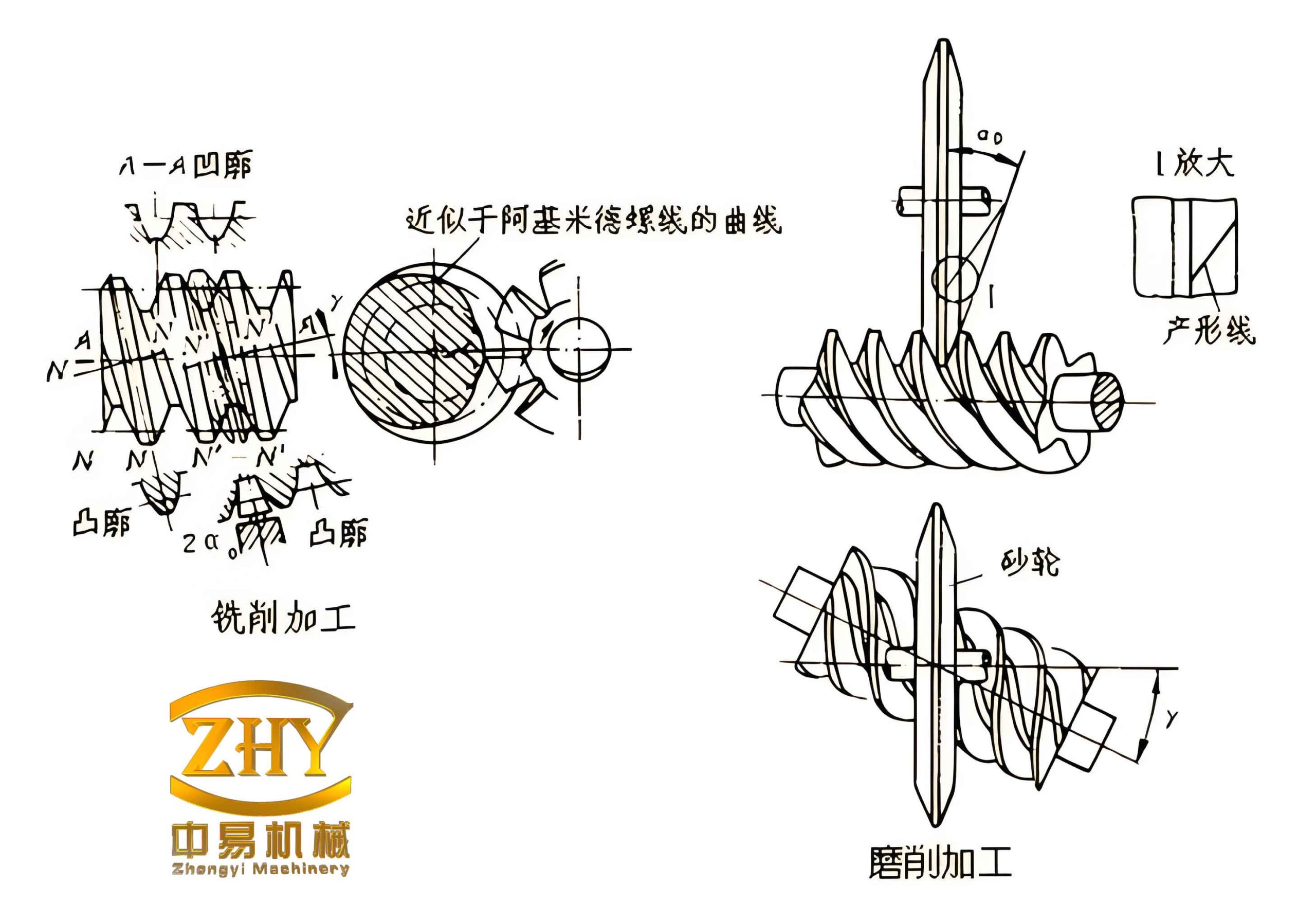
In the figure above, the worm (threaded cylinder) meshes with the worm wheel (gear with helical teeth). The lead angle \(\lambda\) is visible on the worm. This configuration is typical for self-locking drives when \(\lambda\) is small. However, I always caution that even with a small lead angle, dynamic effects, vibration, and thermal expansion can compromise self-locking. Therefore, I recommend a thorough analysis using finite element methods and experimental validation before omitting a brake.
Conclusion
In summary, it is theoretically possible to omit a brake in a worm gear drive if the self-locking condition (\(\lambda \le \phi\)) is satisfied, and if the entire transmission is designed to withstand the rated loads without exceeding stress limits or experiencing uncontrolled motion. However, I have demonstrated that the influencing factors are complex and the risks are significant. Modern crane design, especially for critical mechanisms like tower crane trolleys, has moved away from relying solely on worm gear self-locking. For special cases where such an approach is unavoidable, all stakeholders—designers, manufacturers, users, and inspectors—must carefully consider the conditions outlined in this article, maintain generous safety margins, and ensure rigorous periodic inspection to guarantee safe operation of the lifting equipment.