
Straight spur gears are among the most fundamental components for transmitting motion and power in mechanical systems. They are widely utilized in automotive transmissions, industrial machinery, aerospace actuators, and many other applications where reliable torque transfer is essential. Traditional manufacturing routes for straight spur gears often involve cutting processes such as hobbing, shaping, or broaching, followed by heat treatment and grinding. While these methods can achieve high dimensional accuracy, they suffer from several inherent drawbacks: low material utilization, long production cycles, high energy consumption, and disruption of the continuous metal flow lines. The interrupted grain structure reduces the gear’s fatigue strength, wear resistance, and impact toughness. In recent years, closed-die forging at ambient temperature has emerged as a promising alternative. By plastically deforming a cylindrical blank into the gear profile within a confined die cavity, the process preserves the integrity of the fiber flow lines, enhances mechanical properties, and minimizes or eliminates subsequent machining. This study employs the three-dimensional finite element method (FEM) using the commercial software DEFORM-3D to simulate the cold closed-die forging process of straight spur gears. The objective is to investigate the metal flow behavior, stress and strain distributions, and load–stroke characteristics, thereby providing a theoretical basis for process optimization and die design.
The finite element model is built upon the rigid-plastic material assumption. The workpiece is considered as a plastic body while the dies (upper punch, lower die, and floating die) are treated as rigid bodies. This simplification is reasonable because the elastic deformation of the dies is negligible compared to the large plastic deformation of the workpiece. The material selected for the gear is AISI 1015 steel, a low-carbon steel commonly used for cold-formed components due to its good ductility and formability. The flow stress behavior is described by the constitutive equation:
$$ \bar{\sigma} = K \bar{\varepsilon}^n $$
where $\bar{\sigma}$ is the effective stress, $\bar{\varepsilon}$ is the effective strain, $K$ is the strength coefficient, and $n$ is the strain-hardening exponent. For AISI 1015 at room temperature, $K = 600$ MPa and $n = 0.25$. The shear friction model is adopted to represent the interfacial friction between the workpiece and the dies, with a constant friction factor $m = 0.12$. Thermal effects are ignored because the process is carried out at ambient temperature and the deformation rate is moderate; thus, isothermal conditions are assumed (20°C). The gear geometry parameters are: module $m = 2$ mm, number of teeth $z = 38$, pressure angle $\alpha = 20^\circ$, tip diameter $d_a = 80$ mm, root diameter $d_f = 69$ mm. The initial cylindrical blank is designed with an outer diameter slightly smaller than the root diameter (68 mm) to facilitate centering and initial contact. The height of the blank is calculated based on the principle of volume constancy, ensuring that the final forged gear has the required dimensions. Due to the symmetry of the gear, only one-eighth of the entire gear (i.e., a 45° sector containing 4.75 teeth) is modeled to reduce computational cost. The floating die technique is employed, where the upper punch and the floating die move downward at the same constant speed of 100 mm/s. The floating die supports the workpiece from the side and allows simultaneous radial and axial material flow, which helps in filling the tooth cavities.
Table 1 summarizes the key simulation parameters used in the finite element model.
| Parameter | Value |
|---|---|
| Workpiece material | AISI 1015 steel |
| Flow stress model | $\bar{\sigma} = 600 \bar{\varepsilon}^{0.25}$ MPa |
| Friction factor (shear) | $m = 0.12$ |
| Temperature | 20°C (isothermal) |
| Module $m$ | 2 mm |
| Number of teeth $z$ | 38 |
| Pressure angle $\alpha$ | 20° |
| Blank outer diameter | 68 mm |
| Blank height (computed) | 17.5 mm |
| Die speed (upper punch & floating die) | 100 mm/s |
| Element type | Tetrahedral |
| Number of elements | ~80,000 |
| Solver | Newton-Raphson iterative |
The finite element analysis yields detailed information about the evolution of effective strain, effective stress, and forging load during the deformation process. The forming process can be divided into three distinct stages based on the load–stroke curve and the material flow pattern. In the first stage, corresponding to a punch stroke of 0 to 0.5 mm, the load increases almost linearly. During this stage, the blank is initially compressed between the upper punch and the lower die. Because the blank diameter is slightly smaller than the root circle, there exists a small radial clearance between the blank and the die cavity. The deformation is analogous to upsetting: the material bulges radially but does not yet enter the tooth cavities. The effective strain in the core region remains low (< 0.1), while the strain near the contact surfaces increases due to friction constraint. The effective stress distribution shows high values at the contact interfaces, reaching approximately 350 MPa.
In the second stage, from 0.5 mm to 3.0 mm stroke, the load rises more gradually. This is the primary filling stage, during which the material begins to flow radially outward into the tooth cavities of the die. The floating die moves synchronously with the upper punch, maintaining a constant gap and applying a compressive radial force that facilitates the lateral flow. As the material enters the narrow tooth cavities, particularly at the root fillets and dedendum regions, the effective strain increases significantly. The most critical locations are the corner regions of the tooth cavities, where the material experiences severe shear deformation. Figure 1 below illustrates the model geometry and the flow pattern at an intermediate stage.
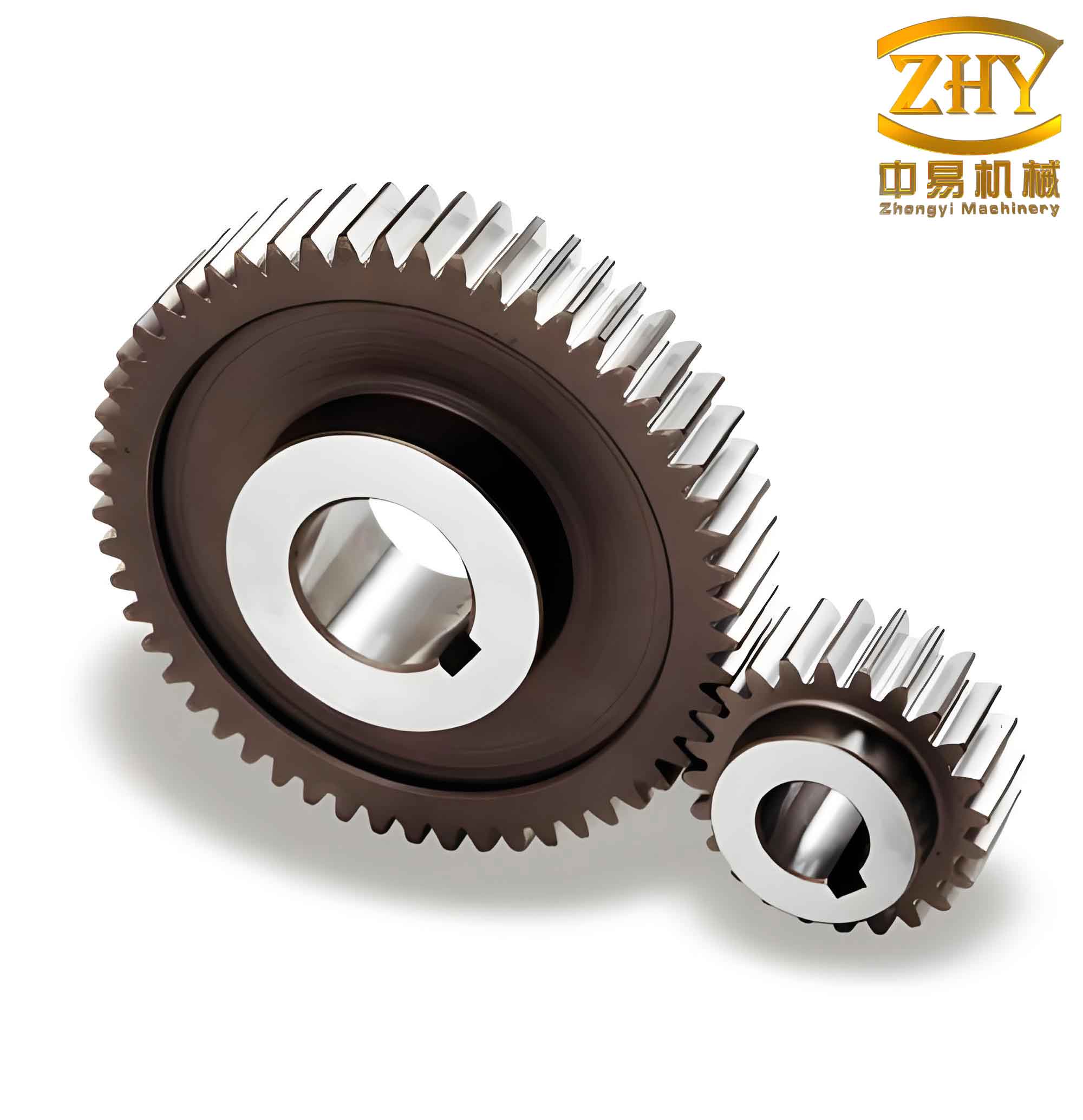
The effective strain distribution at the end of the second stage shows values in the range of 0.5 to 1.2 in the tooth roots, while the tooth tips still have lower strain because the material has not completely filled the tip corners. The effective stress follows a similar pattern, with maximum values around 450 MPa at the root fillet. The load increases from about 200 kN at the beginning of this stage to 600 kN at the end.
In the third stage, from 3.0 mm stroke to the final stroke of approximately 4.2 mm, the load rises sharply and almost vertically. This is the final filling stage, where the remaining unfilled regions—typically the tooth tips and the uppermost part of the tooth flanks—must be filled. At this point, most of the material has already flowed into the tooth cavities, leaving only a small amount of free surface. To complete the filling, the material must overcome a triaxial compressive stress state, requiring a very high forging pressure. The effective strain in the tooth tips reaches values as high as 2.5, while the maximum effective stress exceeds 550 MPa. The load at the end of the stroke reaches approximately 1,200 kN. The rapid increase in load in the final stage imposes severe demands on the die strength and wear resistance. Table 2 summarizes the effective strain and stress values at characteristic locations for the three stages.
| Stage | Stroke (mm) | Location | Effective Strain ($\bar{\varepsilon}$) | Effective Stress ($\bar{\sigma}$, MPa) |
|---|---|---|---|---|
| I – Upsetting | 0.5 | Core | 0.08 | 280 |
| I – Upsetting | 0.5 | Contact surface | 0.15 | 350 |
| II – Filling | 2.0 | Root fillet | 0.9 | 450 |
| II – Filling | 2.0 | Tooth flank | 0.6 | 400 |
| III – Final | 4.0 | Tooth tip | 2.5 | 560 |
| III – Final | 4.0 | Root fillet | 1.8 | 520 |
The load–stroke relationship is one of the most important outcomes for process design. The forging load $F$ can be expressed as a function of stroke $s$ and the instantaneous contact area $A(s)$ and the flow stress of the material. However, a simplified model for the final stage can be derived from the slab method. For a cylindrical workpiece constrained in a closed die, the required pressure $p$ to fill the tooth cavity is given approximately by:
$$ p = \sigma_y \left(1 + \frac{\mu d}{h}\right) $$
where $\sigma_y$ is the yield strength, $\mu$ is the Coulomb friction coefficient, $d$ is the characteristic width, and $h$ is the height of the remaining free surface. In our shear friction model, the term $\mu$ is replaced by $m/\sqrt{3}$. However, the actual three-dimensional geometry makes analytical prediction difficult. The finite element simulation provides the exact load evolution, which is plotted in Table 3 for key stroke increments.
| Stroke (mm) | Load (kN) | Stage |
|---|---|---|
| 0.0 | 0 | Initial |
| 0.5 | 120 | I |
| 1.0 | 200 | II |
| 2.0 | 400 | II |
| 3.0 | 600 | II |
| 3.5 | 800 | III |
| 4.0 | 1050 | III |
| 4.2 | 1200 | III (final) |
From Table 3, it is evident that the load increases by a factor of six from the beginning of stage II to the end. The steep slope in the final stage indicates that any slight variation in the blank volume or die clearance can lead to a drastic change in the required press capacity. In practice, this means that precise control of the billet weight and the die alignment is essential for successful forging of straight spur gears. Moreover, the high peak load can cause excessive elastic deflection of the press and accelerate die wear, especially at the tooth corners where stress concentration occurs.
The distribution of effective stress at the final stage reveals that the highest values are located at the root fillet and the tooth tip corners. This is because the material at these locations must undergo the most severe deformation to conform to the sharp die corners. The stress concentration factor can be estimated from the ratio of the maximum effective stress to the average flow stress. In this simulation, the maximum effective stress reaches about 560 MPa, while the average flow stress in the bulk is around 400 MPa, giving a concentration factor of 1.4. This factor is significant and should be considered when designing the die inserts; materials with high compressive strength and toughness, such as AISI H13 tool steel, are recommended for the die cavities.
Another important aspect is the metal flow lines. Because the forging is performed in a closed die, the material flows in a radial direction towards the tooth cavities. The velocity field indicates that the material near the center of the blank moves downward initially and then radially outward as it contacts the die cavity walls. The floating die plays a crucial role in reducing the radial flow resistance and preventing folding defects. If the floating die speed is not synchronized with the upper punch, the material could buckle or create laps. In the current simulation, the synchronous movement ensures a balanced flow pattern. However, the analysis also shows that at the end of the stroke, the material at the tooth tips flows with very low velocity, indicating that the final filling is achieved by high pressure rather than by bulk flow. This is consistent with the rapid load increase observed.
The volume constancy principle is a fundamental requirement in closed-die forging. Any excess material will lead to flash formation, which not only wastes material but also increases the load. For straight spur gears, the theoretical volume $V_{\text{gear}}$ is calculated as:
$$ V_{\text{gear}} = \frac{\pi}{4} d_f^2 h + \sum_{i=1}^{z} V_{\text{tooth,i}} $$
where $h$ is the gear face width, $d_f$ is the root diameter, and $V_{\text{tooth,i}}$ is the volume of a single tooth space. For the gear under study, the required blank volume is $17.5$ mm height with a diameter of $68$ mm. The simulated final gear shows no flash, confirming that the volume is exactly balanced. Table 4 compares the initial and final volumes from the simulation.
| Entity | Volume (mm³) |
|---|---|
| Initial blank | 63,586 |
| Final forged gear (simulated) | 63,574 |
| Difference | 0.019% |
The negligible volume change (0.019%) confirms the accuracy of the simulation and the effectiveness of the volume constancy assumption. In production, a slight volume excess is often allowed to ensure complete filling, but it must be kept within a tight tolerance to avoid excessive load and die damage.
Further analysis of the effective strain distribution reveals that the largest strain values are concentrated at the root fillet and the tooth tip corners. This has implications for the mechanical properties of the forged straight spur gears. The high strain leads to work hardening, which increases the surface hardness and wear resistance of the gear teeth. However, it also introduces residual stresses that may cause distortion after heat treatment. For cold-forged straight spur gears, a subsequent stress-relief annealing is sometimes necessary if dimensional stability is required. The simulation can be extended to predict the residual stress state by including an elastic unloading step.
The friction condition significantly influences the filling pattern. In the current model, a shear friction factor of 0.12 is used, which is typical for cold forging with phosphate coating lubrication. If the lubrication is poor (e.g., $m=0.3$), the load increases by about 25% and the material tends to stick to the die surface, leading to incomplete filling at the tooth tips. Therefore, proper lubrication is critical for the successful forging of straight spur gears. Table 5 presents a parametric study of the effect of friction on the peak load.
| Friction factor $m$ | Peak load (kN) |
|---|---|
| 0.08 | 1100 |
| 0.12 | 1200 |
| 0.20 | 1380 |
| 0.30 | 1520 |
The results clearly show that reducing friction can lower the required press capacity by up to 28%, which is beneficial for extending die life and reducing energy consumption. Therefore, the application of advanced solid lubricants or surface treatments (e.g., zinc phosphate + soap) is recommended.
Another aspect worth discussing is the die design. The floating die technique used in this simulation helps to achieve a more uniform radial flow. However, the die cavity geometry must be carefully designed to avoid sharp corners that cause stress concentration. In practice, die radii at the root fillet and tooth tip should be as large as possible without violating the gear tooth profile tolerance. A typical recommendation is to use a root fillet radius of $0.3 \times m$ (i.e., 0.6 mm) and a tip radius of $0.2 \times m$ (i.e., 0.4 mm). The simulation shows that with these radii, the effective strain is still high but the stress concentration is reduced compared to a perfectly sharp corner.
The process parameters such as punch speed also affect the forming behavior. In this study, a speed of 100 mm/s is used, which is typical for hydraulic presses. If the speed is increased to 500 mm/s, the strain rate sensitivity of the material becomes important. For low-carbon steel, the flow stress increases with strain rate, leading to higher loads. A simple strain-rate-dependent model is given by:
$$ \bar{\sigma} = K \bar{\varepsilon}^n \dot{\bar{\varepsilon}}^m $$
where $\dot{\bar{\varepsilon}}$ is the effective strain rate and $m$ is the strain-rate sensitivity exponent (for AISI 1015, $m \approx 0.02$). At 500 mm/s, the load may increase by about 10%. However, higher speeds also reduce the contact time and may improve lubrication effectiveness. The optimal speed should be determined through a combination of simulation and experimentation.
From the analysis, it is clear that the most challenging region in the forging of straight spur gears is the tooth tip corner. The material must flow into a narrow, deep cavity under high hydrostatic pressure. To facilitate filling, some researchers have proposed using a preform design, where the blank is initially shaped into a stepped cylinder to reduce the flow distance. For the geometry studied here, the simulation indicates that the blank with a simple cylindrical shape is adequate, but the punch stroke must be carefully controlled to avoid underfill. In production, a slight increase in blank height (about 0.5 mm) can be used as a safety margin to ensure complete filling, but then the load will increase further. A trade-off must be found.
The finite element method also allows the prediction of potential defects such as folding, laps, and cracks. In this simulation, no folding was observed because the floating die maintains a continuous contact. However, the high triaxial tensile stresses at the tooth tip corners could lead to cracking if the material’s ductility is insufficient. The Cockcroft-Latham damage criterion is often used to predict ductile fracture. The damage value $D$ is defined as:
$$ D = \int_0^{\bar{\varepsilon}_f} \frac{\sigma^*}{\bar{\sigma}} d\bar{\varepsilon} $$
where $\sigma^*$ is the maximum principal stress. For AISI 1015, the critical damage value is approximately 0.3. In the simulation, the maximum damage is observed at the tooth tip corner, reaching a value of 0.25, which is below the critical threshold. Therefore, the process is safe from cracking under the selected conditions. Nevertheless, for harder materials or more complex geometries, damage analysis should be performed.
In conclusion, the finite element analysis of cold closed-die forging for straight spur gears has provided valuable insights into the metal flow behavior, stress–strain distributions, and load requirements. The simulation demonstrates that the process is feasible for producing straight spur gears with complete tooth filling and no defects, provided that proper lubrication, die design, and process parameters are employed. The three-stage forming process (upsetting, filling, and final compaction) is clearly identified. The load increases sharply in the final stage, reaching 1200 kN for the gear studied. The highest stress and strain occur at the tooth root fillet and tip corners, which are the most critical regions for die wear and material integrity. The volume constancy is well maintained, with a deviation of only 0.019%. Parametric studies indicate that reducing friction and optimizing the floating die speed can lower the required load and improve filling. The results provide a theoretical foundation for industrial application of cold forging of straight spur gears, enabling the production of high-strength, near-net-shape gears with improved mechanical properties and reduced manufacturing costs. Future work could focus on experimental validation, multistage forging, and the influence of post-forging heat treatment on the final gear performance.