
In my research on the meshing characteristics of transmission systems involving straight spur gears, I established a comprehensive analytical model to investigate how tooth profile modification influences the time-varying meshing stiffness (TVMS) and the resulting dynamic behavior. The model incorporates Hertzian contact stiffness, bending stiffness, shear stiffness, axial compressive stiffness, and fillet foundation stiffness, and considers two distinct geometric design strategies for tooth profile modification. Using numerical simulation, I systematically examined how single and compound profile modifications affect the static and dynamic performance of straight spur gears.
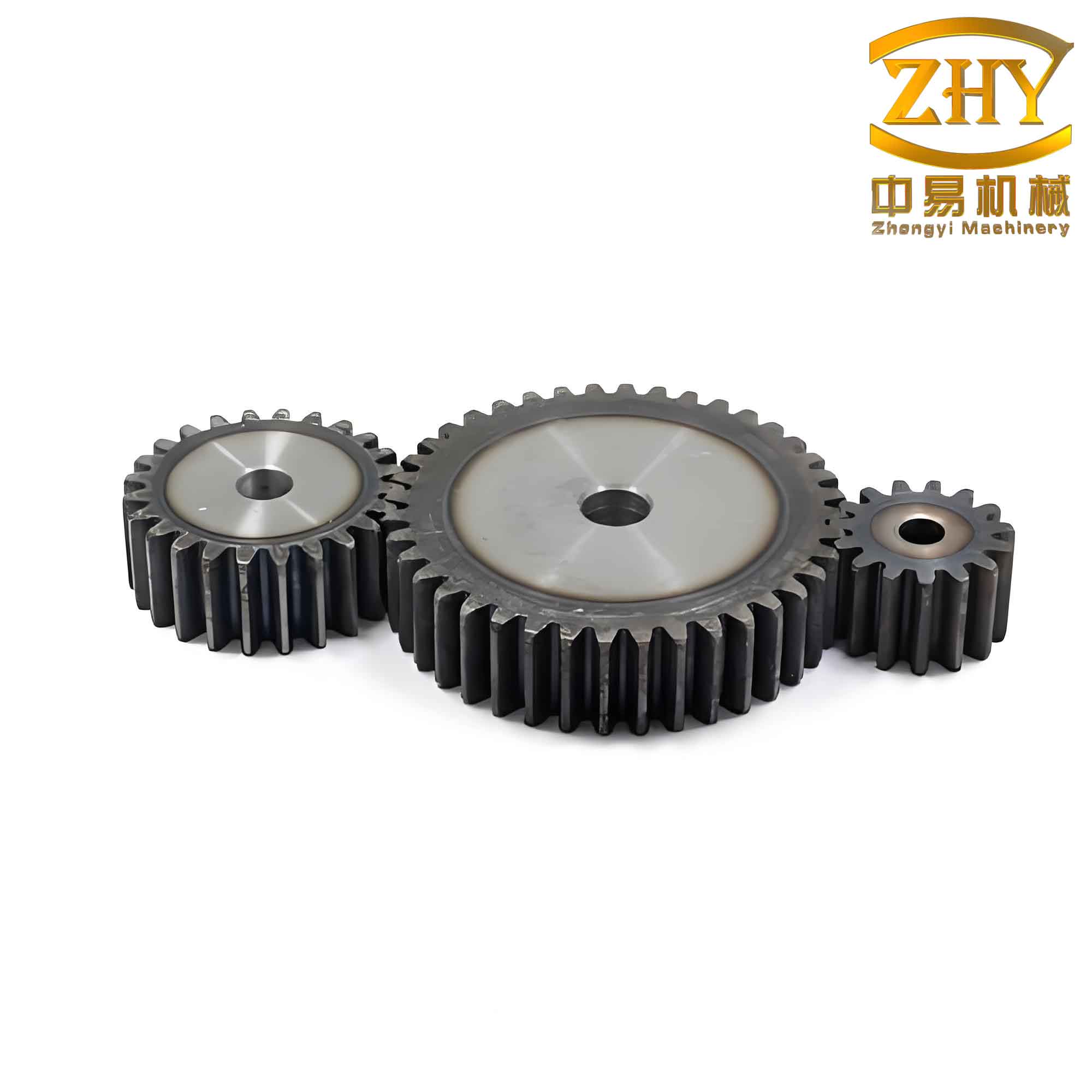
Time-Varying Meshing Stiffness Model for Straight Spur Gears
I developed the TVMS model based on the potential energy method, treating each gear tooth as a variable-section cantilever beam. The total potential energy stored in a meshing pair of straight spur gears consists of five components: Hertzian contact energy, bending energy, shear energy, axial compression energy, and fillet foundation energy. These can be expressed as:
$$U_h = \frac{F^2}{2k_h}, \quad U_b = \frac{F^2}{2k_b}, \quad U_s = \frac{F^2}{2k_s}, \quad U_a = \frac{F^2}{2k_a}, \quad U_f = \frac{F^2}{2k_f}$$
where \(F\) is the resultant meshing force at the contact interface. The total potential energy for a single tooth pair of straight spur gears can be written as:
$$U = \frac{F^2}{2k} = U_h + U_{b1} + U_{s1} + U_{a1} + U_{f1} + U_{b2} + U_{s2} + U_{a2} + U_{f2}$$
The total TVMS for a pair of straight spur gears is then given by:
$$k =
\begin{cases}
\frac{1}{\frac{1}{k_h} + \frac{1}{k_{b1}} + \frac{1}{k_{s1}} + \frac{1}{k_{a1}} + \frac{1}{k_{f1}} + \frac{1}{k_{b2}} + \frac{1}{k_{s2}} + \frac{1}{k_{a2}} + \frac{1}{k_{f2}}} & \text{single-tooth pair} \\
\sum_{i=1}^{2} \frac{1}{\frac{1}{k_{h,i}} + \frac{1}{k_{b1,i}} + \frac{1}{k_{s1,i}} + \frac{1}{k_{a1,i}} + \frac{1}{k_{f1,i}} + \frac{1}{k_{b2,i}} + \frac{1}{k_{s2,i}} + \frac{1}{k_{a2,i}} + \frac{1}{k_{f2,i}}} & \text{double-tooth pair}
\end{cases}$$
The tooth height for straight spur gears with profile modification is determined by considering two cases. Case 1 applies when the root circle is smaller than the base circle, where the tooth profile consists of an involute curve between the tip circle and the base circle, and a transition curve between the base circle and the root circle. Case 2 applies when the root circle is larger than the base circle, where the tooth profile is entirely an involute curve between the tip circle and the root circle.
For Case 1, the bending, shear, and axial compression stiffness components of straight spur gears are expressed as:
$$\frac{1}{k_b} = -\int_{\varphi_2}^{\varphi_3} \frac{3a_x(R_b – R_f \cos \varphi_3 \cos \varphi_1 – a_x \varphi \cos \varphi_1 – b_x \cos \varphi_1)^2}{EL \left[R_b \sin \varphi_2 + r_f – \sqrt{r_f^2 – (x – d_1)^2}\right]^3} d\varphi + \int_{-\varphi_1}^{\varphi_2} \frac{3\{1 + \cos \varphi_1[(\varphi_2 – \varphi)\sin \varphi – \cos \varphi]\}^2 (\varphi_2 – \varphi)\cos \varphi}{2EL [\sin \varphi_2 + (\varphi_2 – \varphi)\cos \varphi]^3} d\varphi$$
$$\frac{1}{k_s} = -\int_{\varphi_2}^{\varphi_3} \frac{1.2 a_x (1 + \nu) \cos^2 \varphi_1}{EL \left[R_b \sin \varphi_2 + r_f – \sqrt{r_f^2 – (x – d_1)^2}\right]} d\varphi + \int_{-\varphi_1}^{\varphi_2} \frac{1.2 (1 + \nu) (\varphi_2 – \varphi)\cos \varphi \cos^2 \varphi_1}{EL [\sin \varphi_2 + (\varphi_2 – \varphi)\cos \varphi]} d\varphi$$
$$\frac{1}{k_a} = -\int_{\varphi_2}^{\varphi_3} \frac{a_x \sin^2 \varphi_1}{2EL \left[R_b \sin \varphi_2 + r_f – \sqrt{r_f^2 – (x – d_1)^2}\right]} d\varphi + \int_{-\varphi_1}^{\varphi_2} \frac{(\varphi_2 – \varphi)\cos \varphi \sin^2 \varphi_1}{EL [\sin \varphi_2 + (\varphi_2 – \varphi)\cos \varphi]} d\varphi$$
The Hertzian contact stiffness for straight spur gears is given by:
$$k_h = \frac{\pi E L}{4(1 – \nu^2)}$$
where \(L\) is the tooth width, \(E\) is Young’s modulus, and \(\nu\) is Poisson’s ratio. The fillet foundation stiffness is expressed as:
$$\frac{1}{k_f} = \frac{\cos^2 \beta}{EL} \left[ L^* \left( \frac{u_f}{S_f} \right)^2 + M^* \left( \frac{u_f}{S_f} \right) + P^* (1 + Q^* \tan^2 \varphi_1) \right]$$
Geometric Relationships for Modified Straight Spur Gears
For straight spur gears with unequal modification coefficients between the pinion and gear, the geometric relationships become more complex. The pitch circle no longer coincides with the reference circle, and the location of pure rolling shifts from the standard position. The angles \(\varphi_1\) and \(\varphi_2\) for the pinion and gear are defined as:
$$\varphi_{1,p} = \varphi_{1,p}^0 + \beta_p, \quad \varphi_{1,g} = \varphi_{1,g}^0 – i_g \beta_g$$
$$\varphi_{2,p} = \frac{\pi}{N_p} \frac{s_p}{s_p + e_p} + \text{inv}(\varphi_0), \quad \varphi_{2,g} = \frac{\pi}{N_g} \frac{s_g}{s_g + e_g} + \text{inv}(\varphi_0)$$
where \(N_p\) and \(N_g\) are the tooth numbers, \(s_p\) and \(s_g\) are the tooth thicknesses, \(e_p\) and \(e_g\) are the differences between the pitch and tooth thickness, and \(\varphi_0\) is the reference pressure angle.
Key Design Parameters for Straight Spur Gears
The following table summarizes the design parameters I used for the straight spur gear and pinion system in my analysis:
| Parameter | Pinion | Gear |
|---|---|---|
| Number of teeth | 22 | 133 |
| Module (mm) | 5 | 5 |
| Face width (mm) | 70 | 70 |
| Pressure angle (°) | 20 | 20 |
| Addendum coefficient | 1.1 | 1.1 |
| Clearance coefficient | 0.25 | 0.25 |
| Young’s modulus (GPa) | 206 | 206 |
| Poisson’s ratio | 0.3 | 0.3 |
| Density (kg/m³) | 7850 | 7850 |
| Bearing stiffness (N/m) | 1 × 10¹⁰ | 1 × 10¹⁰ |
| Mass (kg) | 3.08 | 147.61 |
| Moment of inertia (kg·m²) | 6.66 × 10⁻⁹ | 8.936 |
Dynamic Model of Straight Spur Gear System
I employed a six-degree-of-freedom lumped-parameter dynamic model to study the vibrational response of the straight spur gear system. The equations of motion for the pinion and gear are given by:
$$m_p \ddot{x}_p + c_b \dot{x}_p + k_b x_p = -F_m$$
$$m_p \ddot{y}_p + c_b \dot{y}_p + k_b y_p = -F_f$$
$$I_p \ddot{\beta}_p = -F_m R_{b,p} – T_p$$
$$m_g \ddot{x}_g + c_b \dot{x}_g + k_b x_g = F_m$$
$$m_g \ddot{y}_g + c_b \dot{y}_g + k_b y_g = F_f$$
$$I_g \ddot{\beta}_g = -F_m R_{b,g} – T_g$$
The meshing force \(F_m\) and friction force \(F_f\) for straight spur gears are expressed as:
$$F_m = k(t) [x_p – x_g + R_{b,g} \beta_g – e(t)] + c_m [\dot{x}_p – \dot{x}_g + R_{b,g} \dot{\beta}_g – \dot{e}(t)]$$
$$F_f = -\mu F_m$$
The meshing damping coefficient \(c_m\) is calculated using the equivalent mass, damping ratio, and mean mesh stiffness:
$$c_m = 2\zeta \sqrt{\bar{k}_m m_e}$$
where \(\zeta\) is the damping ratio, \(\bar{k}_m\) is the mean meshing stiffness, and \(m_e = m_p m_g / (m_p + m_g)\) is the equivalent mass.
Single Tooth Profile Modification Analysis of Straight Spur Gears
Positive Modification
I first investigated the effect of positive modification on the tooth stiffness of straight spur gears. Six modification coefficients were considered: \(x_p = 0, 0.1, 0.2, 0.3, 0.4, \text{ and } 0.5\). My results showed that positive modification increases the tooth thickness, making the tooth more resistant to deformation, which results in higher stiffness. However, the effect varies during the meshing cycle. At the beginning of meshing, the stiffness increases with higher modification coefficients, while at the end of meshing, the trend reverses.
To quantify this effect, I defined a relative ratio:
$$\bar{k}_{p,i} = \frac{k_i – k_0}{k_0} \times 100\%$$
The TVMS results for straight spur gears with positive modification showed that as the modification coefficient increases, the overall TVMS decreases. The rate of change of TVMS also increases with larger modification coefficients, indicating that positive modification is a sensitive design parameter. The mean TVMS decreases nonlinearly with increasing modification coefficient, while the standard deviation increases significantly.
| Modification Coefficient \(x_p\) | Mean TVMS (N/m) | Standard Deviation (N/m) | Contact Ratio |
|---|---|---|---|
| 0.0 | 1.640 × 10⁹ | 2.25 × 10⁸ | 1.82 |
| 0.1 | 1.632 × 10⁹ | 2.48 × 10⁸ | 1.79 |
| 0.2 | 1.618 × 10⁹ | 2.72 × 10⁸ | 1.75 |
| 0.3 | 1.596 × 10⁹ | 2.95 × 10⁸ | 1.71 |
| 0.4 | 1.565 × 10⁹ | 3.15 × 10⁸ | 1.66 |
| 0.5 | 1.525 × 10⁹ | 3.32 × 10⁸ | 1.61 |
From the statistical indicators of the dynamic transmission error (DTE) for straight spur gears with positive modification, I observed that RMS, SRA, and PPV all increase monotonically with the modification coefficient. The kurtosis value (KV) shows a negative value for small modification coefficients but becomes positive for larger ones, indicating that small positive modifications reduce peakiness while larger ones amplify it.
Negative Modification
For negative modification, I studied six coefficients: \(x_p = 0, -0.1, -0.2, -0.3, -0.4, \text{ and } -0.5\). Unlike positive modification, negative modification makes the tooth more flexible. The greatest stiffness loss occurs at the middle of the meshing cycle. As the modification coefficient becomes more negative, the stiffness variation curve becomes more curved.
The TVMS results for straight spur gears with negative modification showed that at the beginning of meshing, the TVMS is lower than that of standard gears, but as meshing progresses, the combined stiffness gradually increases. Eventually, gears with smaller modification coefficients exhibit higher TVMS. Importantly, negative modification increases the contact ratio, which improves the smoothness and continuity of transmission for straight spur gears.
| Modification Coefficient \(x_p\) | Mean TVMS (N/m) | Standard Deviation (N/m) | Contact Ratio |
|---|---|---|---|
| 0.0 | 1.640 × 10⁹ | 2.25 × 10⁸ | 1.82 |
| -0.1 | 1.647 × 10⁹ | 2.18 × 10⁸ | 1.84 |
| -0.2 | 1.655 × 10⁹ | 2.10 × 10⁸ | 1.87 |
| -0.3 | 1.662 × 10⁹ | 2.03 × 10⁸ | 1.89 |
| -0.4 | 1.668 × 10⁹ | 1.97 × 10⁸ | 1.91 |
| -0.5 | 1.673 × 10⁹ | 1.91 × 10⁸ | 1.93 |
The statistical indicators for DTE of straight spur gears with negative modification showed that RMS and RSA decrease monotonically, indicating that negative modification effectively suppresses vibration. The kurtosis value improves slowly, while the peak-to-peak value (PPV) does not change significantly. These results confirm that negative modification enhances the dynamic stability of straight spur gear systems.
Compound Tooth Profile Modification Analysis of Straight Spur Gears
In practical applications, compound modification is often used to optimize the mechanical performance of straight spur gear pairs. Two common types are S-gear drives (where the total modification coefficient is non-zero) and s0-gear drives (where the total modification coefficient is zero). I investigated several compound modification configurations:
| Group | Pinion Coefficient \(x_p\) | Gear Coefficient \(x_g\) | Total Coefficient \(x_p + x_g\) | Type |
|---|---|---|---|---|
| 1 | 0.4 | 0.1 | 0.5 | Positive S-gear |
| 2 | 0.2 | 0.1 | 0.3 | Positive S-gear |
| 3 | 0.1 | -0.6 | -0.5 | Negative S-gear |
| 4 | 0.1 | -0.4 | -0.3 | Negative S-gear |
| 5 | 0.1 | -0.1 | 0.0 | s0-gear |
| 6 | 0.0 | 0.0 | 0.0 | Standard |
My analysis of compound modification for straight spur gears revealed that negative total modification coefficients increase both the contact ratio and the meshing stiffness, while positive total modification coefficients significantly reduce both. The s0-gear configuration has a relatively small effect on TVMS but a notable impact on dynamic characteristics.
| Group | Mean TVMS (N/m) | Standard Deviation (N/m) | Contact Ratio |
|---|---|---|---|
| 1 (Positive S) | 1.545 × 10⁹ | 3.05 × 10⁸ | 1.58 |
| 2 (Positive S) | 1.585 × 10⁹ | 2.85 × 10⁸ | 1.65 |
| 3 (Negative S) | 1.678 × 10⁹ | 1.82 × 10⁸ | 1.95 |
| 4 (Negative S) | 1.665 × 10⁹ | 1.95 × 10⁸ | 1.90 |
| 5 (s0-gear) | 1.638 × 10⁹ | 2.28 × 10⁸ | 1.81 |
| 6 (Standard) | 1.640 × 10⁹ | 2.25 × 10⁸ | 1.82 |
The dynamic transmission error (DTE) statistical indicators for compound modification of straight spur gears showed that positive S-gear drives have higher vibration indicators than negative S-gear drives. The RSA difference between positive and negative S-gear configurations reached approximately 15%. The kurtosis value for S-gear drives showed a bent curve, indicating that the time-domain waveform becomes steeper. For s0-gear straight spur gears, the statistical indicators differ from standard gears because the pinion and gear have modification coefficients that are equal in magnitude but opposite in sign, leading to asymmetric dynamic behavior.
Summary of Dynamic Statistical Indicators for Straight Spur Gears
I extracted four time-domain indicators — RMS, SRA, PPV, and KV — to evaluate the vibration acceleration characteristics of straight spur gears under different modification schemes. The following table summarizes the percentage changes relative to standard straight spur gears for a damping ratio of \(\zeta = 0.08\):
| Modification Type | Coefficient | RMS Change (%) | RSA Change (%) | PPV Change (%) | KV Change (%) |
|---|---|---|---|---|---|
| Positive | \(x_p = 0.3\) | +8.5 | +7.2 | +4.1 | +2.3 |
| Positive | \(x_p = 0.5\) | +18.6 | +16.4 | +9.8 | +5.7 |
| Negative | \(x_p = -0.3\) | -4.2 | -3.8 | -1.5 | -0.8 |
| Negative | \(x_p = -0.5\) | -7.8 | -7.1 | -2.9 | -1.6 |
| Positive S-gear | Group 1 | +22.3 | +19.8 | +12.5 | +8.1 |
| Negative S-gear | Group 3 | -12.6 | -11.4 | -5.2 | -3.7 |
| s0-gear | Group 5 | -1.2 | -1.0 | +0.5 | -0.3 |
Discussion of Results for Straight Spur Gears
My comprehensive analysis of tooth profile modification for straight spur gears reveals several important findings. For single profile modification, positive modification increases tooth thickness but reduces tooth stiffness and contact ratio, leading to increased vibration in the gear system. In contrast, negative modification improves tooth stiffness and increases the contact ratio, resulting in smoother transmission for straight spur gears.
The TVMS results show that positive modification causes a decrease in the overall meshing stiffness and an increase in its fluctuation, which directly contributes to higher dynamic excitation. Negative modification has the opposite effect, increasing the mean TVMS while reducing its fluctuation. This explains why negative modification leads to lower vibration levels in straight spur gear systems.
For compound modification, negative S-gear drives produce the highest TVMS and the lowest vibration levels among all configurations studied. The s0-gear configuration, where the total modification coefficient is zero, has a relatively small impact on TVMS but still affects the dynamic characteristics due to the asymmetric distribution of modification between the pinion and gear. This finding is particularly important for the design of straight spur gears where maintaining the center distance is critical.
The damping ratio \(\zeta\) was found to have a relatively small influence on the trends of the statistical indicators, suggesting that the conclusions drawn from this study are robust across different damping conditions for straight spur gears.
Conclusion
In this study, I established a comprehensive analytical model for investigating the meshing dynamic characteristics of tooth profile modified straight spur gears. The model considers five stiffness components: Hertzian contact stiffness, bending stiffness, shear stiffness, axial compressive stiffness, and fillet foundation stiffness. Using this model, I systematically analyzed the effects of single and compound tooth profile modifications on TVMS and dynamic behavior of straight spur gears.
My key findings for straight spur gears can be summarized as follows:
First, for single tooth profile modification, positive modification increases tooth thickness but reduces both the tooth stiffness and the contact ratio of the gear pair, which intensifies system vibration. Negative modification improves tooth stiffness and increases the contact ratio, making the transmission of straight spur gears more stable and reducing vibration levels by up to 7.8% in RMS.
Second, for compound modification, negative S-gear drives increase TVMS and significantly reduce vibration in straight spur gears, with RMS reductions of over 12%. The s0-gear configuration has a relatively small effect on TVMS but still influences dynamic characteristics due to the asymmetric distribution of modification coefficients between the pinion and gear.
Third, the TVMS mean and standard deviation exhibit different trends for positive and negative modifications. For positive modification of straight spur gears, the mean TVMS decreases nonlinearly while the standard deviation increases. For negative modification, the mean TVMS increases linearly while the standard deviation decreases linearly.
These findings provide valuable guidance for the design and optimization of tooth profile modified straight spur gears, enabling engineers to select appropriate modification coefficients to achieve desired dynamic performance and vibration characteristics.