
We developed a comprehensive dynamic model for an encased differential herringbone gear transmission system using the lumped-parameter method. The model accounts for bearing elastic deformations, time-varying mesh stiffness of herringbone gear pairs, error excitations (run-out and meshing-frequency errors), and the effects of intermediate floating components. The herringbone gear time-varying mesh stiffness was computed by applying the helical gear stiffness formula in a parallel configuration. The system’s dynamic equations were solved via the Fourier series method to obtain the dynamic load sharing coefficients. We then systematically investigated how run-out and meshing-frequency errors influence the load sharing behavior of the system. The results show that the load sharing coefficient of the differential stage is highly sensitive to meshing-frequency errors, increasing with larger meshing-frequency errors, while remaining largely unaffected by run-out errors. Conversely, the load sharing coefficient of the encased stage is strongly influenced by run-out errors and increases with them, but is hardly affected by meshing-frequency errors. Furthermore, the impact of meshing-frequency errors on the differential stage’s load sharing coefficient is more significant than that of run-out errors on the encased stage, leading to a larger load sharing coefficient in the differential stage compared to the encased stage.
Encased differential planetary transmissions, which combine a single-degree-of-freedom star gear train (encased stage) with a two-degree-of-freedom differential planetary gear train (differential stage), are widely used in applications such as aircraft engine main reducers, hoisting mechanisms, and ship propulsion systems. These systems achieve power splitting through multiple planet gears (or star gears), offering advantages like compact size, light weight, and high load capacity. The uniformity of load distribution among the multiple planets is a critical issue that directly affects the service life, operational stability, and reliability of the transmission. Therefore, studying the load sharing characteristics of encased differential planetary systems has significant engineering importance. Manufacturing and assembly errors, such as gear run-out and tooth surface deviations, introduce periodic displacement excitations at the meshing interfaces, which are key sources of dynamic excitation. Understanding how these errors affect system dynamics is essential for guiding gear design accuracy and machining process selection. Our work focuses on a herringbone gear variant of this system, which offers advantages in terms of smoothness and load capacity due to its double-helical geometry.
Dynamic Model of the Herringbone Gear Transmission System
The encased differential herringbone gear train under study consists of a differential stage and an encased stage connected through intermediate floating components. The differential stage includes a sun gear Zs1, N planet gears Zpi (i=1,2,…,N), a ring gear Zr1, a carrier H, an intermediate floating member Zg1, and a floating ring gear Zf1. The encased stage comprises a sun gear Zs2, M star gears Zmj (j=1,2,…,M), a ring gear Zr2, an intermediate floating member Zg2, and a floating ring gear Zf2. Input torque Td is applied to Zs1, and power splits through the carrier H and the ring gear Zr1, then passes through the floating components to the encased stage, and finally merges at the output shaft L via H and the encased floating ring gear Zf2.
We built a lumped-parameter dynamic model. A rotating coordinate system (rotating with the carrier at speed ωH) was used for the differential stage, while a fixed coordinate system was adopted for the encased stage. The model incorporates elastic deformations of bearings, time-varying mesh stiffness of herringbone gear pairs, error excitations, and the influence of intermediate floating components (double-tooth couplings) which act as elastic elements to equalize loads. The system has (18 + N + M) degrees of freedom. The generalized displacement vector X is defined as:
$$ X = \{ x_{s1}, H_{s1}, V_{s1}, x_{pi}, x_{r1}, H_{r1}, V_{r1}, x_{g1}, x_{f1}, x_{s2}, H_{s2}, V_{s2}, x_{mj}, x_{r2}, H_{r2}, V_{r2}, x_{g2}, x_{f2}, x_H, x_L \}^T $$
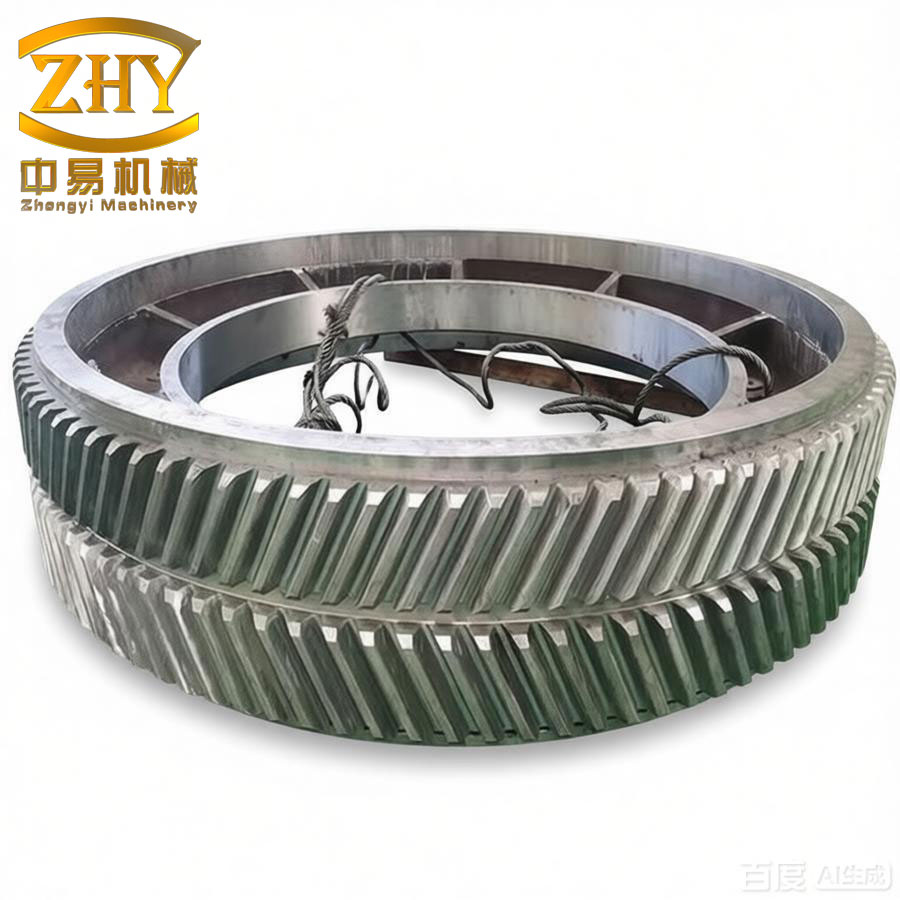
where symbols denote linear displacements along base circles (e.g., xs1, xpi, etc.), transverse/longitudinal displacements of floating centers (H, V), and output shaft displacements. The herringbone gear train schematic is shown below:
Gear Mesh Forces
The elastic mesh forces P between gear pairs are expressed as:
$$ P_{spi} = K_{spi} \left[ x_{s1} – x_{pi} + H_{s1} \cos\left( \frac{\pi}{2} – \alpha_1 + \frac{2\pi}{N}(i-1) \right) + V_{s1} \cos\left( \alpha_1 – \frac{2\pi}{N}(i-1) \right) – e_{spi}(t) \right] $$
$$ P_{rpi} = K_{rpi} \left[ x_{pi} – x_{r1} – H_{r1} \cos\left( \frac{\pi}{2} – \alpha_2 – \frac{2\pi}{N}(i-1) \right) – V_{r1} \cos\left( \pi – \alpha_2 – \frac{2\pi}{N}(i-1) \right) – e_{rpi}(t) \right] $$
$$ P_{smj} = K_{smj} \left[ x_{s2} – x_{mj} + H_{s2} \cos\left( \frac{\pi}{2} – \alpha_3 + \frac{2\pi}{M}(j-1) \right) + V_{s2} \cos\left( \alpha_3 – \frac{2\pi}{M}(j-1) \right) – e_{smj}(t) \right] $$
$$ P_{rmj} = K_{rmj} \left[ x_{mj} – x_{r2} – H_{r2} \cos\left( \frac{\pi}{2} – \alpha_4 – \frac{2\pi}{M}(j-1) \right) – V_{r2} \cos\left( \pi – \alpha_4 – \frac{2\pi}{M}(j-1) \right) – e_{rmj}(t) \right] $$
Here, Kspi, Krpi, Ksmj, Krmj are the time-varying mesh stiffnesses of the corresponding herringbone gear pairs; α1–α4 are the pressure angles; and e(t) represents the equivalent displacement errors (run-out and meshing-frequency errors) projected onto the line of action. Similar expressions hold for the damping forces D, with damping coefficients C.
Equations of Motion
The dynamic equations for each component are given below. For brevity, we list representative ones:
Differential sun gear:
$$ m_{s1} \ddot{x}_{s1} + \sum_{i=1}^N (P_{spi} + D_{spi}) = P_d $$
$$ M_{s1} \ddot{H}_{s1} + \sum_{i=1}^N (P_{spi} + D_{spi}) \sin\left( \alpha_1 – \frac{2\pi}{N}(i-1) \right) + K_{s1} H_{s1} = -G_{s1} \sin(\omega_H t) $$
$$ M_{s1} \ddot{V}_{s1} + \sum_{i=1}^N (P_{spi} + D_{spi}) \cos\left( \alpha_1 – \frac{2\pi}{N}(i-1) \right) + K_{s1} V_{s1} = -G_{s1} \cos(\omega_H t) $$
Differential planet gear:
$$ m_p \ddot{x}_{pi} – (P_{spi} + D_{spi}) + (P_{rpi} + D_{rpi}) = 0 $$
Differential ring gear (with floating intermediate member):
$$ m_{r1} \ddot{x}_{r1} – \sum_{i=1}^N (P_{rpi} + D_{rpi}) + K_{g1q}(x_{r1} – x_{g1}) = 0 $$
$$ M_{r1} \ddot{H}_{r1} – \sum_{i=1}^N (P_{rpi} + D_{rpi}) \sin\left( \alpha_2 + \frac{2\pi}{N}(i-1) \right) + K_{r1} H_{r1} = -G_{r1} \sin(\omega_H t) $$
$$ M_{r1} \ddot{V}_{r1} + \sum_{i=1}^N (P_{rpi} + D_{rpi}) \cos\left( \alpha_2 + \frac{2\pi}{N}(i-1) \right) + K_{r1} V_{r1} = -G_{r1} \cos(\omega_H t) $$
Intermediate floating components (g1, f1, g2, f2) and encased stage equations follow similar patterns. The output shaft equation includes load torque PL. All parameters are defined in the original work.
Error Equivalent Displacement and Time-Varying Mesh Stiffness of Herringbone Gear
Run-out errors represent manufacturing and assembly inaccuracies, while meshing-frequency errors represent tooth profile deviations. Both are transformed into equivalent displacements along the line of action. For the herringbone gear pairs, the combined error displacement e(t) is:
$$ e_{spi}(t) = E_{spi} \sin(\omega_1 t + \phi_{spi}) – E_{pi} \sin(\omega_{p:H} t + \phi_{pi} – \alpha_1) – E_{s1} \sin\left( \omega_{s:H} t – \frac{2\pi}{N}(i-1) – \phi_{s1} + \alpha_1 \right) $$
Similar expressions exist for erpi, esmj, and ermj, with amplitudes E and phase angles φ.
The herringbone gear time-varying mesh stiffness is computed by treating the gear as two helical halves in parallel. Using the formula derived by Maatar and Velex, the stiffness can be written as:
$$ k(t) = k_0 \left[ 1 + \sum_{k=1}^{\infty} \left( A_k \cos(2\pi k \tau – \psi) + B_k \sin(2\pi k \tau – \psi) \right) \right] L_m $$
where τ = t/Tm, Tm is the mesh period, ψ is the mesh phase difference between planets, and k0, Ak, Bk, Lm are defined by Maatar and Velex. The phase differences between inner and outer meshes and among planets are calculated according to Parker and Lin.
Solution of Dynamic Equations and Load Sharing Coefficients
The assembled dynamic equations can be written in matrix form:
$$ [M] \{\ddot{x}\} + [C] \{\dot{x}\} + [K] \{x\} = \{P\} $$
We separated the stiffness matrix into mean and fluctuating parts, and the displacement into static and dynamic components. After neglecting second-order small terms, we obtained a linear time-invariant system:
$$ [M] \{\Delta \ddot{x}\} + [C] \{\Delta \dot{x}\} + [\bar{K}] \{\Delta x\} = \{F\} $$
The excitation vector F includes mesh stiffness fluctuation, error excitations, gravity, and load. The mesh stiffness fluctuation was expanded into a Fourier series up to the 5th harmonic of the mesh frequency for both stages. Additionally, we considered the carrier rotational frequency and the relative rotational frequencies of the sun, planet, and ring gears. The total set included 18 excitation frequencies. We solved the frequency response for each and then superimposed them in the time domain to obtain the displacement time histories.
The dynamic mesh forces were then computed from the displacements. For each mesh cycle, the load sharing coefficient b for a given planet/star gear is defined as:
$$ b_{spi,k1} = \frac{N (P_{spi,k1})_{\max}}{\sum_{i=1}^N (P_{spi,k1})_{\max}} $$
where k1 indexes mesh cycles. The system-level load sharing coefficient for outer meshes of the differential stage is:
$$ B_{spi} = \max_{k1} | b_{spi,k1} – 1 | + 1 $$
Similar definitions apply to inner meshes and to the encased stage. Finally, the overall load sharing coefficient for the differential stage Bp and encased stage Bm are taken as the maximum of their respective outer and inner coefficients.
Analysis of Load Sharing Characteristics
We analyzed a specific herringbone gear reducer. Key parameters are summarized in the table below.
| Parameter | Differential Stage | Encased Stage |
|---|---|---|
| Module (mm) | 7 | 7 |
| Number of planets (N or M) | 3 | 5 |
| Sun gear teeth | 37 | 71 |
| Planet/star teeth | 56 | 39 |
| Ring gear teeth | 149 | 149 |
| Face width factor | 1.2 | 0.6 |
| Normal pressure angle (deg) | 20 | 20 |
| Helix angle (deg) | 22 | 22 |
| Input speed (r/min) | 3000 | – |
| Input power (kW) | 20000 | – |
| Bearing support stiffness (N/m) | 3×10⁸ | 3×10⁸ |
| Run-out error (μm) | 20 (baseline) | 20 (baseline) |
| Meshing-frequency error (μm) | 8 (baseline) | 8 (baseline) |
We first studied the effect of run-out errors alone (setting meshing-frequency errors to zero). The load sharing coefficients for each planet/star gear are plotted conceptually. The differential stage had a coefficient of 1.0233, while the encased stage reached 1.1457. This indicates that the encased stage is more sensitive to run-out errors. The reason is that the encased stage uses 5 star gears (more than 3), and the floating-center equalization method is less effective for such a configuration, leading to larger load imbalance under run-out errors.
Next, we considered meshing-frequency errors alone (run-out errors zero). The differential stage coefficient was 1.2905, much larger than the encased stage coefficient of 1.0072. This shows the differential stage is highly sensitive to meshing-frequency errors. This occurs because the encased stage transmits a much larger torque (by a factor of Zr1/Zs1 ≈ 4), and heavier loads tend to equalize load distribution. Hence the differential stage, with lighter load, suffers more from meshing-frequency errors.
Combined effects (both errors present) gave a differential coefficient of 1.2918 and encased coefficient of 1.1442, confirming that the differential stage dominates the overall load imbalance. The load sharing coefficients of the differential and encased stages as functions of run-out error (with fixed meshing-frequency error of 8 μm) are shown in the table below.
| Run-out error (μm) | Differential Bp | Encased Bm |
|---|---|---|
| 10 | 1.2915 | 1.0802 |
| 20 | 1.2918 | 1.1442 |
| 30 | 1.2920 | 1.1980 |
| 40 | 1.2923 | 1.2455 |
Similarly, with fixed run-out error (20 μm), varying meshing-frequency error produced:
| Meshing-frequency error (μm) | Differential Bp | Encased Bm |
|---|---|---|
| 4 | 1.1452 | 1.1440 |
| 8 | 1.2918 | 1.1442 |
| 12 | 1.4376 | 1.1443 |
| 16 | 1.5820 | 1.1445 |
These results clearly demonstrate that the differential stage load sharing coefficient is governed almost entirely by meshing-frequency errors, while the encased stage is controlled by run-out errors. Furthermore, the sensitivity of the differential stage to meshing-frequency errors is greater than the sensitivity of the encased stage to run-out errors, as indicated by the slopes of the relationships.
Conclusions
Based on our dynamic analysis of the encased differential herringbone gear train, we draw the following conclusions:
- Because the encased stage uses 5 star gears (more than 3), the floating-center method is less effective in mitigating run-out errors, making the encased stage load sharing coefficient sensitive to run-out errors. The differential stage, with only 3 planets, is less affected by run-out errors.
- Meshing-frequency errors strongly affect the differential stage due to its relatively light load; the encased stage, carrying much larger torque, is nearly insensitive to meshing-frequency errors.
- Under run-out errors alone, the differential stage coefficient is much smaller than that under meshing-frequency errors alone; under combined errors, the differential stage coefficient is dominated by meshing-frequency errors, while the encased stage coefficient is dominated by run-out errors.
- The differential stage load sharing coefficient increases with increasing meshing-frequency errors and is nearly independent of run-out errors. The encased stage coefficient increases with run-out errors and is independent of meshing-frequency errors.
- The impact of meshing-frequency errors on the differential stage is greater than that of run-out errors on the encased stage, resulting in a higher load sharing coefficient for the differential stage. Therefore, the differential planets experience more severe load imbalance than the encased star gears in this herringbone gear transmission system.
These findings provide valuable guidance for the design and manufacturing precision of encased differential herringbone gear trains, emphasizing the need to control meshing-frequency errors in the differential stage and run-out errors in the encased stage to achieve balanced load sharing.