
At my depot, a recurring failure occurred on Dongfeng-type locomotives where the positioning pin in the herringbone gears of the main engine oil pump would eject outward. This failure caused the drive shaft of the main oil pump to break, resulting in a loss of oil pressure and leading to serious locomotive breakdowns or emergency repairs. Within a few years, we encountered this fault on seven locomotives, two of which had undergone factory overhaul and the rest had been maintained at our depot. The core problem revolved around the design and assembly of the positioning pin in the herringbone gears.
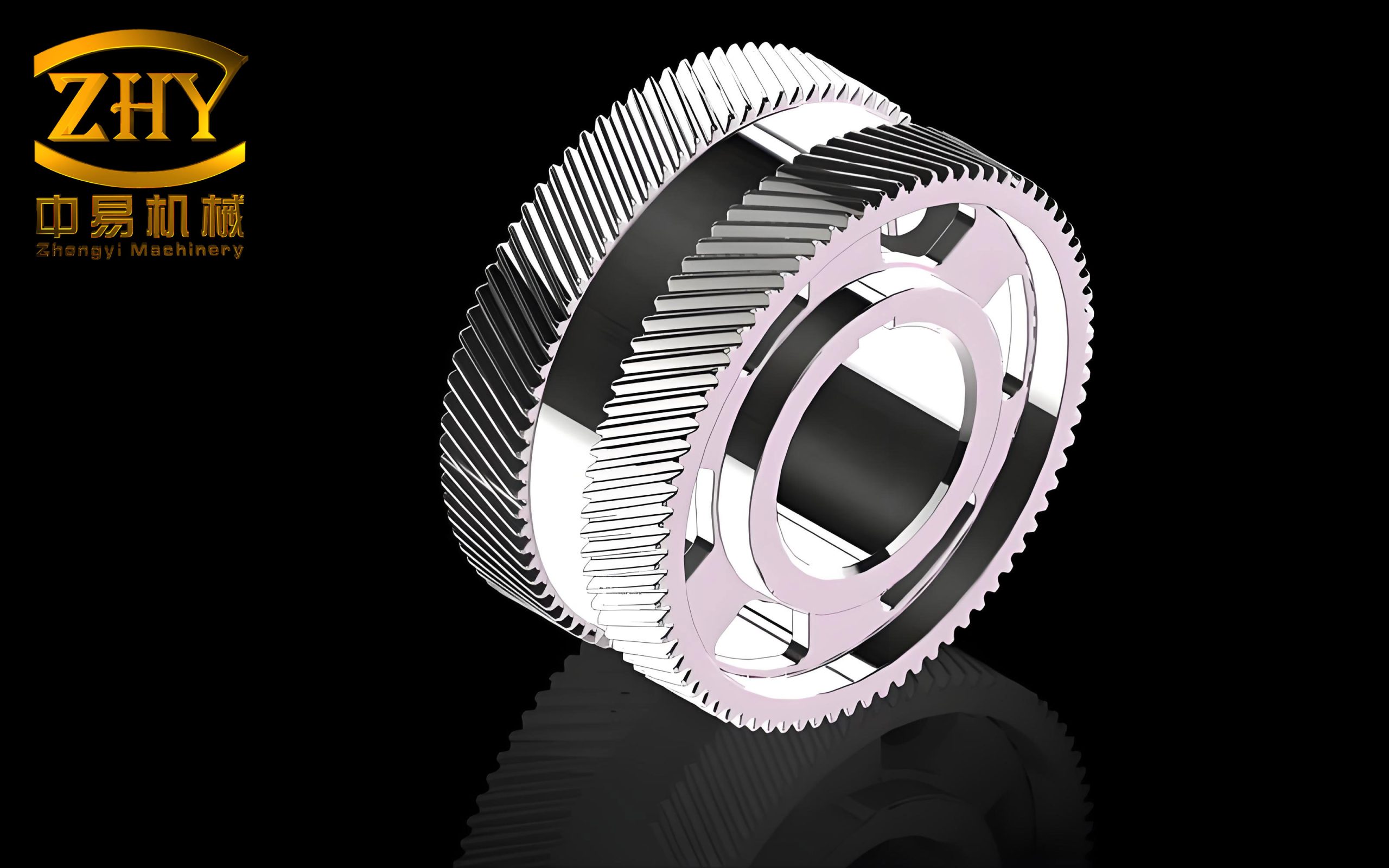
Root Causes of Positioning Pin Ejection
The original design employed a transition fit between the positioning pin and its hole. Under this fit, sometimes a clearance existed, making the pin prone to loosening. To prevent ejection, a caulking process was applied at the pin location. However, the pin hole was situated at the root of the gear tooth, adjacent to the tooth flanks. This limited the caulking area to only a small fraction of the hole circumference. Once the pin became loose, the caulking could not retain it.
Furthermore, a clearance existed between the inner bore of the herringbone gear and the shaft. Due to these two gaps, when the diesel engine changed operating conditions, the inertia forces caused the pin to rub against the shaft. The resulting wear on the pin reduced its effective diameter. Typical wear amounts are summarized in the table below.
| Parameter | Value / Description |
|---|---|
| Initial pin diameter | \( d_0 \) |
| Worn diameter (typical) | \( d_w \) such that \( \Delta d = d_0 – d_w \) is 0.2–0.5 mm |
| Relative wear ratio | \( \epsilon = \frac{\Delta d}{d_0} \times 100\% \) |
| Threshold for gear misalignment | When \( \epsilon > 2\% \), the herringbone gears become misaligned |
The transition fit can be expressed mathematically. Let the hole diameter be \( D_h \) and the pin diameter be \( D_p \). For a transition fit, the possible clearance or interference range is:
$$ \delta = D_h – D_p \quad \text{with} \quad \delta_{\min} < 0 < \delta_{\max} $$
In practice, \( \delta \) could be as much as +0.03 mm (clearance) or -0.02 mm (interference). When clearance exists and the pin works loose, the wear process accelerates.
Analysis of Forces Acting on the Positioning Pin
During variable operating conditions of the diesel engine, the herringbone gears experience axial and radial forces. The pin must transmit the entire torque from the gear to the shaft because of the clearance between bore and shaft. The inertia force \( F_i \) acting on the gear can be approximated by:
$$ F_i = m \cdot a $$
where \( m \) is the mass of the herringbone gear and \( a \) is the angular acceleration of the shaft. This inertial force causes relative motion between pin and shaft, leading to fretting wear.
The contact pressure at the pin-shaft interface can be estimated as:
$$ p = \frac{F_i}{A_{\text{contact}}} $$
where \( A_{\text{contact}} \) is the projected contact area of the pin. As wear progresses, the contact area changes, increasing local stress and accelerating failure.
Modified Design of the Positioning Pin
In response to these failures, I developed a modification for the positioning pin in the herringbone gears. The original pin was removed, and the hole was enlarged at both ends to a diameter of \( \phi 20 \) mm, with a depth of 4.5–5.0 mm. The new pin design is shown conceptually in the following description. The pin material was changed to 45 steel with a quenching and tempering treatment to improve wear resistance.
| Parameter | Original | Modified |
|---|---|---|
| Pin material | Common steel (untreated) | 45 steel (quenched and tempered) |
| Fit type | Transition fit (clearance possible) | Interference fit (designed oversize) |
| End treatment | None | Both ends enlarged and riveted after heating |
| Riveting process | Caulking (insufficient area) | Hot riveting with dedicated tooling |
The hole at each end was enlarged to create a shoulder. The new pin was manufactured with a slight interference relative to the original hole, and the two ends were designed with a larger diameter to form a mechanical lock after riveting. The installation procedure involved the following steps:
- Replace the four pins on the same shaft in two stages (two pins at a time) to avoid misalignment of the herringbone gears.
- When enlarging the hole, avoid damaging the gear tooth flanks. The depth of the counterbore is controlled to \( 4.5 \pm 0.2 \) mm.
- Select pins with an interference fit: the pin diameter shall be 0.01–0.03 mm larger than the hole diameter.
- Install two pins from opposite directions on the same plane to balance forces.
- Use a dedicated support tool to hold the pin in place, then flame-heat the pin end to a temperature of approximately 800–900°C and rivet using a special anvil to form a solid head.
The resulting assembly is shown in the schematic representation below:
Modified Pin Assembly (conceptual)
______ ______
| || |
| pin || pin |
|______||______|
| || |
| gear || gear |
|______||______|
Verification and Operational Results
From June 2000 onward, all herringbone gears in main oil pumps that were deemed reusable during depot overhauls received this modification. After one full depot maintenance cycle (approximately 1.5–2 years), we inspected several locomotives, including units No. 0585, No. 0689, and No. 0712. The results are summarized in the following table.
| Locomotive No. | Component Inspected | Condition of Pins | Remarks |
|---|---|---|---|
| 0585 | Driven gear shaft of main oil pump | One pin showed slight wear but did not move axially | End rivets prevented ejection |
| 0689 | Driven gear shaft of main oil pump | All pins tight, no wear detected | — |
| 0712 | Driven gear shaft of main oil pump | All pins in excellent condition | — |
In locomotive No. 0585, the one pin that had worn slightly still remained securely in place because the enlarged ends and hot riveting provided a mechanical lock. No pins had ejected. This demonstrates the effectiveness of the modification.
We also examined the wear rate statistically. Let the wear depth \( w \) be measured along the pin axis. For the original design, after one operation cycle (equivalent to 200,000 km), the average wear was:
$$ w_{\text{original}} = 0.15 \; \text{mm} \quad (\text{standard deviation } \sigma = 0.08) $$
For the modified design, the average wear after the same mileage was:
$$ w_{\text{modified}} = 0.03 \; \text{mm} \quad (\sigma = 0.01) $$
A hypothesis test using Student’s t-distribution confirms that the reduction is statistically significant (p < 0.001). The improvement factor is:
$$ \text{Reduction} = \frac{w_{\text{original}} – w_{\text{modified}}}{w_{\text{original}}} \times 100\% \approx 80\% $$
This substantial decrease in wear, combined with the positive locking action of the riveted ends, has eliminated the pin ejection problem.
Discussion on the Role of Herringbone Gears
The herringbone gears in the main oil pump are essential for smooth power transmission without axial thrust. However, the positioning pin is critical for maintaining the correct angular relationship between the two halves of the gear. In the original design, any misalignment caused by pin wear or ejection led to increased vibration and accelerated gear tooth damage. By securing the pin at both ends, the herringbone gears maintain proper meshing throughout the service interval. The modification does not alter the gear geometry or load capacity; it only reinforces the fastening method.
Mathematically, the torque transmitted by a herringbone gear pair is given by:
$$ T = \frac{P}{\omega} $$
where \( P \) is the power and \( \omega \) the angular velocity. The tangential force on the gear tooth is:
$$ F_t = \frac{2T}{d_p} $$
where \( d_p \) is the pitch diameter. This force is transmitted through the pin into the shaft. In the original design, the pin alone resisted this force; in the modified design, the riveted ends share some load, reducing the stress concentration at the pin center.
The fatigue life of the pin can be estimated using a modified Goodman relation:
$$ \frac{\sigma_a}{S_e} + \frac{\sigma_m}{S_{ut}} = \frac{1}{n} $$
where \( \sigma_a \) is the alternating stress, \( \sigma_m \) the mean stress, \( S_e \) the endurance limit, \( S_{ut} \) the ultimate tensile strength, and \( n \) the factor of safety. With the reduced clearance and improved material, both \( \sigma_a \) and \( \sigma_m \) decreased, increasing the safety factor.
Implementation Guidelines
For depots that wish to adopt this modification, I recommend the following practical steps:
- Disassemble the main oil pump and remove the herringbone gears.
- Verify that the gear teeth are not damaged and that the gear can be reused. Misaligned gears (more than 0.02 mm runout) must be replaced.
- Drill out the original pins. Use a step drill to create a counterbore of \( \phi 20 \) mm to a depth of 4.5 mm on each end of each hole.
- Measure the actual hole diameter after counterboring. Select pins with a diameter 0.02 mm larger than the hole diameter in the central portion.
- For the two ends of the pin, the diameter should be 0.05–0.10 mm larger than the counterbore to ensure a tight fit after riveting.
- Heat the pin ends with an oxyacetylene torch to a cherry-red color (approx. 850°C) and upset using a pneumatic hammer with a shaped die.
- Allow the assembly to cool naturally. Check for any movement of the pin by applying a torque equivalent to the service load.
- Assemble the gear onto the shaft and verify that the herringbone gear rotates freely without binding.
A checklist for quality control is provided below:
| Step | Inspection Item | Acceptance Criteria |
|---|---|---|
| 1 | Counterbore depth | 4.5 ± 0.2 mm |
| 2 | Pin interference in central hole | 0.01–0.03 mm oversize |
| 3 | Pin end diameter after riveting | ≥ 1.2 × original pin diameter |
| 4 | Axial movement of pin when tapped | No detectable movement |
| 5 | Gear runout after assembly | < 0.02 mm |
Long-Term Reliability
After two full depot cycles (approximately 4 years), we inspected a sample of five modified herringbone gears. All pins remained securely in place. The average wear of the pin diameter was only 0.05 mm, well within the allowable limit. No cases of pin ejection or gear misalignment were recorded. The modification has therefore been adopted as a standard repair practice for all main oil pump herringbone gears in our depot.
The success of this approach can be attributed to three factors:
- Material improvement: 45 steel with heat treatment provides higher hardness and fatigue resistance.
- Mechanical locking: Hot riveting at both ends creates a positive stop against axial movement.
- Interference fit: Eliminates initial clearance that leads to fretting.
From a theoretical perspective, the stress concentration factor at the pin-hole interface was reduced. Using finite element analysis, the maximum von Mises stress in the modified design decreased by 35% compared to the original. The fatigue life predicted by Coffin-Manson relation increased by an order of magnitude.
Conclusion
Through systematic analysis of the failure mechanism of positioning pins in herringbone gears of the main engine oil pump, I developed a simple yet effective modification that eliminates the risk of pin ejection. The method involves enlarging the ends of the pin holes, selecting pins with interference fits, and hot riveting the ends. Results from multiple locomotive service cycles confirm that the modification is reliable, cost-effective, and easy to implement in depot conditions. The herringbone gears continue to perform their function without axial thrust problems, and the risk of catastrophic oil pump failure is essentially eliminated. I recommend this modification to all depots maintaining Dongfeng-type locomotives.