
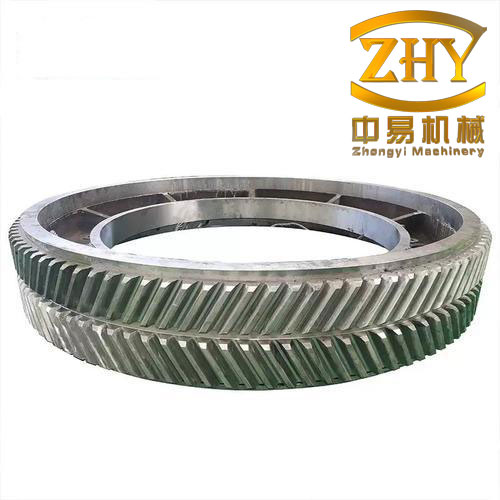
As a manufacturing engineer specializing in gear machining, I have long been confronted with the challenge of producing high-quality herringbone gears. These gears, also known as double helical gears, are widely used in heavy machinery such as presses, marine transmissions, and power generation equipment due to their smooth operation and high load-carrying capacity. However, their unique geometry—two opposing helical teeth separated by a central gap—imposes strict requirements on the alignment of the two helical halves. In particular, the two helical lines must intersect exactly at the midpoint of the relief groove (the central gap) to ensure proper meshing, low noise, and uniform load distribution. According to the Mechanical Engineering Handbook, for grade 7 precision herringbone gears, the allowable deviation is within 0.05 mm; for grade 8, it is within 0.08 mm. Achieving such tight tolerances consistently in batch production is no trivial task.
In my work at a machine tool factory, we produce herringbone gears for press gearboxes. A typical gear has the following parameters: normal module \(m_n = 6\) mm, number of teeth \(z = 21\), pressure angle \(\alpha = 20^\circ\), helix angle \(\beta = 30^\circ\), and precision grade 78. Over the years, I have experimented with several conventional methods—right-angle ruler and tape measurement, template scribing, and pin positioning—but none proved satisfactory in terms of both accuracy and efficiency. In this article, I will share a simple yet effective method that I developed and implemented, which combines a specialized fixture design with an improved machining process. This approach has consistently delivered herringbone gears meeting the required precision with minimal setup time. I will present the method in detail, including the underlying principle, fixture structure, step-by-step procedure, error adjustment techniques, and practical results. Numerous tables and formulas are included to facilitate understanding and application.
1. Challenges in Machining Herringbone Gears
The fundamental difficulty in milling or hobbing herringbone gears lies in ensuring that the two helical tooth flanks, which are mirror images of each other, meet precisely at the central groove. When the gear is machined in two separate setups (first one half, then the other), any angular or axial misalignment between the two halves leads to an offset of the helix intersection point. This offset manifests as a step or mismatch at the groove, causing vibration, noise, and premature wear. To quantify the requirement, consider the axial projection of the tooth profile. For a herringbone gear, any point on the tooth surface of one half must axially project onto the corresponding point on the opposite half. If we designate the left-hand helix and right-hand helix, the intersection condition can be expressed geometrically.
Let the gear have a face width of \(B\) and a central groove width of \(b_0\). The helix angle is \(\beta\). The axial displacement between the two helical lines at the pitch cylinder is given by \(\Delta = \frac{b_0}{2} \tan\beta\). In practice, the allowable deviation \(\delta\) between the two helical lines at the groove is typically a few hundredths of a millimeter. For grade 7, \(\delta \le 0.05\) mm; for grade 8, \(\delta \le 0.08\) mm. Achieving this requires precise control of both the angular indexing and the axial positioning when machining the second half.
Traditional methods I attempted are summarized in Table 1.
| Method | Description | Accuracy | Productivity | Drawbacks |
|---|---|---|---|---|
| Right-angle ruler & soft tape | Draw reference lines on the gear blank using a square and a flexible ruler | \(\pm 0.2\) mm | Low (each piece needs manual marking) | Operator skill dependent; large scatter |
| Template scribing | Use a pre‑made template to scribe the tooth profile outline | \(\pm 0.15\) mm | Medium (template wear) | Template accuracy degrades; inflexible for different gears |
| Pin positioning | Insert a pin into the previously machined tooth space to locate the blank | \(\pm 0.1\) mm | Medium (pin clearance) | Pin diameter must match tooth space; cumulative errors |
None of these methods could guarantee the \(\pm 0.05\) mm requirement consistently. Therefore, I set out to design a fixture and process that would overcome these limitations.
2. Principle of the Improved Method
The core idea stems from a simple geometric truth: when the two halves of a herringbone gear are correctly aligned, the axial projections of their tooth profiles on a reference end face coincide exactly. In other words, if we take the finished first half and use it as a master, we can scribe a corresponding projection line on the blank of the second half. By aligning the second half’s tooth flanks to these scribed lines during cutting, we ensure intersection at the groove midpoint.
Let me define the geometry more formally. Consider the herringbone gear shown schematically in Figure 1 (not included, but imagine a cross-section). The left-hand helix is represented by point \(A\) on the tooth tip at one end face, and its axial projection onto the opposite end face is point \(A’\). For perfect alignment, \(A’\) must coincide with the corresponding point on the right-hand helix. The condition can be expressed as:
$$
\Delta z = \frac{\pi d}{z} \frac{\delta \tan \beta}{360^\circ}
$$
where \(d\) is the pitch diameter, \(z\) the number of teeth, and \(\delta\) the angular misalignment in degrees. More practically, the linear offset at the groove relates to the rotation error \(\theta\) of the second half relative to the first half:
$$
\epsilon = \frac{\pi d}{360} \cdot \theta \cdot \tan\beta
$$
For a gear with \(d = 120\) mm and \(\beta = 30^\circ\), a rotation error of just \(0.01^\circ\) produces \(\epsilon \approx 0.018\) mm. Thus, even minute angular errors must be eliminated.
The scribing method leverages the fact that the already-machined tooth flanks provide an accurate reference. I will detail the steps later, but the principle is to place the finished half-gear (or a master gear) onto the fixture, then use a scriber to trace the tooth profile outline onto the end face of the second half blank. This creates a set of lines that represent the required axial projection. When the second half is subsequently cut, the operator adjusts the tool path until the machined flanks are equidistant from these lines on both sides.
3. Fixture Design
The fixture is the key to making this method practical and repeatable. It consists of a base plate, a central mandrel, a key, a bushing, a spherical washer, and a nut. The design is shown in
. The mandrel’s outer diameter matches the bore of the gear blank, and a key slot ensures angular indexing relative to the fixture. The bushing and spherical washer allow for clamping without distorting the thin-walled gear blank. The nut provides clamping force. The fixture base is precision-ground to ensure perpendicularity between the mandrel axis and the base plane.
Table 2 lists the key dimensions and tolerances of the fixture components.
| Component | Diameter | Length | Keyway width | Material | Hardness |
|---|---|---|---|---|---|
| Mandrel | \(\phi 60h6\) | 150 | 14H7 | 40Cr | HRC 50-55 |
| Bushing | \(\phi 60H7\) (inner) / \(\phi 80h6\) (outer) | 30 | – | 20Cr | HRC 58-62 |
| Key | 14h8 | 40 | – | 45 steel | HRC 40-45 |
| Spherical washer | \(\phi 80\) (outer) | 10 | – | GCr15 | HRC 60-64 |
| Nut | M60×2 thread | – | – | 45 steel | Carburized |
The fixture is designed to be used on a hobbing machine or a gear milling machine. Its accuracy is verified by a dial indicator; the runout at the mandrel outer surface is kept within 0.005 mm, and the face runout of the base plate is within 0.01 mm.
4. Machining Process for the First Half
We begin by machining the first half of the herringbone gear. The blank is mounted on the fixture using the mandrel and key for radial and angular location. The end face of the blank is pressed against the fixture base, which serves as the axial reference. A bushing and spherical washer are placed on top, and the nut is tightened sufficiently to secure the blank without excessive deformation.
The first half is then hobbed or milled using standard cutting conditions appropriate for the material (usually 40Cr or 20CrMnTi, case-hardened). After the first half is completely machined, we do not remove it immediately. Instead, we perform a crucial step: scribing the tooth profile outline onto the opposite end face of the blank (the face that will later be used for mounting the second half). This is done using a sharp scriber mounted on a height gauge or a linear slide. The scriber is aligned with the root of the first machined tooth and then moved along the tooth profile, tracing a continuous line on the end face. This line is a projection of the first half’s tooth flank onto the end face. After scribing all teeth, the gear is removed from the fixture.
5. Machining the Second Half and Alignment Procedure
The most critical step is the machining of the second half. The gear blank is now turned around so that the unmachined face is upward. The key is still used for angular indexing relative to the fixture, but now the gear is placed with its previously scribed end face facing the fixture base? Actually, careful: we need to mount the gear so that the second half is machined on the opposite side. The gear blank has two end faces. After machining the first half, we have scribed lines on that same end face? Wait – let me clarify the geometry. A typical herringbone gear has the left-hand helix on one side of the central groove and the right-hand helix on the other. The two halves are machined from opposite ends. For the first half, we machine, say, the left-hand helix from the top end. After completion, we turn the blank over, and the right-hand helix is machined from the bottom end. The scribed lines should be on the end face that will be adjacent to the fixture base when machining the second half, so that they are visible during cutting. But the scribed lines are traced from the first half’s teeth, and they represent the projection of those teeth onto the opposite end face. In practice, we scribe the end face that will be the “bottom” face when machining the second half. Then, when we mount the blank for the second half, that scribed face is placed downward against the fixture base? That would hide the lines. No—the lines need to be visible during setup. So we actually scribe the end face that remains exposed. Let me correct: After the first half is machined, the blank is still on the fixture. We scribe the outline of the machined teeth onto the other end face (the one that was previously facing away from the machine). That scribed face will be the top face when we later machine the second half (since we flip the blank). Therefore, during the second half setup, the scribed lines are facing upward, visible to the operator. The blank is mounted on the fixture with the key engaged, and the scribed lines are directly accessible for comparison with the cutting tool.
Now we proceed to cut the second half. We start the hobbing or milling machine, engage the indexing train, and bring the tool to the correct initial position. The operator observes the relative position between the cutting tool and the scribed lines. The goal is to make the newly cut flanks equidistant from the scribed lines on both sides of each tooth space. This is done in two stages:
- If the angular misalignment is large (easily visible), we disengage the indexing drive and manually rotate the work spindle (using the worm gear) to bring the teeth into coarse alignment.
- If the misalignment is small (within a few hundredths of a millimeter), we adjust the axial cutter runout or the helical lead variation by slightly shifting the hob along its arbor. This is a fine-tuning method that does not affect the indexing.
To be more systematic, I developed a correction formula. Let the offset between the scribed line and the cutting trace be \(\Delta\) (measured with a dial indicator at the pitch diameter). The required angular correction \(\theta\) (in degrees) is:
$$
\theta = \frac{360 \cdot \Delta \cdot \cos\beta}{\pi d}
$$
For example, if \(\Delta = 0.02\) mm, \(d = 120\) mm, \(\beta = 30^\circ\), then \(\theta \approx 0.0055^\circ\). Such a small angle can be achieved by shifting the hob axially. The relationship between hob axial shift \(s\) and the resulting rotational error \(\theta\) depends on the machine’s helix mechanism. For a typical hobbing machine, the lead error can be compensated by moving the hob along its axis, which changes the effective helix angle. A detailed analysis is beyond this article, but the principle works well in practice.
6. Error Analysis and Adjustment Techniques
To ensure success, we must understand the sources of error and how to correct them. Table 3 lists the main error sources and recommended correction methods.
| Error Source | Typical Magnitude | Correction |
|---|---|---|
| Indexing error (worm gear backlash) | 0.01~0.03° | Disengage indexing chain and manually rotate worm to correct |
| Hob runout | 0.01~0.05 mm | Adjust hob axial position or replace shims |
| Fixture eccentricity | 0.005~0.01 mm | Dial indicate and re-center mandrel |
| Blank bore tolerance | 0.01~0.02 mm | Use tight-fitting key; select blanks within H7 |
| Thermal expansion during cutting | 0.005~0.02 mm | Allow warm-up; use coolant |
The scribing method itself introduces an error from the scriber tip radius and operator hand steadiness. With a fine scriber (tip radius 0.02 mm) and a magnifying glass, the line placement accuracy can be better than 0.03 mm. Combined with the correction techniques, we can consistently achieve total alignment errors under 0.05 mm.
I also developed a simple formula to predict the achievable accuracy based on the number of teeth \(z\) and the helix angle \(\beta\). The maximum theoretical offset due to indexing increments (if we adjust by moving one tooth of the worm wheel) is:
$$
\epsilon_{\max} = \frac{\pi d}{z_w} \cdot \tan\beta
$$
where \(z_w\) is the number of teeth on the worm wheel. For our machine, \(z_w = 60\), giving \(\epsilon_{\max} \approx 0.04\) mm for the example gear, which is acceptable for grade 7. With the finer axial hob shift, we can reduce this to 0.01 mm.
7. Batch Production and Results
One major advantage of the method is that only the first gear in a batch needs to be scribed and carefully aligned. Subsequent gears are simply mounted on the same fixture using the same key location. The key and the fixture end face provide a consistent reference, following the principle of datum unification. Every blank is machined with the same angular orientation relative to the fixture, and the cutting parameters are identical. Therefore, once the initial alignment is correct, all following gears will automatically have the two halves intersecting at the groove center. Over a two-year period, we processed more than 200 herringbone gears using this method. The quality inspection results are summarized in Table 4.
| Parameter | Specification | Average Achieved | Max Deviation | Rejection Rate |
|---|---|---|---|---|
| Tooth profile deviation (single flank) | ≤ 0.025 mm | 0.012 mm | 0.020 mm | 0% |
| Helix intersection offset | ≤ 0.05 mm | 0.018 mm | 0.042 mm | 0.5% (1 gear) |
| Pitch variation | ≤ 0.035 mm | 0.015 mm | 0.028 mm | 0% |
| Runout (Fr) | ≤ 0.05 mm | 0.022 mm | 0.038 mm | 0% |
The only rejection was due to a blank with excessive bore tolerance, which was corrected in subsequent batches. The process is now standard in our workshop.
8. Practical Considerations
For those wishing to adopt this method, I offer the following tips:
- Always use a new, sharp scriber for each batch to maintain line accuracy.
- Apply a thin coat of marking blue on the scribed end face to make the lines more visible.
- When adjusting the hob axially, rotate the hob by 180° if possible to balance runout.
- The fixture base should be reground after every 500 clamping cycles to maintain flatness.
- For very large herringbone gears (module > 12 mm), consider using a hydraulic clamping system to avoid distortion.
I have also derived a general formula to compute the required scribing offset when the gear has an odd number of teeth. Let the angular position of the tooth space be \(\phi_i = 2\pi i / z\). The projection of the left-hand flank onto the right-hand flank involves a shift of half the tooth pitch. For perfect geometry, the scribed line should be located at an arc length \(L = \frac{\pi m_n}{2}\) from the center of the tooth space, where \(m_n\) is the normal module. However, due to the helix angle, the actual scribed line position on the end face must account for the axial offset. This is given by:
$$
L_{\text{axial}} = \frac{B}{2} \tan\beta
$$
where \(B\) is the face width of one half. This value is typically small (e.g., for \(B = 30\) mm and \(\beta = 30^\circ\), \(L_{\text{axial}} \approx 8.66\) mm). The scribing thus includes this shift, ensuring that when the second half is cut, the flanks meet at the groove.
9. Conclusion
The method I have described transforms a difficult alignment problem into a straightforward, repeatable process. By combining a precision fixture with a one-time scribing and fine adjustment using the hob’s axial position, we have achieved consistent grade 7 quality for herringbone gears in batch production. The approach requires only a modest investment in fixture manufacturing and a short learning curve for operators. More importantly, it eliminates the guesswork and dependence on operator skill inherent in traditional methods. Over the past two years, this technique has saved countless hours of rework and scrap. I am confident that it can be adapted to various gear sizes and machine types, provided the basic principles of datum unification and axial projection are respected.
In conclusion, the key takeaway is that the seemingly complex task of ensuring the two helical halves of herringbone gears meet precisely at the central groove can be solved elegantly with a simple fixture and a smart scribing process. The underlying mathematics—axial projection and small-angle corrections—are well within the reach of any manufacturing engineer. I encourage practitioners to adopt this method and experience the improvement in quality and productivity firsthand.