
In my extensive experience with heavy-duty machinery maintenance and remanufacturing, the task of accurately mapping spiral bevel gears stands out as both critical and challenging. These gears are integral to high-load, high-speed applications where smooth operation and low noise are paramount, such as in the powertrains of mining equipment like shearers and scraper conveyors. When a pair fails, precise measurement and calculation are essential for their successful replacement, as the complex geometry of the tooth flank makes direct duplication from a worn sample nearly impossible. This guide consolidates proven methods for determining the key parameters of spiral bevel gears, focusing on practical measurement techniques and subsequent calculations. The ultimate goal is to define the installation distance with high accuracy, ensuring the new gear pair meshes correctly and performs reliably.
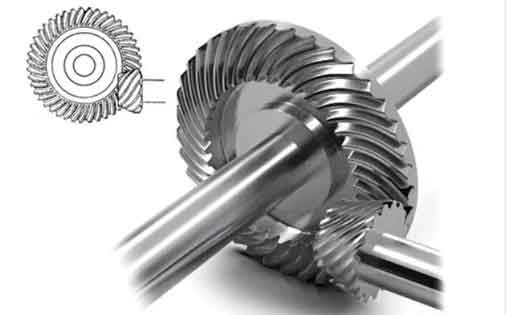
The foundational step in mapping spiral bevel gears involves determining several basic geometric dimensions, which serve as inputs for all subsequent calculations. The formulas for these basic dimensions are summarized in the table below, assuming a standard shaft angle of 90°.
| Parameter Name | Symbol | Formula |
|---|---|---|
| Pinion Pitch Angle | δ₁ | $$ \delta_1 = \arctan\left(\frac{Z_1}{Z_2}\right) $$ |
| Gear Pitch Angle | δ₂ | $$ \delta_2 = 90^\circ – \delta_1 \quad \text{or} \quad \arctan\left(\frac{Z_2}{Z_1}\right) $$ |
| Pinion Pitch Diameter | d₁ | $$ d_1 = m_s \cdot Z_1 $$ |
| Gear Pitch Diameter | d₂ | $$ d_2 = m_s \cdot Z_2 $$ |
| Outer Cone Distance | L_e | $$ L_e = \frac{m_s}{2} \sqrt{Z_1^2 + Z_2^2} $$ |
| Pinion Addendum | h’₁ | $$ h’_1 = (f_0 + \xi) m_s $$ |
| Gear Addendum | h’₂ | $$ h’_2 = (f_0 – \xi) m_s $$ |
| Pinion Outer Cone Height | H₁ | $$ H_1 = L_e \cos \delta_1 – h’_1 \sin \delta_1 $$ |
| Gear Outer Cone Height | H₂ | $$ H_2 = L_e \cos \delta_2 – h’_2 \sin \delta_2 $$ |
| Cutter Blade Group Width (Blade Point Width) | W₂ | $$ W_2 = m_s \cdot K_1 \cdot K_2 $$ where $$ K_1 = 1 – \frac{0.5B}{L_e} $$ and $$ K_2 = \left(\frac{\pi}{2} + \tau_2\right)\cos \beta_m – 2(f_0 + C_0)\tan \alpha $$ |
| Cutter Diameter | D_u | $$ D_u = \frac{L_e}{\sin \beta_m} $$ |
1. Determination of the Outer Cone Distance (Le)
For spiral bevel gears with a 90° shaft angle, the outer cone distance can be measured directly. With a gear pair in mesh, Le is the distance from the apex of the pitch cones (the intersection point of the shaft axes) to the outer edge of the tooth face. On a single gear, a simple steel ruler can be placed along the pitch cone surface from the back of the gear to the large end of the tooth. Accurate measurement of this dimension is the cornerstone for verifying other calculated parameters.
2. Measurement of Face Width and Related Cone Distances
The face width (B) is straightforward to measure using calipers. Once B and Le are known, the mean cone distance (Lm) and inner cone distance (Li) are easily derived:
$$ L_m = L_e – \frac{B}{2} $$
$$ L_i = L_e – B $$
These distances are crucial for defining the working zone of the tooth and for subsequent calculations of spiral angle.
3. Measurement of Tip Diameter and Whole Depth
The tip diameter (D_d) measurement depends on the tooth count. For even-tooth spiral bevel gears, direct measurement with large calipers is possible. For odd-tooth gears, measurement must be performed from a central reference like the bore or shaft, adding the measured distance to the reference diameter. Alternatively, a chordal measurement can be made and corrected using a standard factor (K) from engineering handbooks.
The whole depth (h) is measured at the large end back cone using a depth gauge. This measured value provides a critical check for the calculated module.
4. Determining the Large End Transverse Module (ms)
The module is the most fundamental parameter. For spiral bevel gears, it varies linearly along the face width, being largest at the outer end. The standard large end transverse module (ms) can be determined through several complementary methods:
a. Using Outer Cone Distance and Tooth Count:
$$ m_s = \frac{2L_e}{\sqrt{Z_1^2 + Z_2^2}} $$
This gives a preliminary value. It must be checked against the measured whole depth (h). For Gleason system gears with equal dedendum, typical coefficients are addendum coefficient f0 = 0.85 and bottom clearance coefficient C0 = 0.188. Therefore:
$$ h = (2f_0 + C_0) m_s \quad \Rightarrow \quad m_s = \frac{h}{2f_0 + C_0} $$
The two calculated ms values should be consistent.
b. Using Measured Circular Pitch (t):
If the gear is unworn, the circular pitch at the large end can be measured and used:
$$ m_s = \frac{t}{\pi} $$
This method requires extremely precise measurement.
c. Using Tip Diameter:
$$ m_s = \frac{D_{d1}}{Z_1 + 2f_0 \cos \delta_1 + 2\xi_1 \cos \delta_1} = \frac{D_{d2}}{Z_2 + 2f_0 \cos \delta_2 + 2\xi_2 \cos \delta_2} $$
This requires an estimate of the profile shift coefficient ξ, which can be iterated.
d. Verification via Cutter Blade Group Width (Most Accurate):
The preliminary ms is used to calculate the theoretical blade point width W₂ using the formula in the table above. This calculated W₂ is then rounded to the nearest standard cutter size W₂’. The definitive module is then back-calculated:
$$ m_s = \frac{W’_2}{K_1 K_2} $$
This method, leveraging standard cutter data, typically yields the most reliable module value for spiral bevel gears.
5. Profile Shift and the Determination of the Height Shift Coefficient (ξ)
Spiral bevel gears commonly use a “profile shifted” or “height corrected” design to balance strength and avoid undercut, especially in the pinion. This is a “zero-backlash” type shift where ξ₁ = -ξ₂. The pinion gets a positive shift (ξ > 0), thickening the root, and the gear gets a corresponding negative shift.
The coefficient is derived from the measured addenda:
$$ h’_1 = (f_0 + \xi) m_s, \quad h’_2 = (f_0 – \xi) m_s $$
Subtracting gives:
$$ \xi = \frac{h’_1 – h’_2}{2 m_s} $$
Where the addenda are calculated from measured tip and calculated pitch diameters:
$$ h’_1 = \frac{D_{d1} – d_1}{2 \cos \delta_1}, \quad h’_2 = \frac{D_{d2} – d_2}{2 \cos \delta_2} $$
The calculated ξ should be checked against standard Gleason values for the given tooth combination.
6. Hand and Spiral Angle (βm) Determination
Hand is determined by observing the direction of the tooth curve from the small to the large end. A mating pair must have opposite hands. Conventionally, for a clockwise-rotating drive side, the pinion is left-hand and the gear right-hand, generating separating axial thrust.
The spiral angle β is variable; the mean spiral angle βm at the pitch cone midpoint is the standard reference, often 35°. An approximate value can be found using the “gear marking method”:
- Paint the gear’s face cone and roll it on paper over a 60° arc, tracing radii equal to Le, Lm, Li.
- Locate the midpoint P on the tooth trace at Lm.
- Draw the normal (nn) to the trace at P. This approximates the radial line to the cutter center Ou.
- Draw the tangent (tt) to the trace at P.
- The angle between OP and tt is the approximate face cone spiral angle β’m. The pitch cone spiral angle βm is slightly larger, often by 0.2° to 0.5°.
A more accurate calculation uses the “cutter number” (N0):
- Calculate root angles: $$ \gamma”_1 = \arctan\left(\frac{h”_1}{L_e}\right), \quad \gamma”_2 = \arctan\left(\frac{h”_2}{L_e}\right) $$ where $$ h” = h – h’ $$.
- Compute preliminary cutter number: $$ N_0 = \frac{\gamma”_1 + \gamma”_2}{20′} \times \sin \beta’_m $$ (where 20′ is 20 arcminutes).
- Select the nearest standard cutter number N’0.
- Compute the precise mean spiral angle: $$ \sin \beta_m = \frac{20′ \times N’_0}{\gamma”_1 + \gamma”_2} $$
This method intrinsically links the spiral angle to the gear’s root geometry and standard manufacturing tools.
7. Determination of the Tangential Shift Coefficient (τ)
Tangential shift modifies the tooth thickness independently of the profile shift, primarily to optimize the load distribution across the tooth flank of spiral bevel gears. It is determined from the gear’s normal chordal thickness at the large end (Sxn2). The formula is:
$$ \tau = \frac{\pi}{2} – \frac{2\xi \tan \alpha_n}{\cos \beta_e} – \frac{S_{xn2}}{G \cdot m_s \cdot \cos \beta_e} $$
Where:
- $$ S_{xn2} \approx (1.387 – 0.643\xi) m_s $$ (for standard pressure angle).
- $$ G = 1 – \left( \frac{\pi}{2} – 2\xi \tan \alpha_n \right) \frac{\sin \beta_m \cos \beta_e}{\sqrt{Z_1^2 + Z_2^2}} $$
- $$ \sin \beta_e = \frac{1}{D_u} \left[ L_e + \frac{L_m}{L_e} (D_u \sin \beta_m – L_m) \right] $$ (Large end spiral angle).
- αn is the normal pressure angle (typically 20°).
Careful calculation using the previously determined parameters yields the tangential shift coefficient.
8. The Critical Parameter: Installation Distance (HA)
Accurate installation distance is paramount for the correct meshing and quiet operation of spiral bevel gears. Incorrect HA leads to poor contact patterns, noise, and accelerated wear. Two primary measurement methods exist:
1. Measurement on a Rolling Tester: This is the most reliable method. The gear pair is mounted, coated with marking compound, and run under light load. The axial positions are adjusted until the contact pattern on the flank is optimal (centered). The adjusted positions on the tester’s scales directly give the operational installation distances.
2. Calculation from Measured Dimensions: The installation distance can also be derived analytically.
$$ H_{A1} = H_1 + M_1, \quad H_{A2} = H_2 + M_2 $$
Where:
- H₁, H₂ are the outer cone heights (calculated as in the table).
- M₁, M₂ are the “crossing distances” or “master gear distances,” measured from the mounting face to the crest of the teeth at the back cone. These are physical measurements on the individual gears.
The calculated values should closely match those obtained from the rolling tester adjustment for a correctly mapped gear. Discrepancy indicates potential error in other parameter determinations.
Summary of the Mapping Process
A successful mapping procedure for spiral bevel gears follows a logical, iterative sequence where each parameter informs the next. The table below outlines a recommended step-by-step workflow:
| Step | Action | Key Measurements/Calculations | Purpose & Check |
|---|---|---|---|
| 1 | Record Basic Data | Tooth counts (Z₁, Z₂). Measure B, Dd1, Dd2, h, Le, M₁, M₂, Hand. | Establish foundational data. Identify hand combination. |
| 2 | Preliminary Module & Angles | $$ m_s^{(1)} = \frac{2L_e}{\sqrt{Z_1^2+Z_2^2}} $$, $$ \delta_1 = \arctan(Z_1/Z_2) $$. | Obtain first estimate of core geometry. |
| 3 | Spiral Angle Estimate | Use gear marking method to find β’m. | Get initial spiral angle for cutter number calculation. |
| 4 | Height Shift Coefficient (ξ) | Calculate d₁, d₂. Compute h’₁, h’₂ and then ξ. Verify against standards. | Establish the profile shift balance between pinion and gear. |
| 5 | Refine Module via Cutter Width | Calculate root angles, preliminary cutter number N₀, choose N’₀. Compute precise βm and then ms via W₂ formula. | This step, using standard cutter data, yields the most accurate module (ms). Verify against ms(1) and h. |
| 6 | Tangential Shift (τ) | Calculate βe, Sxn2, G, and finally τ. | Determine the tooth thickness modification for optimal loading. |
| 7 | Final Geometry & Installation | Calculate all pitch diameters, cone heights, and finally HA1, HA2. | Generate final gear data. Compare calculated HA with values from rolling tester adjustment for validation. |
In conclusion, mapping spiral bevel gears is a systematic engineering process that blends direct measurement with trigonometric calculation and verification against manufacturing standards. While methods like measuring chordal thickness or span measurement can provide alternative checks, the approach centered on accurate installation distance determination, verified on a rolling tester, is fundamentally the most robust. Each pair of spiral bevel gears presents a unique puzzle, and solving it requires meticulous attention to the interdependencies of cone distance, module, spiral angle, and shift coefficients. The reward for this diligence is a perfectly meshing replacement gearset that restores the original performance and longevity of the driven machinery.