
In modern automotive transmissions, helical gears play a critical role due to their high efficiency, stable transmission, and constant gear ratios. With the trend toward high-speed and high-torque applications, the reliability of these helical gears is paramount. However, fatigue pitting, a prevalent failure mode accounting for approximately 74% of gear failures, significantly impacts the meshing stiffness, leading to dynamic instability, vibration, and noise. Therefore, accurately calculating the time-varying meshing stiffness of helical gears under pitting conditions is fundamental for fault dynamics analysis. This study focuses on developing a finite element method (FEM)-based approach to analyze the meshing stiffness of both normal and pitted helical gears, examining the effects of varying spalling dimensions, and validating findings through experimental fatigue tests.
The meshing stiffness of helical gears is a key parameter influencing their dynamic behavior. Traditional methods, such as the potential energy method, have been widely used, but FEM offers advantages in handling complex geometries and contact conditions, especially for helical gears with spiral angles. In this work, we employ FEM to model helical gear pairs, compute normal contact forces and elastic deformations, and derive single-tooth and multi-tooth meshing stiffness. The methodology is extended to simulate fatigue pitting by introducing elliptical spalls on tooth surfaces, allowing us to investigate how pitting dimensions alter stiffness characteristics. We also conduct fatigue pitting tests to correlate stiffness reductions with vibration responses, providing insights for gear design and maintenance.
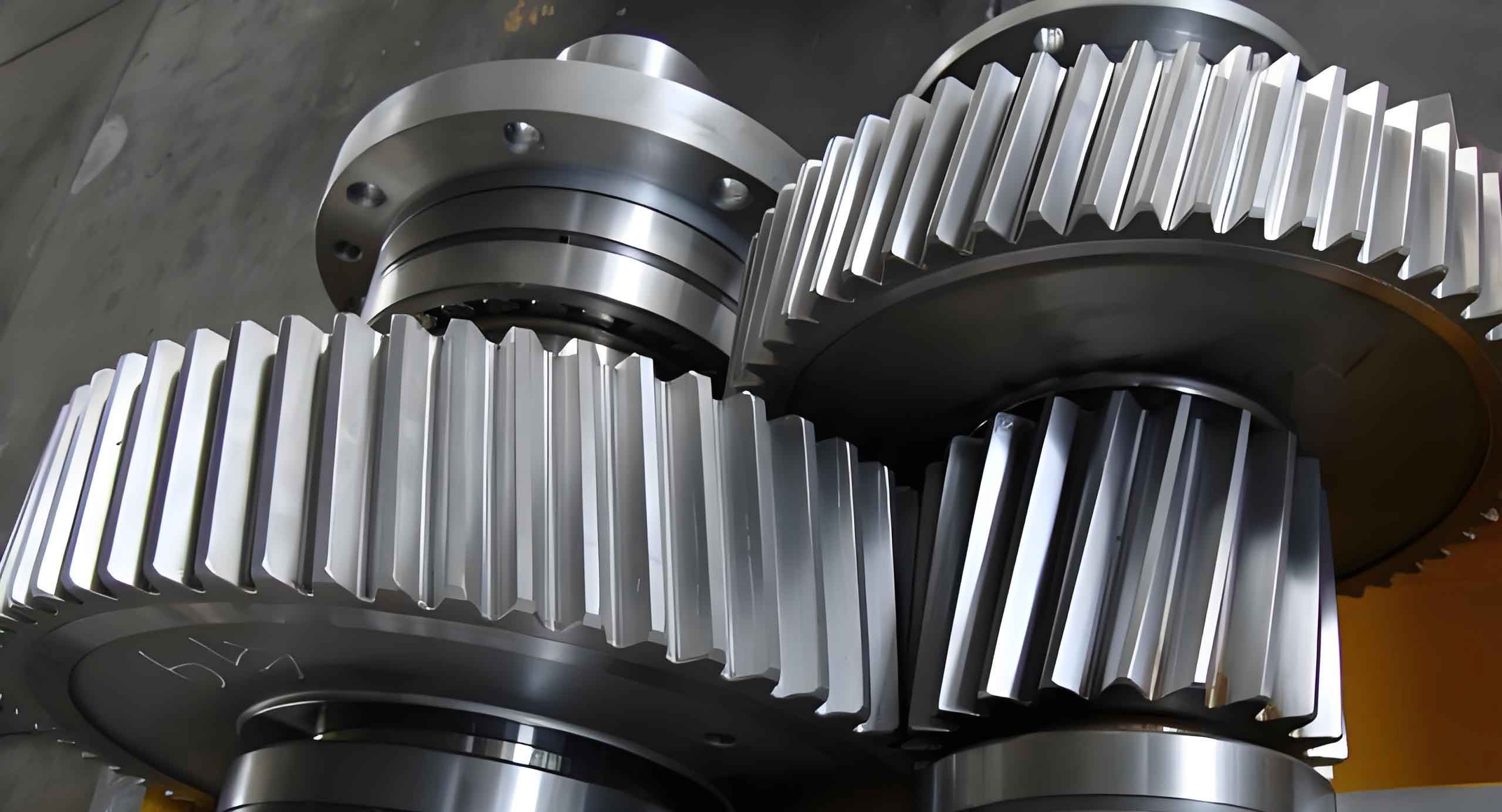
The core of our analysis lies in the meshing stiffness calculation. For helical gears, the stiffness at any meshing position is defined as the ratio of the normal contact force to the comprehensive elastic deformation. This is expressed mathematically as:
$$k_n = \frac{F_n}{u_n}$$
Here, \(k_n\) represents the single-tooth meshing stiffness, \(F_n\) is the normal contact force on the tooth surface, and \(u_n\) is the total elastic deformation. The deformation includes Hertzian contact deformation \(u_h\) and bending deformation \(u_b\), while other factors like support structure deformations are neglected for simplicity. Thus, the total deformation for a tooth pair is:
$$u_n = \sum_{i=1}^{2} u_{hi} + \sum_{i=1}^{2} u_{bi}$$
For multi-tooth engagement in helical gears, the overall meshing stiffness \(K\) is the sum of individual tooth stiffness values over the contact cycle:
$$K = \sum_{i=1}^{n} k_i$$
where \(n\) denotes the number of simultaneously meshing tooth pairs, determined by the contact ratio of the helical gears. The contact ratio \(\epsilon\) is calculated based on gear geometry, and for our helical gears, it is approximately 2.003, leading to alternating two- and three-tooth contacts. The angular shift \(\Delta \alpha\) for stiffness superposition is given by:
$$\Delta \alpha = \frac{\phi}{\epsilon}$$
with \(\phi\) being the rotation angle over a single-tooth meshing cycle. This framework enables us to compute time-varying stiffness profiles.
To implement this, we developed 3D finite element models for both normal and pitted helical gears. The gear parameters are listed in Table 1, which summarizes key specifications such as tooth numbers, module, pressure angle, and material properties. These helical gears are made of 20MnCrS5 steel, commonly used in automotive transmissions, with surface hardening to enhance durability.
| Parameter | Driving Gear | Driven Gear |
|---|---|---|
| Number of Teeth | 17 | 60 |
| Face Width (mm) | 19.8 | 16.9 |
| Center Distance (mm) | 93 | |
| Module (mm) | 2.1 | |
| Pressure Angle (°) | 17.5 | |
| Helix Angle (°) | 29 | |
| Young’s Modulus (GPa) | 210 | |
| Poisson’s Ratio | 0.278 | |
| Density (kg/m³) | 7840 | |
| Material | 20MnCrS5 | |
For the FEM modeling, we used Abaqus software. Normal helical gears were meshed with 8-node linear hexahedral elements (C3D8R) to handle the helical geometry efficiently, while pitted helical gears required 4-node linear tetrahedral elements (C3D4) to accommodate spall-induced mesh distortions. A five-tooth segment model was adopted to balance computational accuracy and time, as shown in the figure above. Boundary conditions included coupling reference points to gear bore surfaces, applying a torque of 250 N·m to the driving gear, and using surface-to-surface contact with a friction coefficient of 0.125, derived from experimental data for 20MnCrS5 under lubrication. The analysis involved three steps: initial contact establishment, torque application, and rotation simulation to cover a full meshing cycle divided into 30 positions.
From the FEM results, we extracted normal contact forces and elastic deformations at each position. For instance, the contact force distribution on helical gear teeth reveals parallel contact lines due to the helix angle, with multiple tooth pairs engaged simultaneously. The average deformation across contact nodes was computed to derive \(u_n\), and combining with \(F_n\) yielded \(k_n\). Table 2 presents the single-tooth meshing stiffness values for a normal helical gear at various rotation angles, illustrating the stiffness variation over the cycle.
| Rotation Angle θ_g (°) | Stiffness k_n (MN/m) | Rotation Angle θ_g (°) | Stiffness k_n (MN/m) |
|---|---|---|---|
| 1 | 115.05 | 16 | 520.17 |
| 2 | 144.58 | 17 | 525.27 |
| 3 | 174.15 | 18 | 524.37 |
| 4 | 202.38 | 19 | 525.11 |
| 5 | 230.10 | 20 | 523.51 |
| 6 | 270.08 | 21 | 514.12 |
| 7 | 315.14 | 22 | 486.57 |
| 8 | 345.17 | 23 | 452.08 |
| 9 | 374.61 | 24 | 406.16 |
| 10 | 408.01 | 25 | 365.86 |
| 11 | 442.51 | 26 | 319.84 |
| 12 | 459.47 | 27 | 275.93 |
| 13 | 490.86 | 28 | 231.40 |
| 14 | 501.91 | 29 | 183.45 |
| 15 | 513.23 | 30 | 124.33 |
Fitting these values, we obtained a smooth single-tooth stiffness curve, which shows an initial increase followed by a decrease as the tooth progresses through mesh. For multi-tooth engagement, we superimposed shifted stiffness curves based on the contact ratio. The time-varying meshing stiffness \(K\) for normal helical gears exhibits periodic fluctuations, with minima corresponding to transitions between two- and three-tooth contacts. This behavior is critical for dynamic analysis, as stiffness variations act as internal excitations in gear systems.
Next, we analyzed pitted helical gears by introducing elliptical spalls on tooth surfaces. We varied spall length (5 mm, 10 mm, 15 mm) with fixed width (2 mm) and depth (2 mm), and spall width (1 mm, 2 mm, 3 mm) with fixed length (10 mm) and depth (2 mm). The single-tooth stiffness for pitted helical gears was computed similarly, and results were aggregated into multi-tooth stiffness. Table 3 summarizes the effects of spall length on meshing stiffness reduction, expressed as percentage decrease relative to normal helical gears at key meshing positions.
| Spall Length (mm) | Average Stiffness Reduction (%) | Peak Reduction Position (°) | Stiffness Change Duration (°) |
|---|---|---|---|
| 5 | 12.5 | 18-22 | 5 |
| 10 | 24.8 | 17-24 | 8 |
| 15 | 36.3 | 16-26 | 11 |
The data indicate that longer spalls lead to greater stiffness reductions and extended regions of stiffness change, as the impaired contact area remains engaged for more of the meshing cycle. For spall width variations, Table 4 shows that wider spalls also reduce stiffness, but the effect is less pronounced on the change duration, highlighting the dominant role of length in altering contact dynamics for helical gears.
| Spall Width (mm) | Average Stiffness Reduction (%) | Peak Reduction Position (°) | Stiffness Change Duration (°) |
|---|---|---|---|
| 1 | 18.7 | 18-22 | 5 |
| 2 | 24.8 | 17-24 | 8 |
| 3 | 30.2 | 17-24 | 8 |
To quantify stiffness mathematically, we can model the effective stiffness \(k_{\text{pitted}}\) of a pitted helical gear tooth as a function of spall dimensions. Assuming the spall reduces the contact area linearly, an approximate relation is:
$$k_{\text{pitted}} = k_{\text{normal}} \left(1 – \beta \frac{L \cdot W}{A_{\text{contact}}}\right)$$
where \(L\) and \(W\) are spall length and width, \(A_{\text{contact}}\) is the nominal contact area, and \(\beta\) is a correction factor derived from FEM results. This formula helps in predicting stiffness loss for various pitting severities in helical gears.
For experimental validation, we conducted fatigue pitting tests on a power circulation test bench. The helical gear pair was operated under conditions mimicking real transmission loads: input speed of 2500 rpm and torque of 250 N·m. Vibration signals were acquired from shaft ends using accelerometers. Gears with spall lengths of 5 mm and 10 mm (width 2 mm) were tested alongside normal helical gears. The time-domain vibration acceleration data revealed periodic impacts at intervals of 0.024 seconds, matching the gear rotation period. As shown in Table 5, the impact amplitude increased with spall length, correlating with the stiffness reductions from FEM analysis.
| Gear Condition | Impact Amplitude (m/s²) | Impact Period (s) | Stiffness Reduction from FEM (%) |
|---|---|---|---|
| Normal Helical Gear | 0.85 | 0.024 | 0 |
| 5 mm Spall Length | 1.42 | 0.024 | 12.5 |
| 10 mm Spall Length | 2.18 | 0.024 | 24.8 |
The vibration response can be linked to meshing stiffness through dynamic equations. For a helical gear pair, the equation of motion under stiffness excitation is:
$$I \ddot{\theta} + c \dot{\theta} + K(t) \theta = T(t)$$
where \(I\) is inertia, \(c\) is damping, \(K(t)\) is the time-varying meshing stiffness, \(\theta\) is angular displacement, and \(T(t)\) is torque. When \(K(t)\) drops due to pitting in helical gears, the system becomes more susceptible to shocks, increasing vibration amplitudes. This aligns with our experimental observations, confirming that stiffness degradation from pitting exacerbates dynamic responses.
In discussion, the findings emphasize the sensitivity of helical gears to surface defects. Compared to spur gears, helical gears have complex contact patterns due to their helix angle, making stiffness calculations more challenging. Our FEM approach effectively captures these nuances, and the results show that pitting not only reduces stiffness but also prolongs the low-stiffness regions during mesh, potentially leading to accelerated wear and failure. The implications for gear design include the need for robust materials and surface treatments to mitigate pitting, especially in high-performance helical gears used in automotive transmissions. Future work could explore combined faults, such as pitting with cracks, or optimize gear geometry to enhance stiffness resilience.
In conclusion, this study presents a comprehensive analysis of time-varying meshing stiffness in fatigue-pitted helical gears using finite element methods. We developed accurate FEM models for both normal and pitted helical gears, computed stiffness values, and analyzed the effects of spall dimensions. Key results indicate that spall length and width significantly reduce meshing stiffness, with length having a more pronounced impact on the duration of stiffness changes. Experimental tests validated that stiffness reductions lead to increased vibration冲击 responses, underscoring the importance of meshing stiffness in gear dynamics. This research provides a foundation for fault diagnosis and design improvements in helical gear systems, contributing to enhanced reliability in automotive applications.
To further illustrate the mathematical framework, we can derive the stiffness variation for helical gears under ideal conditions. The single-tooth stiffness can be approximated using beam theory adapted for helical geometry. For a helical gear tooth, the bending stiffness component \(k_b\) is given by:
$$k_b = \frac{E b h^3}{4 L^3 \cos^2(\psi)}$$
where \(E\) is Young’s modulus, \(b\) is face width, \(h\) is tooth height, \(L\) is effective length, and \(\psi\) is the helix angle. The Hertzian contact stiffness \(k_h\) for helical gears involves elliptical contact areas and can be expressed as:
$$k_h = \frac{\pi E}{2(1-\nu^2)} \sqrt{\frac{R}{\cos(\psi)}}$$
with \(\nu\) as Poisson’s ratio and \(R\) as equivalent radius. The total single-tooth stiffness is then a combination in series:
$$\frac{1}{k_n} = \frac{1}{k_b} + \frac{1}{k_h}$$
This analytical model, while simplified, complements our FEM results and highlights the role of helix angle in stiffness behavior for helical gears.
For practical applications, monitoring meshing stiffness in helical gears can aid in predictive maintenance. Techniques such as vibration analysis or strain gauge measurements could detect stiffness drops indicative of pitting. Our study offers a reference for setting thresholds based on spall dimensions, potentially integrating with digital twin technologies for real-time gear health assessment. As helical gears continue to evolve in advanced transmissions, understanding their stiffness dynamics under faults remains crucial for achieving longevity and performance.