
This discourse serves as a continuation of the foundational work on the generating principle for the broaching of straight bevel gears. The core challenge addressed stems from the inherent asymmetry in the addendum and dedendum heights of gears produced via the circular broaching method. Consequently, selecting the pitch point—the point of contact on the pitch circle—as the sole reference for design and calculation proves inadequate. It becomes imperative to establish the midpoint of the active tooth profile as the primary reference point. Building upon this understanding, this article systematically resolves the issues pertaining to the correction of tooth profile curvature radii and the corresponding adjustments required for circular broaching tool parameters. The theoretical framework developed herein yields results consistent with established calculation methods for approximate conjugate action.
Furthermore, for gears that have not undergone specialized tip and root relief modifications (commonly referred to as ‘Tip and Root Relief’ or TRR), and under the assumption that the root angle equals the cutting installation angle, a direct corollary of our theory provides a practical method for calculating the gear blank dimensions for circular broaching. It is noteworthy that prior attempts, such as those documented in Soviet literature, to correct the tooth profile radius for circular broached gears resulted in computationally complex procedures lacking a firm theoretical foundation, often presented without adequate explanatory theory.
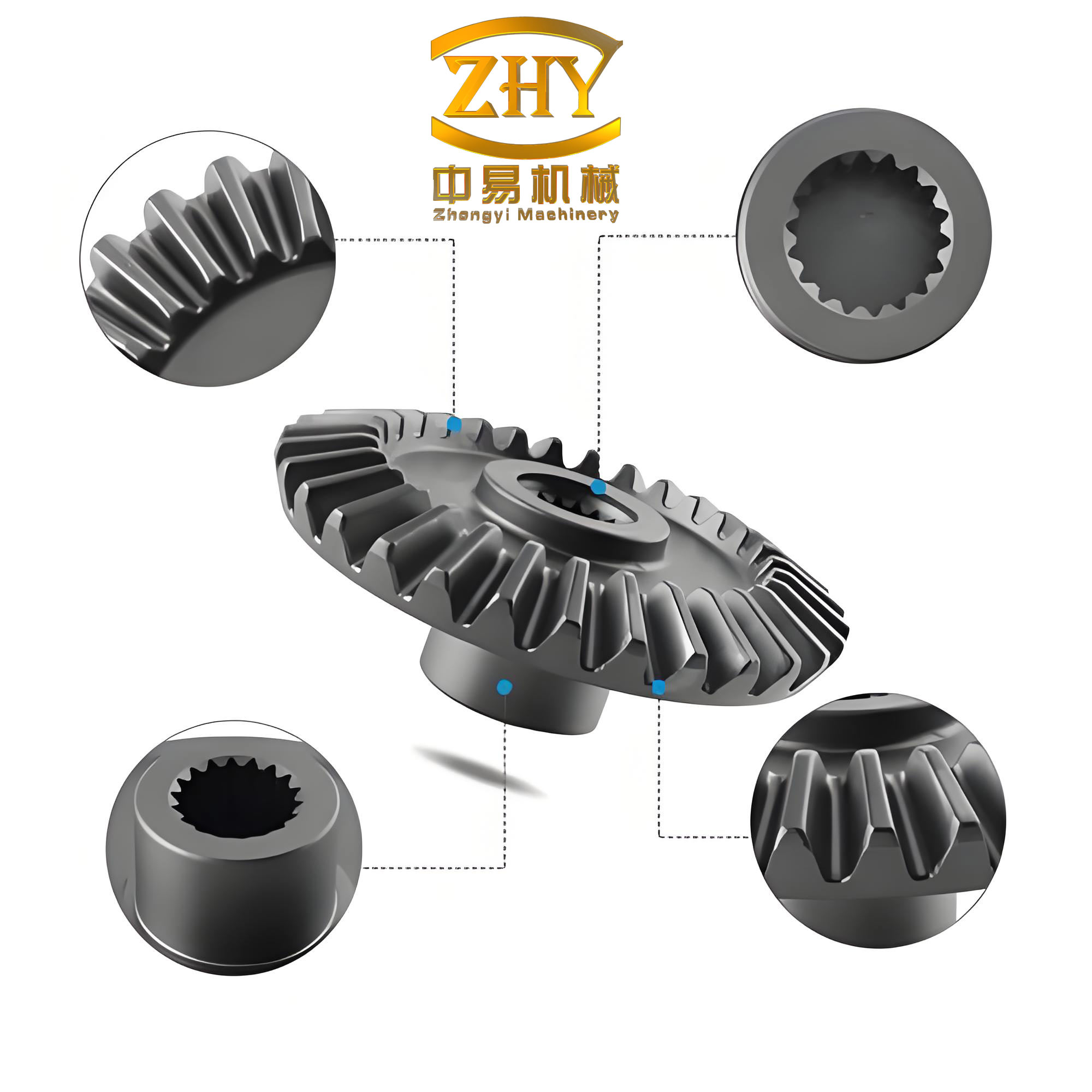
1. Kinematic Geometry of Straight Bevel Gear Drives
A bevel gear drive facilitates motion transmission between two intersecting axes. Let point \(O\) be the common apex. The constant angular velocity vectors are denoted by \(\boldsymbol{\omega}\) and \(\boldsymbol{\omega’}\). The drive geometry is defined by the following angles, all taken as positive values between \(0\) and \(\pi\):
$$ \gamma = \angle(\boldsymbol{\omega}, \boldsymbol{\omega’}), \quad \psi = \angle(\boldsymbol{\omega}, \boldsymbol{V}), \quad \psi’ = \angle(\boldsymbol{\omega’}, \boldsymbol{V}), \quad \chi = \angle(\boldsymbol{V}, \boldsymbol{\omega’}) $$
where \(\boldsymbol{V} = \boldsymbol{\omega} – \boldsymbol{\omega’}\) is the relative angular velocity vector. The fundamental relationship is:
$$ \boldsymbol{\omega} \cdot \boldsymbol{\omega’} = \omega \omega’ \cos \gamma $$
From the sine law in the vector triangle, we derive the gear ratio \(i\):
$$ i = \frac{\omega’}{\omega} = \frac{\sin \psi}{\sin \psi’} $$
The line along \(\boldsymbol{V}\) is the instantaneous axis of rotation. The angles \(\psi\) and \(\psi’\) are the pitch cone angles of the driving and driven straight bevel gears, respectively. They relate to the shaft angle \(\gamma\) and ratio \(i\) as follows:
$$ \tan \psi = \frac{\sin \gamma}{i + \cos \gamma}, \quad \tan \psi’ = \frac{\sin \gamma}{1 + i \cos \gamma} $$
The pitch cones, with apex \(O\) and generatrices along \(\boldsymbol{V}\), are thus uniquely determined.
2. Tooth Surface Geometry and Meshing Condition
For a straight bevel gear, the tooth flank is a conical surface with apex \(O\). Its intersection with a sphere centered at \(O\) (taken as unit radius for simplicity) defines the spherical tooth profile, or ‘spherical involute’ trace. Let \(\boldsymbol{r}(s)\) be the profile, with \(s\) as the arc length parameter. The unit tangent is \(\boldsymbol{t} = d\boldsymbol{r}/ds\). The surface normal \(\boldsymbol{n}\) at a point on the cone satisfies \(\boldsymbol{n} \cdot \boldsymbol{t} = 0\) and \(\boldsymbol{n} \cdot \boldsymbol{r} = 0\). A suitable frame is defined by \(\boldsymbol{r}\), \(\boldsymbol{t}\), and \(\boldsymbol{u} = \boldsymbol{r} \times \boldsymbol{t}\).
The meshing condition for two conjugate surfaces \(\Sigma\) and \(\Sigma’\) in contact at point \(P\) requires that the relative velocity at \(P\) along the common normal is zero:
$$ (\boldsymbol{\omega} \times \boldsymbol{r} – \boldsymbol{\omega’} \times \boldsymbol{r}) \cdot \boldsymbol{n} = \boldsymbol{V} \times \boldsymbol{r} \cdot \boldsymbol{n} = 0 $$
This implies that the common normal \(\boldsymbol{n}\) must intersect the instantaneous axis \(\boldsymbol{V}\). This is analogous to the planar gearing theorem.
Defining a unit vector \(\boldsymbol{e}_V = \boldsymbol{V}/|\boldsymbol{V}|\), and expressing the normal as:
$$ \boldsymbol{n} = \cos \varphi \, \boldsymbol{e}_V + \sin \varphi \, (\boldsymbol{r} \times \boldsymbol{e}_V) $$
a detailed analysis yields the fundamental spherical meshing equation, a form of the Euler-Savary equation for spherical kinematics:
$$ \left( \frac{1}{\rho} + \frac{1}{\rho’} \right) \sin \varphi = \left( \frac{1}{\sin \psi} + \frac{1}{\sin \psi’} \right) \cos \varphi $$
Here, \(\varphi\) is the pressure angle (or meshing angle) at the contact point, and \(\rho, \rho’\) are related to the geodesic curvatures of the spherical profiles. For an infinitesimal arc, they approximate the profile’s radius of curvature on the developed surface. This equation is central to determining conjugate profiles for straight bevel gears.
3. Determination of Profile Curvature Radii for Approximate Conjugation
In practice, perfect theoretical conjugation is neither necessary nor desirable due to sensitivity to errors. We seek profiles that are approximately conjugate to a specified order at a chosen reference point. We assume the profiles have constant curvature (circular arcs on the developed surface) in the region of contact.
Imposing the conditions that the meshing equation and its first derivative with respect to the motion parameter vanish at the reference point ensures second-order approximate conjugation (correct transmission ratio and its first derivative). Solving these conditions yields the initial values for the profile curvature radii, \(\rho_0\) and \(\rho’_0\), at the pitch point:
| Parameter | Formula |
|---|---|
| Driving Gear Initial Curvature Radius | $$ \rho_0 = \frac{\sin^2 \varphi_0}{\left( \frac{1}{\sin \psi} + \frac{1}{\sin \psi’} \right) \cos \varphi_0 – \frac{\varphi_0′}{\sin \psi}} $$ |
| Driven Gear Initial Curvature Radius | $$ \rho’_0 = \frac{\sin^2 \varphi_0}{\left( \frac{1}{\sin \psi} + \frac{1}{\sin \psi’} \right) \cos \varphi_0 – \frac{\varphi_0′}{\sin \psi’}} $$ |
where \(\varphi_0\) is the pressure angle at the pitch point, and \(\varphi_0’\) is its derivative, often set to zero for a symmetric midpoint design. For true second-order approximation, the second derivative condition is also applied, leading to more specific values for \(\rho_0\) and \(\rho’_0\) that depend on higher-order kinematic coefficients. This level of approximation is typically sufficient for high-quality straight bevel gears.
4. Gear Parameters and the Reference Point
The parameters defining a straight bevel gear include the pitch cone angle \(\psi\), mean pressure angle \(\alpha_m\) (often equal to \(\varphi_0\)), and the tooth slot angle \(\theta_s\). The tooth slot angle is related to the circular pitch and the normal chordal thickness at the reference cone.
A critical concept is the shifting of the reference point from the pitch point to the midpoint of the working profile depth. This is essential because the addendum and dedendum are generally unequal, especially in broached gears. The “height” \(h\) of a point on the spherical profile relative to the pitch cone is measured along the back-cone element. For a point parameterized by its arc distance \(u\) from the pitch point, the height is approximately:
$$ h \approx u \cdot \sin \varphi $$
where \(\varphi\) is the local pressure angle. Therefore, to place the reference point at the mid-depth of the working profile, its parameter \(u_m\) must satisfy:
$$ u_m = \frac{h_a’ – h_f}{\sin \alpha_m} $$
for the pinion, and a corresponding value for the gear. Here, \(h_a’\) is the mating gear’s addendum and \(h_f\) is the pinion’s working dedendum. At this midpoint reference, the pressure angle is designed to be the mean pressure angle \(\alpha_m\).
5. Circular Broaching Tool Parameters for the Pitch Point Reference
The circular broaching process generates the tooth flank by a series of cutter blades arranged on a circle. The tool’s geometry relative to the gear blank is defined by two key angles: the blade tilt angle \(\Delta\) and the cutting rotation angle \(\zeta\). A third parameter, the installation angle \(\lambda\), positions the gear axis relative to the tool plane.
When the reference point is the pitch point \(P_0\), these parameters can be derived directly from the gear geometry:
| Tool Parameter | Formula (Pitch Point Reference) |
|---|---|
| Blade Tilt Angle \(\Delta_0\) | $$ \cos \Delta_0 = \sin \psi \sin \theta_s $$ |
| Cutting Rotation Angle \(\zeta_0\) | $$ \sin \zeta_0 = \frac{\cos \alpha_m}{\cos \Delta_0} $$ |
| Installation Angle \(\lambda_0\) | $$ \sin \lambda_0 = \frac{\sin \alpha_m}{\sin \psi} $$ |
These formulas ensure that the tool generates the correct pressure angle \(\alpha_m\) and tooth orientation at the pitch point of the straight bevel gear. The base radius of the broaching cutter is then determined from the required profile curvature \(\rho_0\).
6. Parameter Corrections for the Mid-Point Reference
When the active reference point is shifted to the profile midpoint \(P_m\) (with parameter \(u_m \neq 0\)), corrections must be applied to both the profile curvature radii and the broaching tool parameters to maintain proper meshing action at this point.
First, the profile curvature radii require correction. The corrected radii \(\rho_m\) and \(\rho’_m\) are given by:
$$ \frac{1}{\rho_m} = \frac{1}{\rho_0} + \delta \left( \frac{1}{\rho} \right), \quad \frac{1}{\rho’_m} = \frac{1}{\rho’_0} + \delta \left( \frac{1}{\rho’} \right) $$
The corrections \(\delta(1/\rho)\) and \(\delta(1/\rho’)\) are functions of \(u_m\), the mean pressure angle \(\alpha_m\), the pitch angles, and the kinematic derivatives. They are derived from the second-order expansion of the meshing condition around the pitch point.
Second, the broaching tool parameters must be adjusted. Let the corrected parameters be:
$$ \Delta_m = \Delta_0 + \delta\Delta, \quad \zeta_m = \zeta_0 + \delta\zeta, \quad \lambda_m = \lambda_0 + \delta\lambda $$
The corrections are interdependent and are determined by solving the system of equations derived from enforcing the correct tooth geometry at \(P_m\). The key relations involve the angular displacement \(\xi\) of the gear from its pitch-point contact position to its mid-point contact position:
$$ \xi \approx – \frac{u_m}{\sin \psi \sin \alpha_m} $$
The parameter corrections can then be expressed as:
| Correction Term | Governing Relation |
|---|---|
| \(\delta\Delta\) | Linked to \(\xi\) and the change in the normal vector orientation. |
| \(\delta\zeta\) | $$ \sin \zeta_0 \cdot \delta\zeta \approx -\xi \cdot \sin \psi \cos \alpha_m $$ |
| \(\delta\lambda\) | $$ \cos \lambda_0 \cdot \delta\lambda \approx \xi \cdot (\cos \psi \sin \alpha_m \cos \zeta_0 – \cos \alpha_m \sin \zeta_0) $$ |
These corrections ensure that the circular broaching tool, when set with angles \(\Delta_m, \zeta_m, \lambda_m\), will generate the tooth profile with the corrected curvature \(\rho_m\) precisely at the intended mid-point reference, resulting in a pair of straight bevel gears with optimized localized contact.
7. Summary and Design Workflow
The presented framework provides a complete theoretical basis for calculating the essential parameters for designing and manufacturing straight bevel gears via circular broaching, with a focus on achieving high-quality approximate conjugation.
The design workflow can be summarized as follows:
- Define Kinematic Inputs: Determine the gear ratio \(i\), shaft angle \(\gamma\), and number of teeth for both straight bevel gears.
- Calculate Pitch Geometry: Compute pitch cone angles \(\psi, \psi’\) and mean cone distances.
- Choose Design Angles: Select the mean pressure angle \(\alpha_m\) and determine the tooth slot angle \(\theta_s\) based on desired backlash and tooth thickness.
- Determine Reference Point: Calculate the profile midpoint parameter \(u_m\) based on the addendum and dedendum of the mating pair.
- Compute Initial Curvatures: Calculate the initial profile curvature radii \(\rho_0, \rho’_0\) for second-order approximation at the pitch point using the formulas in Section 3.
- Apply Mid-Point Corrections: Calculate the corrections \(\delta(1/\rho)\) to obtain the final working profile curvatures \(\rho_m, \rho’_m\).
- Calculate Broaching Parameters (Pitch Point): Compute \(\Delta_0, \zeta_0, \lambda_0\) using the formulas in Section 5.
- Calculate Broaching Parameter Corrections: Compute the angular shift \(\xi\) and subsequently the corrections \(\delta\Delta, \delta\zeta, \delta\lambda\) using the relations in Section 6.
- Final Tool Setup: The broaching tool is configured with the corrected angles \(\Delta_m, \zeta_m, \lambda_m\) to generate the gear tooth with curvature \(\rho_m\).
This method systematically addresses the limitations of using the pitch point alone, ensuring that the contact conditions are optimal at the center of the working tooth depth, which is crucial for the performance and durability of straight bevel gears produced by the efficient circular broaching process.