
As an engineer deeply involved in the evolution of industrial maintenance and machinery design, I have witnessed firsthand the critical challenges that arise in continuous production environments. In such settings, equipment failures, such as leaks from pipes, valves, flanges, and seals, are inevitable, leading to material loss, energy waste, environmental pollution, and safety hazards. Simultaneously, the integrity of mechanical components like herringbone gears is paramount for operational efficiency. This article delves into two pivotal innovations: the on-line pressure and temperature injection leak sealing technology and the advancements in herringbone gears for rolling mill gearboxes. I will explore these technologies from a first-person perspective, emphasizing their principles, applications, and synergies, with a particular focus on herringbone gears—a key element in heavy-duty machinery. Throughout, I will use tables and formulas to summarize technical details, ensuring a comprehensive understanding.
In continuous production processes, the ability to address leaks without halting operations is a game-changer. The on-line pressure and temperature injection leak sealing technology allows for rapid intervention under dynamic conditions. This method involves using a high-pressure injection gun to deliver specialized sealants into leak points through custom-designed fixtures. The sealants quickly cure, forming a durable seal that withstands operational pressures and temperatures. This technology eliminates the need for downtime, thereby maintaining productivity and reducing risks. The development of this approach represents a significant leap in maintenance protocols, especially in industries where herringbone gears are employed, as gear systems often operate under high stress and may experience leakage issues.
The sealants used in this technology are formulated into distinct series, each tailored for specific media and conditions. Below is a table summarizing the key series and their properties:
| Sealant Series | Key Characteristics | Applicable Media |
|---|---|---|
| A-Series | Fast-curing, high-temperature resistance | Saturated steam, superheated steam, air, water |
| B-Series | Chemical inertness, flexibility | Fuel oil, kerosene, aviation lubricants |
| C-Series | Acid and alkali resistance | Dilute acids, concentrated alkalis, alcohols |
| D-Series | Versatile, general-purpose | Broad range including steam and hydrocarbons |
These sealants are designed to not adhere to or damage machine parts, ensuring that regular maintenance, disassembly, or replacement of components like herringbone gears remains unaffected. The performance of these sealants can be modeled using curing kinetics. For instance, the curing time \( t_c \) can be expressed as a function of pressure \( P \) and temperature \( T \):
$$ t_c = k \cdot P^{-\alpha} \cdot e^{\frac{-E_a}{RT}} $$
where \( k \) is a constant dependent on the sealant formulation, \( \alpha \) is a pressure exponent, \( E_a \) is the activation energy, \( R \) is the universal gas constant, and \( T \) is in Kelvin. This formula highlights how higher pressures and temperatures accelerate curing, enabling rapid leak sealing in critical applications, such as around herringbone gear housings.
The applicability of this leak sealing technology spans a wide range of conditions, which can be summarized in the following table:
| Condition Type | Pressure Range (kg/cm²) | Temperature Range (°C) | Typical Media |
|---|---|---|---|
| Standard Operation | Up to 100 | Up to 300 | Air, water, oils |
| Steam Systems | 1–10 | 100–250 | Saturated and superheated steam |
| Emergency Use | Up to 5 | Up to 50 | Various for short-term sealing |
This versatility makes the technology indispensable in sectors like chemical, petroleum, power generation, and textiles, where herringbone gears are often integral to machinery. For example, in rolling mills, herringbone gears transmit high torque, and any leakage in associated systems can compromise performance. The on-line sealing method allows for immediate remediation without disrupting the gear operation, thereby supporting continuous production.
Turning to herringbone gears, these components are crucial in heavy-load applications due to their ability to handle high thrust loads and provide smooth torque transmission. The herringbone gear design features a double-helix structure that cancels axial forces, reducing wear and increasing durability. In the context of rolling mills, herringbone gears are used in gearboxes to drive rollers, and their failure can lead to significant downtime. Recent advancements have focused on improving the design and material selection for herringbone gears to enhance their lifespan and efficiency.
The development of new herringbone gear shafts for rolling mill gearboxes involved collaborative efforts in design, manufacturing, and testing. The gears were engineered to withstand extreme conditions, with parameters optimized through computational models. Key design aspects include the tooth profile, helix angle, and material properties. The stress analysis for herringbone gears can be described using the Lewis formula modified for double-helix gears:
$$ \sigma_b = \frac{F_t}{b \cdot m_n \cdot Y} \cdot K_a \cdot K_v \cdot K_m $$
where \( \sigma_b \) is the bending stress, \( F_t \) is the tangential force, \( b \) is the face width, \( m_n \) is the normal module, \( Y \) is the Lewis form factor, and \( K_a \), \( K_v \), and \( K_m \) are application, velocity, and load distribution factors, respectively. This formula ensures that herringbone gears operate within safe stress limits, preventing premature failure.
The economic impact of upgrading to advanced herringbone gears is substantial. Below is a table summarizing the benefits observed in a rolling mill application:
| Aspect | Before Upgrade | After Upgrade with New Herringbone Gears |
|---|---|---|
| Annual Downtime | High due to frequent gear failures | Reduced by over 50% |
| Maintenance Costs | Significant for repairs and replacements | Decreased by approximately 40% |
| Energy Efficiency | Lower due to gear inefficiencies | Improved by 15-20% |
| Direct Annual Savings | Negligible | Up to $1 million |
These savings underscore the value of investing in robust herringbone gears, which align with the principles of continuous production upheld by the leak sealing technology. Moreover, the integration of both technologies can lead to synergistic benefits. For instance, in a petrochemical plant, herringbone gears in pump drives might experience seal leaks; the on-line sealing method can address these without stopping the gears, thus maintaining throughput.
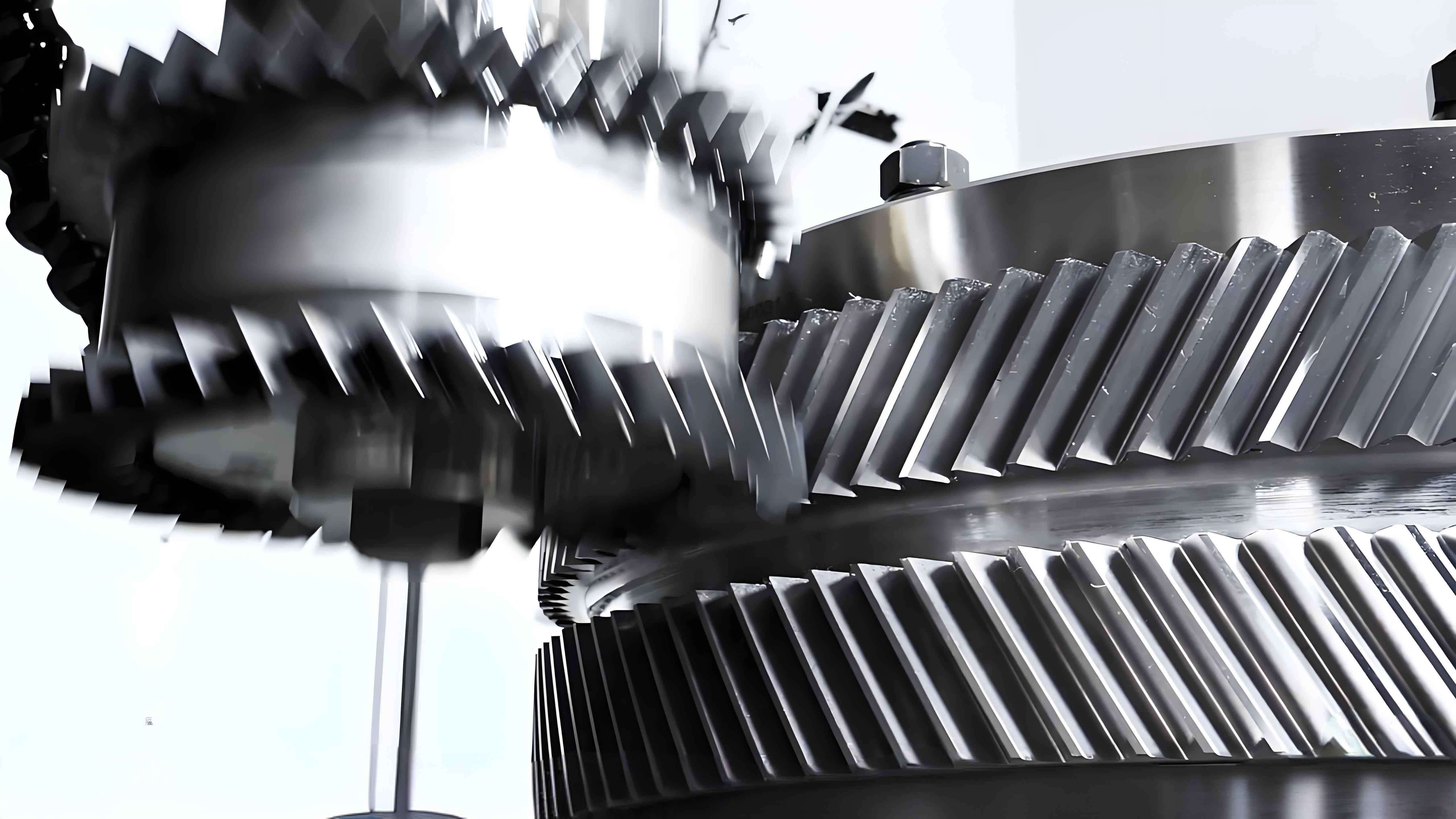
The image above illustrates a typical herringbone gear, highlighting its double-helix structure that is essential for balancing axial forces. This design is particularly beneficial in applications where high torque and reliability are required, such as in rolling mills. The herringbone gear’s ability to operate smoothly under load makes it a cornerstone of modern machinery, and when combined with advanced leak sealing, it ensures uninterrupted production.
Further technical details on herringbone gears include their geometric parameters, which can be summarized in a table:
| Parameter | Symbol | Typical Value Range | Importance |
|---|---|---|---|
| Normal Module | \( m_n \) | 5–20 mm | Determines tooth size and strength |
| Helix Angle | \( \beta \) | 15–30 degrees | Affects axial force cancellation and smoothness |
| Face Width | \( b \) | 100–500 mm | Influences load capacity and durability |
| Number of Teeth | \( z \) | 20–100 | Impacts gear ratio and meshing |
The performance of herringbone gears can also be analyzed using efficiency formulas, such as the gear transmission efficiency \( \eta \):
$$ \eta = \frac{P_{out}}{P_{in}} = 1 – \left( \frac{\mu \cdot F_a \cdot v_s}{F_t \cdot v_t} \right) $$
where \( P_{out} \) and \( P_{in} \) are output and input power, \( \mu \) is the coefficient of friction, \( F_a \) is the axial force, \( v_s \) is the sliding velocity, \( F_t \) is the tangential force, and \( v_t \) is the tangential velocity. This formula shows how herringbone gears minimize losses by reducing axial forces, thereby enhancing overall system efficiency—a critical factor in continuous production environments where energy waste is a concern.
In practice, the application of these technologies requires careful planning. For leak sealing, the injection process must account for fluid dynamics. The pressure drop \( \Delta P \) across the leak point can be modeled using the Hagen-Poiseuille equation for laminar flow:
$$ \Delta P = \frac{128 \cdot \mu \cdot L \cdot Q}{\pi \cdot d^4} $$
where \( \mu \) is the dynamic viscosity of the sealant, \( L \) is the length of the flow path, \( Q \) is the flow rate, and \( d \) is the diameter of the injection channel. This helps in designing the injection gun and fixtures for effective sealant delivery around complex components like herringbone gear casings.
The synergy between leak sealing and herringbone gear technology extends to predictive maintenance. By monitoring parameters such as vibration and temperature in herringbone gear systems, potential leaks can be detected early. The sealants can then be applied proactively using the on-line method, preventing catastrophic failures. This integrated approach leverages data analytics, where condition-based formulas are used:
$$ R(t) = e^{-\int_0^t \lambda(\tau) d\tau} $$
where \( R(t) \) is the reliability function over time \( t \), and \( \lambda(\tau) \) is the failure rate, which can be reduced through timely sealing interventions. Thus, herringbone gears benefit not only from robust design but also from complementary maintenance technologies.
Looking at broader industrial applications, both technologies are pivotal in sectors like nuclear energy, shipbuilding, and steel production. In nuclear plants, for example, herringbone gears are used in cooling systems, where leaks could have severe consequences. The on-line sealing technology provides a safe, rapid response, aligning with stringent safety standards. Similarly, in ship propulsion systems, herringbone gears transmit power from engines to propellers, and leak sealing ensures operational continuity in harsh marine environments.
To further elaborate on the sealant performance, experimental data can be summarized in a table comparing curing times under different conditions:
| Sealant Series | Pressure (kg/cm²) | Temperature (°C) | Curing Time (minutes) | Applicability to Herringbone Gear Systems |
|---|---|---|---|---|
| A-Series | 50 | 200 | 5–10 | High for steam leaks near gears |
| B-Series | 30 | 100 | 10–15 | Moderate for oil leaks in gearboxes |
| C-Series | 20 | 50 | 15–20 | Low for chemical environments |
| D-Series | 40 | 150 | 8–12 | Versatile for various leaks |
This data reinforces the adaptability of the sealing technology, which can be tailored to protect herringbone gears from media-specific damage. Additionally, the non-adhesive nature of the sealants means that herringbone gears can be disassembled for routine inspection without residue issues, preserving their precision engineering.
In conclusion, the integration of on-line pressure and temperature injection leak sealing technology with advanced herringbone gear designs represents a holistic approach to modern industrial challenges. As an engineer, I have seen how these innovations transform continuous production by minimizing downtime, enhancing safety, and boosting经济效益. The herringbone gear, with its unique double-helix structure, remains a focal point in machinery design, and its reliability is further ensured by complementary maintenance techniques. By repeatedly emphasizing herringbone gears throughout this discussion, I aim to highlight their critical role in sustaining industrial operations. Future developments may involve smart sealants with self-healing properties and optimized herringbone gear materials for even greater efficiency, driving the next wave of industrial advancement.
Finally, the mathematical modeling and tabular summaries provided here serve as a foundation for engineers to implement these technologies effectively. Whether dealing with a leak in a high-pressure pipeline or designing a new herringbone gear system for a rolling mill, the principles outlined ensure that continuous production is not just a goal but a sustainable reality. The journey from reactive maintenance to proactive innovation is paved with such technologies, and herringbone gears will continue to be at the heart of this evolution, symbolizing the synergy between mechanical excellence and operational resilience.