
In modern mechanical engineering, the reliability and longevity of gear shafts are paramount for the efficient operation of transmission systems, industrial machinery, and automotive applications. Gear shafts are subjected to extreme cyclic loads, torsional stresses, and surface wear, making their material properties and surface integrity critical design considerations. To mitigate deformation and wear-induced failures, surface hardening techniques such as carburizing and nitrocarburizing are extensively employed. These processes enhance surface hardness, improve wear resistance, and impart favorable residual stress profiles, thereby extending the service life of gear shafts. Among the preferred materials for high-duty gear shafts is 40CrNiMo medium-carbon high-strength steel, renowned for its excellent combination of strength, toughness, and hardenability. However, even with such a versatile material, improper heat treatment practices—often stemming from equipment limitations or insufficient process control—can lead to suboptimal performance, including excessive distortion, inadequate case depth, or premature wear. This study delves into a comprehensive comparative analysis of carburizing versus nitrocarburizing treatments for 40CrNiMo gear shafts, with a focus on optimizing process parameters to achieve superior surface characteristics. We explore the microstructural evolution, hardness gradients, and tribological behavior, and further investigate the influence of nitrocarburizing temperature and time on treatment quality. By integrating empirical data with theoretical models, we aim to establish a refined heat treatment protocol that maximizes the durability and efficiency of gear shafts in demanding operational environments.
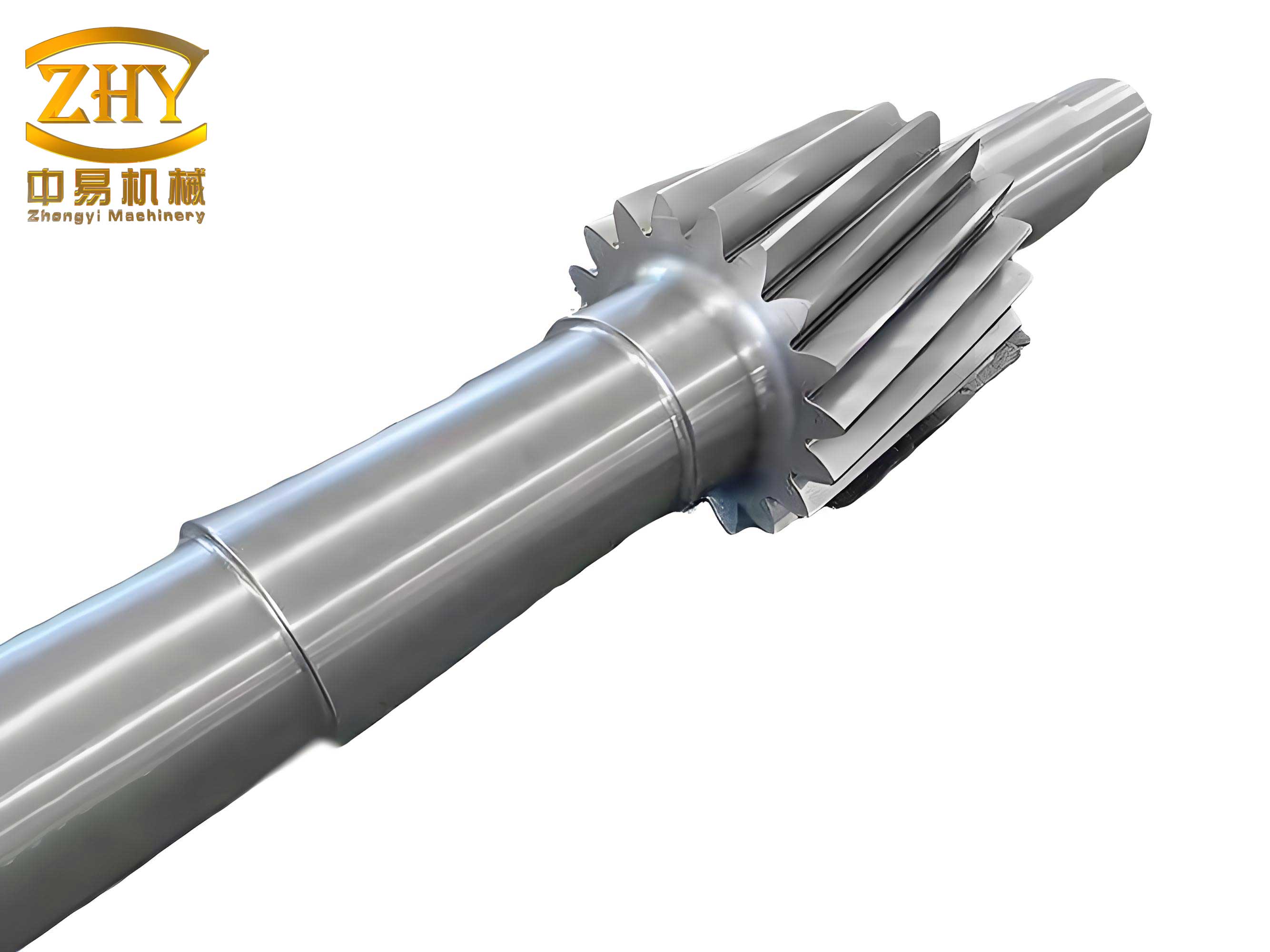
The selection of 40CrNiMo steel for gear shafts is driven by its balanced chemical composition, which confers a synergistic blend of mechanical properties. As detailed in Table 1, the alloy contains optimal levels of carbon, chromium, nickel, and molybdenum, elements that enhance hardenability, fatigue strength, and resistance to temper embrittlement. The presence of nickel improves toughness, while chromium and molybdenum contribute to secondary hardening and elevated temperature stability. This composition aligns with international standards, such as GB/T3077, ensuring consistency and reliability in gear shaft manufacturing. However, the core strength and toughness of 40CrNiMo must be complemented by a hardened surface layer to withstand contact stresses and abrasive conditions. Surface engineering through thermochemical diffusion processes addresses this need by introducing interstitial atoms like carbon and nitrogen into the steel matrix, forming hard carbides, nitrides, or carbonitrides. The efficacy of these treatments depends critically on process variables, including temperature, time, atmosphere composition, and cooling rates. In this investigation, we systematically evaluate two prominent surface hardening routes for gear shafts: conventional gas carburizing and plasma nitrocarburizing. The former involves enriching the surface with carbon at elevated temperatures to form a high-carbon martensitic case upon quenching, whereas the latter simultaneously introduces nitrogen and carbon at lower temperatures, creating a compound layer (often epsilon-carbonitride) and a diffusion zone with enhanced hardness and corrosion resistance. Our methodology encompasses material characterization, mechanical testing, and parametric optimization to elucidate the structure-property relationships in treated gear shafts.
| Element | C | Si | Mn | Mo | Cr | Ni | P | S |
|---|---|---|---|---|---|---|---|---|
| Measured Value | 0.39 | 0.32 | 0.62 | 0.16 | 0.73 | 1.40 | 0.004 | 0.002 |
| Standard Range (GB/T3077) | 0.37-0.44 | 0.17-0.37 | 0.50-0.80 | 0.15-0.25 | 0.60-0.90 | 1.25-1.65 | ≤0.025 | ≤0.025 |
Our experimental approach began with the procurement of 40CrNiMo steel billets, which underwent standard forging and normalization pre-treatments to homogenize the microstructure and refine the grain size—a crucial step for ensuring dimensional stability during subsequent heat treatment of gear shafts. Two distinct surface hardening schemes were implemented. Scheme A (Carburizing) involved gas carburizing in a radiant tube continuous furnace at 930°C for 4 hours, using a methanol and kerosene atmosphere, followed by oil quenching at 860°C and tempering at 250°C for 2 hours. This process aims to produce a deep, carbon-enriched case on the gear shafts. Scheme B (Nitrocarburizing) utilized plasma nitrocarburizing in an ion nitriding furnace at 560°C for 4 hours, with a carbon dioxide-based atmosphere at a pressure of 1600 Pa, followed by similar quenching and tempering steps. The lower processing temperature of nitrocarburizing reduces distortion risks, a significant advantage for precision gear shafts. Post-treatment, samples were sectioned, ground, polished, and etched with 4% nital for metallographic examination. Microhardness profiles were measured using a Vickers hardness tester with a load of 500 gf, traversing from the surface to the core at incremental distances. Wear resistance was assessed via dry sliding wear tests on a pin-on-disk tribometer under room temperature conditions: a load of 50 N, rotational speed of 500 rpm, and cumulative test duration of 120 minutes, with weight loss measured every 20 minutes. These methodologies allow for a direct comparison of the surface integrity and performance of gear shafts subjected to different thermochemical treatments.
The microstructural analysis revealed profound differences between the two treatment schemes. For gear shafts processed via carburizing (Scheme A), the surface region exhibited a coarse martensitic matrix with substantial retained austenite, often appearing in blocky formations. This microstructure, while hard, can be detrimental under cyclic loading due to the potential for austenite transformation-induced instability and reduced fatigue strength. In contrast, nitrocarburizing (Scheme B) yielded a much finer martensitic structure with negligible retained austenite; moreover, a continuous layer of white granular compounds, identified as epsilon-carbonitride (Fe3(C,N)), was uniformly distributed at the surface. This compound layer, typically 5-20 µm thick, provides exceptional lubricity and corrosion resistance, significantly boosting the wear performance of gear shafts. The absence of coarse austenite and the presence of hard carbonitrides suggest that nitrocarburizing promotes a more stable and wear-resistant surface, which is highly desirable for gear shafts operating in harsh environments.
Hardness gradients, as plotted in Figure 2, further underscore the advantages of nitrocarburizing for gear shafts. Both treatments produced high surface hardness, exceeding 900 HV. However, the hardness decay with increasing depth from the surface was markedly slower for Scheme B. At a depth of 0.2 mm, the hardness of nitrocarburized gear shafts remained above 1000 HV, whereas carburized samples dropped to approximately 850 HV. This trend persisted until a depth of 0.7 mm, where hardness values converged to the core hardness of about 600 HV. The superior case depth efficiency of nitrocarburizing can be attributed to the dual diffusion of nitrogen and carbon, which enhances hardenability and promotes the formation of fine precipitates that resist softening. The hardness profile is critical for gear shafts, as it determines the load-bearing capacity and resistance to subsurface fatigue cracking. We can model the hardness decay using an exponential decay function, where hardness \( H \) at a distance \( x \) from the surface is given by:
$$ H(x) = H_c + (H_s – H_c) e^{-kx} $$
Here, \( H_s \) is the surface hardness, \( H_c \) is the core hardness, and \( k \) is a diffusion-dependent attenuation coefficient. For nitrocarburized gear shafts, \( k \) is lower, indicating a more gradual hardness transition and a deeper effective case depth—a key factor in enhancing the durability of gear shafts.
| Distance from Surface (mm) | Scheme A (Carburizing) | Scheme B (Nitrocarburizing) |
|---|---|---|
| 0.0 | 1050 ± 20 | 1080 ± 15 |
| 0.1 | 980 ± 25 | 1040 ± 18 |
| 0.2 | 850 ± 30 | 1010 ± 20 |
| 0.3 | 750 ± 35 | 920 ± 22 |
| 0.4 | 680 ± 30 | 820 ± 25 |
| 0.5 | 640 ± 25 | 740 ± 20 |
| 0.6 | 620 ± 20 | 680 ± 18 |
| 0.7 | 600 ± 15 | 610 ± 15 |
Wear resistance, a paramount metric for gear shafts, was quantitatively evaluated through mass loss measurements during sliding wear tests. As shown in Figure 3, both treatments exhibited increasing wear mass loss with time, but the nitrocarburized gear shafts demonstrated consistently lower wear rates. Over the 120-minute test, the total wear loss for Scheme A was 90 mg, compared to only 62 mg for Scheme B—a reduction of approximately 31%. This translates to a wear rate ratio of 1.45:1, highlighting the superior tribological performance of nitrocarburizing. The enhanced wear resistance stems from the synergistic effects of the hard compound layer and the supportive diffusion zone, which reduce adhesive and abrasive wear mechanisms. The wear volume \( V \) can be estimated using the Archard wear equation:
$$ V = K \frac{N}{H} s $$
where \( K \) is the wear coefficient, \( N \) is the normal load, \( H \) is the hardness, and \( s \) is the sliding distance. For nitrocarburized gear shafts, the higher surface hardness and lower wear coefficient \( K \) (due to the lubricious compound layer) collectively minimize wear volume, thereby prolonging the operational life of gear shafts in service.
Given the evident benefits of nitrocarburizing for gear shafts, we pursued an optimization study to refine the process parameters. The influence of nitrocarburizing temperature (at a fixed time of 4 hours) on surface hardness and case depth is summarized in Figure 4. As temperature increased from 480°C to 640°C, surface hardness rose from 850 HV to a plateau of about 1080 HV above 560°C, while case depth (measured as the distance to 550 HV) expanded from 0.41 mm to 0.74 mm. The relationship between case depth \( d \) and temperature \( T \) follows a diffusion-controlled kinetics model, often expressed as:
$$ d = \sqrt{D_0 t \exp\left(-\frac{Q}{RT}\right)} $$
where \( D_0 \) is the pre-exponential factor, \( t \) is time, \( Q \) is the activation energy for diffusion, and \( R \) is the gas constant. The steep increase in case depth between 480°C and 520°C aligns with the accelerated diffusion rates at higher temperatures. However, excessively high temperatures (e.g., 640°C) risk grain growth and diminished toughness, which is undesirable for gear shafts subjected to impact loads.
| Temperature (°C) | Surface Hardness (HV) | Case Depth (mm) | Compound Layer Thickness (µm) |
|---|---|---|---|
| 480 | 850 ± 20 | 0.41 ± 0.05 | 5 ± 1 |
| 520 | 1020 ± 15 | 0.58 ± 0.04 | 10 ± 2 |
| 560 | 1080 ± 10 | 0.65 ± 0.03 | 15 ± 2 |
| 600 | 1070 ± 15 | 0.70 ± 0.04 | 18 ± 3 |
| 640 | 1060 ± 20 | 0.74 ± 0.05 | 20 ± 3 |
Similarly, the effect of nitrocarburizing time at a constant temperature of 560°C was investigated (Figure 5). Surface hardness peaked at 1100 HV after 6 hours, then slightly declined to 1050 HV at 10 hours, likely due to over-saturation and incipient porosity in the compound layer. Case depth increased monotonically with time, from 0.50 mm at 2 hours to 0.80 mm at 10 hours, following a parabolic growth law \( d \propto \sqrt{t} \). For gear shafts requiring a case depth of 0.2-0.6 mm per design specifications, a time of 4-6 hours is sufficient. Prolonged exposure beyond 6 hours offers diminishing returns in hardness and may compromise the fracture toughness of the surface layer, a critical consideration for dynamically loaded gear shafts.
| Time (h) | Surface Hardness (HV) | Case Depth (mm) | Wear Loss after 120 min (mg) |
|---|---|---|---|
| 2 | 950 ± 25 | 0.50 ± 0.05 | 75 ± 5 |
| 4 | 1080 ± 15 | 0.65 ± 0.03 | 62 ± 4 |
| 6 | 1100 ± 10 | 0.72 ± 0.04 | 58 ± 3 |
| 8 | 1070 ± 15 | 0.76 ± 0.05 | 65 ± 4 |
| 10 | 1050 ± 20 | 0.80 ± 0.06 | 70 ± 5 |
The optimization data collectively indicate that nitrocarburizing at temperatures between 520°C and 560°C for durations of 4 to 6 hours yields an optimal balance of high surface hardness, adequate case depth, and exceptional wear resistance for 40CrNiMo gear shafts. This parameter window ensures the formation of a dense, adherent compound layer without excessive brittleness or distortion. From a production standpoint, this refined process enhances the cost-effectiveness and consistency of manufacturing high-performance gear shafts. Furthermore, the lower processing temperature relative to carburizing reduces energy consumption and mitigates thermal distortion—a significant advantage for precision gear shafts with tight tolerances.
In discussing the broader implications, it is essential to consider the underlying diffusion mechanisms that govern these surface treatments. Carburizing primarily relies on carbon diffusion into austenite, which is temperature-sensitive and can lead to significant austenite retention upon quenching. Nitrocarburizing, by contrast, involves the simultaneous ingress of nitrogen and carbon, which lowers the activation energy for diffusion and facilitates the formation of stable carbonitrides. The interplay between these elements can be described using Fick’s second law with a source term for multi-component diffusion. For gear shafts, the resultant microstructure is a composite of a thin compound layer (dominated by ε-Fe3(C,N)) and a deeper diffusion zone strengthened by nitrogen-rich martensite and fine alloy nitrides. This dual-layer architecture provides a gradual transition in mechanical properties, reducing stress concentrations and improving fatigue performance—a key attribute for gear shafts undergoing cyclic loading.
Additionally, the wear behavior of treated gear shafts can be modeled using advanced tribological frameworks. The compound layer in nitrocarburized gear shafts acts as a solid lubricant, reducing the coefficient of friction and minimizing surface damage. This effect is particularly beneficial in boundary lubrication regimes common in gear systems. The wear coefficient \( K \) in the Archard equation can be expressed as a function of surface hardness and compound layer properties:
$$ K = K_0 \left(\frac{H_0}{H}\right)^n e^{-\beta \delta} $$
where \( K_0 \) and \( H_0 \) are reference values, \( n \) is an exponent, \( \beta \) is a material constant, and \( \delta \) is the compound layer thickness. This relationship highlights how nitrocarburizing enhances wear resistance through both hardness increase and intrinsic lubricity, making it a superior choice for gear shafts exposed to abrasive and adhesive wear.
In conclusion, our investigation demonstrates that nitrocarburizing outperforms conventional carburizing for 40CrNiMo gear shafts in terms of microstructural refinement, hardness profile stability, and wear resistance. The optimized nitrocarburizing parameters—520-560°C for 4-6 hours—produce a hard, durable surface layer with a gradual hardness transition, minimizing the risk of spalling and fatigue failure. These findings provide a robust technical basis for improving the surface treatment protocols of gear shafts in industrial applications. Future work could explore hybrid processes, such as plasma-assisted nitrocarburizing followed by laser hardening, to further tailor the surface properties of gear shafts for extreme conditions. By continuously refining these heat treatment strategies, we can enhance the reliability and efficiency of gear shafts, contributing to advancements in mechanical power transmission and machinery design.