
In the realm of power transmission systems, spiral bevel gears are indispensable components for transmitting torque and motion between intersecting shafts, particularly in automotive, aerospace, and industrial machinery. The performance and durability of spiral bevel gears heavily depend on the quality of tooth meshing, which is primarily evaluated through the contact pattern on the tooth surfaces and the characteristics of the transmission error curve. Traditional manufacturing methods for spiral bevel gears often utilize linear cutting blades with modifications to generate tooth surfaces, but this approach can impose constraints on achieving optimal contact and error profiles. In this comprehensive study, I explore an innovative method by employing parabolic cutting blades instead of linear ones for machining spiral bevel gears. By varying the parabolic parameters of the blade, we can alter the tooth surface geometry, thereby influencing the meshing behavior to enhance performance. This article delves into a detailed mathematical modeling, simulation-based analysis, and discussion of results to elucidate the relationship between blade geometry and meshing properties in spiral bevel gears. The goal is to provide a foundation for improving gear design and manufacturing processes through controlled blade profiling.
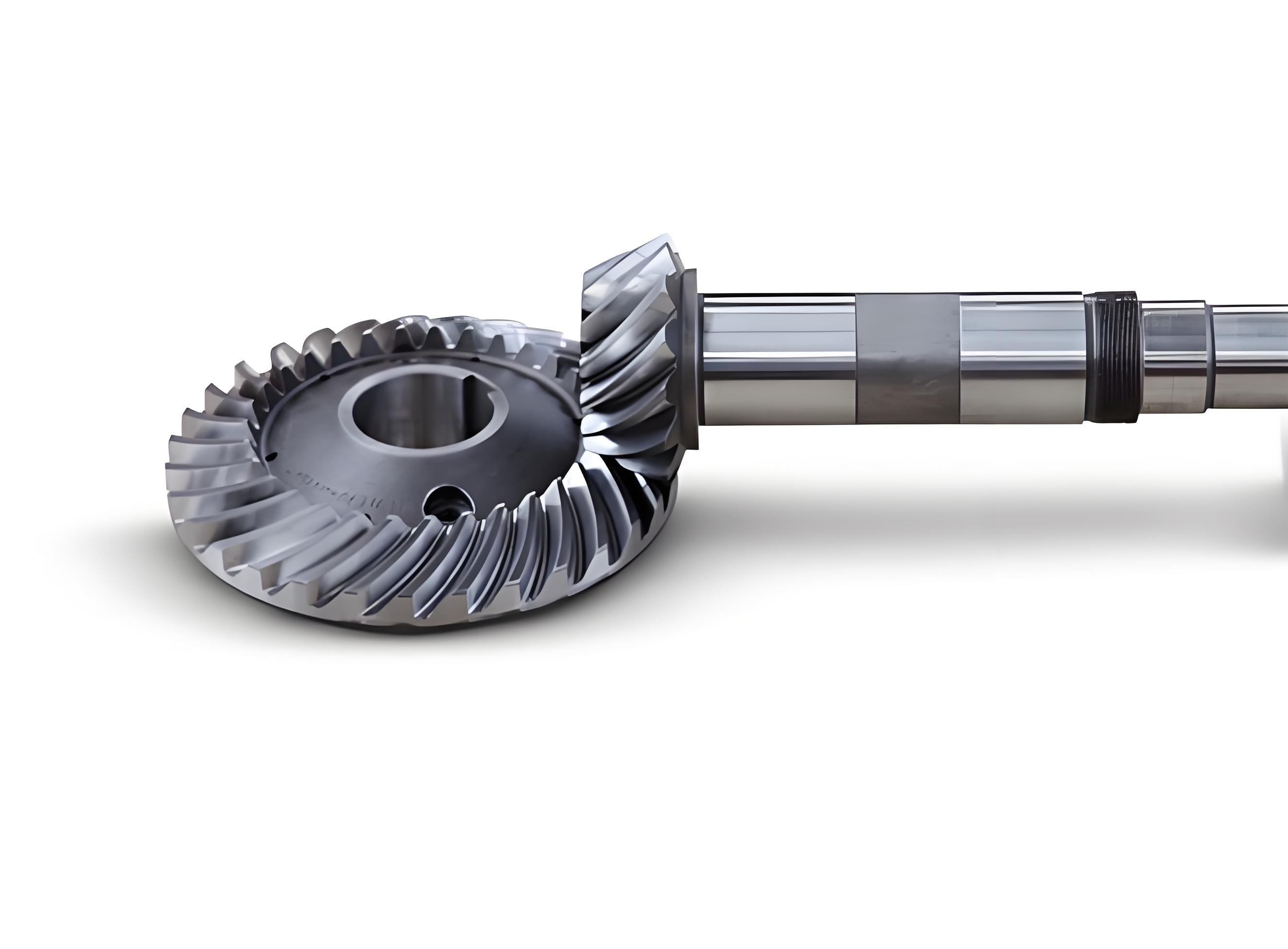
The meshing quality of spiral bevel gears is critical for minimizing noise, vibration, and wear, which directly impacts the efficiency and lifespan of gear systems. Key indicators include the path of contact, which describes the trajectory of contact points on the tooth surfaces during engagement, and the transmission error curve, which quantifies deviations from ideal motion transmission. Conventional machining of spiral bevel gears involves using straight-edged blades with modifications to approximate conjugate meshing. However, this method may require extensive tooth surface corrections to achieve desirable contact patterns. To address this, I propose a paradigm shift by adopting parabolic blades, which introduce a controlled curvature to the cutting edge, allowing for more flexible tooth surface generation. This approach can potentially reduce post-processing adjustments and improve the inherent meshing characteristics of spiral bevel gears. In this analysis, I focus on developing a rigorous mathematical framework to model tooth surfaces generated by parabolic blades, perform tooth contact analysis (TCA), and simulate the effects of varying parabolic parameters on meshing behavior.
The design and analysis of spiral bevel gears necessitate a robust mathematical model that encapsulates the geometry of the cutting tool, the kinematics of the machining process, and the resulting tooth surfaces. For spiral bevel gears, the manufacturing process typically involves a gear generator where a cutter head with multiple blades rotates to sweep out the tooth surfaces on a gear blank. In this study, I consider a parabolic blade profile that replaces the conventional straight edge, enabling a more nuanced control over the tooth surface curvature. The mathematical model begins with establishing coordinate systems for both the gear and pinion during cutting, deriving equations for the parabolic blade, transforming these to obtain tooth surface equations, and formulating the conditions for tooth contact analysis. All simulations are conducted using computational tools like MATLAB, allowing for precise calculation and visualization of results. The integration of parabolic blades into the machining of spiral bevel gears opens new avenues for optimizing gear performance, and this article aims to provide a thorough exploration of this methodology.
To model the machining of spiral bevel gears with parabolic blades, I first define a series of coordinate systems that represent the relative positions and motions between the cutter and the gear blank. For the gear (often the larger member), a cutting coordinate system is established. Let \( S_{m2} \) be a fixed coordinate system attached to the machine tool, with its origin \( O_{m2} \) at the machine center. A moving coordinate system \( S_{c2} \) is attached to the cradle, initially coincident with \( S_{m2} \) but rotating about the \( Z_{m2} \)-axis with an angle \( \phi_{c2} \) during cutting. The cutter head is represented by a coordinate system \( S_G \) with origin \( O_G \) at the cutter center, where the \( X_G O_G Y_G \) plane coincides with the blade tip plane. The radial distance of the cutter is denoted by \( S_{r2} \), and the angular orientation by \( q_2 \). The gear blank is positioned using auxiliary coordinate systems \( S_{a2} \) and \( S_{b2} \), and a body-fixed system \( S_2 \), which rotates with an angle \( \phi_2 \) during machining. Parameters such as \( X_{B2} \) (bedding distance), \( E_{m2} \) (vertical offset), \( X_{D2} \) (axial offset), and \( \gamma_{m2} \) (blank installation angle) define the installation of the gear blank. Similarly, for the pinion (the smaller gear), analogous coordinate systems are defined by replacing subscripts “2” with “1” and “G” with “P”. This structured approach ensures accurate representation of the machining kinematics for both members of the spiral bevel gear pair.
The core of this methodology lies in the mathematical description of the parabolic cutting blade. Unlike a straight blade, a parabolic blade has a curved edge defined by a quadratic function, allowing for continuous variation in the blade profile. Consider a parabolic blade used for cutting the gear tooth surfaces. Let \( R_{u2} \) be the nominal radius of the cutter, \( PW \) the point width (blade tip distance), \( \alpha_G \) the tool pressure angle, and \( \pm \) signs indicate expressions for concave and convex sides, respectively. The parabolic blade is characterized by a vertex position parameter \( A_0 \) and a parabolic parameter \( a_2 \), which controls the curvature. The blade tip radius is \( N_{c2} \), and \( r_{c2} = R_{u2} \pm PW/2 \). Using parameters \( s_G \) (along the blade edge) and \( \theta_G \) (rotation angle around the cutter axis), the surface generated by the revolving parabolic blade can be expressed as follows. The position vector \( \mathbf{r}_G(s_G, \theta_G) \) for points on this surface is:
$$
\mathbf{r}_G(s_G, \theta_G) = \begin{bmatrix}
\left[ r_{c2} \pm s_G \sin\alpha_G \pm a_2 (s_G – A_0)^2 \cos\alpha_G \right] \cos\theta_G \\
\left[ r_{c2} \pm s_G \sin\alpha_G \pm a_2 (s_G – A_0)^2 \cos\alpha_G \right] \sin\theta_G \\
– s_G \cos\alpha_G \pm a_2 (s_G – A_0)^2 \sin\alpha_G \\
1
\end{bmatrix}
$$
This equation represents a parametric surface where \( s_G \) varies along the blade edge and \( \theta_G \) rotates around the cutter axis. The unit normal vector \( \mathbf{n}_G(s_G, \theta_G) \) to this surface is essential for subsequent contact analysis and is given by:
$$
\mathbf{n}_G(s_G, \theta_G) = \frac{1}{\sqrt{1 + 4a_2^2 (s_G – A_0)^2}} \begin{bmatrix}
\left[ \cos\alpha_G – 2a_2 (s_G – A_0) \sin\alpha_G \right] \cos\theta_G \\
\left[ \cos\alpha_G – 2a_2 (s_G – A_0) \sin\alpha_G \right] \sin\theta_G \\
\pm \sin\alpha_G \pm 2a_2 (s_G – A_0) \cos\alpha_G
\end{bmatrix}
$$
When the parabolic parameter \( a_2 = 0 \), these equations reduce to those for a straight blade, confirming the generality of this model. For the pinion, similar equations apply with substitutions: subscript “G” becomes “P”, and parameters may differ. The parabolic blade is designed such that at the vertex position \( A_0 \), the pressure angle remains \( \alpha_G \), ensuring compatibility with standard gear geometry. This blade formulation allows for controlled deviations from a straight edge, enabling tailored tooth surfaces for spiral bevel gears.
To obtain the tooth surface equations for the gear and pinion, coordinate transformations are applied. Let \( [\mathbf{M}_{ij}] \) denote the homogeneous transformation matrix from coordinate system \( i \) to \( j \), and \( [\mathbf{L}_{ij}] \) represent the corresponding sub-matrix for normal vector transformations (the rotational part). For the gear, the tooth surface position vector \( \mathbf{r}_2(s_G, \theta_G, \phi_{c2}) \) and unit normal vector \( \mathbf{n}_2(s_G, \theta_G, \phi_{c2}) \) in the gear coordinate system \( S_2 \) are derived through a series of transformations:
$$
\mathbf{r}_2(s_G, \theta_G, \phi_{c2}) = [\mathbf{M}_{2b2}] [\mathbf{M}_{b2a2}] [\mathbf{M}_{a2m2}] [\mathbf{M}_{m2c2}] [\mathbf{M}_{c2G}] \mathbf{r}_G(s_G, \theta_G)
$$
and
$$
\mathbf{n}_2(s_G, \theta_G, \phi_{c2}) = [\mathbf{L}_{2b2}] [\mathbf{L}_{b2a2}] [\mathbf{L}_{a2m2}] [\mathbf{L}_{m2c2}] [\mathbf{L}_{c2G}] \mathbf{n}_G(s_G, \theta_G)
$$
Similarly, for the pinion, the tooth surface equations \( \mathbf{r}_1(s_P, \theta_P, \phi_{c1}) \) and \( \mathbf{n}_1(s_P, \theta_P, \phi_{c1}) \) are obtained by replacing “2” with “1” and “G” with “P”. These transformations incorporate all machining adjustments, such as radial and angular tool positions, enabling accurate generation of tooth surfaces for spiral bevel gears. The resulting surfaces are parametric, defined by blade parameters \( s_G, s_P \) and rotation angles \( \theta_G, \theta_P \), as well as machine settings \( \phi_{c2}, \phi_{c1} \). This mathematical representation forms the basis for performing tooth contact analysis to evaluate meshing performance.
Tooth contact analysis (TCA) is a computational technique used to simulate the meshing of gear pairs under load-free conditions, predicting contact patterns and transmission errors. For spiral bevel gears, TCA involves solving systems of equations that enforce contact conditions between the pinion and gear tooth surfaces. I define a fixed global coordinate system \( S_m \) for meshing analysis. The gear rotates about the \( Z_2 \)-axis, and the pinion rotates about the \( Z_1 \)-axis, with rotation angles \( \Psi_2 \) and \( \Psi_1 \), respectively. Let \( \mathbf{r}^{(1)}_m \) and \( \mathbf{r}^{(2)}_m \) be the position vectors of a point on the pinion and gear tooth surfaces expressed in \( S_m \), and \( \mathbf{n}^{(1)}_m \) and \( \mathbf{n}^{(2)}_m \) be their corresponding unit normal vectors. The relative velocity between the surfaces at a potential contact point is \( \mathbf{v}^{(12)}_m \). The fundamental conditions for contact at a point are: (1) the points coincide, (2) the normals are aligned, and (3) the relative velocity has no component along the common normal (to avoid separation or penetration). Mathematically, these are expressed as:
$$
\mathbf{r}^{(1)}_m = \mathbf{r}^{(2)}_m
$$
$$
\mathbf{n}^{(1)}_m = \mathbf{n}^{(2)}_m
$$
$$
\mathbf{n}^{(2)}_m \cdot \mathbf{v}^{(12)}_m = 0
$$
These equations constitute a system that can be solved for the unknown parameters. In practice, an initial contact point is chosen, typically at the midpoint of the tooth face and height, and the assembly positions are adjusted so that at this point, the gear pair is in contact with a specified transmission ratio equal to the inverse ratio of tooth numbers: \( \frac{\Psi_1}{\Psi_2} = \frac{Z_2}{Z_1} \). Solving the nonlinear system yields initial installation parameters, denoted by angles \( \Psi_{10} \) and \( \Psi_{20} \). To trace the path of contact across the tooth surfaces, I treat \( \Psi_1 \) as an independent variable, increment it in steps, and solve the contact equations for each value to obtain corresponding parameters, including \( \Psi_2 \). The transmission error \( \delta(\Psi_2) \) is then computed as the deviation from ideal motion:
$$
\delta(\Psi_2) = (\Psi_2 – \Psi_{20}) – (\Psi_1 – \Psi_{10}) \frac{Z_1}{Z_2}
$$
This error curve provides insight into the smoothness of meshing; smaller and smoother errors indicate better performance. By simulating TCA for spiral bevel gears with parabolic blades, I can assess how changes in blade curvature affect contact patterns and transmission errors, offering a tool for design optimization.
For simulation purposes, I consider a specific spiral bevel gear pair with detailed parameters. The basic geometric parameters of the gear set are summarized in the table below, which includes dimensions for both the pinion and gear. These parameters are essential for defining the tooth blank geometry and ensuring accurate modeling.
| Parameter | Pinion | Gear | Unit |
|---|---|---|---|
| Number of Teeth | 47 | 53 | – |
| Module (at Midpoint) | 3.000 | mm | |
| Mid-Spiral Angle | 35 | ° | |
| Shaft Angle | 90 | ° | |
| Face Width | 20.000 | mm | |
| Addendum | 2.7999 | 2.3001 | mm |
| Dedendum | 2.9001 | 3.3999 | mm |
| Pitch Cone Angle | 41.5664 | 48.4336 | ° |
| Root Cone Angle | 40.0031 | 46.6009 | ° |
| Face Cone Angle | 43.0758 | 49.6737 | ° |
| Hand of Spiral | Right | Left | – |
In addition to the basic parameters, the machining settings for generating the tooth surfaces are critical. These settings include tool geometry and machine adjustments, as listed in the following table. Note that for consistency, the pinion is machined with a straight blade (parabolic parameter \( a_1 = 0 \)), while the gear is machined with parabolic blades of varying parameters to study their effects.
| Parameter | Pinion (Concave Side) | Gear | Unit |
|---|---|---|---|
| Blade Tip Radius | 75.300 | 75.300 | mm |
| Cutter Diameter | 152.400 | mm | |
| Point Width | 1.400 | mm | |
| Tool Pressure Angle | 19.0833 | 20.9167 | ° |
| Blank Installation Angle | 40.0031 | 46.6009 | ° |
| Bedding Distance | 1.7796 | 0.00044 | mm |
| Axial Offset | -2.7684 | 0 | mm |
| Vertical Offset | -1.3150 | 0 | mm |
| Radial Tool Position | 82.4911 | 84.5736 | mm |
| Angular Tool Position | 51.9687 | -49.3259 | ° |
| Cutting Ratio (Roll) | 1.4740 | 1.3366 | – |
Using these parameters, I implemented a simulation in MATLAB to perform TCA for the spiral bevel gear pair. The parabolic blade for the gear is designed with the vertex at the midpoint of the equivalent straight blade, i.e., \( A_0 \) corresponds to the mid-position along the blade edge. By varying the parabolic parameter \( a_2 \) while keeping all other machining constants unchanged, I generated multiple tooth surfaces for the gear and analyzed their meshing with the pinion. This approach allows for isolating the effect of blade curvature on the contact characteristics. The simulation outputs include the path of contact on the tooth surfaces and the transmission error curves, which are compared across different \( a_2 \) values.
The results reveal significant variations in both contact patterns and transmission errors as the parabolic parameter \( a_2 \) changes. For reference, I consider three cases: \( a_2 = 0.000 \) (straight blade), \( a_2 = 0.0005 \), and \( a_2 = 0.001 \). The contact pattern refers to the region on the tooth surface where contact occurs during meshing; ideally, it should be centered and elongated along the tooth face to distribute loads evenly. The transmission error curve indicates the deviation from perfect kinematic transmission; smoother curves with smaller amplitudes are desirable for reduced noise and vibration. The following observations are made based on the simulation outputs for the gear’s convex side (similar trends apply to the concave side).
As \( a_2 \) increases from 0.000 to 0.001, the contact pattern on the gear tooth surface undergoes a noticeable transformation. With a straight blade (\( a_2 = 0.000 \)), the contact region is relatively uniform and aligned with the tooth profile. However, with parabolic blades, the contact region begins to tilt increasingly towards the face width direction, exhibiting greater curvature in the path of contact. This tilting effect is due to the altered tooth surface geometry induced by the parabolic blade, which changes the local curvatures and contact conditions. Specifically, the introduction of parabolic curvature modifies the surface normal vectors and their alignment during meshing, leading to a shifted and curved contact trajectory. This behavior can be quantified by analyzing the coordinates of contact points along the tooth surface. Let \( (x, y, z) \) represent a contact point in the tooth coordinate system; the trend shows that as \( a_2 \) increases, the variation in \( y \)-coordinates (along the face width) becomes more pronounced relative to \( x \)-coordinates (along the tooth height), indicating a bending of the contact path. This effect is summarized in the table below, which lists approximate characteristics of the contact patterns for different \( a_2 \) values.
| Parabolic Parameter \( a_2 \) | Contact Pattern Orientation | Curvature of Path | Approximate Coverage on Tooth Face |
|---|---|---|---|
| 0.000 (Straight) | Aligned with tooth profile | Low curvature | Centered, elliptical shape |
| 0.0005 | Tilted towards face width | Moderate curvature | Extended along face, slightly skewed |
| 0.001 | Strongly tilted | High curvature | Narrower but longer along face |
Concurrently, the transmission error curves exhibit corresponding changes. For \( a_2 = 0.000 \), the error curve is relatively flat with minor fluctuations, indicating near-ideal meshing. As \( a_2 \) increases to 0.0005 and 0.001, the error curve becomes steeper, with larger amplitudes near the engagement and disengagement points. The transmission error \( \delta(\Psi_2) \) at the point where the next tooth pair enters meshing (a critical value for noise generation) increases in magnitude with \( a_2 \). However, the rate of increase diminishes as \( a_2 \) grows, suggesting a nonlinear relationship. Mathematically, this can be expressed by fitting a function to the error data. For instance, the peak transmission error \( \delta_{\text{max}} \) can be approximated as a quadratic function of \( a_2 \):
$$
\delta_{\text{max}}(a_2) \approx c_1 a_2 + c_2 a_2^2
$$
where \( c_1 \) and \( c_2 \) are constants derived from simulation data. This relationship highlights that small changes in blade curvature can have significant effects on transmission errors, but the sensitivity decreases at higher curvatures. The following table provides numerical values of the transmission error at the meshing entry point for different \( a_2 \) values, based on the simulation.
| Parabolic Parameter \( a_2 \) | Transmission Error \( \delta(\Psi_2) \) at Entry (arc-seconds) | Change Relative to Straight Blade |
|---|---|---|
| 0.000 | 5.2 | 0% |
| 0.0005 | 12.8 | +146% |
| 0.001 | 18.3 | +252% |
To further analyze the trend, I plotted \( \delta(\Psi_2) \) at the entry point against \( a_2 \) over the range \( 0.000 \) to \( 0.001 \). The curve shows a monotonically increasing but decelerating rise, consistent with the quadratic approximation. This behavior implies that while parabolic blades can be used to tailor contact patterns, they also introduce larger transmission errors, which may necessitate a trade-off in design. However, it is important to note that transmission errors can be compensated through other means, such as micro-geometry modifications, making parabolic blades a valuable tool for achieving specific contact patterns without compromising overall performance. The ability to control contact patterns is crucial for spiral bevel gears, as it affects load distribution, stress concentrations, and wear characteristics.
The underlying mechanism for these changes lies in the geometry of the tooth surfaces generated by parabolic blades. The parabolic blade imparts a controlled curvature along the blade edge, which translates into variations in the tooth surface curvature. Using differential geometry, the principal curvatures of the tooth surface can be derived from the surface equations. For a parabolic blade, the surface curvature depends on both \( s_G \) and \( a_2 \). The Gaussian curvature \( K \) and mean curvature \( H \) at a point on the tooth surface influence how contact stresses are distributed. Generally, as \( a_2 \) increases, the curvature along the tooth length (face width direction) increases relative to that along the tooth height, leading to the observed tilting of the contact pattern. This can be expressed mathematically by computing the curvature tensor from the surface parametrization. Let the tooth surface be given by \( \mathbf{r}(u,v) \), where \( u = s_G \) and \( v = \theta_G \). The first fundamental form coefficients \( E, F, G \) and second fundamental form coefficients \( L, M, N \) are calculated, and the principal curvatures \( \kappa_1 \) and \( \kappa_2 \) are obtained by solving:
$$
\det \begin{bmatrix} L – \kappa E & M – \kappa F \\ M – \kappa F & N – \kappa G \end{bmatrix} = 0
$$
For parabolic blades, analytical expressions become complex, but numerical evaluations show that \( \kappa_1 \) (associated with the face width direction) increases with \( a_2 \), while \( \kappa_2 \) (associated with the tooth height direction) remains relatively stable. This anisotropy in curvature alters the contact ellipse during meshing, which is determined by the relative curvatures of the pinion and gear surfaces. The contact ellipse dimensions \( a \) (major axis) and \( b \) (minor axis) can be approximated using Hertzian contact theory, where:
$$
a \propto \left( \frac{\Delta \kappa}{A} \right)^{-1/3}, \quad b \propto \left( \frac{\Delta \kappa}{B} \right)^{-1/3}
$$
with \( \Delta \kappa \) being the relative curvature difference and \( A, B \) constants. As \( a_2 \) increases, the relative curvature in the face width direction changes, causing the contact ellipse to elongate along the face width, matching the observed contact pattern tilting. This geometric insight confirms that parabolic blades offer a direct means to manipulate tooth surface curvature for desired contact behavior in spiral bevel gears.
In practical applications, the choice of parabolic parameter \( a_2 \) should be guided by the specific requirements of the gear system. For instance, in high-load applications where even load distribution is critical, a moderate \( a_2 \) value might be selected to achieve a contact pattern that spreads across the tooth face. Conversely, for high-speed applications where noise reduction is paramount, a smaller \( a_2 \) might be preferred to minimize transmission errors. The simulation methodology presented here enables designers to predict these effects without physical prototyping, saving time and cost. Furthermore, this approach can be extended to optimize parabolic parameters using iterative algorithms, such as gradient-based methods or genetic algorithms, to achieve target contact patterns and error curves. For example, one could formulate an optimization problem where the objective is to minimize transmission error amplitude while constraining the contact pattern within a specified zone. The design variables would include \( a_2 \), \( A_0 \), and possibly other blade parameters, demonstrating the flexibility of parabolic blades in the design of spiral bevel gears.
Beyond the basic analysis, several factors warrant further consideration. First, the interaction between parabolic blades and other manufacturing variations, such as cutter head runout or machine tool errors, could affect the results. Sensitivity analyses could be conducted to assess the robustness of parabolic blade designs. Second, the effects of load on contact patterns and transmission errors are not covered in this load-free TCA; loaded tooth contact analysis (LTCA) would be necessary to evaluate performance under operating conditions. Parabolic blades might influence stress distributions and contact pressures, which are vital for durability. Third, the application of parabolic blades to both pinion and gear, rather than just one member, could provide additional degrees of freedom for optimization. Exploring symmetric or asymmetric parabolic profiles on both members might yield superior meshing characteristics for spiral bevel gears. These avenues represent fertile ground for future research.
In conclusion, this study demonstrates the potential of parabolic cutting blades as an alternative to straight blades for machining spiral bevel gears. Through mathematical modeling and simulation, I have shown that the parabolic parameter \( a_2 \) significantly influences both the contact pattern and transmission error curve. As \( a_2 \) increases, the contact pattern tilts towards the face width direction with increased curvature, while transmission errors become larger but with diminishing sensitivity. These findings provide a foundation for tailoring tooth surface geometry to meet specific performance criteria in spiral bevel gears. The ability to control meshing behavior through blade design reduces reliance on post-manufacturing corrections and offers a proactive approach to gear optimization. Future work should focus on experimental validation, loaded analysis, and multi-parameter optimization to fully harness the benefits of parabolic blades in industrial applications. Spiral bevel gears are critical components in many mechanical systems, and advancements in their manufacturing technology, such as the use of parabolic blades, contribute to enhanced efficiency, reliability, and performance across various sectors.