
Addressing excessive vibration stress in critical transmission components, particularly bevel gears, is paramount for the safety and reliability of modern aeroengines. High-cycle fatigue failures originating from resonant vibrations pose a significant threat, often occurring without prior warning. This work details the development, theoretical analysis, and experimental validation of a novel spiral ring friction damper specifically designed for the vibration mitigation of an aeroengine central drive bevel gear. We present a comprehensive study, from the damper’s design principles and energy dissipation mechanics to its integration and performance verification through rigorous engine-representative testing.
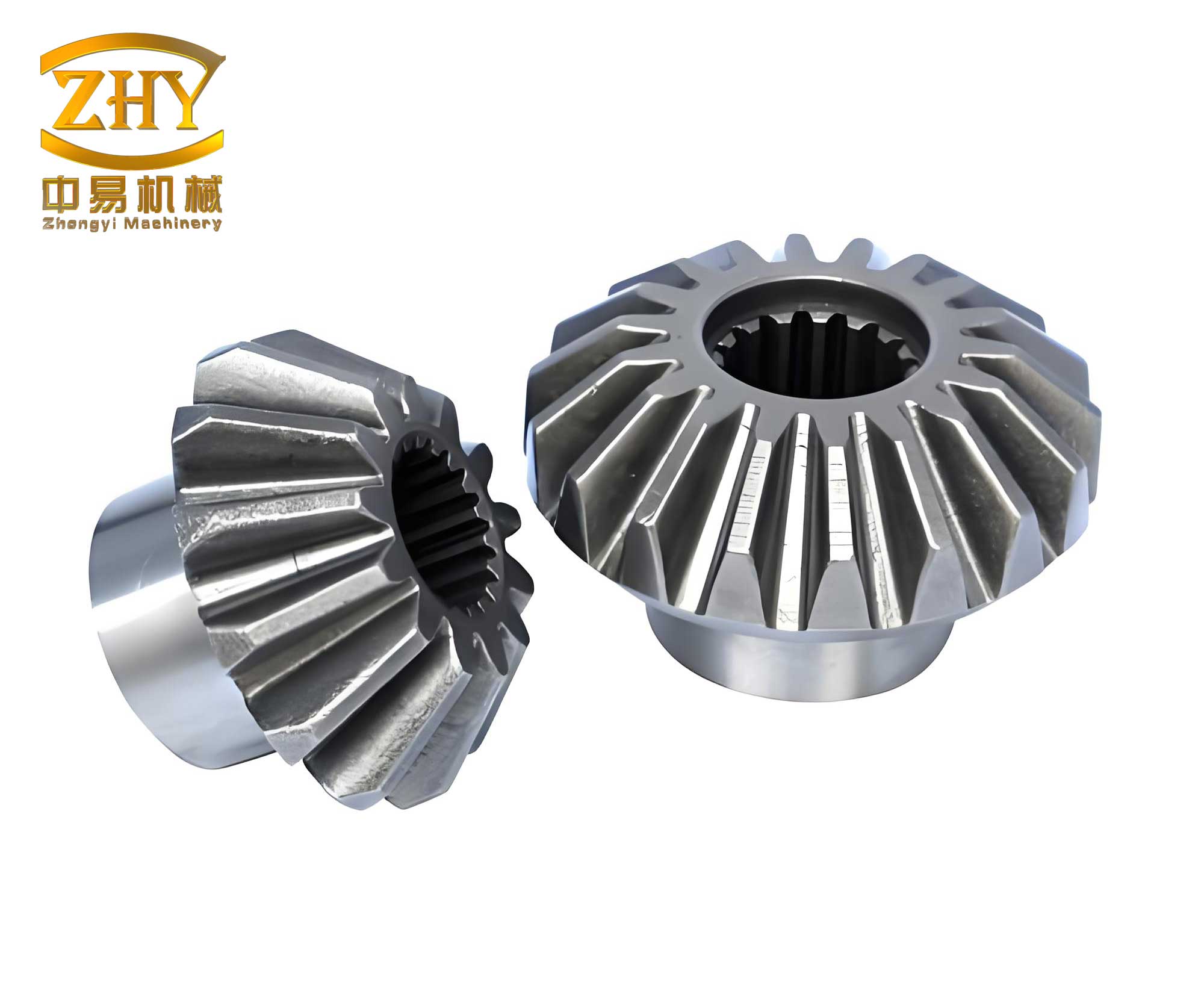
The operational environment for an aeroengine bevel gear is exceptionally demanding, characterized by high rotational speeds, significant mechanical loads, and elevated temperatures. Under these conditions, the gear’s cyclic deformation can synchronize with external excitations (e.g., meshing frequency, shaft orders), leading to resonant conditions known as traveling wave vibrations. For a rotating bevel gear, these manifest as forward or backward traveling waves, where the resonance frequency is a function of the gear’s fixed-base natural frequency, its rotational speed, and the number of nodal diameters (m) in the mode shape. The resulting dynamic stresses can quickly exceed the material’s endurance limit, initiating fatigue cracks—often at stress concentrators like the fillet region on the gear’s small end face—and potentially leading to catastrophic gear failure. While structural modification to shift natural frequencies is a primary approach, it is often constrained by weight, strength, and functional requirements. Consequently, supplemental damping techniques become essential. These are broadly categorized into internal damping methods, using viscoelastic layers or fluids, and external friction damping methods, using attached mechanical dampers. External friction dampers, such as ring dampers, offer a robust solution with predictable performance less sensitive to temperature variations compared to many viscoelastic materials.
Traditional ring dampers, such as C-shaped (split) or continuous (solid) rings, have been widely studied. However, they present practical challenges. C-rings require compression for installation, while solid rings necessitate thermal expansion/contraction processes (heating the gear, cooling the ring), complicating assembly and disassembly in field applications. Furthermore, their damping efficacy relies primarily on initial interference fit and centrifugal force, which may not provide optimal energy dissipation across all operational modes. To overcome these limitations, we propose a spiral ring damper. This design incorporates a multi-turn helical structure that blends advantages: it retains a degree of preload like a solid ring but can be installed by simply rotating (screwing) it into a machined groove on the gear rim, akin to the simplicity of handling a C-ring but without the need for significant compression. This innovation significantly eases maintenance and reduces the risk of introducing large unbalance during installation—a critical consideration for high-speed rotating assemblies like an aeroengine bevel gear.
Design and Energy Dissipation Mechanism of the Spiral Ring Damper
The core of our vibration control strategy is the spiral ring damper. The target bevel gear is machined with a continuous internal circumferential groove on its rim. The damper itself is fabricated as a three-turn helical ring from a high-strength alloy, such as 1Cr18Ni9, with a rectangular cross-section. The damper’s free diameter is designed to be slightly larger than the groove diameter, ensuring an initial radial interference fit upon installation. This preload, enhanced by centrifugal force at operational speeds, establishes consistent contact pressure between the damper’s outer surface and the groove’s inner wall. The system thus forms a coupled structure where the gear rim and the damper are mechanically linked but can exhibit relative motion under dynamic loads.
The fundamental damping mechanism is dry friction. When the bevel gear undergoes resonant flexural vibration (e.g., a diametral mode), the gear rim experiences cyclical circumferential strain. The attached damper, due to its different bending stiffness and inertial characteristics, develops a different strain field. This strain incompatibility drives relative tangential motion (micro-slip) at the frictional interface. The work done against friction forces dissipates vibrational energy as heat, thereby attenuating the resonant response amplitude of the bevel gear. The energy dissipation per cycle ($W’$) is the key metric, derived from integrating the friction force over the slip path. The relative slip $S(\theta, t)$ at a given angular position $\theta$ and time $t$ consists of two components:
$$S_1(\theta) = \int_{\theta_0}^{\theta} (\varepsilon_r – \varepsilon_d) R_t d\theta = \left( \frac{C_r}{R_r^2} + \frac{C_d}{R_d^2} \right) \frac{(m^2-1) W_0 R_t}{m} \left[ \sin(m\theta) – \sin(m\theta_0) \right] \cos(\omega t)$$
$$S_2(\theta) = \int_{\frac{\pi}{2m}-\theta}^{\frac{\pi}{2m}-\theta_0} \left[ \frac{R_d}{A_d E} \int_{0}^{\theta} \mu P \cos(\omega t) d\theta \right] R_t d\theta = \frac{\mu P R_d}{A_d E} \cdot \frac{1}{2} \left[ \left( \frac{\pi}{2m} – \theta \right)^2 – \left( \frac{\pi}{2m} – \theta_0 \right)^2 \right] \cos(\omega t)$$
Here, $S_1$ is the slip due to unrestrained differential strain, and $S_2$ is the reduction in slip due to the restraining friction force. The total slip is $S(\theta) = S_1(\theta) – S_2(\theta)$. The net energy dissipated per cycle $W’$ is calculated by integrating the friction power over the contact area and vibration period. To optimize the damper, we seek the contact pressure $P$ (a function of interference and speed) that maximizes $W’$. This optimal pressure is found by solving the system derived from the Lagrangian $G(\theta_0, P, \lambda) = f(\theta_0, P) + \lambda g(\theta_0, P)$:
$$
\begin{cases}
\frac{\partial G}{\partial \theta_0} = 0 \\[6pt]
\frac{\partial G}{\partial P} = 0 \\[6pt]
\frac{\partial G}{\partial \lambda} = 0
\end{cases}
$$
An equivalent viscous damping coefficient $C_e$ can then be estimated to quantify the damper’s effectiveness in a linearized sense:
$$C_e = \frac{W’}{\pi \omega W_0^2}$$
This analytical framework guides the design, allowing us to size the damper’s cross-section ($A_d$), select an appropriate interference fit, and predict its damping performance for specific resonant modes of the bevel gear.
Modal and Traveling Wave Resonance Analysis of the Bevel Gear System
To understand the vibration problem and assess the damper’s impact, we performed a detailed dynamic analysis of the bevel gear. A finite element model was constructed using cyclic symmetry, analyzing a fundamental sector representing 1/35th of the full gear (35 being the number of teeth). Boundary conditions simulated the actual mounting constraints, including radial and axial constraints at bearing surfaces and circumferential constraints at the internal spline connection.
Modal analyses were conducted for both the baseline (undamped) bevel gear and the gear with the integrated spiral damper model. The results, summarized in Table 1, show the natural frequencies for the first-order diametral modes. Critically, the addition of the damper causes only a minor shift in natural frequencies. This indicates that the primary benefit of the spiral ring is not frequency tuning but rather amplitude reduction via damping, making it an ideal solution when frequency separation is not feasible.
| Configuration | Nodal Diameters (m) | Natural Frequency (Hz) |
|---|---|---|
| Baseline (Undamped) | 1 | 2,963 |
| 2 | 3,529 | |
| 3 | 6,457 | |
| 4 | 10,710 | |
| With Spiral Damper | 1 | 2,983 |
| 2 | 3,545 | |
| 3 | 6,564 | |
| 4 | 10,789 |
The stress distribution for critical modes, such as the 3-nodal diameter (3ND) and 4-nodal diameter (4ND) first-order modes, confirms that the maximum vibrational stress is concentrated at the tooth root on the gear’s small end face—aligning perfectly with the observed failure origin in the problematic bevel gear.
For a rotating bevel gear, resonance occurs when an excitation order ($k$, e.g., from meshing or shaft imbalance) coincides with a traveling wave frequency. The conditions for traveling wave resonance are given by:
$$f_e = f_d \pm \frac{mN}{60}$$
where $f_e$ is the excitation frequency (Hz), $f_d$ is the dynamic frequency (approximately the fixed-base natural frequency), $N$ is the rotational speed (rpm), and $m$ is the number of nodal diameters. The ‘+’ sign corresponds to a backward traveling wave, and the ‘-‘ sign to a forward traveling wave. The excitation frequency is often an engine order: $f_e = k \cdot N / 60$. The critical speed for resonance for a given mode $m$ and excitation order $k$ is:
$$N_{\text{res}} = \frac{60 \cdot f_d}{|k \mp m|}$$
We calculated the resonant conditions within the engine’s operational speed range for the first-order modes. The results, shown in Table 2, identified two critical resonances: a 3ND forward traveling wave and a 4ND backward traveling wave. Both occur at speeds within the normal operating envelope of the bevel gear, confirming the root cause of the high-cycle fatigue issue and highlighting the necessity for a damping solution.
| Configuration | Nodal Diam. (m) | Wave Type | Exciting Order (k) | Resonant Speed (rpm) | Resonant Freq. (Hz) |
|---|---|---|---|---|---|
| Baseline | 3 | Forward | 32 | 12,107 | 6,457 |
| 4 | Backward | 39 | 16,477 | 10,710 | |
| With Damper | 3 | Forward | 32 | 12,315 | 6,568 |
| 4 | Backward | 39 | 16,600 | 10,790 |
Experimental Validation and Performance Assessment
The efficacy of the spiral ring damper was validated through comprehensive strain-gauge testing on a specialized gear transmission test rig capable of replicating engine speed and load profiles. The test article was the central drive bevel gear. Strain gauges were installed at strategic high-stress locations identified by FEA: primarily on the small-end tooth fillets and secondary locations on the gear web. Two consecutive tests were performed: first with the baseline bevel gear, and then with the identical gear fitted with the spiral damper.
Data was acquired using a wireless telemetry system to capture dynamic strain signals across the entire speed ramp-up to 100% design speed (20,500 rpm). Order analysis was performed on the collected data to construct waterfall plots, clearly identifying resonant peaks where excitation orders intersected with structural modes.
The baseline test data confirmed the severe resonant behavior. High-magnitude strain peaks were observed at speeds corresponding to the predicted 3ND forward and 4ND backward traveling wave resonances. The maximum measured vibratory strain and the corresponding stress, extrapolated to the peak stress location, are summarized in Table 3. The stress level for the 4ND resonance far exceeded the typical allowable vibratory stress limit for such a component, clearly justifying the failure.
| Vibration Mode | Max Measured Strain (με) | Max Local Stress (MPa) | Extrapolated Peak Stress (MPa) | Risk Assessment |
|---|---|---|---|---|
| 3ND Forward Traveling Wave | 285.7 | 57.1 | ~162 | Elevated |
| 4ND Backward Traveling Wave | 472.7 | 94.5 | ~323 | Critical (Above Allowable) |
The test with the spiral damper installed revealed a dramatic improvement. While the resonant speeds were slightly shifted (consistent with the minor frequency change in Table 1), the amplitude of the strain peaks was drastically reduced. The resonant responses for the critical modes were still identifiable but at a much lower intensity. The post-damping test results are summarized in Table 4.
| Vibration Mode | Max Measured Strain (με) | Max Local Stress (MPa) | Extrapolated Peak Stress (MPa) | Risk Assessment |
|---|---|---|---|---|
| 3ND Forward Traveling Wave | 130.2 | 26.1 | ~74 | Safe |
| 4ND Backward Traveling Wave | 138.5 | 27.7 | ~95 | Safe (Within Allowable) |
To quantitatively express the vibration reduction performance, we calculate the amplitude reduction ratio $\gamma$ for each critical mode:
$$\gamma = \left(1 – \frac{S’}{S}\right) \times 100\%$$
where $S$ is the resonant stress peak for the baseline bevel gear, and $S’$ is the resonant stress peak for the damped bevel gear. The final comparative performance is presented in Table 5.
| Vibration Mode | Baseline Stress S (MPa) | Damped Stress S’ (MPa) | Amplitude Reduction Ratio $\gamma$ |
|---|---|---|---|
| 3ND Forward Traveling Wave | 51.5 | 24.0 | 53.4% |
| 4ND Backward Traveling Wave | 94.5 | 27.7 | 70.7% |
The results are conclusive. The spiral ring damper achieved a 53.4% reduction in the 3ND forward wave resonance and a remarkable 70.7% reduction in the more severe 4ND backward wave resonance. After damping, the maximum vibratory stress in the bevel gear was brought well within the safe allowable limit. Furthermore, the damper demonstrated effectiveness across the entire speed range, ensuring smooth operation.
Conclusion
This study successfully demonstrates the application of a novel spiral ring friction damper for solving a critical high-cycle fatigue vibration problem in an aeroengine central drive bevel gear. The damper’s design leverages a multi-turn helical geometry that simplifies installation and removal compared to traditional ring dampers while minimizing added unbalance. The underlying energy dissipation mechanism, based on controlled dry friction between the gear rim and the damper due to strain incompatibility, was analyzed and optimized.
Through a combined analytical and experimental approach, we validated the damper’s performance. Finite element analysis confirmed that the damper primarily adds damping without significantly altering the system’s natural frequencies. Dynamic strain testing under engine-representative conditions provided definitive proof of its efficacy, showing stress reductions exceeding 50% for critical traveling wave resonances. The damped bevel gear exhibited vibratory stress levels fully compliant with design allowables.
The spiral ring damper presents a robust, practical, and highly effective solution for mitigating resonant vibrations in high-speed bevel gears. Its advantages in ease of assembly, maintenance, and performance make it a highly promising technology for enhancing the reliability and safety of current and future aeroengine transmission systems. This work confirms its viability and provides a framework for its design and application in similar challenging dynamic environments.