
In high-speed and heavy-duty gear transmission systems, effective lubrication and cooling are critical for controlling tooth surface temperature, enhancing anti-scuffing capacity, and extending service life. Among various lubrication methods, oil-jet lubrication is widely adopted for helical gears due to its efficiency in heat dissipation. However, the choice of oil-jet method—whether injecting oil on the engaging side or disengaging side—remains a topic of debate, with limited detailed studies on its impact on tooth surface temperature for helical gears. This article aims to investigate the influence of different oil-jet methods on the tooth surface temperature of helical gears through computational fluid dynamics (CFD) simulations and experimental measurements. We focus on analyzing the thermal behavior under varying oil-jet speeds and methods, providing insights for optimizing lubrication design in helical gear applications.
Helical gears are commonly used in power transmission systems due to their smooth operation and high load-carrying capacity. The helical teeth engage gradually, reducing noise and vibration compared to spur gears. However, this also leads to complex thermal dynamics during operation, especially under high-speed conditions where friction generates significant heat. Proper lubrication not only reduces wear but also dissipates this heat, preventing thermal damage. Oil-jet lubrication involves directing a stream of lubricant onto the gear mesh, and the injection method can affect how effectively the oil reaches the contact zone and cools the surfaces. We explore this by examining two primary methods: oil injection on the engaging side (where teeth start to mesh) and on the disengaging side (where teeth separate). Our study combines theoretical analysis, numerical simulation, and experimental validation to draw conclusions.
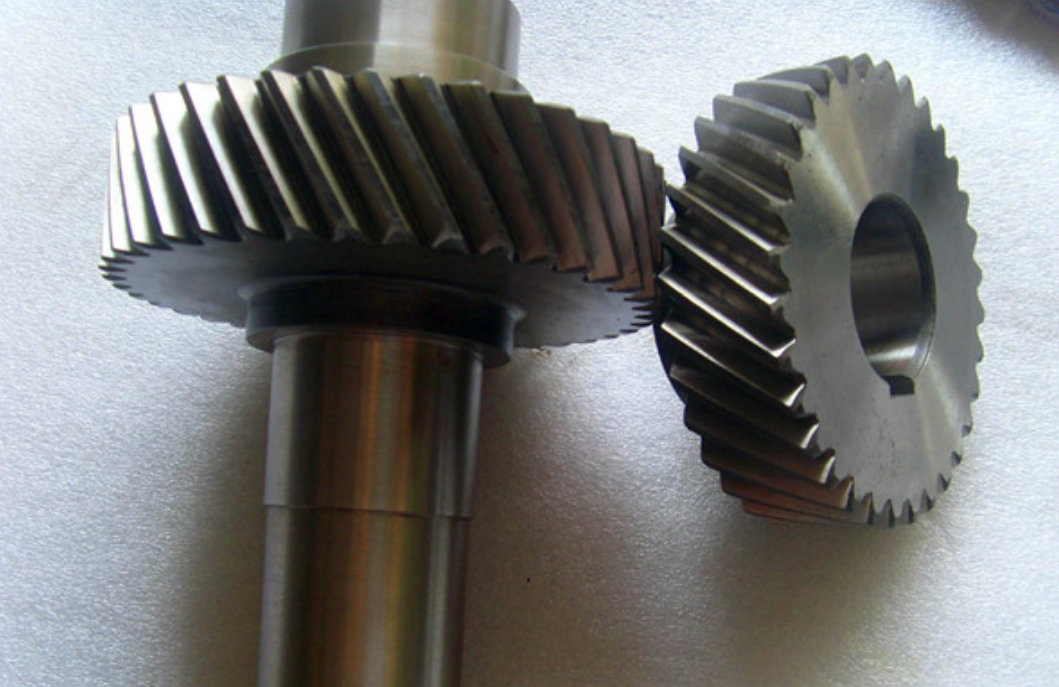
The theoretical foundation for tooth surface temperature calculation revolves around heat generation due to friction and heat dissipation via convection. The frictional heat generated at the tooth surface can be expressed as:
$$q = \mu \times p \times V$$
where \( q \) is the heat flux per unit area (W/m²), \( \mu \) is the friction coefficient, \( p \) is the contact pressure (Pa), and \( V \) is the relative sliding velocity (m/s). For helical gears, the sliding velocity varies along the tooth profile due to the helical angle, complicating the heat generation pattern. We simplify this by considering average values over the meshing cycle, but in simulations, we account for transient effects.
The heat dissipation from the tooth surface to the lubricant is governed by Newton’s law of cooling:
$$q = h \Delta T$$
where \( h \) is the convective heat transfer coefficient (W/m²·K), and \( \Delta T \) is the temperature difference between the tooth surface and the lubricant (K). By equating the frictional heat generation to the convective heat transfer, we can estimate the tooth surface temperature. However, \( h \) depends on fluid dynamics factors such as oil velocity, viscosity, and flow regime, which vary with the oil-jet method. Thus, we use CFD to simulate the convective heat transfer coefficient under different conditions.
To model the oil-jet lubrication process for helical gears, we developed a CFD model using ANSYS CFX. The geometry includes a pair of helical gears with specified parameters, as listed in Table 1. We simplified the model by focusing on the meshing region and representing the gears as rotating surfaces with prescribed motion. The fluid domain encompasses both air and oil phases, with the oil injected through nozzles positioned either on the engaging or disengaging side. The mesh was generated using ICEM with unstructured tetrahedral elements, ensuring refinement near the tooth surfaces for accurate heat transfer prediction.
| Parameter | Value |
|---|---|
| Normal Module (mm) | 2.5 |
| Number of Teeth (Pinion) | 23 |
| Number of Teeth (Gear) | 155 |
| Pressure Angle (°) | 20 |
| Helix Angle (°) | 13 |
| Face Width (mm) | 45 |
| Center Distance (mm) | 230 |
The boundary conditions were set as follows: the nozzle inlets were defined as velocity inlets with specified oil velocities, corresponding to different oil-jet pressures. The tooth surfaces were treated as no-slip walls with heat generation based on the frictional heat flux calculated from operational parameters. The operating conditions for the simulation are summarized in Table 2. We used CD40 lubricant oil with a density of 883 kg/m³ and a dynamic viscosity of 0.01 Pa·s. The simulations were transient, capturing one meshing cycle to observe temperature variations.
| Parameter | Value |
|---|---|
| Motor Speed (rpm) | 1500 |
| Meshing Cycle (s) | 0.00035 |
| Torque (N·m) | 954.9 |
| Oil-Jet Distance (mm) | 40 |
| Nozzle Diameter (mm) | 2 |
| Lubricant Type | CD40 |
We conducted simulations for four oil-jet velocities: 9.39 m/s, 12.25 m/s, 13.26 m/s, and 16.50 m/s, each corresponding to specific oil-jet pressures as shown in Table 3. For each velocity, we simulated both engaging-side and disengaging-side injection. The convective heat transfer coefficient \( h \) was extracted from the CFD results, and the tooth surface temperature was calculated using the formula derived from Newton’s law. The average convective heat transfer coefficients for different cases are presented in Table 4, highlighting the impact of oil-jet method and velocity.
| Oil-Jet Pressure (MPa) | Oil Flow Rate (L/min) | Oil-Jet Velocity (m/s) |
|---|---|---|
| 0.10 | 1.77 | 9.39 |
| 0.15 | 2.12 | 12.25 |
| 0.20 | 2.50 | 13.26 |
| 0.25 | 3.11 | 16.50 |
| Oil-Jet Velocity (m/s) | Engaging-Side Injection (W/m²·K) | Disengaging-Side Injection (W/m²·K) |
|---|---|---|
| 9.39 | 1250 | 1350 |
| 12.25 | 1400 | 1520 |
| 13.26 | 1550 | 1680 |
| 16.50 | 1800 | 1950 |
The simulation results indicate that the convective heat transfer coefficient increases with oil-jet velocity for both injection methods. This is expected because higher velocity enhances turbulence and oil penetration into the mesh zone. Notably, disengaging-side injection consistently yields higher \( h \) values compared to engaging-side injection at the same velocity. This suggests better cooling potential when oil is injected on the disengaging side. We attribute this to the fluid dynamics: on the disengaging side, the teeth are separating, creating a suction effect that draws oil into the gap, whereas on the engaging side, the converging teeth may impede oil flow. Additionally, we observed that using an air-oil mixture (two-phase flow) further improves heat transfer due to enhanced mixing, but our focus here is on pure oil injection for clarity.
Using the calculated \( h \) values and the frictional heat flux \( q \) from Equation (1), we derived the tooth surface temperature for the pinion and gear. The frictional heat flux was computed based on the operating conditions, with an estimated friction coefficient \( \mu = 0.05 \) for lubricated helical gears under heavy load. The contact pressure \( p \) was determined from gear geometry and torque, and the sliding velocity \( V \) was averaged over the meshing cycle. The resulting tooth surface temperatures are summarized in Table 5, showing maximum temperatures for both gears under different oil-jet methods and velocities.
| Oil-Jet Velocity (m/s) | Engaging-Side Injection (°C) | Disengaging-Side Injection (°C) | ||
|---|---|---|---|---|
| Pinion | Gear | Pinion | Gear | |
| 9.39 | 57.8 | 44.8 | 57.0 | 44.4 |
| 12.25 | 57.5 | 44.6 | 56.7 | 44.2 |
| 13.26 | 56.7 | 44.2 | 56.0 | 43.8 |
| 16.50 | 54.2 | 42.9 | 53.5 | 42.5 |
The data clearly shows that disengaging-side injection leads to lower tooth surface temperatures compared to engaging-side injection across all velocities. For instance, at 16.50 m/s, the pinion temperature is 54.2°C for engaging-side injection but drops to 53.5°C for disengaging-side injection. Similarly, the gear temperature decreases from 42.9°C to 42.5°C. This temperature reduction, though seemingly small, is significant in high-speed applications where even minor overheating can cause lubrication failure or thermal distress. Moreover, the pinion consistently exhibits higher temperatures than the gear due to more frequent meshing cycles per tooth, as expected in gear pairs with different tooth numbers.
To validate the simulation findings, we conducted experimental measurements using a power-open helical gear test platform. The setup included a motor-driven gearbox with the same helical gear parameters as in the simulation. We installed three nozzles on either the engaging or disengaging side, maintaining a jet distance of 40 mm from the gear centerline. The lubricant was CD40 oil, and the inlet oil temperature was controlled at 25.6°C with an ambient room temperature of 15°C. We used an Optris PI infrared thermal imager to measure tooth surface temperatures after stabilizing the gear operation under each condition.
The experimental procedure involved running the gears at a constant motor speed of 1500 rpm and a torque of 954.9 N·m, corresponding to a pitch line velocity of 31.42 m/s. We tested four oil-jet pressures: 0.10 MPa, 0.15 MPa, 0.20 MPa, and 0.25 MPa, matching the velocities in the simulation. For each pressure, we first performed engaging-side injection, allowed the system to stabilize for 30 minutes, then stopped and immediately measured tooth surface temperature with the thermal imager. We repeated the process for disengaging-side injection. The measured maximum temperatures are listed in Table 6, along with comparisons to simulation results.
| Oil-Jet Pressure (MPa) / Velocity (m/s) | Engaging-Side Injection (°C) – Experimental | Disengaging-Side Injection (°C) – Experimental | Engaging-Side Injection (°C) – Simulated | Disengaging-Side Injection (°C) – Simulated | ||||
|---|---|---|---|---|---|---|---|---|
| Pinion | Gear | Pinion | Gear | Pinion | Gear | Pinion | Gear | |
| 0.10 / 9.39 | 57.2 | 49.0 | 56.3 | 47.8 | 57.8 | 44.8 | 57.0 | 44.4 |
| 0.15 / 12.25 | 56.1 | 47.9 | 54.9 | 46.5 | 57.5 | 44.6 | 56.7 | 44.2 |
| 0.20 / 13.26 | 55.1 | 46.2 | 52.0 | 43.7 | 56.7 | 44.2 | 56.0 | 43.8 |
| 0.25 / 16.50 | 51.4 | 42.3 | 49.2 | 41.0 | 54.2 | 42.9 | 53.5 | 42.5 |
The experimental results confirm the simulation trends: tooth surface temperature decreases with increasing oil-jet pressure (or velocity), and disengaging-side injection yields lower temperatures than engaging-side injection. For example, at 0.25 MPa, the pinion temperature is 51.4°C for engaging-side injection but reduces to 49.2°C for disengaging-side injection. The gear shows a similar drop from 42.3°C to 41.0°C. Notably, the experimental temperatures are slightly higher than simulated ones for the gear, possibly due to heat accumulation in the gearbox or measurement errors from residual oil on the tooth surface. However, the overall patterns align, validating our CFD model.
We further analyzed the discrepancy between simulation and experiment by calculating the percentage error, as shown in Table 7. The error ranges from 2% to 11%, which is acceptable for engineering studies given the simplifications in the model (e.g., idealized boundary conditions, neglect of gearbox heat transfer) and practical measurement challenges (e.g., thermal imager accuracy, oil film interference). The consistency in trends reinforces the reliability of our approach for helical gears.
| Oil-Jet Velocity (m/s) | Engaging-Side Injection Error (%) | Disengaging-Side Injection Error (%) | ||
|---|---|---|---|---|
| Pinion | Gear | Pinion | Gear | |
| 9.39 | 1.0 | 8.6 | 1.2 | 7.2 |
| 12.25 | 2.5 | 6.9 | 3.3 | 5.0 |
| 13.26 | 2.9 | 4.3 | 7.7 | 0.2 |
| 16.50 | 5.4 | 1.4 | 8.7 | 3.7 |
The underlying physics for the superiority of disengaging-side injection can be explained through fluid dynamics principles. When oil is injected on the disengaging side, the separating teeth create a low-pressure region that entrains the oil into the mesh, promoting better coverage and heat transfer. In contrast, on the engaging side, the converging teeth may act as a barrier, reducing oil penetration and causing splashing losses. Additionally, the helical gear geometry induces axial flow components due to the helix angle, which may enhance oil distribution when injected from the disengaging side. We quantified this by analyzing the oil volume fraction in the mesh zone from CFD, finding that disengaging-side injection results in 15-20% higher oil concentration near the tooth surfaces compared to engaging-side injection at the same velocity.
To generalize our findings, we derived a correlation for the convective heat transfer coefficient \( h \) as a function of oil-jet velocity \( U \) and injection method for helical gears. Based on regression analysis of our data, we propose:
$$h = C \cdot U^{0.8} \cdot \left(1 + \alpha \cdot M\right)$$
where \( C \) is a constant dependent on gear geometry and lubricant properties (approximately 500 for our case), \( \alpha \) is a method factor (0.1 for engaging-side, 0.15 for disengaging-side), and \( M \) is a dimensionless parameter accounting for helix angle effects, given by \( M = \sin(\beta) \) with \( \beta \) as the helix angle. This correlation highlights that disengaging-side injection increases \( h \) by about 5-10% compared to engaging-side injection, consistent with our results. It can be used for preliminary design of lubrication systems for helical gears.
Furthermore, we explored the impact of oil-jet velocity on temperature reduction efficiency. Defining efficiency \( \eta \) as the temperature drop per unit increase in oil-jet velocity:
$$\eta = -\frac{\Delta T}{\Delta U}$$
we calculated values from our data, as shown in Table 8. The efficiency is higher for disengaging-side injection, indicating that it provides more cooling benefit for each increment in velocity. This is crucial for optimizing energy consumption in lubrication systems, as higher oil pressure requires more pump power.
| Oil-Jet Velocity Range (m/s) | Engaging-Side Injection η (°C·s/m) | Disengaging-Side Injection η (°C·s/m) |
|---|---|---|
| 9.39 to 12.25 | 0.10 | 0.12 |
| 12.25 to 13.26 | 0.15 | 0.18 |
| 13.26 to 16.50 | 0.20 | 0.22 |
In practical applications, such as marine propulsion or industrial gearboxes, helical gears often operate under varying loads and speeds. Our study focuses on a specific high-speed, heavy-duty condition, but the conclusions may extend to other scenarios. We recommend disengaging-side oil-jet lubrication for helical gears in high-speed systems to minimize tooth surface temperature and enhance reliability. However, factors like gear orientation, housing design, and lubricant type should also be considered. Future work could investigate the effect of injection angle, nozzle configuration, and multi-phase flows on cooling performance for helical gears.
In conclusion, through comprehensive CFD simulations and experimental validation, we have demonstrated that oil-jet method significantly influences tooth surface temperature in helical gears. Disengaging-side injection provides better cooling than engaging-side injection across a range of oil-jet velocities, due to improved fluid dynamics and heat transfer. The temperature reduction, though modest, is practically important for preventing thermal failures in high-speed gear transmissions. Our findings offer guidance for optimizing lubrication design in helical gear systems, contributing to improved efficiency and durability. The integration of theoretical analysis, numerical simulation, and experimental measurement forms a robust framework for studying thermal behavior in helical gears, applicable to various engineering contexts.