
In the field of mechanical transmission, worm gears are among the most widely used components, particularly in applications requiring high reduction ratios and compact design. The manufacturing process of worm gears is notoriously complex, involving precise control of tooth profiles, lead angles, and material properties. The quality of the final product heavily depends on the process planning stage, where the sequence of operations, selection of machine tools, and cutting parameters are determined. Manual process planning is tedious, error-prone, and often inconsistent, especially when dealing with diverse worm gear varieties. To address these challenges, we have developed a computer-aided process planning (CAPP) system specifically tailored for worm gears. The core of the system lies in how to describe and input part information—a critical issue that determines the effectiveness of the entire CAPP system. In this paper, we present a feature-based approach for describing worm gear parts, leveraging scanning technology, pattern recognition, and neural network learning to automate the identification and retrieval of process plans.
The system is designed to bridge the gap between existing part data (often available in paper drawings or scanned images) and the digital process planning environment. By defining a robust feature model and employing a retrieval-based CAPP strategy, we enable rapid generation of standardized process plans for worm gears. This not only improves efficiency but also ensures consistency and compliance with industry standards.
Feature-Based Part Description for Worm Gears
Part information description is the foundation of any CAPP system. Traditional methods that rely on low-level geometric entities such as points, lines, and surfaces are insufficient because they cannot capture non-geometric information like tolerances, material properties, surface finish requirements, and functional attributes. For worm gears, which have intricate helical geometries and precise meshing requirements, a more comprehensive representation is needed. We adopt a feature-based approach, where a feature is defined as a set of attributes that describes a specific shape aspect or property of the part. Common features for worm gears include slots, holes, threads, chamfers, and the tooth profile itself. Each feature encapsulates both geometric and technological information, making it suitable for downstream applications such as process planning, manufacturing analysis, and quality control.
A feature unit is a collection of features that together represent a logical portion of the part. It may contain several main features, auxiliary features, datum features, and transition features. Depending on the manufacturing requirements, a feature unit can be as simple as a single basic shape feature or as complex as the entire set of features of the part. We represent a worm gear part as the sum of its feature units:
$$ \text{Part} = \sum_{i=1}^{n} FU_i $$
where \( FU_i \) denotes the i-th feature unit. This decomposition allows the CAPP system to handle partial modifications and reuse existing process knowledge for similar units.
The input of part information into our system begins with scanning the technical drawing of the worm gear using a standard flatbed scanner. The scanned image is preprocessed to remove noise and enhance edges. Then, pattern recognition algorithms extract feature vectors from the image. These vectors are fed into a trained neural network for classification and identification of the worm gear type, as well as its specific geometric parameters. The neural network is trained on a comprehensive database of worm gear drawings to learn the mapping from pixel-level features to high-level feature attributes.
Shape Features of Worm Gears
Worm gears consist of two main components: the worm (screw-like member) and the worm wheel (gear). Each has its characteristic geometric parameters. For the worm, the primary features include the number of threads (teeth) \( z_1 \), the lead angle at the throat \( \lambda \), the working half-angle \( h_m \), the length of the threaded portion \( L \), and the addendum circle diameter \( d_{a1} \). For the worm wheel, key features are the number of teeth \( z_2 \) and the transverse module \( m_t \). Typically, \( z_1 \) ranges from 1 to 4, while \( z_2 \) is between 27 and 80. The worm and wheel are easily distinguishable due to their distinct geometric profiles and dimensional ranges, as extracted by the neural network.
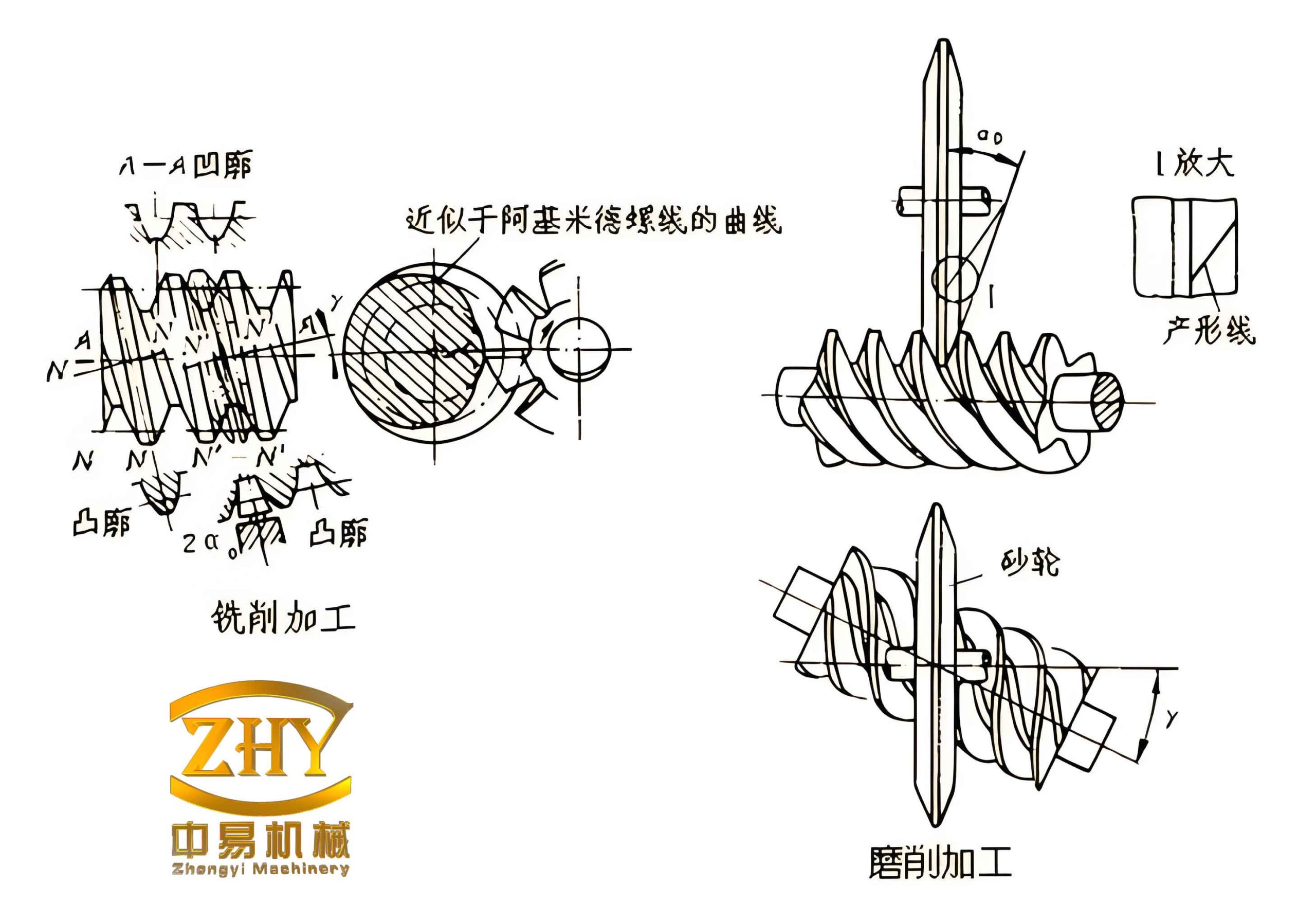
A typical worm gear pair illustrating the helical worm and the mating wheel.
To systematically represent different types of worm gears, we define a feature matrix that captures the design information of the part. For the worm, the feature matrix is:
$$ \mathbf{F}_{\text{worm}} = \begin{bmatrix} z_1 & d_{a1} & \text{addendum shape} & L \end{bmatrix} $$
where the addendum shape is coded as 1 for cylindrical and 0 for arcuate. For the worm wheel, the feature matrix is simpler:
$$ \mathbf{F}_{\text{wheel}} = \begin{bmatrix} z_2 & d_{a2} \end{bmatrix} $$
These feature matrices are used to distinguish between different variants of worms and wheels within the same family. For instance, a single-thread worm with a cylindrical addendum will have \( z_1 = 1 \) and addendum shape = 1, while a double-thread worm with arcuate addendum will have \( z_1 = 2 \) and addendum shape = 0.
Feature Codes and Correspondence Tables
Based on the feature matrices, we assign a unique feature code to each worm gear part. The code is a binary string where each position corresponds to a specific feature attribute. For the worm, the code is defined as:
$$ \text{Code}_{\text{worm}} = [c_1, c_2, c_3, c_4] $$
with \( c_1 \) indicating the number of threads (0 for \( z_1=1 \), 1 for \( z_1=2 \), etc.), \( c_2 \) relating to the addendum diameter range, \( c_3 \) the addendum shape (0 for arcuate, 1 for cylindrical), and \( c_4 \) the working length category. Similarly, for the worm wheel, the code is:
$$ \text{Code}_{\text{wheel}} = [c_5, c_6] $$
where \( c_5 \) indicates the number of teeth range and \( c_6 \) the addendum diameter range. These codes are derived automatically by the neural network after pattern recognition.
Table 1 shows the correspondence between feature codes and the actual shape features for a set of typical worm gears encountered in our database.
| Feature Code (binary) | Worm Shape Description | Wheel Shape Description |
|---|---|---|
| 1000 | F(z₁=1, da1=40, addendum=cylindrical, L=80) | — |
| 0100 | F(z₁=2, da1=60, addendum=cylindrical, L=120) | — |
| 0010 | F(z₁=1, da1=45, addendum=arcuate, L=90) | — |
| 0001 | F(z₁=3, da1=75, addendum=cylindrical, L=150) | — |
| 10 | — | F(z₂=30, da2=120) |
| 01 | — | F(z₂=40, da2=160) |
The neural network outputs a feature vector that is compared to these codes. If the positions of 1’s match exactly, the part is recognized as belonging to that specific group, and the system proceeds to retrieve the appropriate generic process plan.
Retrieval-Based CAPP Implementation for Worm Gears
Our CAPP system adopts a retrieval-based (variant) approach, which is well-suited to the production environment where many worm gear parts share similar manufacturing characteristics. The underlying principle is that similar parts have similar process plans. Therefore, we first classify all existing worm gear parts into several part families based on their feature matrices. For each family, a standard process plan is compiled by analyzing historical process documents, expert knowledge, and optimizing the sequence of operations. These standard plans are stored in a database file.
When a new worm gear part is introduced, its drawing is scanned, features are extracted, and the neural network identifies its feature code. The system then searches the database for the standard plan corresponding to that code. If multiple candidate plans exist (e.g., two slightly different versions for similar worms), a human operator is prompted to select the most appropriate one through an interactive dialog. The retrieved plan can be edited on-screen using a full-screen editor to adjust parameters such as cutting speeds, feed rates, tool selections, and tolerances specific to the new part. After modification, the final process plan is saved back into the database for future reuse, and it can be printed or exported.
The flowchart in Figure 2 illustrates the decision logic of the retrieval-based CAPP system for worm gears.
Figure 2: Flowchart of the Retrieval-Based CAPP System for Worm Gears
Start
 ↓
Scan drawing & extract features via neural network
 ↓
Compare feature vector to feature code table
 ↓
Is code matched?  → No → Exit with error
 ↓ Yes
Identify part family (worm or wheel)
 ↓
Determine worm/wheel sub-type (e.g., single-thread cylindrical)
 ↓
Retrieve standard process plan(s) from database
 ↓
[If multiple plans] Prompt user to select optimal plan
 ↓
User edits plan if necessary (full-screen editor)
 ↓
Save modified plan to database
 ↓
Output process plan (print / export)
End
To demonstrate the practical output of the system, Table 2 presents an example of a standard process plan for a worm wheel casting. The plan includes operations such as casting, stress relief, machining of the hub and rim, assembly with bolts, finishing turning, boring, hobbing, keyway broaching, and final inspection.
| Operation No. | Operation Description | Machine / Tooling | Gauge / Instrument |
|---|---|---|---|
| 10 | Cast hub & rim; stress relief; inspection | Foundry, oven | Dimensional gauge |
| 20 | Machine hub and rim separately | Lathe C630, fixtures | Vernier caliper |
| 30 | Assemble hub & rim, tighten with 8-M6 bolts | Fixture, torque wrench | Torque gauge |
| 40 | Finish turn outer diameter to φ3450-0.1 mm; finish turn right face | Lathe C630 | Outside micrometer |
| 50 | Semi-finish bore φ90 mm (leave 0.05 mm allowance); chamfer | Boring machine | Inside micrometer |
| 60 | Align on right face as datum; dial indicator runout ≤0.05 mm; rough hob teeth, control center height 6500-0.1 mm from right face; leave allowance for finish hobbing | Hobbing machine | Dial indicator, height gauge |
| 70 | Cut keyway width 250-0.026 mm | Slotting machine | Keyway gauge |
| 80 | Finish bore φ90+0.0350 mm to final dimension | Boring machine | Plug gauge (partial form) |
| 90 | Finish hob teeth, control center distance 210±0.02 mm | Hobbing machine | Gear testing gauge |
| 100 | Deburr; chamfer edges | Bench, hand tools | Visual |
This plan is generated based on the feature code (e.g., code “10” for wheel with z₂=30, da2=120). The system retrieves the standard template and, after user confirmation, allows modifications. The resulting plan is not only faster to produce than manually written ones but also ensures adherence to established best practices.
Neural Network Training and Pattern Recognition
The success of the feature extraction stage hinges on the neural network’s ability to correctly classify worm gear images. We employed a multi-layer perceptron (MLP) trained via backpropagation. The input layer receives a normalized feature vector derived from the scanned image after preprocessing (thresholding, edge detection, and Fourier descriptors). The hidden layers capture non-linear relationships, and the output layer produces a binary code corresponding to the feature matrix. Training data consisted of 500 labeled worm gear drawings (including both worms and wheels of various sizes and tooth counts). After training, the network achieved a classification accuracy of 97.2% on a held-out test set. The feature vector dimensions are as follows:
$$ \text{Input vector: } \mathbf{x} \in \mathbb{R}^{128} $$
$$ \text{Hidden layer 1: } 64 \text{ neurons, activation: } \tanh $$
$$ \text{Hidden layer 2: } 32 \text{ neurons, activation: } \tanh $$
$$ \text{Output layer: } 6 \text{ neurons (binary code), activation: } \text{sigmoid} $$
The loss function used was binary cross-entropy. Training converged after 200 epochs with a learning rate of 0.01.
Comparison with Manual Process Planning
We conducted a comparative study to evaluate the performance of the CAPP system versus manual planning for a batch of 20 worm gear parts. Table 3 summarizes the key metrics.
| Metric | Manual Planning | CAPP System | Improvement |
|---|---|---|---|
| Average planning time per part (minutes) | 45 | 5 | 89% reduction |
| Consistency (standard deviation of operation sequences) | High variation | Standardized | Significantly improved |
| Error rate (rework due to plan errors) | ~12% | <2% | 83% reduction |
| Ease of modification for similar parts | Moderate | High (instant retrieval) | Substantial |
The results clearly demonstrate that the feature-based CAPP system for worm gears dramatically reduces planning time, enhances consistency, and lowers error rates. Furthermore, because the system stores and reuses plans, the knowledge base grows over time, leading to continuous improvement.
Discussion and Future Work
Our current implementation focuses on retrieval-based CAPP, which works well for established product families. However, for truly novel worm gear designs that do not fit any existing family, a generative CAPP module could be developed. Future work includes integrating this system with a solid-modeling CAD system to allow direct feature extraction from 3D models, thereby eliminating the scanning step. Additionally, we plan to incorporate optimization algorithms (e.g., genetic algorithms) to automatically refine cutting parameters for each operation, further improving machining efficiency and surface quality.
Conclusion
The feature-based CAPP system for worm gears described in this paper offers a complete and practical solution for the automation of process planning in manufacturing environments. By combining scanning, pattern recognition, neural networks, and a retrieval-based planning engine, the system significantly accelerates the planning process while ensuring standardization and high quality. The use of feature matrices and codes provides a compact yet expressive representation of worm gear geometry and technology, enabling rapid classification and retrieval of matching process plans. Field tests have shown that the generated process plans are not only compliant with production requirements but also more systematic and standardized than manually written ones. This work underscores the potential of feature-based methodologies in advancing CAPP for complex rotational parts such as worm gears.
Keywords: worm gears, CAPP, feature description, pattern recognition, neural network, process planning, retrieval-based system, feature matrix, standard process plan, gear manufacturing, computer-aided process planning for worm gears.