
In this study, we systematically investigate the nonlinear dynamic characteristics of a helical gear transmission system under the influence of tooth surface wear. The dynamic evolution of tooth surface morphology induced by wear significantly alters meshing characteristics, where variations in time-varying mesh stiffness (TVMS) and transmission error serve as critical contributors to gear system failures. Traditional analytical methods often neglect the influence of wear on friction behavior, making it difficult to accurately reflect the dynamic evolution patterns under actual operating conditions. To address this gap, we employ a modified Archard wear model to dynamically predict tooth surface wear in helical gears, establishing computational models for TVMS and transmission error that account for wear progression. By introducing the load distribution factor (LSF), a potential relationship between wear and friction is established. A friction coefficient model for helical gears under mixed lubrication conditions is proposed, incorporating variations in the equivalent radius along the contact line, along with a corresponding solution method. Based on a friction dynamics model of a helical gear-rotor-bearing system, we investigate the influence of tooth surface wear on system dynamic behavior under mixed lubrication conditions.
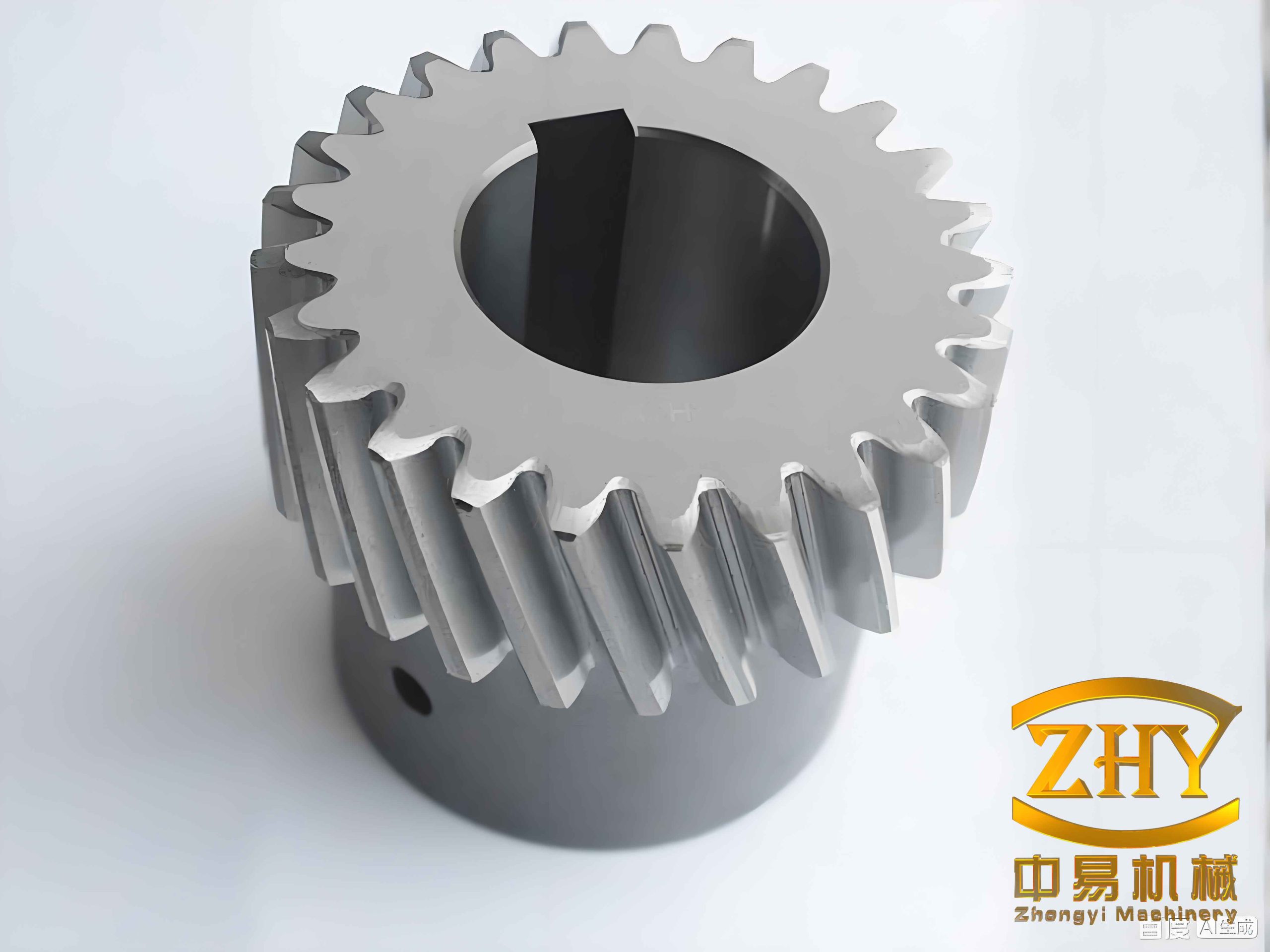
Our research demonstrates that at a rotational speed of 5818 rad/min, vibration displacement increases with wear severity, transitioning from single-period to period-doubling motion. The amplitude fluctuates over time, with the amplitudes at the meshing frequency (fm) and its third harmonic (3fm) gradually increasing. Sidebands with intervals of fm/2 to fm/3 also emerge. As tooth surface wear intensifies and the rotational speed increases from 5200 rad/min to 6400 rad/min, the system exhibits a typical nonlinear evolution path, transitioning from chaotic motion through period-doubling bifurcation toward periodic motion. The sideband intervals gradually converge from fm/4 to fm, and the influence of chaotic motion on vibration displacement surpasses that of wear. Consequently, the dominant mechanism of vibration amplification varies with speed ranges: in non-chaotic regions, it is primarily driven by wear-induced TVMS attenuation, increased transmission error, and friction coefficient variations; whereas in chaotic regions, it is dominated by chaotic nonlinear dynamics.
1. Wear Model for Helical Gears
1.1 Wear Evolution and Transmission Error
To solve the tooth surface wear depth problem in helical gears, we adopt the following assumptions: (1) the contact force is uniformly distributed along the contact line; (2) the wear depth is very small, allowing the teeth to remain in contact at the theoretical positions; (3) the gear material is elastically isotropic, ignoring surface treatments and composite heat treatments. The helical gear is sliced into multiple spur gear segments. According to the classical Archard wear equation , the wear depth on the driving gear at point A is given by:
$$
h_w^A = N_s \times 2 p_A k_s a_H \left| \frac{V_1 – V_2}{V_1} \right|
$$
where \(N_s\) is the number of meshing cycles, \(p_A\) is the contact pressure at point A during meshing, \(k_s\) is the wear coefficient (taken as \(5 \times 10^{-18}\)), \(a_H\) is the half-contact width, and \(V_1\), \(V_2\) are the surface velocities of the driving and driven gears at point A, respectively. Table 1 lists the key parameters of the helical gear pair used in this study.
| Parameter | Gear1 | Gear2 |
|---|---|---|
| Teeth | 24 | 48 |
| Module / mm | 2 | 2 |
| Face width / mm | 25 | 25 |
| Pressure angle / (°) | 20 | 20 |
| Helix angle / (°) | 15 | 15 |
Due to the helix angle, the contact line is inclined. The transmission error of the worn helical gear is obtained by taking the minimum wear depth along each contact line as the single-tooth transmission error. The total wear transmission error is then obtained by superposing the single-tooth transmission errors of multiple tooth pairs in contact:
$$
e_{\text{wear}} = \sum_{i=1}^{n} e_{Lb,i}
$$
where \(n\) is the number of tooth pairs currently in meshing, and \(e_{Lb,i}\) is the single-tooth wear transmission error for the \(i\)-th pair. The result is periodic and is fitted with a fifth-order Fourier series for efficient solution in the dynamic equations.
1.2 Time-Varying Mesh Stiffness and Load Sharing Factor
The TVMS of the worn helical gear is calculated using the slicing method and the potential energy method. The Hertzian contact stiffness \(k_h\) is:
$$
k_h = \frac{\pi E b}{4(1 – \nu^2)}
$$
where \(E\) and \(\nu\) are the elastic modulus and Poisson’s ratio of the gear material, and \(b\) is the tooth width. After wear, the bending stiffness \(k_b\), shear stiffness \(k_s\), and axial compressive stiffness \(k_a\) are modified as:
$$
\begin{aligned}
k_b &= \int_0^b \frac{E \, dy}{A + \int_{R_b – R_f}^{0} \frac{12 D^2 dx}{[2 R_b \sin\alpha_2 – h_w(\alpha)\cos\alpha]^3}} \\
k_s &= \int_0^b \frac{E \, dy}{B + \int_{R_b – R_f}^{0} \frac{2.4(1+\nu)\cos^2\alpha_1(y) dx}{2 R_b \sin\alpha_2 – h_w(\alpha)\cos\alpha}} \\
k_a &= \int_0^b \frac{2E \, dy}{C + \int_{R_b – R_f}^{0} \frac{2\sin^2\alpha_1(y) dx}{2 R_b \sin\alpha_2 – h_w(\alpha)\cos\alpha}}
\end{aligned}
$$
The fillet-foundation stiffness \(k_f\) is based on Muskhelishvili’s elastic theory. The total single-tooth mesh stiffness \(k_i\) for the \(i\)-th tooth pair is:
$$
k_i = \frac{1}{\frac{1}{k_h} + \frac{1}{k_{b1,i}} + \frac{1}{k_{b2,i}} + \frac{1}{k_{a1,i}} + \frac{1}{k_{a2,i}} + \frac{1}{k_{s1,i}} + \frac{1}{k_{s2,i}} + \frac{1}{k_{f1,i}} + \frac{1}{k_{f2,i}}}
$$
Then the overall TVMS \(k_m\) is:
$$
k_m = \sum_{i=1}^{n} k_i
$$
The load sharing factor (LSF) is defined as:
$$
\mathrm{LSF}_i = \frac{k_i}{k_m}
$$
Table 2 summarizes the TVMS and LSF computed for different wear levels (number of cycles \(N_s\)).
| Wear Level (\(N_s\)) | TVMS (N/m) | LSF (for the first contacting pair) |
|---|---|---|
| Health | \(5.35 \times 10^8\) | 0.61 |
| \(1 \times 10^8\) | \(5.30 \times 10^8\) | 0.60 |
| \(2 \times 10^8\) | \(5.25 \times 10^8\) | 0.59 |
| \(3 \times 10^8\) | \(5.15 \times 10^8\) | 0.58 |
1.3 Friction Coefficient Model under Mixed Lubrication
Using the slicing method, the helical gear is divided along the face width. The time-varying friction coefficient \(\mu(x,y)\) under mixed lubrication is given by:
$$
\mu(x,y) = \frac{0.0127 \times 1.13}{1.13 – R_{\text{avg}}} \lg \left[ \frac{29700 F(x)}{L_b(x) \eta |v_s(x,y)| v_e^2(x,y)} \right]
$$
where \(R_{\text{avg}} = 0.8\,\mu\)m is the average surface roughness, \(\eta = 0.058\) Pa·s is the dynamic viscosity, \(L_b(x)\) is the actual contact length, \(F(x)\) is the contact force on the contact line, and \(v_s\), \(v_e\) are the sliding and entrainment velocities. The actual contact line length \(L_b(x)\) varies with the position along the meshing zone and is expressed piecewise as:
$$
L_b(x) = \begin{cases}
x / \sin\beta_b, & 0 < x < \varepsilon_\beta p_b \\
b / \cos\beta_b, & \varepsilon_\beta p_b < x < \varepsilon_\alpha p_b \\
(A_1B_2 – x) / \sin\beta_b, & \varepsilon_\alpha p_t < x < A_1B_2
\end{cases}
$$
The total friction force \(F_f\) and the friction torque \(M_{f1,2}\) are obtained by integrating the micro-friction forces over all contacting slices. Table 3 shows the computed friction coefficient values at representative points.
| Angular displacement (°) | Face width (mm) | Friction coefficient \(\mu\) |
|---|---|---|
| 10 | 0 | 0.12 |
| 20 | 12.5 | 0.15 |
| 30 | 25 | 0.10 |
1.4 Dynamic Model of Helical Gear-Rotor-Bearing System
The helical gear transmission system has 24 degrees of freedom:
$$
\left\{ x_{b1}, y_{b1}, z_{b1}, x_{b2}, y_{b2}, z_{b2}, x_{b3}, y_{b3}, z_{b3}, x_{b4}, y_{b4}, z_{b4}, x_1, y_1, z_1, \theta_{1x}, \theta_{1y}, \theta_{1z}, x_2, y_2, z_2, \theta_{2x}, \theta_{2y}, \theta_{2z} \right\}
$$
The tapered roller bearings (models 30205 for bearings 1 and 2, 30206 for bearings 3 and 4) are modeled based on Hertzian line contact theory. The mesh displacement along the line of action is:
$$
x_n = \left[ R_{b1}\theta_{1z} – R_{b2}\theta_{2z} + (x_1 – x_2)\sin\alpha_t \right] \cos\beta_b + \left[ z_1 – z_2 + (R_{b1}\theta_{1y} – R_{b2}\theta_{2y}) \right] \sin\beta_b + (y_1 – y_2)\cos\alpha_t \cos\beta_b – e(t) – e_{\text{wear}}
$$
The meshing force \(F_m\) is:
$$
F_m = c_m \dot{x}_n + k_m f(x_n)
$$
where \(c_m\) is the mesh damping and \(f(x_n)\) is the backlash function. The complete set of equations for the system includes balance of forces and moments for each bearing and gear, accounting for the friction forces and moments computed earlier. The dynamics are solved using numerical integration.
2. Dynamic Response of Worn Helical Gear System
2.1 Effect of Wear at a Fixed Rotational Speed
We first analyze the system at a fixed speed of 5818 rad/min (meshing frequency \(f_m = 2327\) Hz). Table 4 summarizes the dynamic behavior for different wear levels.
| Wear Level | Motion Type | Poincaré Points | Dominant Frequencies (amplitudes increase with wear) |
|---|---|---|---|
| Health | Period-1 | 1 | \(f_m\) |
| \(N_s = 1 \times 10^8\) | Period-2 | 2 | \(f_m\), \(3f_m\), \(f_m/2\) |
| \(N_s = 2 \times 10^8\) | Period-2 | 2 | \(f_m\), \(3f_m\), \(f_m/2\) |
| \(N_s = 3 \times 10^8\) | Period-3 | 3 | \(f_m\), \(3f_m\), \(f_m/3\), \(2f_m/3\), \(4f_m/3\) |
As wear deepens, the system transitions from single-period to multi-period motion. The time-domain waveform evolves from single-peak to double-peak and then triple-peak, while the maximum peak displacement increases. The FFT spectra reveal that subharmonic resonances become more prominent, with sideband intervals decreasing from \(f_m\) to \(f_m/3\). These observations indicate that wear-induced increase in transmission error (or equivalent backlash) causes richer nonlinear responses.
2.2 Effect of Wear over a Range of Rotational Speeds
We extend the analysis to the speed range 5200–6400 rad/min. Table 5 presents the bifurcation characteristics summarized from the bifurcation diagrams and top Lyapunov exponent (TLE) analysis.
| Wear Level | Chaos (C) Range (rad/min) | Period-doubling (P-n) Range (rad/min) | Period-1 (P-1) Range (rad/min) |
|---|---|---|---|
| Health | 5200–5350, 5397–5488 | 5488–5810 | 5810–6400 |
| \(N_s = 1 \times 10^8\) | 5200–5539 | 5539–5919 | 5919–6400 |
| \(N_s = 2 \times 10^8\) | 5243–5581 | 5581–6101, 5200–5243 | 6101–6400 |
| \(N_s = 3 \times 10^8\) | 5370–5615 | 5615–6224 | 5200–5370, 6224–6400 |
The results show a common evolutionary route: chaos → period-doubling → periodic motion across all wear levels. As wear increases, the periodic motion intervals shrink while the period-doubling and chaotic intervals expand. Notably, chaotic motion often produces vibration amplitudes that exceed those observed in higher-order periodic or even single-period motion at higher speeds. For example, in the health condition, chaos-induced displacements reach up to 90% of the maximum vibration amplitude in that speed range; for \(N_s = 1 \times 10^8\) and \(2 \times 10^8\), chaotic responses can equal the maximum amplitude, and for \(N_s = 3 \times 10^8\), the absolute maximum displacement occurs within the chaotic zone. This confirms that chaotic nonlinearity can dominate over the wear-induced degradation in amplifying vibrations.
Table 6 provides the sideband interval evolution observed in the FFT spectra as speed increases for each wear level.
| Wear Level | Chaotic sideband interval | Period-doubling sideband interval | Period-1 sideband interval |
|---|---|---|---|
| Health | \(f_m/4\) | \(f_m/3\) | \(f_m\) |
| \(N_s = 1 \times 10^8\) | \(f_m/4\) | \(f_m/3\) | \(f_m\) |
| \(N_s = 2 \times 10^8\) | \(f_m/4\) | \(f_m/3\), \(f_m/2\) | \(f_m\) |
| \(N_s = 3 \times 10^8\) | \(f_m/4\) | \(f_m/3\), \(f_m/2\) | \(f_m\) |
These data indicate that as speed increases, the sidebands converge toward the meshing frequency, reflecting a regularization of the dynamics. The wear level influences the onset and persistence of these intervals, but the overall trend is consistent.
3. Validation of Wear-Dependent Dynamics
To validate our model, we compare it with a simplified model that only considers TVMS variation (ignoring friction and wear-induced transmission error) and with experimental data obtained from a helical gearbox test bench. The experimental setup (details omitted to avoid referencing figures) consisted of a driving motor, torque sensors, a helical gearbox, piezoelectric accelerometers, and a magnetic particle brake. The test was conducted at 3000 rad/min under heavy wear (no load).
Table 7 summarizes the comparison of acceleration amplitude and frequency components.
| Metric | Our Model | Simplified Model | Experiment |
|---|---|---|---|
| Acceleration range (m/s²) | −10 to 10 (smooth) | −8 to 8 (sine-like) | −20 to 20 (with spikes) |
| Dominant peaks | \(f_m\), \(2f_m\), \(3f_m\), \(4f_m\) | \(f_m\) only | \(f_m\), \(2f_m\), \(3f_m\), \(4f_m\) |
| Sidebands | \(2f_m \pm f_r\) present | None | \(2f_m \pm f_r\) present |
| Harmonic amplitude | Underestimated | Significantly underestimated | Baseline |
Our model captures the main meshing frequency and its harmonics, and shows sideband modulation at \(2f_m \pm f_r\) (where \(f_r\) is the rotation frequency), which is characteristic of practical systems. The simplified model fails to reproduce the harmonics and sidebands, confirming that wear-induced transmission error and friction effects must be included for accurate dynamic simulation.
4. Conclusions
We have investigated the nonlinear dynamic behavior of a helical gear transmission system under tooth surface wear using a comprehensive model that integrates wear evolution, time-varying mesh stiffness, transmission error, load sharing factor, and mixed-lubrication friction. The main conclusions are:
- At a fixed speed of 5818 rad/min, increasing wear drives the system from single-period to triple-period motion, with subharmonic resonances and growing vibration amplitudes. The sideband intervals decrease from \(f_m\) to \(f_m/3\), highlighting enhanced nonlinearity.
- Across the speed range 5200–6400 rad/min, all wear levels exhibit a consistent evolution: chaos → period-doubling → period-1. The chaotic regime dominates the vibration amplification, often surpassing the effect of wear itself. This underscores the importance of avoiding chaotic operating conditions in practice.
- The comparison with experiments shows that our model, which includes wear-induced transmission error and friction, reproduces the key spectral features (harmonics and sidebands), whereas a simplified model neglecting these effects fails to do so. Therefore, accurate nonlinear dynamic simulation of helical gear systems subject to wear must account for the coupled wear-friction-stiffness interactions.