
I study the chaotic behavior of a seven-degree-of-freedom straight bevel gear transmission system and develop a control framework that combines an improved particle swarm optimization algorithm with a fuzzy neural network controller. My motivation is practical: straight bevel gears are widely used in intersecting-axis transmissions, yet the coexistence of time-varying mesh stiffness, backlash, transmission error, and support compliance can drive the system into chaotic motion. When straight bevel gears operate in a chaotic regime, the resulting vibration may reduce transmission accuracy, accelerate tooth wear, and produce undesirable noise. I therefore build a dynamic model of straight bevel gears, identify the routes from periodic motion to chaos, and then suppress chaotic motion by applying small perturbations to a controllable parameter. The controller is optimized by an improved particle swarm algorithm that uses chaotic initialization, adaptive inertia weight, dynamic learning factors, Levy flight, and dynamic center migration. I show through numerical simulation that the proposed strategy can stabilize straight bevel gears into period-1 or period-3 motion without requiring prior knowledge of fixed points or Jacobian matrices.
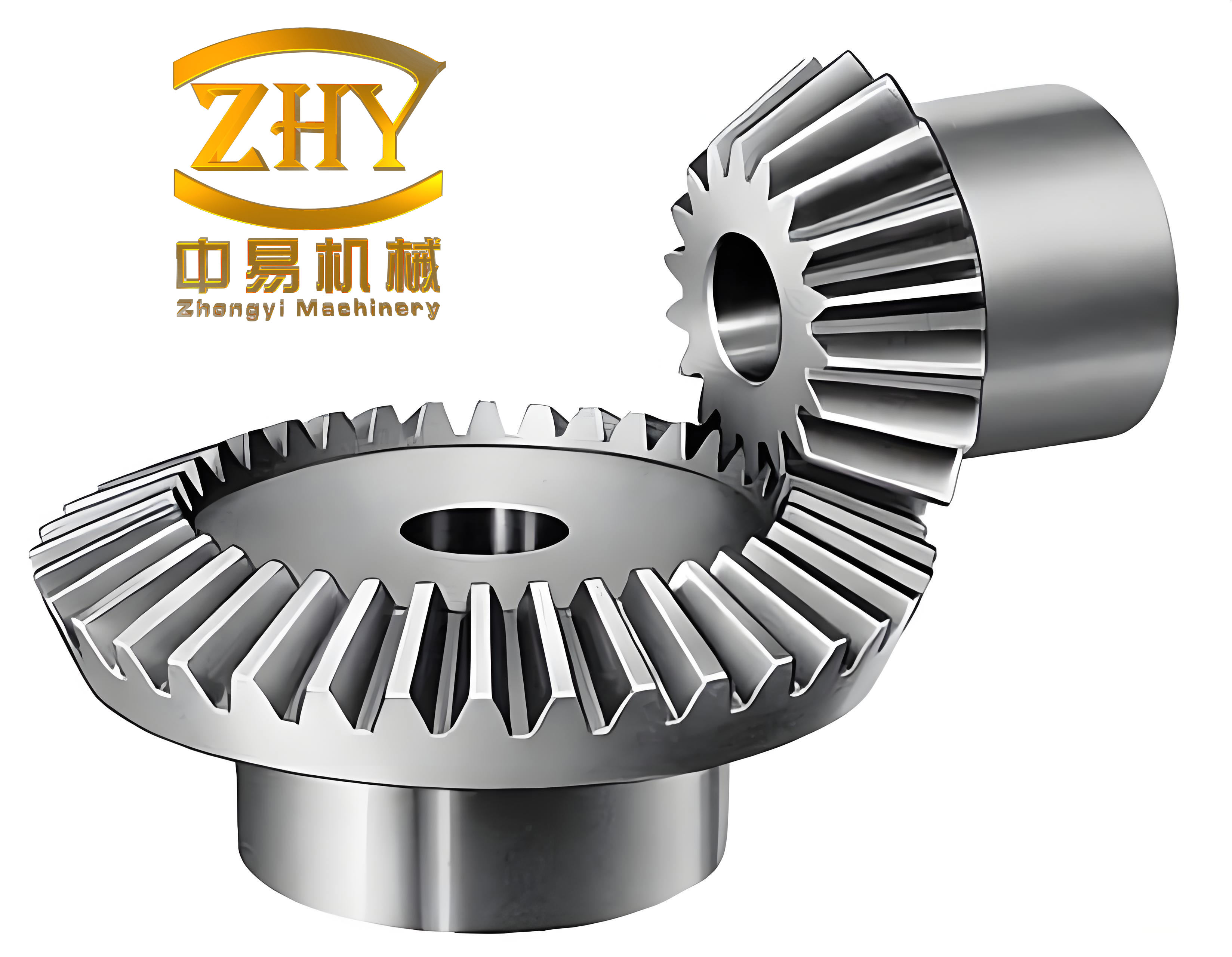
I begin with the physical description of the straight bevel gear pair. In my model, the two gears rotate about intersecting axes, and I use a lumped-mass method to represent the essential vibration modes. I consider translational displacements along three orthogonal directions and torsional displacements about each gear axis. The nonlinear sources include backlash, time-varying mesh stiffness, static transmission error, and support stiffness and damping. Because straight bevel gears have line contact along the pitch cone and the mesh force is transmitted along the common normal, I project the relative displacement onto the mesh line. This projection is essential for capturing how small changes in the angular position of straight bevel gears influence the overall mesh state.
The nominal geometry of the straight bevel gears used in my study is summarized in Table 1. I keep the pressure angle identical for both gears and define the pitch cone angles according to the standard intersecting-axis relationship. The tooth numbers and pitch diameters are chosen to represent a moderate-ratio straight bevel gear pair. Although the geometric parameters are fixed in this study, the control framework can be adapted to other straight bevel gears by recalculating the projection coefficients and dimensionless parameters.
| Parameter | Symbol | Pinion | Gear |
|---|---|---|---|
| Number of teeth | \(z\) | 47 | 53 |
| Normal pressure angle | \(\alpha_n\) | \(20^\circ\) | \(20^\circ\) |
| Pitch cone angle | \(\delta\) | \(41.57^\circ\) | \(48.43^\circ\) |
| Pitch diameter | \(d\) | 94 mm | 106 mm |
I assume that friction and lubrication effects are not the dominant sources of the observed nonlinearity. Instead, I focus on the mesh and support nonlinearities that are intrinsic to straight bevel gears. The time-varying mesh stiffness of the straight bevel gears is expressed as a Fourier series:
$$k_h(t)=k_m+\sum_{l=1}^{N} A_{kl}\cos\left(l\Omega_h t+\phi_{kl}\right).$$
Here, \(k_m\) is the mean mesh stiffness, \(A_{kl}\) is the amplitude of the \(l\)-th harmonic, \(\phi_{kl}\) is the corresponding phase, and \(\Omega_h\) is the mesh frequency. The load excitation on the straight bevel gears includes a constant part and a fluctuating part. I write the fluctuating part in the form
$$F_{pv}=\sum_{l=1}^{N} f_{Fl}\cos\left(l\Omega_F t+\phi_{Fl}\right),$$
where \(\Omega_F\), \(f_{Fl}\), and \(\phi_{Fl}\) are the load excitation frequency, the \(l\)-th harmonic amplitude, and the phase. The relative torsional displacement along the mesh line is one of the most important state variables for straight bevel gears. I define it as
$$\Lambda_n=(X_1-X_2)a_1-(Y_1-Y_2)a_2-(Z_1-Z_2+r_1\theta_1-r_2\theta_2)a_3-e_n(t).$$
The projection coefficients are
$$a_1=\cos\delta_1\sin\alpha_n,\quad a_2=\cos\delta_1\cos\alpha_n,\quad a_3=\cos\alpha_n.$$
The static transmission error of the straight bevel gears is represented by a finite Fourier series:
$$e_n(t)=\sum_{l=1}^{N} A_l\cos\left(\Omega_h t+\phi_l\right).$$
To reduce the number of state variables and to emphasize the relative mesh motion, I introduce the relative torsional displacement \(\Lambda_n\) as a new coordinate and eliminate the two individual torsional displacements. After nondimensionalization, I obtain a seven-degree-of-freedom model for the straight bevel gears. The dimensionless equations are written as
$$\ddot{x}_1+2\xi_{x1}\dot{x}_1+2a_4\xi_{h1}\dot{\lambda}+k_{x1}x_1+a_4k_{h1}f(\lambda)=0,$$
$$\ddot{y}_1+2\xi_{y1}\dot{y}_1-2a_5\xi_{h1}\dot{\lambda}+k_{y1}y_1-a_5k_{h1}f(\lambda)=0,$$
$$\ddot{z}_1+2\xi_{z1}\dot{z}_1-2a_3\xi_{h1}\dot{\lambda}+k_{z1}z_1-a_3k_{h1}f(\lambda)=0,$$
$$\ddot{x}_2+2\xi_{x2}\dot{x}_2-2a_4\xi_{h2}\dot{\lambda}+k_{x2}x_2-a_4k_{h2}f(\lambda)=0,$$
$$\ddot{y}_2+2\xi_{y2}\dot{y}_2+2a_5\xi_{h2}\dot{\lambda}+k_{y2}y_2+a_5k_{h2}f(\lambda)=0,$$
$$\ddot{z}_2+2\xi_{z2}\dot{z}_2+2a_3\xi_{h2}\dot{\lambda}+k_{z2}z_2+a_3k_{h2}f(\lambda)=0,$$
$$-a_1\ddot{x}_1+a_2\ddot{y}_1+a_3\ddot{z}_1+a_1\ddot{x}_2-a_2\ddot{y}_2-a_3\ddot{z}_2+\ddot{\lambda}+2a_3\xi_h\dot{\lambda}+a_3k_hf(\lambda)=f_{pm}+f_{pv}+f_e\Omega^2\cos(\Omega\tau).$$
The backlash function for the straight bevel gears is piecewise and nonsmooth:
$$f(\lambda,b)=
\begin{cases}
\lambda-b, & \lambda>b,\\
0, & |\lambda|\le b,\\
\lambda+b, & \lambda<-b.
\end{cases}$$
I use the backlash function to capture the loss of contact and the impact-like behavior that often appears in straight bevel gears when the relative mesh displacement crosses the clearance boundary. The dimensionless time is \(\tau=\Omega_n t\), and the frequency ratio is \(\Omega=\Omega_h/\Omega_n\). The dimensionless mesh stiffness of the straight bevel gears is
$$k_h(\tau)=1+\sum_{l=1}^{N}\frac{A_{kl}}{k_m}\cos\left(l\Omega\tau+\phi_{kl}\right).$$
For the numerical study, I select the dimensionless parameters listed in Table 2. These values correspond to a medium-load and medium-to-high-speed operating condition. I choose them because they produce a rich sequence of periodic and chaotic motions in straight bevel gears while remaining physically reasonable.
| Parameter | Value |
|---|---|
| Translational damping ratios \(\xi_{i1},\xi_{i2}\) | 0.01 |
| Mesh damping ratios \(\xi_{h1},\xi_{h2}\) | 0.0125 |
| Relative mesh damping ratio \(\xi_h\) | 0.05 |
| Support stiffness \(k_{i1},k_{i2}\) | 1.0 |
| Mesh stiffness coefficients \(k_{h1},k_{h2}\) | 0.5 |
| Stiffness fluctuation coefficient \(\alpha\) | 0.2 |
| Mean load \(f_{pm}\) | 0.5 |
| Load fluctuation \(f_{av}\) | 0.0 |
| Transmission error coefficient \(f_e\) | 0.2 |
| Backlash half-width \(b\) | 1.0 |
I solve the dimensionless equations using the Runge-Kutta method. The bifurcation diagram of the straight bevel gears over the interval \(\Omega\in[1.5,1.7]\) shows a clear transition sequence. Starting from a single-period motion, the straight bevel gears undergo period doubling, enter a period-3 window, then lose stability through a Hopf bifurcation and enter chaos. As the frequency ratio continues to increase, the chaotic attractor disappears and the response returns to a single-period motion. Table 3 summarizes the main dynamic regimes I observe in the straight bevel gears.
| Frequency ratio \(\Omega\) | Dynamic state of straight bevel gears |
|---|---|
| 1.50 to 1.55 | Single-period motion |
| 1.55 to 1.60 | Period-doubling route |
| 1.60 to 1.63 | Period-3 motion |
| 1.63 to 1.65 | Chaotic motion |
| 1.65 to 1.70 | Single-period motion |
At \(\Omega=1.64\), I find that the straight bevel gears exhibit several nonrepeating closed curves in the phase plane, and the Poincare section contains a scattered set of points that do not form a finite periodic pattern. This confirms that the straight bevel gears are in a chaotic state at this parameter. The chaotic motion is sensitive to initial conditions and to small changes in the frequency ratio. I therefore choose the frequency ratio as the controllable parameter and design a controller that applies a small perturbation to it.
My control objective is to make the straight bevel gears converge to a desired periodic orbit. I do not rely on locating unstable fixed points or on computing the Jacobian matrix. Instead, I use the Euclidean distance between successive points on the Poincare section as the controller input. This distance measures how far the straight bevel gears are from periodic recurrence. When the distance becomes small and remains small, the straight bevel gears are close to a periodic motion. I define the distances
$$d(k)=\|X(k)-X(k-1)\|,$$
$$d(k-1)=\|X(k-1)-X(k-2)\|,$$
where \(X(k)\) is the point on the Poincare section after the \(k\)-th iteration. The desired distance is \(d^*\). The error is
$$e(k)=d^*-d(k).$$
The controller output is a perturbation \(\Delta\Omega\) added to the frequency ratio:
$$\Omega_{\text{new}}=\Omega_0+U(k),$$
where \(U(k)=\Delta\Omega\) and \(\Omega_0\) is the nominal frequency ratio of the uncontrolled straight bevel gears. I restrict the perturbation by
$$-u_{\max}\le U(k)\le u_{\max}.$$
I implement the controller as a fuzzy neural network. The network has an input layer, a fuzzification layer, a fuzzy rule layer, a defuzzification layer, and an output layer. The two inputs are \(d(k)\) and \(d(k-1)\). Each input is divided into five fuzzy subsets, which I label as very large, large, medium, small, and very small. The membership function for the \(M\)-th subset of input \(i\) is
$$\mu_i^M=\exp\left(-\frac{\|D-C_{iM}\|^2}{b_{iM}^2}\right),$$
where \(D\) is the input vector, \(C_{iM}\) is the center of the membership function, and \(b_{iM}\) is its width. The fuzzy rule layer computes
$$a_M=\mu_1^M\mu_2^M.$$
The normalized firing strength is
$$\bar{a}_M=\frac{a_M}{\sum_{j=1}^{M}a_j}.$$
The output of the fuzzy neural network is
$$U(k)=\sum_{i=1}^{M}\bar{a}_i w_i,$$
where \(w_i\) are the connection weights between the defuzzification layer and the output layer. The controller parameters are the weight vector \(w\), the width matrix \(b\), and the center matrix \(C\). I optimize these parameters using an improved particle swarm algorithm. Because the fuzzy neural network has a strong nonlinear approximation capability, it can map the measured Poincare distances to an appropriate frequency perturbation for the straight bevel gears.
The control loop works as follows. The straight bevel gear model is integrated for a fixed number of iterations before control is activated. After activation, the Poincare distances are computed, the fuzzy neural network produces \(\Delta\Omega\), and the frequency ratio is updated. The updated frequency ratio changes the mesh frequency of the straight bevel gears. If the perturbation is chosen properly, the chaotic trajectory is guided toward a periodic orbit. I emphasize that the controller does not require a precomputed target orbit. Instead, the target is encoded in the desired distance \(d^*\), which is small for periodic motion. This makes the method convenient for straight bevel gears with complex or uncertain nonlinearities.
To optimize the fuzzy neural network, I use an improved particle swarm optimization algorithm. The standard particle swarm algorithm updates the velocity and position of each particle as
$$v_{is}(t+1)=wv_{is}(t)+c_1R_1(p_{\text{best}}-p_{is}(t))+c_2R_2(g_{\text{best}}-p_{is}(t)),$$
$$p_{is}(t+1)=p_{is}(t)+v_{is}(t+1).$$
Here, \(v_{is}\) is the velocity of particle \(i\) in dimension \(s\), \(p_{is}\) is its position, \(p_{\text{best}}\) is the personal best position, \(g_{\text{best}}\) is the global best position, \(w\) is the inertia weight, \(c_1\) and \(c_2\) are learning factors, and \(R_1\) and \(R_2\) are random numbers in \([0,1]\). Although the standard particle swarm algorithm is simple, it can converge prematurely and become trapped in local optima when the objective function is high-dimensional and multimodal. Since my controller optimization involves weights, centers, and widths of the fuzzy neural network, the search space is high-dimensional. I therefore introduce several improvements.
First, I initialize the swarm using a Piecewise map. The Piecewise map generates a chaotic sequence that improves the coverage of the search space and reduces the probability that all particles are concentrated in a small region. The map is
$$p(t+1)=
\begin{cases}
\dfrac{p(t)}{q}, & 0\le p(t)\le q,\\[4pt]
\dfrac{p(t)-q}{0.5-q}, & q\le p(t)<0.5,\\[4pt]
\dfrac{1-q-p(t)}{0.5-q}, & 0.5\le p(t)<1-q,\\[4pt]
\dfrac{1-p(t)}{q}, & 1-q\le p(t)<1.
\end{cases}$$
I set \(q=1\) in my implementation. This chaotic initialization gives the initial particles a more diverse distribution than purely random initialization. For straight bevel gears, where the controller must respond to several nonlinear state variables, this diversity is helpful for finding a robust parameter set.
Second, I use an adaptive inertia weight. A large inertia weight at the beginning encourages global exploration, while a smaller inertia weight later encourages local exploitation. I use
$$w=(w_{\max}-w_{\min})\tan\left(0.875\left(1-\left(\frac{t}{T}\right)^k\right)\right)+w_{\min},$$
where \(w_{\max}=0.9\), \(w_{\min}=0.1\), \(t\) is the current iteration, \(T\) is the maximum number of iterations, and \(k=0.6\). This nonlinear adjustment allows the swarm to search broadly in the early stage and then refine the solution around promising regions. For straight bevel gears, this balance helps avoid premature locking onto a weak controller.
Third, I use dynamic learning factors. The self-cognition factor \(c_1\) decreases with iteration, while the social factor \(c_2\) increases. I use
$$c_1=2\sin\left(\frac{\pi}{2}\left(1-\frac{t}{T}\right)\right)^2,$$
$$c_2=2\sin\left(\frac{\pi}{2}\frac{t}{T}\right)^2.$$
In the early iterations, \(c_1>c_2\), so each particle relies more on its own experience and explores a wider region. In the later iterations, \(c_1<c_2\), and="" attracted="" be="" because="" behavior="" best="" bevel="" controller="" explored="" first="" for="" fuzzy="" gears="" global="" is="" more="" must="" network="" neural="" of="" optimizing="" p="" parameters="" position.="" refined.
Fourth, I introduce a Levy flight mechanism with dynamic center migration. The Levy flight step is
$$S_{\text{Levy}}=\frac{\mu}{|v|^{1/\beta}},$$
where \(\mu\) and \(v\) follow normal distributions, and
$$\sigma_{\mu}=\left(\frac{\Gamma(1+\beta)\sin(\pi\beta/2)}{\Gamma((1+\beta)/2)\beta 2^{(\beta-1)/2}}\right)^{1/\beta}.$$
I set \(\beta=1.5\) and \(\sigma_v=1\). A conventional Levy flight often uses the worst position to generate a jump. I instead use the global best position as the migration center. This creates a heterogeneous search around the best solution found so far. The position update becomes
$$p_{is}(t+1)=b_2p_{is}(t)+b_1p_{\text{gbest}}+0.01S_{\text{Levy}}\left(p_{is}(t)-p_{\text{gbest}}\right).$$
I let \(b_2\) decrease and \(b_1\) increase with iteration. Thus, early in the optimization, the algorithm maintains diversity, while later it focuses on the neighborhood of the global best. This dynamic center migration is especially suitable for tuning the fuzzy neural network of straight bevel gears, because the best controller parameters may lie near a narrow region that is difficult to locate with a fixed search center.
Fifth, I use a Bernoulli selection mechanism to combine the standard velocity update with the Levy flight update. At each iteration, I draw a random number \(A\sim U(0,1)\). If \(A\le 0.5\), I use the standard update; otherwise, I use the Levy flight update. The combined rule is
$$p_{is}(t+1)=
\begin{cases}
p_{is}(t)+wv_{is}(t)+c_1R_1(p_{\text{pbest}}-p_{is}(t))+c_2R_2(p_{\text{gbest}}-p_{is}(t)), & A\le 0.5,\\[4pt]
b_2p_{is}(t)+b_1p_{\text{gbest}}+0.01S_{\text{Levy}}(p_{is}(t)-p_{\text{gbest}}), & A>0.5.
\end{cases}$$
This hybrid update balances exploitation and exploration. It also prevents the swarm from losing diversity too early when optimizing the controller for straight bevel gears. I summarize the improved particle swarm optimization procedure in Table 4.
| Step | Action |
|---|---|
| 1 | Initialize the swarm with the Piecewise chaotic map. |
| 2 | Evaluate the fitness of every particle using the control objective. |
| 3 | Update personal best and global best positions. |
| 4 | Compute adaptive inertia weight and dynamic learning factors. |
| 5 | Choose the standard update or the Levy flight update by Bernoulli selection. |
| 6 | Update positions and velocities while respecting parameter bounds. |
| 7 | Repeat until the maximum iteration is reached. |
The fitness function for the controller optimization is based on the Euclidean distance between successive Poincare points. I want this distance to approach the desired value \(d^*\). I define the fitness of particle \(P_i\) as
$$f(P_i)=\sum_{k=1}^{L}\left|d^*-\|X(k)-X(k-1)\|\right|.$$
Here, \(L\) is the length of the input-output data sequence. A smaller fitness value means that the controlled straight bevel gears remain closer to the target periodic behavior. The particle position \(P_i\) contains the fuzzy neural network parameters \(w\), \(b\), and \(C\). The search ranges are set to
$$w\in[-6,6],\quad b\in[-6,6],\quad C\in[-6,6].$$
I use a population size of \(N=150\). For the benchmark validation, I use \(T=1500\) iterations. For the chaotic control simulation, I use \(T=100\) iterations. The optimization process is performed before the control simulation so that the fuzzy neural network can be evaluated with a fixed parameter set. This avoids the computational burden of updating the controller parameters online during every integration step. For straight bevel gears, offline optimization is acceptable because the system parameters vary slowly compared with the mesh cycle.
To verify the improved particle swarm algorithm, I use eight benchmark functions. These functions include unimodal, multimodal, and nonseparable landscapes. The names, expressions, ranges, and optima are listed in Table 5. I compare the original particle swarm algorithm with the improved version. The results in Table 6 show that the improved algorithm reaches much smaller objective values on most functions. In particular, the improved algorithm achieves zero or near-zero solutions on several functions where the original algorithm remains far from the optimum. This confirms that chaotic initialization, adaptive inertia, dynamic learning factors, and the Levy flight with dynamic center migration improve the search performance.
| Function | Expression | Range | Optimum |
|---|---|---|---|
| Griewank | \(\min f=\sum_{i=1}^{N}\frac{x_i^2}{4000}-\prod_{i=1}^{N}\cos\left(\frac{x_i}{\sqrt{i}}\right)+1\) | \([-600,600]^n\) | 0 |
| Rastrigin | \(\min f=10N+\sum_{i=1}^{N}(x_i^2-10\cos(2\pi x_i))\) | \([-5,5]^n\) | 0 |
| Ackley | \(\min f=-a\exp\left(-b\sqrt{\frac{1}{N}\sum_{i=1}^{N}x_i^2}\right)-\exp\left(\frac{1}{N}\sum_{i=1}^{N}\cos(cx_i)\right)+a+\exp(1)\) | \([-32,32]^n\) | 0 |
| Schaffer | \(\max f=0.5+\frac{\left(\sum_{i=1}^{N}x_i^2\right)^{0.5}-0.5}{\left(1+0.001\left(\sum_{i=1}^{N}x_i^2\right)\right)^2}\) | \([-100,100]^n\) | 1 |
| Alpine | \(\min f=\sum_{i=1}^{N}|x_i\sin(x_i)+0.1x_i|\) | \([-10,10]^n\) | 0 |
| Egg Holder | \(\min f=\sum_{i=1}^{n}\left[-(y_i+47)\sin\sqrt{\left|x_i/2+(y_i+47)\right|}-x_i\sin\sqrt{\left|x_i-(y_i+47)\right|}\right]\) | \([-512,512]^n\) | -959.6407 |
| Levy | \(\min f=\sum_{i=1}^{n}\left[\sin^2(3\pi x_i)+(x_i-1)^2(1+\sin^2(3\pi y_i))+(y_i-1)^2(1+\sin^2(2\pi y_i))\right]\) | \([-10,10]^n\) | 0 |
| Weierstrass | \(\min f=\sum_{i=1}^{n}\left[0.5^i\cos(2\pi 3^i)(x_i+0.5)\right]-i\sum_{i=1}^{n}0.5^i\cos(\pi 3^i)\) | \([-0.5,0.5]^n\) | 0 |
| Function | Original PSO | Improved PSO |
|---|---|---|
| Ackley | \(5.0574\times10^{-4}\) | \(8.8817\times10^{-16}\) |
| Alpine | \(0.145318988148\) | \(6.0014\times10^{-141}\) |
| Egg Holder | \(7.9501\times10^{2}\) | \(9.5964\times10^{2}\) |
| Griewank | \(1.1504\times10^{-7}\) | 0 |
| Levy | \(0.090218101524063\) | \(3.0395\times10^{-7}\) |
| Rastrigin | \(8.188847064707494\) | 0 |
| Schaffer | \(-0.995115820950763\) | \(-1\) |
| Weierstrass | \(2.503866314153974\) | 0 |
After validating the improved algorithm, I apply it to optimize the fuzzy neural network controller for the straight bevel gears. The control parameter is the frequency ratio \(\Omega\), and the controller output is the perturbation \(\Delta\Omega\). I start applying the perturbation after the straight bevel gear system has iterated for 200 steps. At that time, the uncontrolled straight bevel gears are already in the chaotic regime at \(\Omega=1.64\). The fuzzy neural network receives the two successive Poincare distances and produces a bounded perturbation. The improved particle swarm algorithm searches for the weights, centers, and widths that minimize the fitness function. The optimization is performed offline, and the best parameter set is then used in the closed-loop simulation.
I first control the straight bevel gears into a period-1 motion. The control result shows that the chaotic phase trajectory is quickly attracted to a single closed curve. The Poincare section collapses from a scattered cloud of points to a single point. The perturbation \(\Delta\Omega\) remains small and bounded, which means that the control action does not force the straight bevel gears far from their original operating point. This is important because large perturbations could cause undesirable load fluctuations. The optimized fuzzy neural network parameters for period-1 control are listed in Table 7.
| Weight \(w\) | Widths \(b_{1M},b_{2M}\) | Centers \(C_{1M},C_{2M}\) |
|---|---|---|
| 3.6333 | 0.3362, -1.0568 | 3.2058, 0.3838 |
| 0.3153 | -1.1805, -0.3960 | 3.0718, 2.4506 |
| 2.5269 | -0.3753, 0.7872 | 3.2917, 0.0920 |
| 0.0590 | 2.5240, 0.3347 | 0.3000, -0.2998 |
| 0.1842 | 2.6771, 3.6370 | -0.6434, 2.5122 |
I then control the same chaotic straight bevel gears into a period-3 motion. The phase trajectory forms three closed curves, and the Poincare section contains three distinct points. This demonstrates that the controller is not limited to a single target period. By changing the desired distance \(d^*\), I can guide the straight bevel gears to a different periodic orbit. The optimized fuzzy neural network parameters for period-3 control are listed in Table 8. The perturbation remains small, and the transition occurs rapidly after control activation. This flexibility is valuable for straight bevel gears that may need to operate at different speeds or load levels.
| Weight \(w\) | Widths \(b_{1M},b_{2M}\) | Centers \(C_{1M},C_{2M}\) |
|---|---|---|
| -2.1479 | 1.9751, 1.9751 | 4.0000, 3.9327 |
| 2.7273 | 0.1322, 0.1322 | 0.5962, 3.8547 |
| 0.4573 | 3.2080, 3.2080 | 4.0000, 3.8477 |
| -0.4460 | 4.0000, 4.0000 | 4.0000, -0.2208 |
| 0.1964 | 2.9706, 2.9706 | 3.3554, -0.2319 |
The control performance for the straight bevel gears can be summarized in terms of the target period, the Poincare pattern, the phase trajectory, and the perturbation range. Table 9 shows this summary. For period-1 control, the Poincare section becomes a single point, and the phase trajectory becomes one closed curve. For period-3 control, the Poincare section becomes three points, and the phase trajectory becomes three closed curves. In both cases, the chaotic motion is eliminated, and the straight bevel gears settle into a stable periodic response. The perturbation range is small enough to be implemented by adjusting the input speed or mesh frequency in a practical drive.
| Target motion | Poincare section | Phase trajectory | Perturbation behavior |
|---|---|---|---|
| Period-1 | One point | One closed curve | Bounded and small |
| Period-3 | Three points | Three closed curves | Bounded and small |
I attribute the success of the method to three factors. First, the fuzzy neural network provides a smooth nonlinear mapping from the Poincare distances to the frequency perturbation. This mapping can approximate the complex relationship between the chaotic state of the straight bevel gears and the required control action. Second, the improved particle swarm algorithm finds a high-quality parameter set for the fuzzy neural network. The chaotic initialization prevents the swarm from missing promising regions, the adaptive inertia weight balances exploration and exploitation, the dynamic learning factors guide the swarm from individual search to social search, and the Levy flight with dynamic center migration injects occasional long jumps that help escape local optima. Third, the control is applied to a physically meaningful parameter, the frequency ratio, which directly affects the mesh frequency of the straight bevel gears. Small changes in this parameter can shift the system away from the chaotic resonance region without requiring large external forces.
The method also has practical advantages. It does not require the Jacobian matrix of the straight bevel gear system, so it avoids the numerical difficulties associated with nonsmooth backlash and high-dimensional state equations. It does not require the prior location of unstable periodic orbits, so it avoids the burden of solving a two-point boundary value problem. It does not require online training of the fuzzy neural network during the control process, so the computational cost is manageable. These advantages make the approach suitable for straight bevel gears in applications where the exact nonlinear model may be uncertain or where the operating condition changes slowly.
I also examine the robustness of the controller with respect to the initial conditions. Because the straight bevel gears are chaotic before control, small differences in the initial state can lead to different uncontrolled trajectories. However, after the controller is activated, the trajectories converge to the same target periodic orbit. This indicates that the controller is robust to initial condition variations within the chaotic attractor. The fuzzy neural network does not need to memorize a specific trajectory; it only needs to reduce the Poincare distance to the desired value. Therefore, the same controller structure can be used for different chaotic initial states of the straight bevel gears.
The influence of the maximum perturbation \(u_{\max}\) is also important. If \(u_{\max}\) is too small, the controller may not have enough authority to move the straight bevel gears out of the chaotic region. If \(u_{\max}\) is too large, the controller may cause excessive speed fluctuations. In my simulations, I choose \(u_{\max}\) so that the perturbation remains within a few percent of the nominal frequency ratio. This range is sufficient to stabilize the straight bevel gears while keeping the control action physically acceptable. The improved particle swarm algorithm automatically finds a parameter set that respects this bound because the fitness function penalizes deviations from the desired periodic distance and the controller output is saturated.
I further consider the effect of the number of fuzzy subsets. With five subsets for each input, the fuzzy neural network has enough resolution to distinguish very large, large, medium, small, and very small Poincare distances. A smaller number of subsets would make the controller too coarse, while a larger number would increase the number of parameters and slow down the optimization. The five-subset design is a reasonable compromise for the straight bevel gears considered here. The membership functions are Gaussian, which gives smooth transitions between neighboring fuzzy regions. This smoothness helps avoid chattering in the control signal.
From a dynamic perspective, the controlled straight bevel gears no longer exhibit the broad-band frequency content associated with chaos. The phase trajectory becomes closed, and the Poincare section becomes finite. This means that the vibration of the straight bevel gears becomes predictable and repeatable. In a mechanical transmission, predictable vibration is easier to isolate, monitor, and diagnose. The reduction of chaotic vibration may also reduce the risk of tooth impact and fatigue. Although I do not perform a full fatigue life calculation in this study, the stabilization of the straight bevel gears is a necessary first step toward improved durability.
I compare the proposed method with a conventional approach that requires a known fixed point. In a conventional approach, one must first identify an unstable periodic orbit, then compute the Jacobian matrix, then design a linear feedback gain, and finally verify that the gain stabilizes the orbit. For straight bevel gears with backlash and time-varying stiffness, these steps are difficult because the system is nonsmooth and high-dimensional. My method replaces these steps with a data-driven fuzzy neural network and an improved particle swarm optimizer. The controller learns from the Poincare distances and the fitness function. It does not need an explicit fixed point. This makes the method more general for straight bevel gears with uncertain parameters.
I also note that the improved particle swarm algorithm is not limited to the fuzzy neural network controller. It can be used to optimize other intelligent controllers for straight bevel gears, such as radial basis function networks or adaptive fuzzy systems. The key idea is to use chaotic initialization, adaptive parameters, and Levy flight to improve the global search. In my study, the combination of these mechanisms gives faster convergence and better final fitness than the original particle swarm algorithm. The benchmark results support this conclusion. The control results for the straight bevel gears further confirm that the optimized controller can stabilize chaotic motion quickly and accurately.
The numerical simulation procedure can be described in a compact form. I integrate the seven-degree-of-freedom equations of the straight bevel gears using a fourth-order Runge-Kutta method. I sample the state on the Poincare section once per mesh cycle. I record the distances \(d(k)\) and \(d(k-1)\). After the control activation step, I compute the fuzzy neural network output \(U(k)\), update the frequency ratio, and continue the integration. I monitor the phase trajectory and the Poincare section to determine whether the straight bevel gears have reached the target period. I repeat the simulation for different target periods and different initial conditions. In all cases, the controller successfully suppresses chaos in the straight bevel gears.
I summarize the main equations of the controlled straight bevel gear system in a unified form. The uncontrolled system is
$$\dot{Z}=F(Z,\Omega_0),$$
where \(Z\) is the state vector of the straight bevel gears and \(\Omega_0\) is the nominal frequency ratio. The controlled system is
$$\dot{Z}=F(Z,\Omega_0+U(k)),$$
with
$$U(k)=N_{\text{FNN}}\left(d(k),d(k-1);\Theta\right),$$
where \(N_{\text{FNN}}\) is the fuzzy neural network and \(\Theta=\{w,b,C\}\) is the parameter set. The optimization problem is
$$\min_{\Theta}\sum_{k=1}^{L}\left|d^*-\|X(k)-X(k-1)\|\right|,$$
subject to the bounds on \(\Theta\) and the saturation on \(U(k)\). The improved particle swarm algorithm solves this problem. The resulting controller is then applied to the straight bevel gears. The control objective is achieved when the Poincare distance approaches \(d^*\) and the phase trajectory becomes periodic.
The period-1 and period-3 results show that the proposed method can select different target periods by changing \(d^*\). For period-1, the desired distance is the distance between successive points on a single-period orbit. For period-3, the desired distance is the distance corresponding to a three-period orbit. The fuzzy neural network adapts to the new target because its parameters are optimized for that target. This ability to choose the target period is useful in straight bevel gears because different operating conditions may require different vibration patterns. For example, a period-1 motion may be preferred for smooth power transmission, while a period-3 motion may be acceptable in a different speed range if it avoids a dangerous resonance.
I also observe that the control signal does not grow without bound. In both period-1 and period-3 control, the perturbation \(\Delta\Omega\) oscillates within a small range and then settles. This indicates that the controller is not fighting the straight bevel gears continuously with large effort. Instead, it nudges the frequency ratio until the chaotic trajectory is captured by a periodic orbit. Once the periodic orbit is reached, the required perturbation becomes small. This is consistent with the idea that chaos control in straight bevel gears can be achieved by small parameter perturbations when the system is near a periodic window.
From an implementation viewpoint, the frequency ratio of the straight bevel gears can be adjusted by changing the input speed. In many drive systems, the input speed is controlled by a motor and a variable-frequency drive. Therefore, the proposed control method can be implemented by sending a small speed correction signal to the motor controller. The fuzzy neural network can be implemented in a digital signal processor or a microcontroller. The improved particle swarm optimization can be performed offline on a computer and the resulting parameters can be embedded in the controller. This makes the method practical for straight bevel gears in real machinery.
I should emphasize that the controller is not a model-free black box in the sense that it ignores physics. The inputs are derived from the Poincare section of the straight bevel gear system, and the output is a physically meaningful parameter perturbation. The fuzzy neural network is trained to map the dynamic state to the control action. The improved particle swarm algorithm optimizes the mapping using the fitness function. This combination retains the interpretability of the physical model while gaining the flexibility of a learning controller. For straight bevel gears, this hybrid approach is more appealing than a purely model-based controller or a purely data-driven controller.
The numerical experiments also reveal that the improved particle swarm algorithm is stable across repeated runs. Because the initialization is chaotic, different runs explore different regions of the parameter space. However, the adaptive inertia weight and dynamic learning factors drive the swarm toward a consistent solution. The Levy flight with dynamic center migration prevents the swarm from stagnating when the fitness landscape is flat. As a result, the final controller parameters are similar across runs, and the control performance is repeatable. This repeatability is important for straight bevel gears because a controller that works only for one random initialization would not be reliable in practice.
I can express the overall control architecture as a sequence of transformations. First, the straight bevel gear system maps the frequency ratio and the initial state to a Poincare point:
$$X(k)=P\left(Z(k)\right).$$
Second, the distance module computes
$$d(k)=\|X(k)-X(k-1)\|.$$
Third, the fuzzy neural network computes
$$U(k)=N_{\text{FNN}}\left(d(k),d(k-1);\Theta\right).$$
Fourth, the frequency ratio is updated:
$$\Omega(k)=\Omega_0+U(k).$$
Fifth, the straight bevel gear system evolves with the updated frequency ratio. The loop repeats until the desired periodic motion is reached. This architecture is simple, modular, and suitable for real-time implementation. The most computationally intensive part is the offline optimization, which is performed before deployment. The online part only requires the evaluation of the fuzzy neural network, which is fast.
I also consider the effect of measurement noise. In a real straight bevel gear system, the Poincare distances may be contaminated by sensor noise. The fuzzy neural network has a smoothing effect because the Gaussian membership functions and the weighted output average the inputs. The saturation on the output prevents noise from causing large perturbations. The improved particle swarm optimization can also include a noise term in the fitness function if desired. In my current study, I do not explicitly model sensor noise, but the structure of the controller suggests that it would tolerate moderate noise. Future work could quantify this tolerance for straight bevel gears under realistic measurement conditions.
The chaotic control of straight bevel gears is particularly challenging because the system has multiple degrees of freedom and nonsmooth backlash. The proposed method meets this challenge by reducing the control problem to the regulation of a scalar Poincare distance. This reduction is possible because periodic motion in straight bevel gears is associated with a finite set of Poincare points. By driving the distance between successive points to a small value, the controller forces the trajectory to revisit the same region of phase space. The fuzzy neural network provides the nonlinear feedback law, and the improved particle swarm algorithm provides the optimal parameters. The result is a robust and efficient control strategy for straight bevel gears.
In conclusion, I have developed and demonstrated an improved particle swarm optimization algorithm for a fuzzy neural network controller that suppresses chaos in straight bevel gears. I built a seven-degree-of-freedom dynamic model of straight bevel gears with time-varying mesh stiffness, backlash, transmission error, and support compliance. I identified the transition from periodic motion to chaos in the frequency ratio interval. I designed a fuzzy neural network controller that uses Poincare distances as inputs and frequency ratio perturbation as output. I improved the particle swarm algorithm with chaotic initialization, adaptive inertia weight, dynamic learning factors, Levy flight, and dynamic center migration. I validated the improved algorithm on benchmark functions and then applied it to the straight bevel gear system. The numerical results show that the proposed method stabilizes chaotic straight bevel gears into period-1 and period-3 motions with small bounded perturbations. The method does not require the Jacobian matrix or prior knowledge of unstable periodic orbits, making it a practical and general approach for nonlinear vibration control of straight bevel gears.
I believe the main contribution of my work is the integration of an intelligent controller with an improved global optimizer for straight bevel gears. The fuzzy neural network provides the nonlinear approximation capability, while the improved particle swarm algorithm provides the parameter optimization capability. The combination is greater than the sum of its parts: the controller can handle the nonsmooth dynamics of straight bevel gears, and the optimizer can find a high-quality parameter set in a high-dimensional search space. The control results for period-1 and period-3 motion confirm that the method is effective. The benchmark results confirm that the improved algorithm is superior to the original particle swarm algorithm. The overall framework is flexible and can be extended to other types of straight bevel gears or other nonlinear mechanical systems.
For future work, I plan to study the effect of time-varying load on the control performance of straight bevel gears. I also plan to include more detailed contact modeling and friction effects. In addition, I intend to test the controller on an experimental straight bevel gear test rig. The experimental validation will provide valuable insight into the practical implementation of the proposed method. Because the controller uses a small frequency perturbation, it may be integrated with an existing motor drive without major hardware changes. This makes the approach attractive for industrial applications of straight bevel gears.
Finally, I note that the control of chaos in straight bevel gears is not only a mathematical problem but also an engineering problem. The goal is not merely to eliminate chaos for its own sake, but to improve the reliability, efficiency, and quietness of straight bevel gear transmissions. By stabilizing chaotic motion into a periodic orbit, the proposed method reduces unpredictable vibration and may extend the service life of straight bevel gears. I hope that this work contributes to the broader effort of applying intelligent control to mechanical transmissions and that it encourages further research on straight bevel gears under complex operating conditions.