
In modern industrial applications, screw gear reducers, commonly known as worm gear reducers, play a pivotal role in transmitting power and motion with high torque and low speed. As an engineer specializing in mechanical systems, I have extensively worked with these devices and observed that their reliability is crucial for operational safety and productivity. Based on my experience, this article delves into the common fault types, causes, and handling methods for screw gear reducers, emphasizing preventive maintenance to enhance longevity. I will structure this discussion around the equipment characteristics, mechanical design, and practical troubleshooting, incorporating tables and formulas for clarity. Throughout, I will frequently reference “screw gear” to highlight its significance in power transmission systems.
Screw gear reducers are widely used in industries such as metallurgy, chemical processing, packaging, and construction due to their large reduction ratios, compact design, and smooth operation. The core of a screw gear reducer involves a worm (screw) and a worm wheel (gear), where the worm drives the wheel to achieve speed reduction and torque multiplication. However, like any mechanical component, screw gear reducers are prone to failures that can lead to downtime or accidents. Understanding these faults is essential for effective maintenance. In this article, I aim to provide a comprehensive guide based on technical insights and field observations.
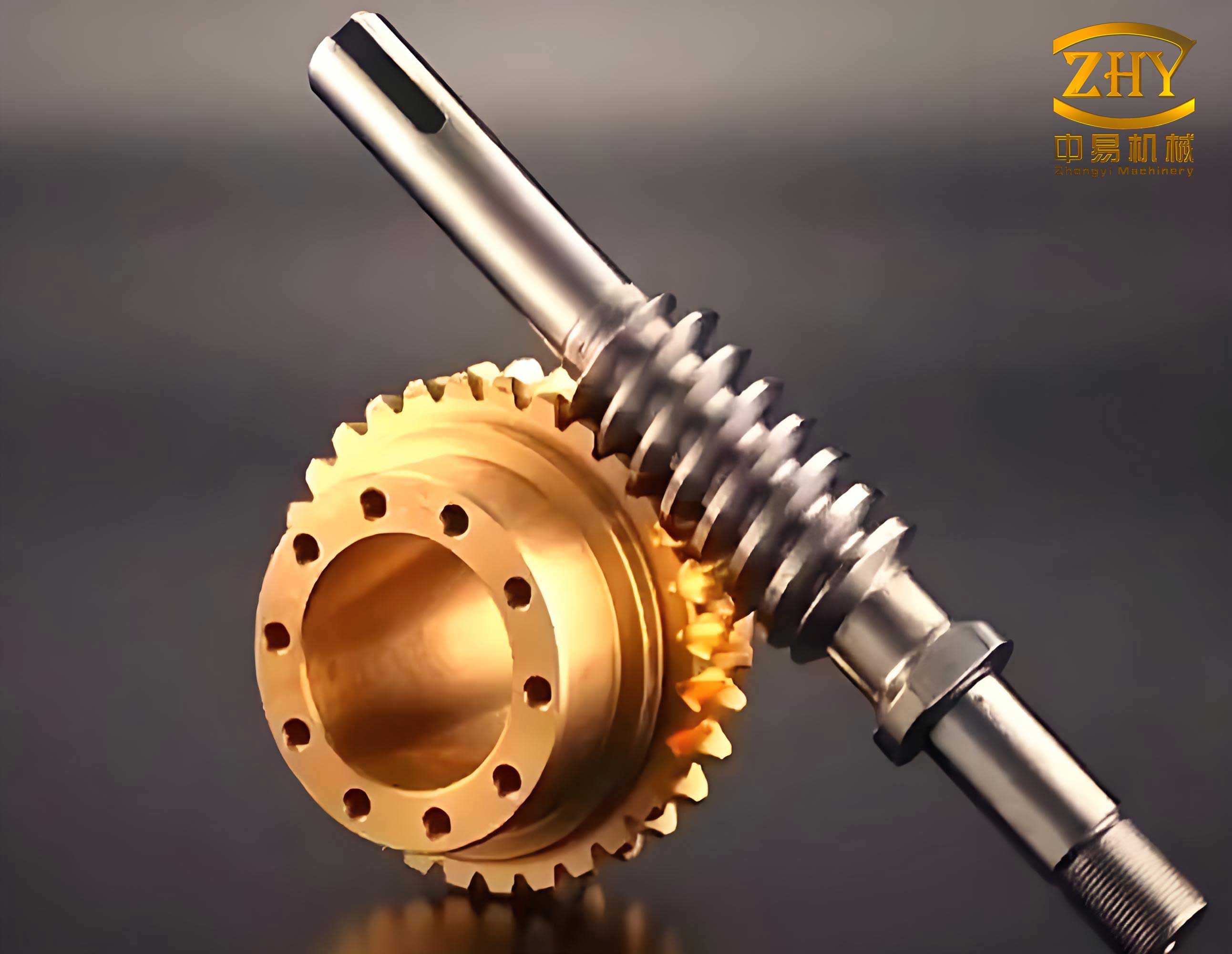
The mechanical structure of a typical screw gear reducer, such as the RV series, includes components like the worm (screw gear), oil seals, flanges, bearings, housing, retaining rings, oil seal covers, and oil plugs. The housing is often made of cast aluminum alloy for lightweight and heat dissipation, while oil seals use materials like nitrile rubber for leak prevention. The screw gear transmission relies on the meshing between the worm and worm wheel, which can be categorized into three main types: cylindrical worm drives, enveloping worm drives, and cone worm drives. Each type has distinct advantages; for instance, cylindrical screw gear drives offer high efficiency and compactness, whereas enveloping screw gear drives provide better load distribution and lubrication. The selection of materials for the screw gear and worm wheel is critical—common materials include bronze or cast iron for the wheel and carbon or alloy steel for the worm. Recent advancements introduce zinc-aluminum alloys as alternatives to improve wear resistance and cost-effectiveness.
To quantify the performance of a screw gear reducer, key parameters include the transmission ratio and efficiency. The transmission ratio, denoted as \( i \), is defined as the ratio of the input speed (worm speed) to the output speed (worm wheel speed). For a screw gear system, this can be expressed as:
$$ i = \frac{N_1}{N_2} = \frac{Z_2}{Z_1} $$
where \( N_1 \) is the rotational speed of the worm (screw gear), \( N_2 \) is the rotational speed of the worm wheel, \( Z_1 \) is the number of starts on the worm, and \( Z_2 \) is the number of teeth on the worm wheel. Typically, screw gear reducers achieve high ratios, often ranging from 10:1 to 100:1, making them ideal for heavy-duty applications. The efficiency \( \eta \) of a screw gear reducer accounts for power losses due to friction and heat, calculated as:
$$ \eta = \frac{P_{\text{out}}}{P_{\text{in}}} \times 100\% $$
where \( P_{\text{out}} \) is the output power and \( P_{\text{in}} \) is the input power. In screw gear systems, efficiency tends to be lower than in other gear types due to sliding friction, often ranging from 50% to 90%, depending on factors like lubrication and material pairing.
Now, let’s explore the common fault types in screw gear reducers. Based on my analysis, I have identified five primary issues: overheating, oil leakage, vibration, wear of the screw gear and worm wheel, and abnormal noise. Each fault stems from specific causes and requires tailored handling methods. Below, I summarize these in a table for quick reference, but I will elaborate on each subsequently.
| Fault Type | Potential Causes | Recommended Solutions |
|---|---|---|
| Overheating | Misalignment with driven equipment, overload operation, excessive friction in oil seals, improper lubricant quantity or quality | Realign shafts, reduce load, lubricate oil seal lips, adjust oil level, replace with suitable lubricant |
| Oil Leakage | Worn oil seal lips, damaged shaft necks, loose drain plugs, broken oil indicators | Replace oil seals, repair or replace shafts, tighten plugs with sealant, replace oil indicators |
| Vibration | Poor fixation of reducer or driven machine, worn or damaged screw gear pair, bearing wear, loose bolts | Secure mounting, replace screw gear pair or bearings, tighten bolts |
| Screw Gear Wear | Overload, unsuitable lubricant, insufficient lubrication, infrequent oil changes, high operating temperature | Adjust load, use correct lubricant, refill oil as per guidelines, follow oil change schedule, cool environment |
| Abnormal Noise | Misalignment, damaged or loose bearings, poor meshing of screw gear pair, low lubricant level | Realign connections, replace bearings, repair or replace screw gear components, add lubricant |
Overheating in a screw gear reducer is a frequent issue that can accelerate wear and reduce efficiency. From my observations, overheating often results from misalignment between the reducer and the driven machine, causing excessive friction. For instance, if the axes are not coaxial, the screw gear experiences uneven loads, leading to heat generation. Mathematically, the heat generation rate \( Q \) can be approximated by the frictional power loss:
$$ Q = P_{\text{in}} \times (1 – \eta) $$
where \( \eta \) is the efficiency. Overload operation exacerbates this, as the screw gear transmission is pushed beyond its designed capacity. Additionally, oil seals that rub excessively due to wear or improper installation can generate localized heat. Lubrication plays a critical role—too little oil increases friction, while too much oil can cause churning and heat buildup. I recommend using high-quality lubricants with appropriate viscosity, as specified by manufacturers. For example, synthetic oils with anti-wear additives can enhance the performance of screw gear systems. Regular monitoring with infrared thermometers can help detect overheating early.
Oil leakage is another common problem in screw gear reducers, often leading to lubricant loss and environmental contamination. In my experience, leaks primarily occur at oil seal points, especially if the seal lips wear out over time. The shaft neck where the seal contacts may also wear, creating gaps. Drain plugs that are not tightened properly or lack sealant can be culprits too. To address this, I emphasize preventive measures like using durable oil seals made of materials resistant to high temperatures and corrosion. For screw gear reducers operating in harsh conditions, fluorocarbon rubber seals might be preferable. The oil level should be checked via indicators regularly; if the oil indicator is damaged, it must be replaced promptly to avoid overfilling or underfilling. A simple formula to estimate leak rate \( L \) is:
$$ L = \frac{V_{\text{loss}}}{t} $$
where \( V_{\text{loss}} \) is the volume of oil lost over time \( t \). Keeping this rate minimal ensures optimal lubrication for the screw gear components.
Vibration in screw gear reducers can indicate underlying mechanical issues that, if ignored, may lead to catastrophic failure. Based on my fieldwork, vibration often stems from poor fixation—if the reducer or driven machine is not securely mounted, it can oscillate during operation. The screw gear pair itself might be worn or damaged, causing irregular meshing and dynamic imbalances. Bearing wear is another key factor; bearings support the worm (screw gear) and worm wheel, and their degradation introduces play. Loose bolts on housing or flanges can amplify vibrations. To mitigate this, I advise conducting periodic vibration analysis using accelerometers. The vibration amplitude \( A \) can be correlated with fault severity, and frequency spectra can identify specific components like the screw gear meshing frequency. Tightening all fasteners and ensuring proper alignment during installation are basic yet effective steps. In severe cases, replacing the screw gear pair or bearings may be necessary.
Wear of the screw gear and worm wheel is a critical fault that directly impacts the reducer’s lifespan. As a screw gear system operates, the sliding contact between the worm and wheel causes gradual material loss. From my analysis, wear accelerates under overload conditions, where contact stresses exceed material limits. The wear rate \( W \) can be modeled using Archard’s equation for adhesive wear:
$$ W = k \frac{F_n s}{H} $$
where \( k \) is a wear coefficient, \( F_n \) is the normal load, \( s \) is the sliding distance, and \( H \) is the material hardness. For screw gear reducers, using softer materials like bronze for the wheel and harder steels for the worm is common, but improper lubrication can increase \( k \). Lubricant quality is paramount—contaminated or degraded oil loses its protective film, leading to metal-to-metal contact. I recommend adhering to lubrication schedules: for instance, in high-duty screw gear applications, oil should be changed every 2,000 operating hours or as per manufacturer guidelines. Temperature control is also vital; excessive ambient heat can thin the lubricant, reducing its effectiveness. Cooling fans or heat exchangers might be installed in hot environments to maintain optimal operating temperatures for the screw gear system.
Abnormal noise, such as grinding or whining sounds, often signals issues in screw gear reducers. In my experience, noise typically arises from misalignment between the reducer and motor, causing the screw gear to mesh inaccurately. Damaged bearings with increased clearance can produce rattling noises, while poor meshing of the screw gear pair due to wear or manufacturing defects leads to rhythmic knocking. Insufficient lubrication exacerbates noise by increasing friction. To diagnose, I use acoustic emission sensors to capture sound patterns; the sound pressure level \( L_p \) in decibels can indicate severity. Solutions include realigning the drive system, replacing faulty bearings, and ensuring the screw gear teeth are properly profiled. For noise reduction, using helical or ground screw gear teeth can improve meshing smoothness. Regular lubrication checks are essential—the oil level should be within the recommended range, as indicated on the oil gauge.
Beyond fault-specific handling, general maintenance practices are crucial for screw gear reducers. I have compiled a list of key considerations based on best practices. First, the operating environment temperature should be maintained between -10°C and +40°C to prevent material brittleness or lubricant breakdown. Second, for reducers stored idle for 4-6 months, oil seals may degrade due to rubber aging; thus, replacing seals before recommissioning is advisable to prevent leaks. Third, regular oil checks via indicators are mandatory—insufficient oil accelerates screw gear wear, while excess oil causes overheating. I often use the following formula to determine optimal oil volume \( V_{\text{oil}} \) for a screw gear reducer:
$$ V_{\text{oil}} = C \times D \times W $$
where \( C \) is a constant based on reducer size, \( D \) is the housing diameter, and \( W \) is the width. Manufacturers usually provide specific charts, but this gives a rough estimate. Fourth, lubricant selection should match the screw gear materials and operating conditions; for example, EP (Extreme Pressure) oils are suitable for high-load scenarios. Fifth, periodic inspections of all components, including bolts, seals, and the screw gear mesh, can preempt failures. I recommend a maintenance schedule every 500 hours for visual checks and every 2,000 hours for comprehensive overhauls.
To further illustrate material choices for screw gear systems, I present a table comparing common materials and their properties. This helps in selecting appropriate pairs to minimize wear and extend service life.
| Component | Material | Key Properties | Typical Applications |
|---|---|---|---|
| Worm Wheel | Tin Bronze (e.g., ZCuSn10P1) | Excellent wear resistance, good anti-galling, low strength, high cost | High-speed screw gear drives (>3 m/s sliding velocity) |
| Worm Wheel | Aluminum Bronze (e.g., ZCuAl10Fe3) | High strength, moderate wear resistance, lower cost | Medium-speed screw gear drives (<4 m/s sliding velocity) |
| Worm Wheel | Gray Cast Iron | Low efficiency, economical | Low-speed screw gear drives (<2 m/s sliding velocity) | Worm (Screw Gear) | Carbon Steel (e.g., 45 steel, heat-treated) | Hardness 220-300 HBS, good toughness | Low-speed screw gear transmissions |
| Worm (Screw Gear) | Alloy Steel (e.g., 20CrMnTi, case-hardened) | Hardness 56-62 HRC, high wear resistance | High-speed, heavy-duty screw gear drives |
| Alternative | Zinc-Aluminum Alloy (ZA27) | Good mechanical properties, low wear rate, cost-effective | Replacing bronze in screw gear wheels for extended life |
In terms of screw gear transmission types, each offers unique benefits. Cylindrical screw gear drives, including Archimedes, involute, and convolute varieties, are prevalent for their simplicity and efficiency. Enveloping screw gear drives provide better load distribution due to increased contact area, while cone screw gear drives allow multiple tooth engagement for higher torque capacity. The choice depends on application requirements; for instance, in heavy lifting equipment like cranes, enveloping screw gear reducers are preferred for their durability. The efficiency \( \eta \) for a screw gear drive can be estimated using empirical formulas based on the lead angle \( \lambda \) and coefficient of friction \( \mu \):
$$ \eta = \frac{\tan \lambda}{\tan(\lambda + \phi)} $$
where \( \phi = \arctan \mu \) is the friction angle. This highlights how screw gear design impacts performance—steeper lead angles generally improve efficiency but may reduce torque capacity.
In conclusion, screw gear reducers are indispensable in industrial machinery, but their reliability hinges on proactive fault diagnosis and maintenance. From my perspective as an engineer, understanding the root causes of overheating, leakage, vibration, wear, and noise is the first step toward effective troubleshooting. By implementing the solutions outlined—such as proper alignment, adequate lubrication, and regular inspections—operators can significantly extend the life of screw gear systems. The use of advanced materials like zinc-aluminum alloys and high-performance lubricants further enhances durability. I emphasize that preventive maintenance is not just a cost-saving measure but a safety imperative, especially in critical applications like mining or marine systems. As technology evolves, innovations in screw gear design and monitoring tools will continue to improve reliability. Ultimately, a well-maintained screw gear reducer ensures smooth operation, reduces downtime, and supports industrial productivity.