
In the intricate world of aeronautical transmission systems, the selection of the appropriate gear type is paramount for achieving optimal performance, reliability, and efficiency. Among the various gear geometries employed, bevel gears, particularly those configured for a 1:1 ratio—often referred to as miter gears—hold a critical role in redirecting shaft power at right angles. Two prevalent types used in such applications are the straight bevel gear and the Zerol bevel gear. Due to their kinematic similarity, especially in miter gears configurations where the shaft angle is 90 degrees and the gear ratio is unity, these two types are frequently considered interchangeable in many design layouts, particularly within the demanding environment of aerospace engineering. Both types generate axial forces that tend to separate the gears, whether in forward or reverse operation, which simplifies bearing arrangement considerations during a swap. However, beneath this apparent similarity lies a fundamental difference in tooth geometry that profoundly influences their meshing behavior, load distribution, and ultimately, their dynamic performance. This article delves into a critical comparative analysis of these two miter gears variants, focusing on a key performance metric: Transmission Error (TE).
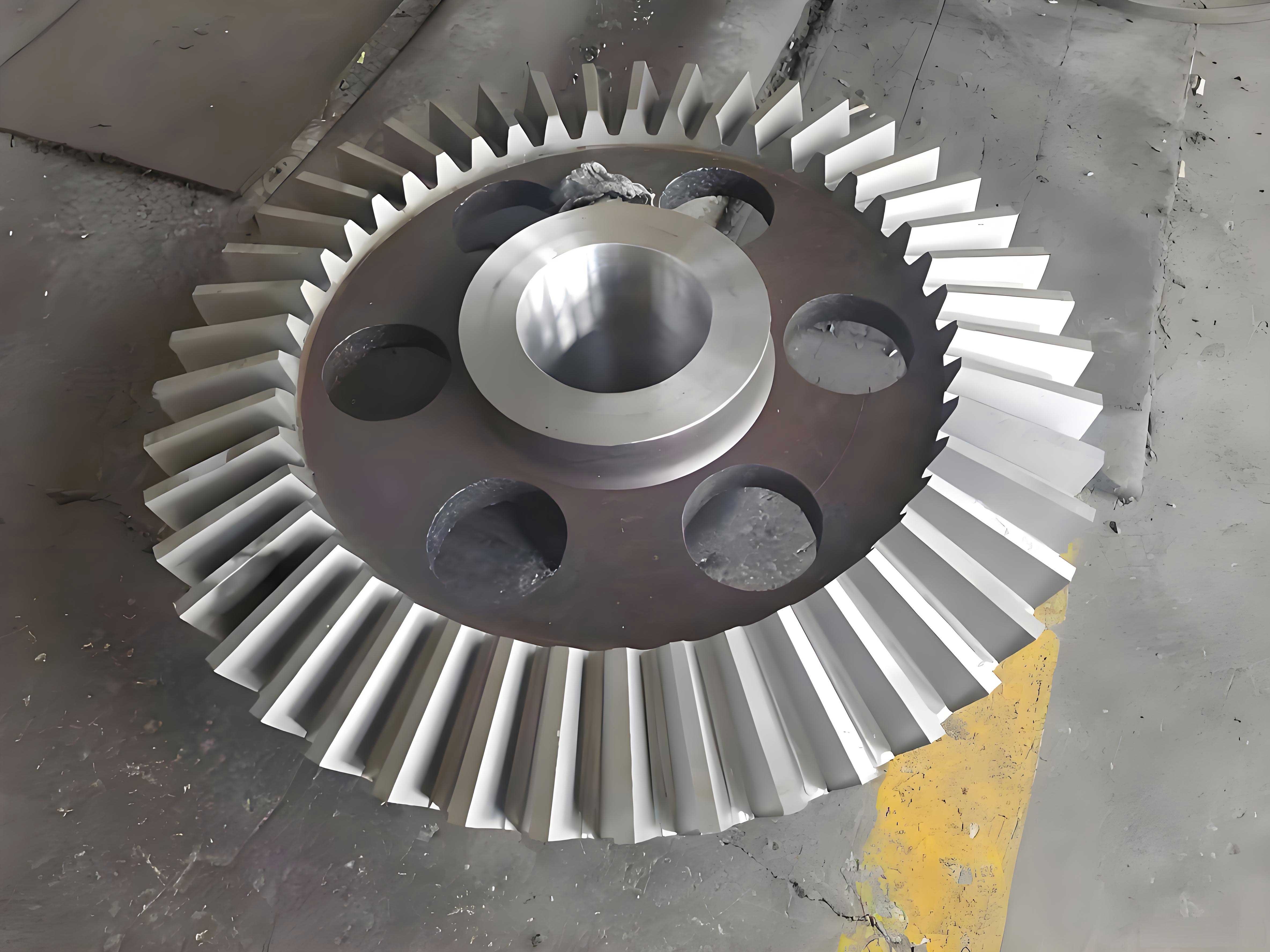
Transmission Error is universally acknowledged as a primary excitation source for gear vibration and noise. It is defined as the deviation of the actual angular position of the driven gear from its theoretical, perfectly conjugate position, caused by elastic deflections under load and inherent manufacturing imperfections. For a gear pair, TE (in radians) can be expressed as:
$$ TE = \theta_2 – \left( \frac{z_1}{z_2} \right) \theta_1 $$
where $\theta_1$ and $\theta_2$ are the rotational displacements of the pinion and gear, and $z_1$ and $z_2$ are their tooth numbers. In the case of miter gears, where $z_1 = z_2$, this simplifies to $TE = \theta_2 – \theta_1$. Minimizing and controlling the pattern of TE is crucial for designing high-performance, quiet, and durable gear transmissions, especially in aviation where reliability is non-negotiable. While significant research exists on straight bevel gears concerning load distribution and stress analysis, and on spiral bevel gears concerning ease-off topography and contact analysis, a direct, detailed comparison of the static Transmission Error characteristics between straight and Zerol miter gears under varied operational conditions has been less explored. This work aims to bridge that gap by constructing precise geometric models of both gear types, performing detailed finite element-based quasi-static contact analyses, and systematically comparing their TE response under different loads and assembly misalignments.
Theoretical Foundations and Geometric Modeling
The accurate prediction of gear behavior begins with a precise geometric definition of the tooth flanks. The methodologies for generating the tooth surfaces of straight bevel gears and Zerol bevel gears are fundamentally distinct, stemming from their different production processes.
Mathematical Generation of Straight Bevel Miter Gears
Straight bevel gear teeth are based on spherical involutes. The generation process can be visualized as a plane rolling without slip on the base cone of the gear. A radial line on this plane traces out the spherical involute surface in space. To mathematically define this, we establish two coordinate systems: a fixed system $Oxyz$ attached to the gear blank (with the z-axis along the gear axis), and a moving system $Ox’y’z’$ attached to the generating plane, where $z’$ is along the instantaneous line of contact between the plane and the base cone.
A point $A$ on the radial line in the moving system is given by:
$$ \mathbf{r}_{A}^{(m)} = \begin{bmatrix} l \sin \psi \\ 0 \\ l \cos \psi \end{bmatrix} $$
where $l$ is the radial distance (sphere radius) and $\psi$ is the angle from the $z’$-axis.
The transformation from the moving system to the fixed system involves a rotation about the x-axis by the base cone angle $\theta_b$ and a subsequent rotation related to the rolling parameter $\phi$:
$$ \mathbf{M} = \mathbf{R}_x(\theta_b) \cdot \mathbf{R}_{z’}(\phi) $$
The detailed derivation leads to the parametric equations for the spherical involute surface in the fixed coordinate system $Oxyz$:
$$ x = l [ \cos \phi \sin \psi \cos \theta_b + \sin \phi (\cos \psi \cos \phi_g + \sin \psi \sin \theta_b \sin \phi_g) ] $$
$$ y = l [ -\sin \phi \sin \psi \cos \theta_b + \cos \phi (\cos \psi \cos \phi_g + \sin \psi \sin \theta_b \sin \phi_g) ] $$
$$ z = l [ \cos \psi \sin \phi_g – \sin \psi \sin \theta_b \cos \phi_g ] $$
where $\phi_g$ is a phase angle related to the gear blank. The relationship $\psi = \phi \sin \theta_b$ holds true for pure rolling. Using these equations, discrete points on the tooth flank can be calculated via computational software like MATLAB. These point clouds are then imported into CAD software (e.g., Siemens NX) to generate a smooth spline surface, which is subsequently used to create the solid model of a straight bevel miter gear. The key geometric parameters for the model used in this analysis are summarized below:
| Parameter | Pinion / Gear (Miter Pair) |
|---|---|
| Number of Teeth, $z$ | 17 / 17 |
| Module (at large end), $m_n$ (mm) | 3 |
| Normal Pressure Angle, $\alpha_n$ | 25° |
| Shaft Angle, $\Sigma$ | 90° |
| Pitch Cone Angle, $\delta$ | 45° |
| Face Width, $b$ (mm) | 12 |
| Outer Cone Distance, $R_e$ (mm) | ~51.17 |
Virtual Manufacturing of Zerol Bevel Miter Gears
In contrast, Zerol bevel gears are a subset of spiral bevel gears with a zero spiral angle. Their tooth flanks are generated through a face-milling process using a circular cutting tool (cutter head). The complex curvature of the tooth surface is a product of the relative motion between the cutter and the gear blank, governed by specific machine settings. Therefore, generating an accurate model requires simulating this virtual manufacturing process. Based on provided machine tool settings (like cutter radius, blade angles, machine root angle, cradle angle, and velocity ratios), the locus of the cutter blades relative to the rotating gear blank is calculated. The envelope of these successive cutter positions defines the theoretical tooth surface. This process, known as “formate” or “generated” cutting simulation, is implemented in specialized gear design software or can be approximated in general CAD software through Boolean subtraction operations along the simulated tool path. The resulting Zerol bevel miter gear model possesses localized tooth surface curvatures that differ from the spherical involute, leading to a point or elliptical contact pattern under no load, which expands under load. A representative set of basic and machine settings for the Zerol miter gears analyzed is provided below. Note the zero spiral angle, which differentiates it from standard spiral bevel gears while retaining the face-milled, longitudinally curved tooth profile.
| Parameter | Pinion (Convex/Concave) | Gear |
|---|---|---|
| Number of Teeth, $z$ | 17 | 17 |
| Module (at large end), $m_n$ (mm) | 3 | |
| Normal Pressure Angle, $\alpha_n$ | 25° | |
| Shaft Angle, $\Sigma$ | 90° | |
| Spiral Angle, $\beta$ | 0° | |
| Mean Cutter Radius, $r_c$ (in) | 6.5 / 5.5 | 6.0 |
| Machine Root Angle | 24°59′ | 54°46′ |
Finite Element Analysis Methodology for Miter Gears
To perform a quasi-static contact analysis, the solid models of both miter gears types are imported into a Finite Element Analysis (FEA) software suite, such as Abaqus/Standard. A crucial aspect of this analysis is model fidelity. While past studies often used segment models (3-5 teeth), this analysis incorporates the full gear body including the hub and bore. This is because the hub’s compliance can influence the overall deflection of the gear body, thereby affecting the mesh stiffness and the resulting Transmission Error. The gears are assembled in their nominal operating position with an initial small clearance.
Meshing Strategy: A structured hexahedral mesh is employed for accuracy and computational efficiency. The tooth flank region, where contact occurs, is finely discretized. For instance, approximately 40 elements are used across the face width and the tooth height to capture stress gradients and contact pressure accurately. The hub and web regions, which experience lower stress gradients, are meshed more coarsely. The contact surfaces of both pinion and gear are defined as potential contact pairs using a surface-to-surface discretization method with a finite sliding formulation. A master-slave contact algorithm is typically employed, with the finer-meshed surface usually designated as the slave. A penalty contact method with a frictionless assumption (for simplification in initial static analysis) is used to enforce contact constraints.
Boundary Conditions and Load Steps: The analysis is performed in several steps to ensure numerical convergence and simulate the gradual application of load, which is essential for nonlinear contact problems.
- Step 1 (Close-up): The gear’s bore is fully constrained. A very small rotational displacement is applied to the pinion’s reference point to eliminate the initial tooth flank clearance and establish stable contact, avoiding rigid body motion.
- Step 2 (Preload): With the gear still fixed, a small nominal torque (e.g., 1 Nm) is applied to the pinion’s reference point to seat the contact properly.
- Step 3 (Full Load Application): The torque on the pinion is ramped up to its target value (e.g., 10 Nm, 20 Nm). The gear remains fixed. This step determines the loaded contact pattern and stress state.
- Step 4 (Rotation for TE): This is the critical step for TE calculation. The full torque is maintained on the pinion. The rotational constraint on the gear’s reference point is released, and instead, a small imposed rotation is applied to the gear. The analysis solves for the equilibrium state where the contact forces from the pinion balance the reaction torque induced by the gear’s rotation. The difference between the actual rotations of the two miter gears is the quasi-static Transmission Error.
The material is defined as linear elastic steel with a Young’s modulus $E = 210$ GPa and a Poisson’s ratio $\nu = 0.3$. Output variables include the rotational displacement of both gear bodies (read from their respective reference points, RP1 and RP2, which are kinematically coupled to their inner bore surfaces), contact pressures, and von Mises stresses.
Results and Comparative Discussion
Transmission Error Under Nominal Conditions
Under a nominal load (e.g., 15 Nm input torque) and perfect assembly, the computed Transmission Error over one mesh cycle reveals distinct characteristics for the two miter gears types. The straight bevel miter gear exhibits a TE curve that approximates a near-rectangular waveform. The error drops sharply as a new tooth pair enters contact (the double-pair contact region), remains at a relatively constant lower value, and then rises sharply as one tooth pair exits contact, leading to a single-pair contact region with a higher TE value. This pattern is a direct consequence of the discrete change in total mesh stiffness when the number of tooth pairs in contact changes from two to one and back. For the analyzed model, the peak-to-peak TE value $TE_{pp}$ is approximately $0.40 \times 10^{-4}$ rad.
The Zerol bevel miter gear, however, shows a qualitatively different TE curve. The transitions at the entry and exit of contact are more gradual. This “smoother” waveform is attributed to the longitudinal crowning and localized contact ellipse of the Zerol gear design, which causes a more progressive load sharing between successive tooth pairs. The load is not transferred instantaneously from one pair to the next, but over a brief roll angle, softening the stiffness transition. However, the absolute magnitude of the TE for the Zerol gear is found to be larger, with a $TE_{pp}$ of about $0.79 \times 10^{-4}$ rad in this comparison. This higher magnitude is likely due to greater local contact deformation resulting from the concentrated elliptical contact patch, compared to the theoretically line contact of the straight bevel gear (which quickly becomes an area contact under load due to deflection). The key takeaway is that while the Zerol miter gears may have a larger TE amplitude, its waveform has lower spectral content at higher harmonics, potentially making it less acoustically excitable. The choice between the two involves a trade-off between absolute error magnitude and the smoothness of the error function.
Influence of Load Magnitude
The behavior of miter gears under varying operational loads is critical. A series of analyses were conducted with input torques ranging from 5 Nm to 25 Nm. The results demonstrate a clear and approximately linear relationship between load and Transmission Error for both gear types. As the torque $T$ increases, the tooth deflections increase, causing a proportional rise in the quasi-static TE. This can be conceptually linked to the mesh stiffness $k_m$. For a constant stiffness, the static deflection $\delta = F / k_m$, and force $F$ is proportional to torque. Since TE is directly related to the composite deflection of the mating flanks, a linear trend follows. The following table summarizes the minimum TE value (often in the double-pair zone) and the peak-to-peak value across the load range for both miter gears types.
| Input Torque, T (Nm) | Straight Bevel Miter Gears | Zerol Bevel Miter Gears | ||
|---|---|---|---|---|
| TE_min (10-5 rad) | TE_pp (10-5 rad) | TE_min (10-5 rad) | TE_pp (10-5 rad) | |
| 5 | 1.54 | 0.95 | 3.74 | 2.85 |
| 10 | 3.33 | 2.02 | 7.42 | 4.93 |
| 15 | 5.05 | 3.15 | 10.75 | 6.65 |
| 20 | 6.77 | 4.10 | 13.78 | 8.01 |
| 25 | 8.49 | 5.05 | 16.57 | 9.38 |
The linear trend can be modeled as $TE_{min} = C_1 \cdot T$ and $TE_{pp} = C_2 \cdot T$, where $C_1$ and $C_2$ are constants dependent on the gear geometry and material. The consistently higher values for the Zerol bevel miter gears across all loads confirms its higher compliance in this specific design comparison. This load-TE relationship is vital for system designers to predict noise and vibration levels across the engine’s power spectrum.
Sensitivity to Assembly Misalignments
Practical assembly of miter gears always involves some degree of misalignment, which can significantly degrade performance. This analysis investigates five common error components applied individually: three linear offset errors ($\Delta a$, $\Delta b$, $\Delta c$) of the gear along the three Cartesian axes, and two angular misalignment errors ($\varepsilon_v$, $\varepsilon_h$) of the pinion axis in the vertical and horizontal planes, respectively. Each error was introduced at a magnitude representative of aerospace manufacturing tolerances (e.g., 0.1 mm or 0.1°).
The impact on Transmission Error is profoundly different between the two miter gears designs. The straight bevel miter gear pair exhibits extreme sensitivity to almost all introduced errors. The TE curves become severely distorted, losing their periodic regularity. The peak TE values can increase dramatically. For instance, an offset error $\Delta b$ (along the axis separating the gear shafts) caused the maximum TE to increase by over $2.8 \times 10^{-4}$ rad. This high sensitivity is due to the straight teeth’ lack of localized profile corrections; misalignment quickly leads to edge contact or severe load concentration on one end of the tooth line.
Conversely, the Zerol bevel miter gear pair demonstrates remarkable robustness to most misalignments. Errors $\Delta a$, $\Delta c$, $\varepsilon_v$, and $\varepsilon_h$ caused minimal change in both the shape and amplitude of the TE curve. This robustness is a direct benefit of the face-milled, longitudinally crowned tooth geometry, which is designed to accommodate small misalignments by shifting and slightly distorting the contact ellipse without causing catastrophic edge loading. The only error to which the Zerol gear showed notable sensitivity was the same $\Delta b$ offset, which increased the peak TE by about $0.5 \times 10^{-4}$ rad—still a much smaller change than for the straight bevel gear. This comparative analysis underscores a critical advantage of Zerol miter gears in real-world applications where perfect assembly cannot be guaranteed. The following table qualitatively summarizes the sensitivity.
| Misalignment Type | Impact on Straight Bevel Miter Gears | Impact on Zerol Bevel Miter Gears |
|---|---|---|
| $\Delta a = 0.1$ mm | High – Major TE distortion & increase | Low – Minimal change |
| $\Delta b = 0.1$ mm | Very High – Largest TE increase | Moderate – Noticeable TE increase |
| $\Delta c = 0.1$ mm | High – Major TE distortion & increase | Low – Minimal change |
| $\varepsilon_v = 0.1$° | High – Significant TE increase | Low – Minimal change |
| $\varepsilon_h = 0.1$° | Moderate – Significant TE increase | Low – Minimal change |
Conclusions and Engineering Implications
This detailed comparative analysis of straight and Zerol bevel miter gears, based on precise geometry and nonlinear finite element contact analysis, provides valuable insights for aerospace transmission designers. The study confirms that while kinematically similar, the two types exhibit fundamentally different static transmission error characteristics, which are the precursors to dynamic performance.
The Zerol bevel miter gears, with their face-milled and crowned teeth, produce a Transmission Error waveform with smoother transitions during mesh cycles. This characteristic is advantageous for reducing vibration excitation at higher frequencies, potentially leading to lower noise emissions—a critical factor in aircraft cabin and system design. However, this comes at the cost of a higher overall magnitude of Transmission Error under load due to greater localized contact compliance. Furthermore, the most significant finding is the superior robustness of Zerol bevel miter gears to common assembly misalignments. Their ability to maintain relatively stable TE patterns under offset and angular errors makes them a more forgiving and reliable choice in practical engineering applications where manufacturing and assembly tolerances are finite.
Straight bevel miter gears, while potentially offering slightly lower TE under ideal, perfectly aligned conditions, exhibit a harsh, rectangular TE waveform that is rich in higher harmonics. More importantly, their performance is highly sensitive to even small misalignments, leading to severely degraded and unpredictable TE behavior. This sensitivity poses a significant risk in high-reliability aerospace systems unless assembly precision is exceptionally controlled and maintained throughout the service life.
Therefore, the selection between straight and Zerol bevel miter gears is not merely a matter of substitution but a deliberate design decision. For applications where alignment is exceptionally well-controlled and maintained, and where minimizing absolute deflection might be prioritized, straight bevel gears could be considered. However, for the vast majority of aerospace applications where robustness, reliability, and smooth operation under real-world imperfect conditions are paramount, Zerol bevel miter gears present a compelling and technically superior choice. Their inherent tolerance to misalignment provides a larger operational safety margin, contributing directly to the overall system’s durability and performance consistency. This analysis strongly suggests that Zerol bevel miter gears should be the preferred variant for demanding aerospace power transmission applications requiring right-angle drives with high reliability.