
The manufacturing of herringbone gears represents a significant challenge in the production of heavy-duty machinery, particularly for critical applications such as drilling pumps. The unique double-helical design, which effectively cancels out axial thrust forces, is offset by the notorious difficulty in machining, especially when features like narrow groove widths are present. This article details a first-person engineering analysis and methodology for successfully producing these components using finger-type milling cutters on a conventional gear hobbing machine, a solution developed to overcome equipment limitations while maintaining requisite quality.
The core challenge in machining herringbone gears with narrow grooves lies in the absence of sufficient space for a tool to retract, eliminating the possibility of using standard gear generation processes like hobbing across the entire face width. Advanced CNC刨齿机 (planing) or 插齿机 (shaping) machines are typically employed for this task. However, when access to such specialized machinery is constrained, an alternative method utilizing a finger-type milling cutter on a standard Y31200B gear hobbing machine becomes a viable, albeit demanding, engineering project. The success of this method hinges on a holistic approach encompassing process planning, custom tooling design, and meticulous parameter optimization.
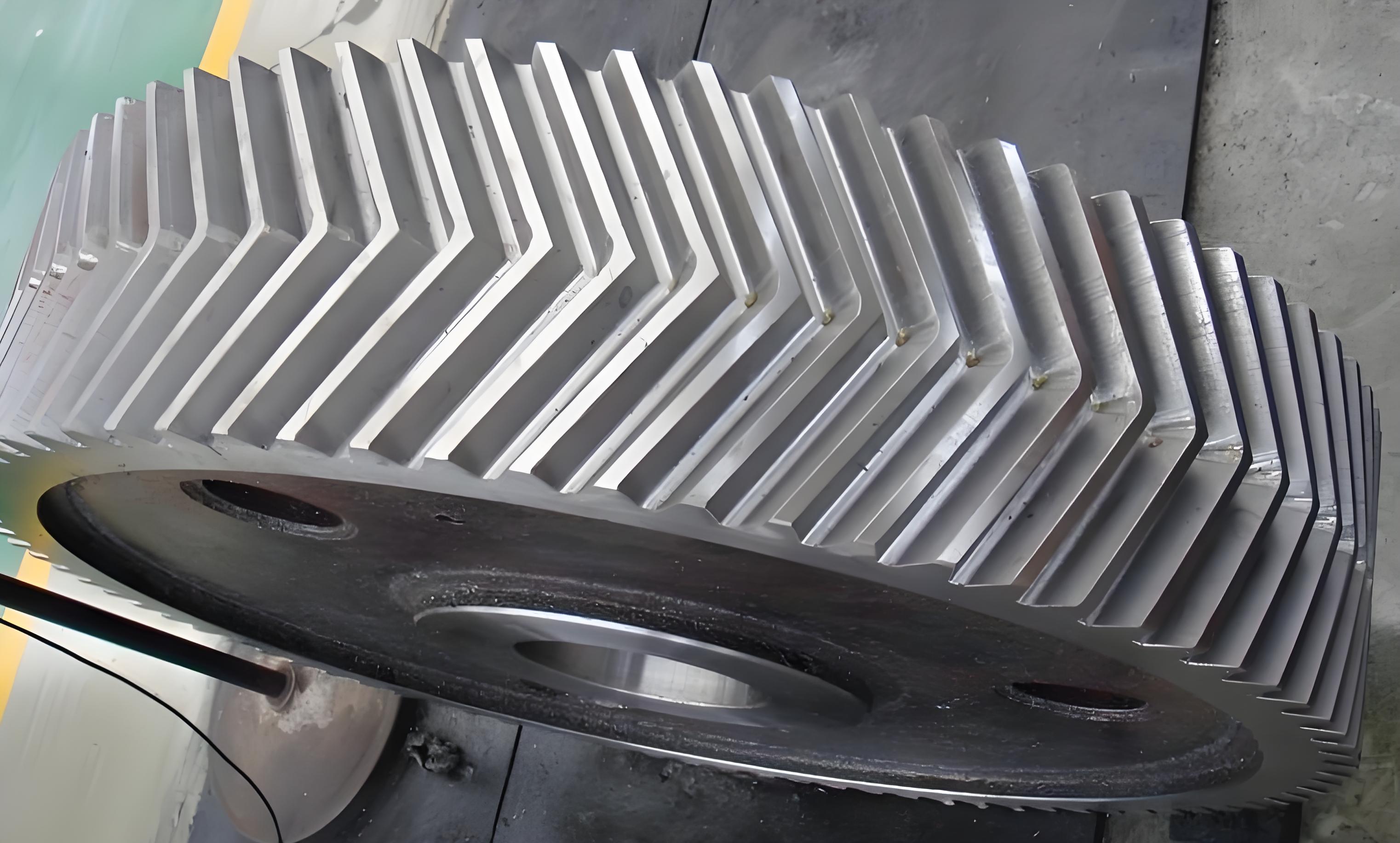
1. Overall Process Design and Fixturing
The machining sequence must be carefully orchestrated to ensure accuracy and manage internal stresses. The following step-by-step process was established:
- Forging and Normalizing: The gear blank is forged and then normalized to refine the grain structure and prepare it for subsequent machining.
- Rough Turning: All major diameters and faces are rough-turned, leaving adequate stock for finishing.
- Heat Treatment (Quenching and Tempering): The gear is subjected to a bulk quench and temper process to achieve a core hardness in the range of 285-320 HB, providing the necessary strength for its service life.
- Finish Turning: All features are finish-turned to their final dimensions, except for the narrow groove. The groove area is left without chamfers at this stage.
- Marking for Alignment: Reference lines are scribed on the workpiece to facilitate correct alignment on the hobbing machine.
- Milling the First Helix (e.g., Left-Hand): The workpiece is mounted on a custom-designed base fixture (discussed below). The machine is set up, the finger cutter is aligned and tilted to the helix angle. After trial cuts to verify indexing and helix direction, the left-hand helix is completely machined in a continuous operation without stopping to ensure surface consistency.
- Secondary Marking: Using the freshly machured left-hand helix as a datum, alignment lines for the opposing helix are scribed.
- Milling the Second Helix (Right-Hand): The workpiece is carefully re-positioned (sometimes flipped). The machine is re-adjusted for the opposite helix angle. The cutter is aligned using the scribed lines, and the right-hand helix is machined continuously to completion.
- Final Groove Chamfering and Deburring: The narrow groove is finally chamfered, and all sharp edges are deburred and blended.
A critical component of this strategy is the design of a rigid and precise mounting fixture. The fixture must ensure perfect perpendicularity of the gear axis to the machine table and resist the significant cutting forces generated during milling. A typical design involves a massive, ground base plate with precisely machined locating features (e.g., a spigot or keyway) and a through-bolt clamping system. The runout of the fixture’s mounting face must be minimized, ideally below 0.01 mm, to prevent cumulative errors in gear tooth alignment.
2. Finger-Type Milling Cutter: Design and Geometry
The finger-type milling cutter is a form-relieved tool whose profile is derived from the gear tooth space. Its design is paramount to the success of the operation, influencing finish quality, tool life, and machining efficiency. The design process involves two distinct cutter types: one for roughing and one for finishing.
2.1. Cutter Profile Calculation
The exact profile of the finger cutter is not a simple inverse of the gear tooth. It must be calculated based on the gear’s basic parameters: module (m), pressure angle ($\alpha$), number of teeth (Z), and helix angle ($\beta$). The coordinate points $(x_c, y_c)$ on the cutter profile in its transverse section can be determined via the gear meshing principle. For a gear with an involute profile, the relationship involves solving for the tool profile that will generate the desired gear space. A series of points is calculated using equations derived from the condition of tangency between the tool surface and the gear flank during the machining motion.
$$ r_b = \frac{m \cdot Z \cdot \cos(\alpha)}{2} $$
$$ \theta = \tan(\alpha) – \alpha $$
$$ x_{gear}(\eta) = r_b (\cos(\eta) + \eta \sin(\eta)) $$
$$ y_{gear}(\eta) = r_b (\sin(\eta) – \eta \cos(\eta)) $$
Where $r_b$ is the base radius and $\eta$ is the roll angle parameter. The tool profile coordinates are then found by transforming these gear coordinates through the machining kinematics, which include the relative motion between the rotating cutter and the indexed workpiece. This often requires iterative numerical methods to obtain a precise profile point set for grinding the cutter.
2.2. Roughing Cutter Design
The primary goal of the roughing cutter is to remove the bulk of material efficiently without overloading the machine or tool. Key features include:
- Conical Form: A tapered body helps in reducing cutting forces and provides better chip ejection.
- Reduced Number of Teeth (Flutes): Typically 4-6 flutes to provide large chip gullets for heavy cuts.
- Large Core Diameter: For maximum rigidity and resistance to deflection.
- Optimized Helix Angle: On the cutting edges to ensure a smoother, shearing cut rather than an impact load.
| Parameter | Symbol | Typical Value / Design Note |
|---|---|---|
| Overall Flute Length | L | > Total tooth depth of gear + clearance |
| Number of Flutes | Zc | 4-6 |
| Core Diameter at Shank | Dcore | Approx. 0.7 * Dcutter |
| Helix Angle | βc | 15° – 25° |
| Rake Angle | γ | 8° – 12° (positive) |
| Clearance (Relief) Angle | αf | 3° – 5° |
2.3. Finishing Cutter Design
The finishing cutter is responsible for achieving the final dimensional accuracy and surface finish on the herringbone gears. Its design prioritizes precision and surface generation:
- Cylindrical Form: Maintains a constant profile for accurate tooth form transfer.
- Increased Number of Teeth: Often 8-12 flutes to provide a finer finish and better guidance.
- Precision Ground Profile: The tooth profile is ground to high accuracy, often with a small corner radius to reduce stress concentration on the gear root.
- Strict Tolerances on Runout: The radial runout of cutting edges must be very low (< 0.02 mm) to ensure uniform cutting and tooth-tooth consistency.
- Chip Gullet Design: While smaller than the roughing cutter’s, the gullet must still be sufficient to prevent chip packing during the finishing pass.
| Feature | Roughing Cutter | Finishing Cutter |
|---|---|---|
| Primary Objective | High Material Removal Rate (MRR) | High Accuracy & Surface Finish |
| Body Shape | Tapered/Conical | Cylindrical |
| Number of Flutes | Low (4-6) | High (8-12) |
| Profile Tolerance | Moderate (IT9-IT10) | Tight (IT7-IT8) |
| Edge Preparation | Chamfered/Strong | Sharp/Precision Honed |
| Helix Angle | Higher for shearing | Lower for stability |
3. Tool Material Selection
The choice of tool material is critical given the hardness of the quenched and tempered gear steel (285-320 HB). Standard High-Speed Steel (HSS) grades often lack the hot hardness and wear resistance for sustained production. While coated HSS, Powder Metallurgy (PM) HSS, and carbide are superior choices, their cost and complexity in regrinding the intricate finger profile can be prohibitive. A balanced and effective solution was found in using Cobalt-Free Super-Hard High-Speed Steel. These grades, such as those with high Vanadium and Carbon content (e.g., M2Al or similar proprietary grades), offer:
- Excellent wear resistance due to a high volume of hard carbides.
- Sufficient hot hardness to withstand the cutting temperatures generated.
- Good toughness to resist chipping on the relatively delicate cutting edges of the finger cutter.
- Machinability and grindability that allow for the economical manufacture and re-sharpening of the complex tool profile.
This choice represents an optimal compromise between performance, manufacturability, and lifecycle cost for the tooling when machining these demanding herringbone gears.
4. Optimization of Cutting Parameters
The machining parameters are the final, crucial link in realizing a successful process. They must be selected to harmonize tool life, productivity, and achieved quality on the herringbone gears.
4.1. Depth of Cut (ap) Strategy
A multi-pass strategy is essential. The initial roughing pass removes most of the stock, leaving a semi-finish allowance. The finishing pass is then divided into two or more light cuts to achieve final size and finish without overloading the tool.
$$ a_{p\ total} = h_{tooth} + \text{clearance} $$
Where $h_{tooth}$ is the full tooth depth. The distribution is typically:
$$ a_{p1} (Rough) \approx 0.7 \times a_{p\ total} $$
$$ a_{p2} (Semi-finish) \approx 0.2 \times a_{p\ total} $$
$$ a_{p3} (Finish 1) \approx 0.08 \times a_{p\ total} $$
$$ a_{p4} (Finish 2) \approx 0.02 \times a_{p\ total} $$
For a gear with a 20mm tooth depth, this might translate to: Rough = 14mm, Semi-finish = 4mm, Finish 1 = 1.6mm, Finish 2 = 0.4mm. It is vital that before the final finishing passes, excess stock is removed in the tooth thickness direction, leaving only a symmetrical finishing allowance.
4.2. Feed Rate (f) and Cutting Speed (vc)
These parameters are interdependent and limited by machine power, tool strength, and desired surface finish.
- Cutting Speed (vc): For HSS tools machining alloy steel of ~300 HB, the cutting speed must be conservative to control tool wear. A range of 10-20 m/min is typical.
$$ v_c = \frac{\pi \cdot D_c \cdot n}{1000} $$
Where $D_c$ is the cutter diameter and $n$ is the spindle speed in RPM. For a Ø38 mm finishing cutter, a speed of 96 RPM gives $v_c \approx 11.4 \text{ m/min}$. - Feed Rate (f): The feed per revolution of the cutter is chosen based on the finish required. A too-high feed increases cutting force and degrades surface finish; a too-low feed can cause rubbing and accelerated flank wear.
Recommended Cutting Parameters for Herringbone Gear Machining Operation Spindle Speed (RPM) Cutting Speed, vc (m/min) Feed per Revolution, f (mm/rev) Roughing 40-60 4.8 – 7.2 0.10 – 0.15 Semi-Finishing 70-90 8.4 – 10.7 0.08 – 0.12 Finishing 90-110 10.7 – 13.1 0.05 – 0.08
4.3. Cutting Fluid Selection and Application
The correct cutting fluid is non-negotiable for achieving tool life and surface integrity when machining herringbone gears. A heavy-duty, sulfurized mineral oil-based cutting oil is ideal. Its functions are:
- Extreme Pressure (EP) Protection: The sulfur forms a protective layer at high pressure/temperature points, preventing seizure and galling.
- Cooling: Although less effective than water-based coolants, it removes heat from the cutting zone.
- Lubrication: It reduces friction between the tool flank and the workpiece, improving finish and reducing power consumption.
Application must be copious and targeted. A high-volume, low-pressure flood directed precisely at the cutter-workpiece engagement zone is required to ensure effective penetration and chip flushing. For roughing, flow rates of 8-10 L/min are common, while for finishing, a slightly lower but very consistent flow of 2-4 L/min is used to avoid turbulence that might affect precision.
5. Process Capabilities and Practical Considerations
Implementing this method for manufacturing herringbone gears yields specific results and entails practical trade-offs.
Achievable Quality: With meticulous setup, tool grinding, and parameter control, this process can consistently achieve gear accuracy to AGMA 9-10 or ISO 8-9 class. Surface roughness ($R_a$) in the range of 3.2 – 1.6 μm is attainable. The primary limitations on accuracy are:
$$ \text{Total Profile Error} \approx \sqrt{E_{tool}^2 + E_{machine}^2 + E_{setup}^2 + E_{deflection}^2} $$
Where $E_{tool}$ is tool profile error, $E_{machine}$ is machine indexing and guideway error, $E_{setup}$ is workpiece alignment error, and $E_{deflection}$ is system deformation under load.
Productivity and Economics: The most significant drawback of this method is its low material removal rate compared to dedicated gear hobbling or shaping. The process is serial (tooth space by tooth space) rather than continuous. Therefore, it is best suited for low-to-medium volume production, prototype development, or maintenance and repair operations where investment in specialized machinery is not justified.
Critical Setup Procedures: Success depends on rigorous pre-machining checks:
- Tool Runout: The finger cutter must be mounted in its holder with minimal radial runout (< 0.03 mm).
- Fixture Accuracy: The mounting face runout must be verified (< 0.01 mm).
- Workpiece Alignment: The gear blank must be indicated true both radially and axially on the fixture (< 0.04 mm TIR).
- Helix Angle Setting: The machine tool head must be swiveled to the exact helix angle of the gear. A small error here ($\Delta\beta$) propagates into a tooth alignment error across the face width.
- Continuous Finishing Pass: The final finishing cut for each helix must be performed in one uninterrupted operation. Any stop or feed interruption will leave a visible witness mark on the tooth flank, detrimental to both appearance and performance of the herringbone gears.
In conclusion, the machining of herringbone gears with narrow grooves using finger-type milling cutters on a conventional machine tool is a demanding yet entirely feasible engineering task. It requires a systems-level approach that integrates specialized tool design, appropriate material science, optimized cutting mechanics, and painstaking process control. While it cannot match the efficiency of dedicated CNC gear manufacturing systems, it stands as a powerful and flexible solution for specific production scenarios, ensuring the continued manufacture and maintenance of essential machinery reliant on these complex and critical herringbone gears.