
In the field of automotive engineering, the design of final drive systems is critical for vehicle performance, efficiency, and noise reduction. Among various gear types, hyperboloid gears, also known as hypoid gears, have gained prominence due to their superior characteristics: smooth operation, high strength, and the offset of the pinion, which facilitates optimal vehicle layout. However, the design process for hyperboloid gears is notoriously complex, involving numerous parameters and intricate calculations. This complexity often hinders design efficiency, leading to prolonged development cycles. In this paper, I present a comprehensive approach to the computer-aided design (CAD) of hyperboloid gears, focusing on optimizing key parameters to enhance performance and streamline the design workflow. By integrating optimization algorithms with CAD tools, we aim to reduce the manual effort required from designers, thereby accelerating the entire process. The core of this methodology revolves around using the tooth surface overlap coefficient as an objective function, employing mixed discrete variable optimization techniques, and automating the generation of gear drawings. Throughout this discussion, the term “hyperboloid gear” will be emphasized repeatedly to underscore its significance in automotive applications.
The fundamental aspect of hyperboloid gear design lies in understanding their geometric and mechanical properties. Hyperboloid gears are characterized by their curved tooth surfaces, which allow for larger contact areas and improved load distribution compared to straight bevel gears. This results in higher torque capacity and reduced noise, making hyperboloid gears ideal for automotive final drives. The design process typically involves determining parameters such as the number of teeth, module, spiral angle, and offset distance, all of which influence the gear’s performance. To address this, we delve into the key formulas used in hyperboloid gear analysis, starting with the tooth surface overlap coefficient, which is a measure of the smoothness and continuity of gear engagement. A higher overlap coefficient generally correlates with quieter operation and better load sharing.
The tooth surface overlap coefficient, denoted as \( e \), is calculated using a formula that incorporates various geometric parameters. For a hyperboloid gear pair, it can be expressed as:
$$ e = \frac{\sqrt{R_{a1}^2 – R_{v1}^2} + \sqrt{R_{a2}^2 – R_{v2}^2} – A \sin \alpha}{\pi m_t \cos \beta_m} $$
where \( R_{a1} \) and \( R_{a2} \) are the outer cone distances for the pinion and gear, respectively; \( R_{v1} \) and \( R_{v2} \) are the virtual cone distances; \( A \) is the offset distance; \( \alpha \) is the pressure angle; \( m_t \) is the transverse module at the large end; and \( \beta_m \) is the mean spiral angle. This formula ensures that the gear teeth maintain contact during rotation, minimizing impact and vibration. In practice, designers aim to maximize \( e \) within constraints to achieve optimal performance. To facilitate this, we break down the parameters further. For instance, the outer cone distance \( R_a \) is given by \( R_a = \frac{d}{2 \sin \gamma} \), where \( d \) is the pitch diameter and \( \gamma \) is the pitch cone angle. The virtual cone distance \( R_v \) is derived from the gear’s geometry, accounting for the hyperboloid shape. These relationships highlight the interdependence of hyperboloid gear parameters, necessitating a systematic approach to design.
Beyond geometry, strength analysis is crucial to ensure the durability of hyperboloid gears under operational loads. The primary failure modes include tooth bending fatigue and surface pitting due to contact stresses. Therefore, we compute the bending stress \( \sigma_b \) and contact stress \( \sigma_h \) using established formulas. For bending stress, the equation for the pinion is:
$$ \sigma_{b1} = \frac{2 T_1 K_o K_s K_m}{b m_t J_1} $$
and for the gear:
$$ \sigma_{b2} = \frac{2 T_2 K_o K_s K_m}{b m_t J_2} $$
Here, \( T_1 \) and \( T_2 \) are the torques on the pinion and gear; \( K_o \) is the overload factor; \( K_s \) is the size factor; \( K_m \) is the load distribution factor; \( b \) is the face width; and \( J_1 \), \( J_2 \) are the geometry factors for bending strength. The contact stress, which governs surface durability, is calculated as:
$$ \sigma_h = C_p \sqrt{\frac{2 T_1 K_o K_s K_m}{b d_1^2 I} \cdot \frac{\cos \beta}{\sin \alpha}} $$
where \( C_p \) is the elastic coefficient (for steel gears, \( C_p = 191 \sqrt{\text{MPa}} \)), \( d_1 \) is the pinion pitch diameter, \( \beta \) is the spiral angle, and \( I \) is the geometry factor for contact stress. These stresses must be below allowable limits to prevent failure. In automotive applications, the torque \( T_2 \) for the gear is often determined based on the vehicle’s daily driving torque, which considers factors like gross vehicle weight, tire radius, and road resistance. For example, for a truck, the daily driving torque \( T_{2d} \) can be estimated as:
$$ T_{2d} = \frac{G r_r}{i_f \eta_f} \left( f_r + i_g + \frac{C_d A_f v^2}{21.15 G} \right) $$
where \( G \) is the gross vehicle weight, \( r_r \) is the tire rolling radius, \( i_f \) is the final drive ratio, \( \eta_f \) is the drivetrain efficiency, \( f_r \) is the rolling resistance coefficient, \( i_g \) is the grade resistance, \( C_d \) is the aerodynamic drag coefficient, \( A_f \) is the frontal area, and \( v \) is the vehicle speed. This torque serves as the basis for strength calculations, ensuring the hyperboloid gear can handle typical operating conditions.
To manage the complexity of these calculations, we adopt an optimization-based approach. The goal is to determine the optimal set of hyperboloid gear parameters that maximize the tooth surface overlap coefficient while satisfying constraints on strength, geometry, and manufacturability. We define the design variables as a vector \( \mathbf{X} = [z_1, z_2, m_t, \beta, E]^T \), where \( z_1 \) and \( z_2 \) are the numbers of teeth for the pinion and gear (discrete variables), \( m_t \) is the transverse module (discrete due to standardization), \( \beta \) is the spiral angle (continuous), and \( E \) is the offset distance (continuous). The objective function is to maximize \( e(\mathbf{X}) \), subject to constraints such as bending stress limits, contact stress limits, geometric boundaries, and practical design rules. The mathematical model is formulated as:
$$ \text{Maximize: } f(\mathbf{X}) = e(\mathbf{X}) $$
$$ \text{Subject to: } g_1(\mathbf{X}) = \sigma_{b1} – [\sigma_b] \leq 0 $$
$$ g_2(\mathbf{X}) = \sigma_{b2} – [\sigma_b] \leq 0 $$
$$ g_3(\mathbf{X}) = \sigma_h – [\sigma_h] \leq 0 $$
$$ g_4(\mathbf{X}) = \beta_{\min} – \beta \leq 0 $$
$$ g_5(\mathbf{X}) = \beta – \beta_{\max} \leq 0 $$
$$ g_6(\mathbf{X}) = E_{\min} – E \leq 0 $$
$$ g_7(\mathbf{X}) = E – E_{\max} \leq 0 $$
$$ g_8(\mathbf{X}) = z_1_{\min} – z_1 \leq 0 $$
$$ g_9(\mathbf{X}) = z_1 – z_1_{\max} \leq 0 $$
$$ g_{10}(\mathbf{X}) = z_2_{\min} – z_2 \leq 0 $$
$$ g_{11}(\mathbf{X}) = z_2 – z_2_{\max} \leq 0 $$
Here, \( [\sigma_b] \) and \( [\sigma_h] \) are the allowable bending and contact stresses, respectively, and the min/max values for variables are based on design standards and vehicle requirements. To solve this mixed discrete-continuous optimization problem, we employ the Mixed Discrete Variable Direct Search (MDVDS) method. This algorithm handles discrete variables natively, avoiding the need for post-optimization rounding that could lead to suboptimal or infeasible solutions. The MDVDS method iteratively explores the design space, evaluating the objective and constraints at discrete points, and converges to an optimal solution that balances performance and practicality. The use of hyperboloid gear parameters in this optimization framework ensures that the resulting design is tailored for automotive applications.
Once the optimal parameters are obtained, the next step is to integrate them into a CAD system for gear drawing generation. We utilize AutoLISP, a programming language for AutoCAD, to automate this process. The optimization results are stored in a data file, which is then read by an AutoLISP script. This script calculates the remaining geometric parameters of the hyperboloid gear, such as tooth profiles, cone angles, and fillet radii, based on the optimized variables. Subsequently, it generates a detailed 2D drawing of the gear, including dimensions, tolerances, and annotations. This automation significantly reduces manual drafting time and minimizes errors. For instance, the script can compute the gear blank dimensions, tooth spacing, and machining features, outputting them directly into an AutoCAD drawing file. This seamless transition from optimization to CAD exemplifies the power of computer-aided design in hyperboloid gear development.
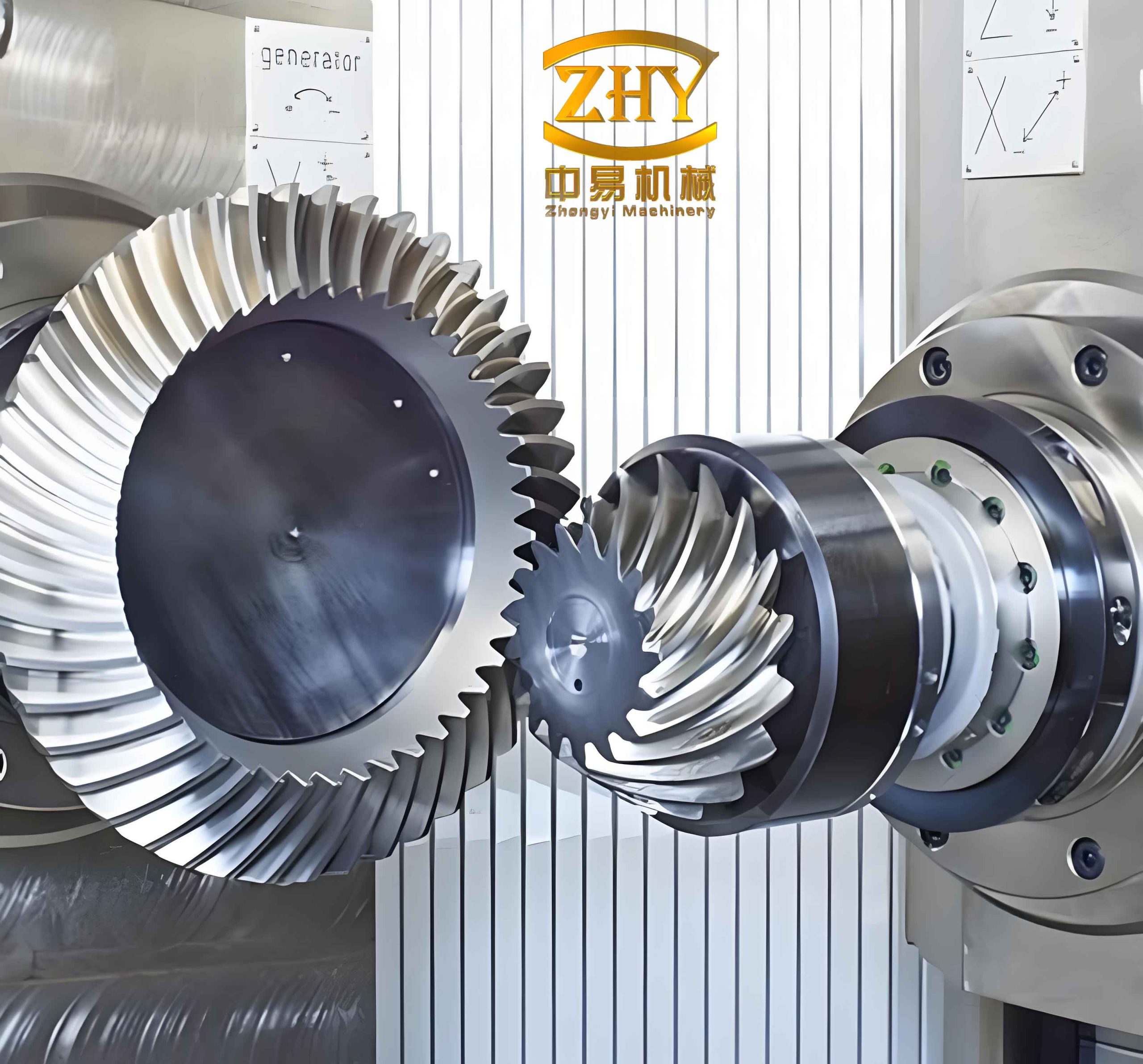
To illustrate the proposed methodology, I present a detailed design case study for a light truck. The vehicle specifications are as follows: gross vehicle weight \( G = 4500 \, \text{kg} \), engine maximum torque \( T_{\text{engine}} = 350 \, \text{Nm} \), final drive ratio \( i_f = 6.33 \), and tire size 7.00-16. The hyperboloid gear is designed for the final drive, targeting a balance between strength and noise reduction. The input parameters provided to the optimization algorithm include allowable stresses, variable bounds, and vehicle type indicators. For this truck, we set the allowable bending stress \( [\sigma_b] = 300 \, \text{MPa} \) and allowable contact stress \( [\sigma_h] = 1500 \, \text{MPa} \). The bounds for design variables are: pinion teeth \( z_1 \) between 6 and 12, gear teeth \( z_2 \) between 30 and 45, transverse module \( m_t \) between 4 mm and 8 mm, spiral angle \( \beta \) between 30° and 50°, and offset distance \( E \) between 30 mm and 60 mm. These bounds are derived from industry standards for hyperboloid gears in similar vehicles.
The optimization process yields the following optimal solution: \( z_1 = 10 \), \( z_2 = 40 \), \( m_t = 6.5 \, \text{mm} \), \( \beta = 42^\circ \), and \( E = 45 \, \text{mm} \). The corresponding tooth surface overlap coefficient is calculated as \( e = 2.15 \), which exceeds typical thresholds for smooth operation. The bending and contact stresses are verified to be within limits: \( \sigma_{b1} = 280 \, \text{MPa} \), \( \sigma_{b2} = 275 \, \text{MPa} \), and \( \sigma_h = 1450 \, \text{MPa} \). Using these parameters, the AutoLISP script computes additional geometric details, such as pitch diameters, cone angles, and face widths. For example, the pinion pitch diameter \( d_1 = m_t z_1 / \cos \beta = 6.5 \times 10 / \cos 42^\circ \approx 86.5 \, \text{mm} \), and the gear pitch diameter \( d_2 = m_t z_2 / \cos \beta = 6.5 \times 40 / \cos 42^\circ \approx 346 \, \text{mm} \). The table below summarizes the key parameters for this hyperboloid gear design:
| Parameter | Symbol | Value | Unit |
|---|---|---|---|
| Pinion teeth | \( z_1 \) | 10 | – |
| Gear teeth | \( z_2 \) | 40 | – |
| Transverse module | \( m_t \) | 6.5 | mm |
| Spiral angle | \( \beta \) | 42 | degrees |
| Offset distance | \( E \) | 45 | mm |
| Tooth surface overlap coefficient | \( e \) | 2.15 | – |
| Pinion bending stress | \( \sigma_{b1} \) | 280 | MPa |
| Gear bending stress | \( \sigma_{b2} \) | 275 | MPa |
| Contact stress | \( \sigma_h \) | 1450 | MPa |
This table highlights the effectiveness of the optimization in achieving a balanced design for the hyperboloid gear. The CAD system then generates the gear drawing, which includes views of the gear blank, tooth profile details, and manufacturing notes. The automation ensures that all dimensions are consistent with the optimized parameters, reducing the risk of human error. This case study demonstrates how the integration of optimization and CAD can streamline the design of hyperboloid gears for automotive applications.
In conclusion, the computer-aided design of hyperboloid gears represents a significant advancement in automotive engineering. By focusing on the tooth surface overlap coefficient as an objective function and employing mixed discrete variable optimization, we can efficiently determine optimal gear parameters that enhance performance and reliability. The subsequent automation of drawing generation via AutoLISP and AutoCAD further boosts design productivity, allowing engineers to concentrate on higher-level tasks. This methodology not only accelerates the design cycle but also ensures that hyperboloid gears meet stringent automotive standards for strength, noise, and efficiency. Future work could extend this approach to include dynamic analysis, thermal effects, and advanced materials, further refining the design of hyperboloid gears. As vehicle technologies evolve, the role of CAD in hyperboloid gear development will continue to grow, driving innovation in automotive final drive systems. Throughout this discussion, the importance of hyperboloid gears has been emphasized, underscoring their critical role in modern vehicles.
To further elaborate on the theoretical underpinnings, let’s explore the geometric relationships in hyperboloid gears. The pitch cone angles for the pinion and gear, denoted \( \gamma_1 \) and \( \gamma_2 \), are related to the shaft angle \( \Sigma \) (usually 90° in automotive final drives) and the offset distance \( E \). For a hypoid gear pair, the formula is:
$$ \tan \gamma_1 = \frac{\sin \Sigma}{\frac{z_2}{z_1} + \cos \Sigma} $$
and \( \gamma_2 = \Sigma – \gamma_1 \). However, due to the offset in hyperboloid gears, this is modified to account for the hyperboloid geometry. The actual calculation involves iterative methods, but for design purposes, approximate formulas are used. The mean spiral angle \( \beta_m \) is critical for determining the tooth orientation and is computed as the average of the pinion and gear spiral angles: \( \beta_m = \frac{\beta_1 + \beta_2}{2} \). In many designs, \( \beta_1 \) and \( \beta_2 \) are set equal for simplicity, but they can differ to optimize contact patterns. The face width \( b \) is another key parameter, typically limited to one-third of the cone distance to prevent excessive deflection. For a hyperboloid gear, the cone distance \( R \) is given by \( R = \frac{d_2}{2 \sin \gamma_2} \), where \( d_2 \) is the gear pitch diameter. Thus, \( b \leq \frac{R}{3} \). These geometric constraints are incorporated into the optimization to ensure manufacturable and functional hyperboloid gear designs.
Regarding strength analysis, the geometry factors \( J \) and \( I \) are derived from tooth shape and loading conditions. For hyperboloid gears, these factors are complex functions of the number of teeth, spiral angle, pressure angle, and tool geometry. They are often obtained from charts or empirical formulas. For instance, the bending geometry factor \( J \) can be approximated as:
$$ J \approx 0.25 – 0.35 \left( \frac{1}{z} \right) + 0.02 \beta $$
for typical automotive hyperboloid gears. Similarly, the contact geometry factor \( I \) is influenced by the relative curvature of the tooth surfaces. A common expression is:
$$ I = \frac{\cos \alpha \cos \beta_m}{\frac{1}{\rho_1} + \frac{1}{\rho_2}} $$
where \( \rho_1 \) and \( \rho_2 \) are the radii of curvature at the contact point. These formulas highlight the nonlinear relationships that make hyperboloid gear design challenging. By including them in the optimization algorithm, we ensure that the selected parameters yield acceptable stress levels.
The optimization algorithm itself, the Mixed Discrete Variable Direct Search (MDVDS), warrants further discussion. This method is particularly suited for problems where some variables are discrete (e.g., tooth counts, module values) and others are continuous (e.g., angles, offsets). The algorithm proceeds by generating a set of candidate points in the design space, evaluating the objective and constraints, and moving towards better solutions. It uses strategies like pattern searches and discrete perturbations to handle discrete variables without converting them to continuous ones. This avoids the pitfalls of rounding, which can lead to constraint violations. The MDVDS method is implemented in software, allowing for rapid iteration and convergence. In our context, it efficiently explores combinations of hyperboloid gear parameters to maximize the overlap coefficient while satisfying all design rules.
In terms of CAD integration, the AutoLISP script performs several key functions. First, it reads the optimized parameters from a text file. Then, it calculates derived dimensions, such as the addendum, dedendum, and tooth thickness, based on standard gear formulas. For hyperboloid gears, these calculations involve trigonometric transformations due to the curved tooth surfaces. The script also generates the gear blank geometry, including the cone angles, back angles, and mounting features. Finally, it uses AutoCAD commands to draw the gear in multiple views (e.g., front, side, and detail sections) and adds dimensions and annotations. This automation not only saves time but also ensures consistency across designs. For example, if the optimization changes the module, the script automatically updates all related dimensions in the drawing.
The benefits of this CAD approach extend beyond individual gear design. It facilitates the creation of design libraries for hyperboloid gears, where optimized parameters for different vehicle types can be stored and reused. This supports modular design practices, enabling engineers to quickly adapt gears for new applications. Moreover, the integration with finite element analysis (FEA) tools can be enhanced by exporting the CAD geometry for stress and vibration simulations, creating a full digital twin of the hyperboloid gear. This holistic approach leverages computer-aided technologies to push the boundaries of automotive gear design.
In summary, the design of hyperboloid gears is a multifaceted process that benefits greatly from computer-aided methodologies. By combining optimization techniques with CAD automation, we can achieve high-performance gear designs with reduced effort and time. The emphasis on hyperboloid gears throughout this paper reflects their importance in automotive final drives, where they contribute to smoother, quieter, and more efficient vehicles. As computational power increases and algorithms improve, the potential for further advancements in hyperboloid gear design is substantial, promising even greater efficiencies and innovations in the automotive industry.