
In the field of gear manufacturing, the scraping process for hardened miter gears represents a significant advancement in precision engineering. As a manufacturing engineer specializing in gear production, I have extensively worked on developing and refining scraping tools for straight bevel gears, commonly referred to as miter gears. This article delves into the intricate details of scraping tool design, manufacturing processes, and key parameters, emphasizing the importance of this technique for improving gear accuracy after heat treatment. The scraping process is particularly crucial for miter gears that have undergone quenching or carburizing, as it effectively eliminates deformation caused by thermal processes and enhances overall gear performance. Throughout this discussion, I will frequently reference miter gears to underscore their central role in this context.
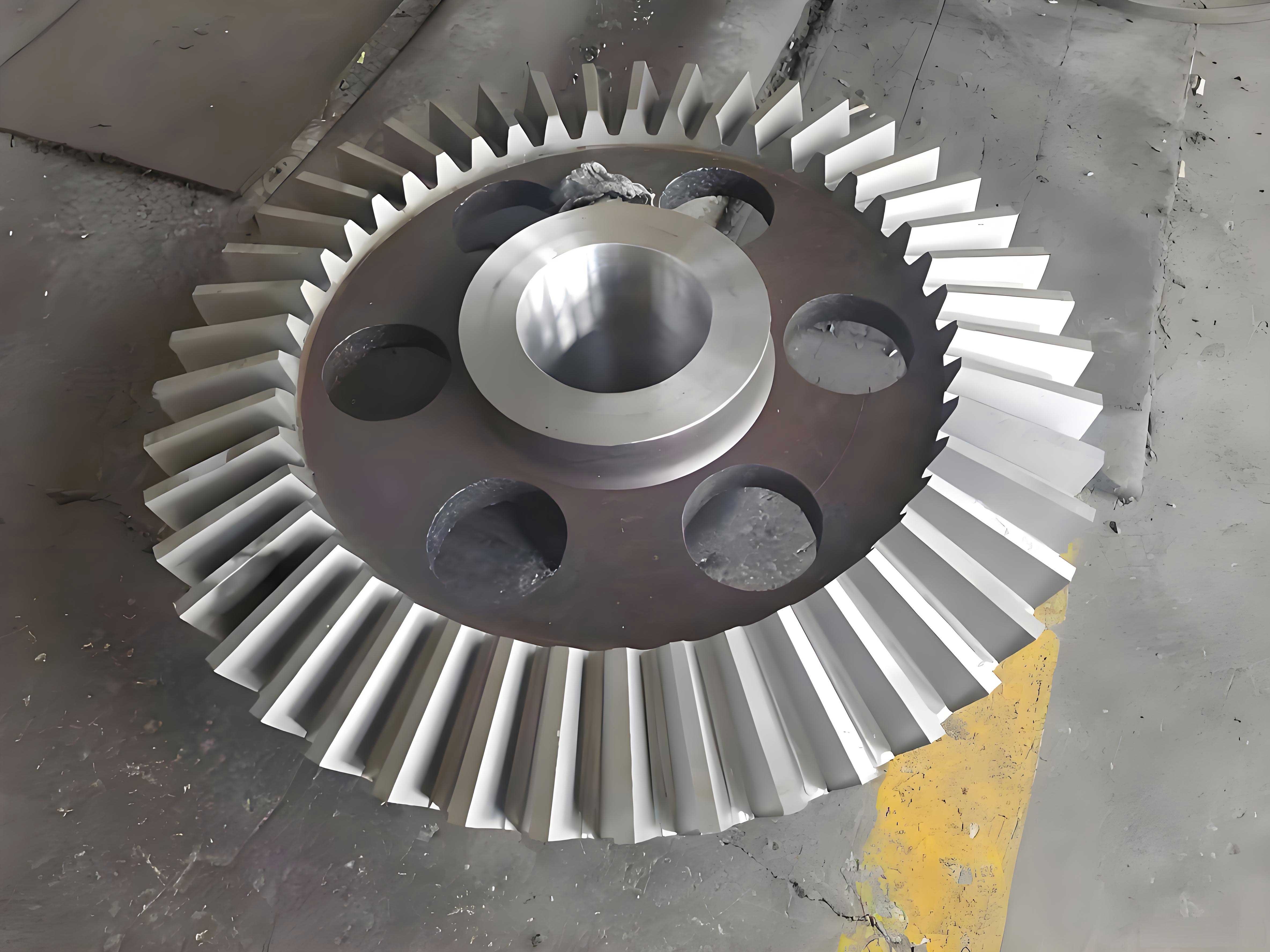
The success of the scraping process hinges on the precise manufacturing and regrinding of scraping tools. These tools are specifically designed for miter gears, which are straight bevel gears with a 1:1 ratio, often used in applications requiring efficient power transmission at right angles. The scraping tool, as illustrated in the accompanying figure, consists of a carbon structural steel body welded with high-strength, high-hardness carbide tips. This design ensures durability and efficiency when machining hardened surfaces of miter gears. The tool’s structure, aside from the carbide inserts at both ends, aligns with standard fine-planing tool dimensions, facilitating compatibility and interchangeability in machining setups. In my experience, optimizing these tools for miter gears involves careful consideration of cutting angles, material selection, and manufacturing tolerances.
The cutting geometry of the scraping tool is fundamental to its performance. As shown in the design, the cutting edge forms a wedge angle with the top edge, which is critical for effective chip removal and tool longevity. When installed on the machine, the cutting edge exhibits a negative rake angle due to its inclination, enhancing cutting performance under hard surface conditions. This geometry is essential for scraping miter gears, as it reduces cutting forces and minimizes tool wear. The key parameters include the wedge angle, clearance angle, and rake angle, which collectively influence the tool’s ability to maintain precision during the scraping of miter gears. For instance, the wedge angle is set to optimize strength, while the negative rake angle improves cutting action on hardened surfaces. The following table summarizes the primary cutting angles for scraping tools used on miter gears:
| Parameter | Symbol | Typical Value | Role in Scraping Miter Gears |
|---|---|---|---|
| Wedge Angle | β | 70° to 80° | Enhances tool strength and reduces chipping |
| Rake Angle | γ | -10° to -15° | Improves cutting on hardened surfaces |
| Clearance Angle | α | 6° to 10° | Prevents rubbing and ensures smooth operation |
| Edge Inclination | λ | 5° to 10° | Facilitates chip flow and reduces heat generation |
The tool’s profile angle, typically set at 20°, may undergo slight variations due to the edge inclination. However, since miter gears are often processed in pairs, this deviation is generally acceptable. For applications requiring strict profile accuracy, the tool’s profile angle can be adjusted accordingly. The surface finish of the tool’s front and rear faces must be high, with no cracks or chips allowed after grinding. In my practice, achieving this involves meticulous control over the manufacturing steps, which I will detail below.
Manufacturing the scraping tool involves four main stages: body machining, carbide tip welding, body finishing, and edge grinding. Among these, welding and grinding are critical, as they directly impact the tool’s performance on miter gears. I will focus on these aspects while providing comprehensive insights into each stage. The body is machined using milling machines with specialized fixtures, similar to those for standard planing tools. However, to accommodate diamond grinding wheels for carbide, certain dimensions are adjusted. For example, when milling the profile surfaces, the allowance for grinding is minimized to prevent interference. The following formula calculates the key dimensions for body machining, ensuring precision for tools used on miter gears:
$$ D = d_0 + \frac{H}{\tan(\theta)} – \delta $$
Where \(D\) is the final dimension, \(d_0\) is the base diameter, \(H\) is the height, \(\theta\) is the tool’s profile angle, and \(\delta\) is the grinding allowance. This calculation is vital for maintaining consistency across batches of scraping tools for miter gears.
Body finishing and carbide grinding employ magnetic fixtures, as depicted in the process diagrams. The grinding method parallels that for standard tools, but with adaptations for hard carbide materials. For instance, when grinding the profile surfaces, the fixture is oriented to allow diamond wheels to focus on the carbide without contacting the steel body. The measurement during grinding uses magnetic comparators and specialized gauge blocks, with dimensions derived from the formula above. To enhance productivity, measurements are often conducted directly on the machine. The grinding process involves both rough and fine stages: rough grinding leaves an allowance of 0.1 to 0.2 mm, while fine grinding achieves the required surface finish. The table below outlines the grinding parameters for scraping tools used on miter gears:
| Grinding Stage | Wheel Type | Grit Size | Allowance (mm) | Surface Finish |
|---|---|---|---|---|
| Rough Grinding | Resin-bonded diamond wheel | 80-100 | 0.1-0.2 | Ra 0.8 μm |
| Fine Grinding | Resin-bonded diamond wheel | 150-200 | 0.02-0.05 | Ra 0.4 μm |
The rake angle grinding is another crucial step, as it defines the cutting performance on miter gears. The rake angle, measured in the cross-section perpendicular to the cutting edge, must be maintained accurately during regrinding. Using universal vises or dedicated fixtures, the grinding angle is calculated based on the tool’s geometry. The relationship between the vise rotation angle and the tool’s parameters is given by:
$$ \phi_v = \arctan\left(\frac{\tan(\gamma)}{\sin(\alpha_t)}\right) $$
Where \(\phi_v\) is the vise rotation angle, \(\gamma\) is the rake angle in the cutting edge cross-section, and \(\alpha_t\) is the tool’s profile angle. This ensures that the cutting edge remains perpendicular to the tool’s base plane, critical for preserving the profile accuracy of miter gears. Since the scraping depth for miter gears is small (typically 0.05 to 0.1 mm), the rake surface is ground only to a width of 1-2 mm, with each regrinding pass removing no more than 0.02 mm. Diamond wheels with fine grits are used to maintain a high surface finish.
Welding carbide tips to the steel body is a delicate process that requires precise temperature control to avoid cracks or deformation. Although numerous resources cover welding techniques, I emphasize its importance for tools used on miter gears. Proper welding ensures strong bonding, which is essential for withstanding the high stresses during scraping of hardened miter gears. Post-welding, the tool undergoes stress relief annealing to enhance durability. The choice of carbide grade also plays a role; for miter gears with high hardness, grades with high wear resistance are preferred.
Fixture design is integral to the manufacturing process. Magnetic fixtures, as shown in the diagrams, enable accurate grinding and measurement. For example, one fixture holds the tool at a specific angle for profile grinding, while another facilitates rake angle grinding. These fixtures are calibrated to ensure repeatability across multiple tools for miter gears. The measurement system uses gauge blocks and comparators, with dimensions calculated from geometric relationships. The following formula determines the gauge block height for profile grinding:
$$ H_g = H_f – \frac{D_m}{2} \cdot \left(1 – \cos(\psi)\right) $$
Where \(H_g\) is the gauge block height, \(H_f\) is the fixture height, \(D_m\) is the measurement cylinder diameter, and \(\psi\) is the tool’s clamping angle. This approach minimizes errors during the production of scraping tools for miter gears.
In addition to the core processes, several auxiliary steps contribute to tool quality. For instance, drilling mounting holes with jigs ensures interchangeability, while final inspections check for defects like cracks or uneven edges. The tool’s tip radius, often ground with silicon carbide wheels, must be controlled to prevent stress concentration during the scraping of miter gears. Cooling during grinding is also critical, as it prevents thermal damage to the carbide. In my experience, using water-based coolants in plane grinding improves surface finish compared to dry grinding on tool grinders, though the latter offers higher efficiency.
The application of scraping tools for miter gears extends beyond manufacturing to maintenance and regrinding. When tools become dull, regrinding the rake and clearance angles restores their performance. This process requires careful alignment to avoid altering the tool’s profile, which could affect the accuracy of miter gears. Regular calibration of grinding equipment is necessary to maintain consistency. Moreover, the scraping process itself involves minimal material removal, making it ideal for finishing hardened miter gears with tight tolerances. The table below compares scraping with other finishing methods for miter gears:
| Finishing Method | Material Removal | Surface Finish | Suitability for Miter Gears |
|---|---|---|---|
| Scraping | 0.05-0.1 mm | Ra 0.4-0.8 μm | High precision, post-heat treatment |
| Grinding | 0.1-0.3 mm | Ra 0.2-0.4 μm | General finishing, but may cause burns |
| Honing | 0.01-0.05 mm | Ra 0.1-0.2 μm | Fine finishing, but limited to soft gears |
From a material science perspective, the selection of carbide grades for scraping tools is driven by the hardness of miter gears. Common grades include K10 or P20, which balance toughness and wear resistance. The steel body, typically made from medium-carbon steel, provides sufficient strength to support the carbide tips during the scraping of miter gears. Heat treatment of the body, such as quenching and tempering, enhances its mechanical properties. This combination ensures that the tool can withstand the cyclic loads encountered in machining miter gears.
Optimizing the scraping process for miter gears involves iterative testing and parameter adjustment. For example, cutting speed and feed rate are tuned based on gear hardness and tool geometry. The following empirical formula relates cutting parameters to tool life for miter gears:
$$ T = C \cdot v_c^{-n} \cdot f^{-m} $$
Where \(T\) is tool life, \(v_c\) is cutting speed, \(f\) is feed rate, and \(C\), \(n\), and \(m\) are constants derived from experimentation. This helps in planning maintenance schedules for scraping tools used in high-volume production of miter gears.
Quality control is paramount throughout the tool manufacturing process. Each tool undergoes dimensional checks using coordinate measuring machines (CMMs) or optical comparators. The profile accuracy, especially for miter gears, is verified against master gears. Additionally, non-destructive testing methods like dye penetrant inspection detect surface cracks in carbide tips. These measures ensure that every scraping tool meets the stringent requirements for machining precision miter gears.
In conclusion, the development of scraping tools for hardened miter gears is a multifaceted endeavor that integrates mechanical design, material science, and precision manufacturing. As an engineer, I have seen how this process elevates the quality of miter gears used in critical applications like automotive differentials or industrial machinery. The key takeaways include the importance of cutting geometry, the rigor of grinding and welding processes, and the need for meticulous measurement. By adhering to these principles, manufacturers can produce reliable scraping tools that enhance the accuracy and durability of miter gears. Future advancements may involve additive manufacturing for tool bodies or advanced coatings for carbide, further pushing the boundaries of gear technology. Regardless, the focus remains on optimizing every aspect for the efficient scraping of miter gears, ensuring they meet the ever-increasing demands of modern engineering.