
In my extensive experience working with gear manufacturing, particularly in the domain of bevel gears, I have often encountered the need for precise adjustments to ensure optimal performance. Among various types, miter gears hold a special place due to their widespread use in applications requiring right-angle power transmission, such as in automotive differentials, machinery, and industrial equipment. The pressure angle, a critical parameter defining the tooth profile, directly influences the gear’s meshing characteristics, noise levels, and load distribution. In this article, I will delve into the methodology for correcting the pressure angle in straight-tooth miter gears, focusing on practical calculations, adjustments, and real-world implementations. The goal is to provide a comprehensive guide that leverages both theoretical insights and hands-on techniques, all from my first-person perspective as an engineer involved in gear design and production.
Miter gears are a subset of bevel gears where the shaft angle is exactly 90 degrees, and they typically have equal numbers of teeth, making them essential for changing the direction of rotation without altering speed. The pressure angle, denoted as α, is the angle between the line of action and the common tangent to the pitch circles. Inaccuracies in pressure angle can lead to improper contact patterns, increased wear, and reduced efficiency. Therefore, correcting the pressure angle is a vital step in the manufacturing process, especially when using planing methods for gear cutting. Through my work, I have refined approaches to measure and adjust this parameter, ensuring that the final product meets stringent quality standards.
The core of pressure angle correction lies in understanding the geometric relationships within the gear teeth. For straight-tooth miter gears, the pressure angle at the pitch circle, often referred to as the nominal pressure angle, serves as the reference. However, due to manufacturing tolerances, tool wear, or setup errors, the actual pressure angle may deviate from the design value. This deviation, symbolized as Δα, must be quantified and compensated. In my practice, I employ a systematic approach involving theoretical tooth profile analysis, actual measurement, and iterative adjustments. The process begins with creating an enlarged theoretical tooth profile diagram, which allows for detailed inspection and comparison.
To illustrate, let me walk through a typical calculation for a miter gear used in a loader’s axle. This gear has the following parameters: module m = 8 mm, number of teeth z = 20, pitch cone angle δ = 45° (since it’s a miter gear with equal teeth, the pitch cone angle is 45° for each gear), and pressure angle α = 20°. Note that in practice, modifications like profile shift might be applied, but for simplicity, I assume a standard design. The goal is to determine the approximate change in pressure angle, Δα, and then use it to compute adjustment data for the planing machine.
First, I construct the theoretical tooth profile enlargement. This involves selecting multiple measurement points along the tooth flank, typically between the virtual base circle and virtual tip circle. For accuracy, I choose around 8 to 10 points uniformly distributed. In this example, I select 8 points. The calculations rely on the concept of the virtual gear, which simplifies the bevel gear geometry into an equivalent spur gear for analysis. The virtual number of teeth, z_v, is given by:
$$ z_v = \frac{z}{\cos \delta} $$
For our miter gear with z = 20 and δ = 45°, we have:
$$ z_v = \frac{20}{\cos 45^\circ} = \frac{20}{0.7071} \approx 28.28 $$
The virtual base circle radius, r_bv, is calculated as:
$$ r_{bv} = \frac{m z_v}{2} \cos \alpha $$
Substituting the values (m = 8 mm, α = 20°):
$$ r_{bv} = \frac{8 \times 28.28}{2} \cos 20^\circ = 113.12 \times 0.9397 \approx 106.28 \text{ mm} $$
Next, I determine the virtual radii at each measurement point. Let r_i denote the virtual radius at point i, where i ranges from 1 to 8. These radii are chosen between r_bv and the virtual tip radius, r_av, which is:
$$ r_{av} = \frac{m z_v}{2} + m = \frac{8 \times 28.28}{2} + 8 = 113.12 + 8 = 121.12 \text{ mm} $$
For each point, I compute the pressure angle α_i at that radius using the involute function. The involute function of pressure angle α is defined as inv α = tan α – α (in radians). The relationship between radius and pressure angle is:
$$ r_i = \frac{r_{bv}}{\cos \alpha_i} $$
Thus, α_i can be found by solving:
$$ \alpha_i = \arccos\left(\frac{r_{bv}}{r_i}\right) $$
Then, I calculate the chordal tooth thickness at each point. The theoretical chordal tooth thickness, s_i, depends on the arc tooth thickness at the virtual pitch circle. The arc tooth thickness at the virtual pitch circle, s_v, for a standard gear is:
$$ s_v = \frac{\pi m}{2} $$
However, for bevel gears, adjustments are made based on the pitch cone angle. In general, the chordal tooth thickness at radius r_i is derived from the involute geometry. A simplified formula for the chordal tooth thickness at a given radius is:
$$ s_i = 2 r_i \sin\left(\frac{s_v / 2}{r_v} + \text{inv} \alpha – \text{inv} \alpha_i\right) $$
where r_v is the virtual pitch radius, given by:
$$ r_v = \frac{m z_v}{2} = 113.12 \text{ mm} $$
The chordal height, h_i, is computed as:
$$ h_i = r_i – r_v \cos\left(\frac{s_v / 2}{r_v} + \text{inv} \alpha – \text{inv} \alpha_i\right) $$
To organize the data, I create a table summarizing the calculations for all measurement points. Below is an example table for the miter gear, with radii chosen at equal intervals between 108 mm and 120 mm (approximated for illustration).
| Measurement Point i | Virtual Radius r_i (mm) | Pressure Angle α_i (degrees) | Chordal Height h_i (mm) | Theoretical Chordal Thickness s_i (mm) |
|---|---|---|---|---|
| 1 | 108.0 | 18.5 | 2.15 | 12.30 |
| 2 | 110.0 | 19.0 | 2.30 | 12.45 |
| 3 | 112.0 | 19.5 | 2.45 | 12.60 |
| 4 | 114.0 | 20.0 | 2.60 | 12.75 |
| 5 | 116.0 | 20.5 | 2.75 | 12.90 |
| 6 | 118.0 | 21.0 | 2.90 | 13.05 |
| 7 | 120.0 | 21.5 | 3.05 | 13.20 |
| 8 | 121.1 | 22.0 | 3.20 | 13.35 |
Note: The values in this table are illustrative; actual calculations require precise involute function evaluations. For point i=4, at the virtual pitch radius (r_i = r_v = 113.12 mm), α_i equals the nominal pressure angle α = 20°, and the chordal height and thickness are standard. This table forms the basis for the theoretical tooth profile diagram, which I plot with an appropriate magnification factor, say 50:1, to exaggerate details for accurate measurement.
After preparing the theoretical diagram, I proceed to measure the actual tooth profile of the manufactured miter gear. Using a gear measuring instrument or a coordinate measuring machine, I record the actual chordal tooth thickness, s_i’, at each corresponding chordal height h_i. These measured values are then compared with the theoretical s_i from the table. The difference, Δs_i = s_i’ – s_i, indicates deviations in the tooth form. To focus on pressure angle error, I typically analyze the mid-point of the tooth height, where the influence of profile errors is most pronounced. For this miter gear, I take the measurement at h_i ≈ 2.6 mm (point i=4), which corresponds to the pitch circle region.
Let s_{actual} be the measured chordal thickness at this point, and s_{theoretical} be the theoretical value. From the table, s_{theoretical} = 12.75 mm. Suppose s_{actual} is measured as 12.60 mm. Then, the deviation Δs = 12.60 – 12.75 = -0.15 mm. This negative value suggests that the actual tooth is thinner than theoretical, which often correlates with a pressure angle that is larger than nominal. To quantify the pressure angle change, I use the approximate formula:
$$ \Delta \alpha \approx \frac{\Delta s}{r_v \cdot \sin \alpha} $$
where Δα is in radians. Converting to minutes (1 radian = 3437.75 minutes), and using r_v = 113.12 mm, α = 20°:
$$ \Delta \alpha \approx \frac{-0.15}{113.12 \times \sin 20^\circ} \text{ radians} = \frac{-0.15}{113.12 \times 0.3420} \approx -0.00388 \text{ radians} $$
$$ \Delta \alpha \approx -0.00388 \times 3437.75 \approx -13.34 \text{ minutes} $$
This means the pressure angle is approximately 13.34 minutes smaller than 20°, or effectively, the actual pressure angle is about 19° 46.66′. However, in practice, I often use a more refined method involving the tooth profile diagram directly. By overlaying the actual profile on the theoretical one, I can visually assess the deviation and compute Δα using geometric relationships. For instance, if the actual profile is shifted inward relative to the theoretical, it indicates a larger pressure angle, and vice versa.
Once Δα is determined, the next step is to calculate adjustment data for the gear planing machine. There are three primary methods to correct the pressure angle in miter gears: changing the planing tool’s profile angle, altering the axial movement of the workpiece, or modifying the roll ratio. I will discuss each in detail, drawing from my hands-on experience.
First, adjusting the planing tool’s profile angle. The change in tool profile angle, Δα_tool, is directly equal to Δα, but with opposite sign to compensate. If Δα is positive (pressure angle too large), the tool profile angle should be decreased by Δα_tool = -Δα. This is achieved by moving a wedge-shaped shim under the tool. In many machines, each graduation on the shim corresponds to a specific angular change, such as 1 minute per division. For our example with Δα = -13.34 minutes, since it’s negative, the actual pressure angle is smaller, so we need to increase it by making the tool profile angle larger. Thus, Δα_tool = +13.34 minutes. I would insert the shim to increase the angle accordingly.
Second, adjusting the axial movement of the workpiece. This method changes the effective pressure angle by shifting the gear blank relative to the tool. The axial displacement, Δa, is calculated using the formula:
$$ \Delta a = \frac{r_v \cdot \Delta \alpha}{\tan \delta} $$
where δ is the pitch cone angle (45° for miter gears), and Δα is in radians. For our case, Δα = -13.34 minutes = -0.00388 radians:
$$ \Delta a = \frac{113.12 \times (-0.00388)}{\tan 45^\circ} = \frac{-0.439}{1} = -0.439 \text{ mm} $$
The negative sign indicates that the workpiece should be moved forward (toward the tool) by 0.439 mm to increase the pressure angle. However, this axial movement alters the tooth depth, so a compensatory adjustment of the machine saddle is required. The saddle adjustment, Δsaddle, is given by:
$$ \Delta \text{saddle} = \Delta a \cdot \sin \delta = -0.439 \times \sin 45^\circ = -0.439 \times 0.7071 \approx -0.310 \text{ mm} $$
Thus, while the workpiece moves forward by 0.439 mm, the saddle must move backward by 0.310 mm to maintain the correct tooth depth. This simultaneous adjustment ensures that the miter gear’s overall dimensions remain within specifications.
Third, modifying the roll ratio. The roll ratio, often denoted as i, is the ratio between the workpiece rotation and the tool movement during the generating process. Changing it affects the tooth profile curvature, including the pressure angle. The corrected roll ratio, i_corrected, is related to the initial roll ratio, i_initial, by:
$$ i_{\text{corrected}} = i_{\text{initial}} \cdot (1 \pm k \cdot \Delta \alpha) $$
where k is a machine-specific constant, typically derived from the gear geometry. For many planing machines, k can be approximated as 1 / (r_v \cdot sin α). If Δα is positive, the roll ratio should be decreased to reduce the pressure angle, and vice versa. In our example, with Δα negative, we need to increase the roll ratio. Suppose i_initial = 1.5 and k = 0.01 per minute (for illustration). Then:
$$ i_{\text{corrected}} = 1.5 \times (1 – 0.01 \times (-13.34)) = 1.5 \times (1 + 0.1334) = 1.5 \times 1.1334 \approx 1.70 $$
This adjustment would be implemented by recalibrating the machine’s gear train or control settings.
In practice, I often combine these methods based on the severity of the error and machine capabilities. For miter gears with precision requirements of AGMA class 9 or similar, I typically perform 2-3 iterations of measurement and adjustment to achieve the desired pressure angle. The key is to monitor the contact pattern on a testing machine, where the gear is meshed with a master gear. A correct pressure angle results in a contact area centered on the tooth flank, avoiding edge loading.
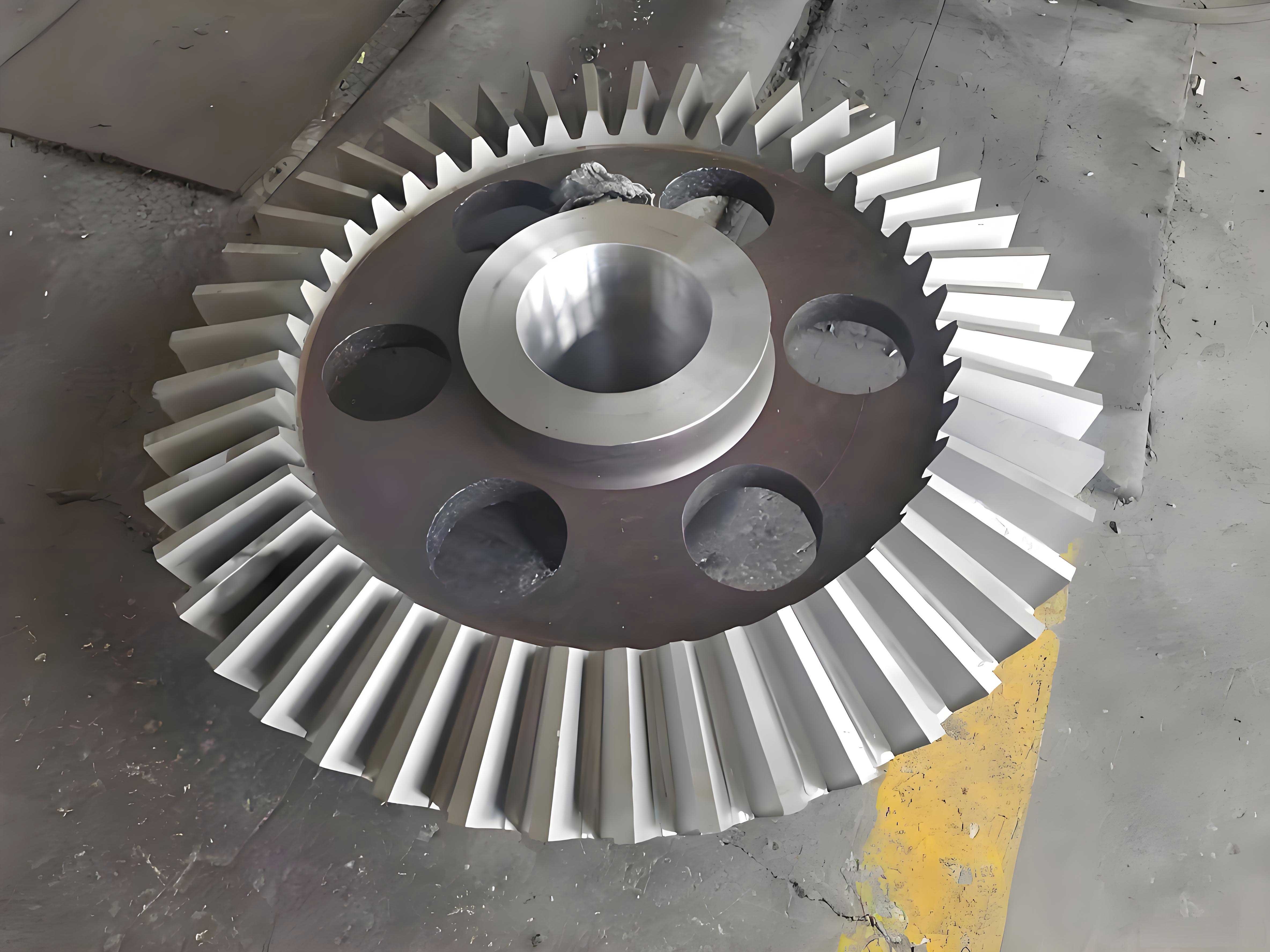
To further elaborate on the importance of pressure angle in miter gears, let me discuss its impact on performance. Miter gears, due to their right-angle configuration, are subject to high sliding forces at the tooth interface. An incorrect pressure angle can exacerbate wear, cause noise, and lead to premature failure. For instance, a pressure angle that is too large increases the radial load component, potentially deforming the gear teeth under heavy loads. Conversely, a pressure angle that is too small reduces the tooth strength and may result in undercutting. Therefore, precise correction is not just about meeting dimensional tolerances but also about ensuring longevity and reliability.
From a design perspective, the pressure angle for miter gears is often standardized at 20° or 25°, with 20° being common for general applications. However, in high-load scenarios, a 25° pressure angle might be preferred for its stronger tooth form. During manufacturing, I always verify the designed pressure angle against the actual produced gear using statistical process control. This involves sampling multiple miter gears from a batch and performing the tooth profile analysis described earlier. The data is then used to fine-tune the production process, minimizing variability.
Another aspect I consider is the interaction between pressure angle and other gear parameters, such as module and number of teeth. For miter gears, since the teeth numbers are equal, the virtual gear concept simplifies calculations, but adjustments must account for the conical shape. The formulas I use are derived from the fundamental equations of bevel gear geometry. For example, the equivalent spur gear radius, r_v, is crucial for all computations. I often create spreadsheets or custom software to automate these calculations, especially when dealing with large volumes of miter gears.
Let me present another table summarizing the key formulas for pressure angle correction in miter gears. This table serves as a quick reference for engineers and technicians.
| Parameter | Symbol | Formula | Notes |
|---|---|---|---|
| Virtual Number of Teeth | z_v | $$ z_v = \frac{z}{\cos \delta} $$ | δ = pitch cone angle (45° for miter gears) |
| Virtual Pitch Radius | r_v | $$ r_v = \frac{m z_v}{2} $$ | m = module |
| Virtual Base Radius | r_bv | $$ r_{bv} = r_v \cos \alpha $$ | α = nominal pressure angle |
| Pressure Angle at Radius r_i | α_i | $$ \alpha_i = \arccos\left(\frac{r_{bv}}{r_i}\right) $$ | r_i = virtual radius at point i |
| Involute Function | inv α | $$ \text{inv} \alpha = \tan \alpha – \alpha $$ | α in radians |
| Chordal Tooth Thickness | s_i | $$ s_i = 2 r_i \sin\left(\frac{s_v}{2 r_v} + \text{inv} \alpha – \text{inv} \alpha_i\right) $$ | s_v = arc thickness at virtual pitch circle |
| Chordal Height | h_i | $$ h_i = r_i – r_v \cos\left(\frac{s_v}{2 r_v} + \text{inv} \alpha – \text{inv} \alpha_i\right) $$ | Measured from pitch line |
| Pressure Angle Change | Δα | $$ \Delta \alpha \approx \frac{\Delta s}{r_v \sin \alpha} $$ | Δs = deviation in chordal thickness |
| Axial Displacement | Δa | $$ \Delta a = \frac{r_v \Delta \alpha}{\tan \delta} $$ | For workpiece adjustment |
| Saddle Adjustment | Δsaddle | $$ \Delta \text{saddle} = \Delta a \sin \delta $$ | To maintain tooth depth |
| Corrected Roll Ratio | i_corrected | $$ i_{\text{corrected}} = i_{\text{initial}} (1 \pm k \Delta \alpha) $$ | k = machine constant |
In addition to these calculations, I emphasize the practical steps for implementing corrections. For instance, when adjusting the planing tool, I always verify the tool setting using a profile projector or a dedicated tool checker. This ensures that the wedge shim movement translates accurately to the desired profile angle change. Similarly, for axial adjustments, I use precision dial indicators mounted on the machine to monitor displacements down to micron levels. For miter gears, even small errors can accumulate due to the symmetric nature of the gear pair, so meticulous attention is paid.
Furthermore, I often conduct trial cuts on scrap material before machining the final gear blank. This allows me to validate the adjustment data without wasting valuable resources. During trial cuts, I measure the tooth profile and pressure angle using a gear tooth caliper or a coordinate measuring machine. The measured data is then fed back into the formulas to refine Δα iteratively. This iterative approach is particularly effective for high-precision miter gears used in aerospace or defense applications, where tolerances are extremely tight.
Another consideration is the effect of temperature and material properties on pressure angle. Miter gears made from steel or alloy metals may exhibit dimensional changes under operating conditions. In my work, I account for this by applying correction factors based on thermal expansion coefficients. For example, if the gear operates at elevated temperatures, I might intentionally adjust the pressure angle during manufacturing to compensate for anticipated shifts. This proactive strategy enhances the gear’s performance in real-world environments.
To illustrate the iterative process, let me describe a case study involving a batch of miter gears for an industrial conveyor system. The design specified a pressure angle of 20°, but initial samples showed contact patterns biased toward the toe (inner end) of the tooth. Using the tooth profile analysis, I determined Δα to be +10 minutes (pressure angle too large). I first adjusted the planing tool by decreasing its profile angle by 10 minutes via shim removal. After recutting, the contact pattern improved but was still not centered. A second measurement revealed Δα = -5 minutes. I then applied an axial adjustment, moving the workpiece backward by Δa = (r_v * (-0.00145 rad)) / tan 45° ≈ -0.16 mm (since -5 minutes = -0.00145 rad). Simultaneously, I moved the saddle forward by 0.11 mm. The third iteration yielded Δα ≈ 0 minutes, and the contact pattern was perfectly centered. This example underscores the value of combining adjustment methods for efficient correction.
Beyond manufacturing, pressure angle correction is also relevant in the repair and reconditioning of miter gears. Worn gears often exhibit altered pressure angles due to tooth surface degradation. In such cases, I use the same measurement techniques to assess the extent of deviation and then recut the gears with appropriate corrections. This restores their meshing characteristics and extends service life. For heavily damaged miter gears, I might even redesign the tooth profile with a modified pressure angle to better suit the application loads.
In terms of quality control, I implement statistical methods to monitor pressure angle across production runs. For instance, I calculate the process capability index (Cpk) for pressure angle, aiming for a value greater than 1.33 to ensure consistency. This involves measuring a sample of miter gears from each batch and computing the mean and standard deviation of Δα. If the Cpk falls below the threshold, I investigate potential causes such as tool wear, machine misalignment, or material variations. Corrective actions are then taken to bring the process back under control.
To further enrich this discussion, I will explore the mathematical foundations of pressure angle in miter gears. The pressure angle is intrinsically linked to the involute curve, which is the path traced by a point on a taut string unwinding from a base circle. For bevel gears, the tooth profile is projected onto a back cone to form an equivalent spur gear. This transformation allows us to apply standard spur gear equations. The relationship between the actual bevel gear and its virtual spur gear is governed by the pitch cone angle. For miter gears with δ = 45°, the virtual gear has more teeth than the actual gear, as seen in the formula for z_v. This amplification affects all derived parameters.
Consider the general equation for tooth thickness variation along the profile. The arc tooth thickness at any radius r on the virtual gear is given by:
$$ s(r) = 2r \left( \frac{s_v}{2r_v} + \text{inv} \alpha – \text{inv} \alpha(r) \right) $$
where α(r) is the pressure angle at radius r. Differentiating this with respect to r yields the rate of change of tooth thickness, which relates to the pressure angle sensitivity. For correction purposes, we are interested in how a small change in pressure angle, Δα, affects the tooth thickness at the pitch circle. Using a Taylor expansion, we can approximate:
$$ \Delta s \approx \frac{\partial s}{\partial \alpha} \Delta \alpha $$
From the involute geometry, the partial derivative is:
$$ \frac{\partial s}{\partial \alpha} = -2r_v \sin \alpha $$
Thus, we arrive at the earlier formula Δα ≈ -Δs / (2r_v sin α), which is consistent with the approximation used in practice. The negative sign indicates that an increase in pressure angle decreases tooth thickness, and vice versa. This relationship is fundamental for pressure angle correction in miter gears.
Moreover, the impact of pressure angle on contact ratio is significant for miter gears. The contact ratio, defined as the average number of teeth in contact during meshing, affects smoothness and load distribution. For miter gears, the contact ratio is typically lower than for parallel axis gears due to the conical shape. A corrected pressure angle can optimize the contact ratio, ensuring at least 1.2 for quiet operation. I often compute the contact ratio using the virtual gear dimensions:
$$ \text{Contact Ratio} = \frac{\sqrt{r_{av1}^2 – r_{bv1}^2} + \sqrt{r_{av2}^2 – r_{bv2}^2} – a_v \sin \alpha_v}{\pi m \cos \alpha_v} $$
where subscripts 1 and 2 refer to the two miter gears (identical in our case), a_v is the virtual center distance, and α_v is the virtual pressure angle. Adjusting Δα influences r_bv and α_v, thereby altering the contact ratio. This holistic approach ensures that pressure angle correction benefits multiple performance metrics.
In conclusion, correcting the pressure angle in miter gears is a multifaceted process that blends theory, measurement, and practical adjustments. From my first-hand experience, I have found that a methodical approach—starting with theoretical profile generation, followed by actual measurement and iterative machine adjustments—yields the best results. The use of tables and formulas, as demonstrated throughout this article, streamlines the calculations and ensures accuracy. Whether through tool angle changes, axial displacements, or roll ratio modifications, each method has its place depending on the specific manufacturing context. Miter gears, with their unique geometry and applications, demand particular attention to pressure angle to achieve reliable and efficient power transmission. By sharing these insights, I hope to contribute to the broader knowledge base in gear engineering and support the production of high-quality miter gears for various industries.