
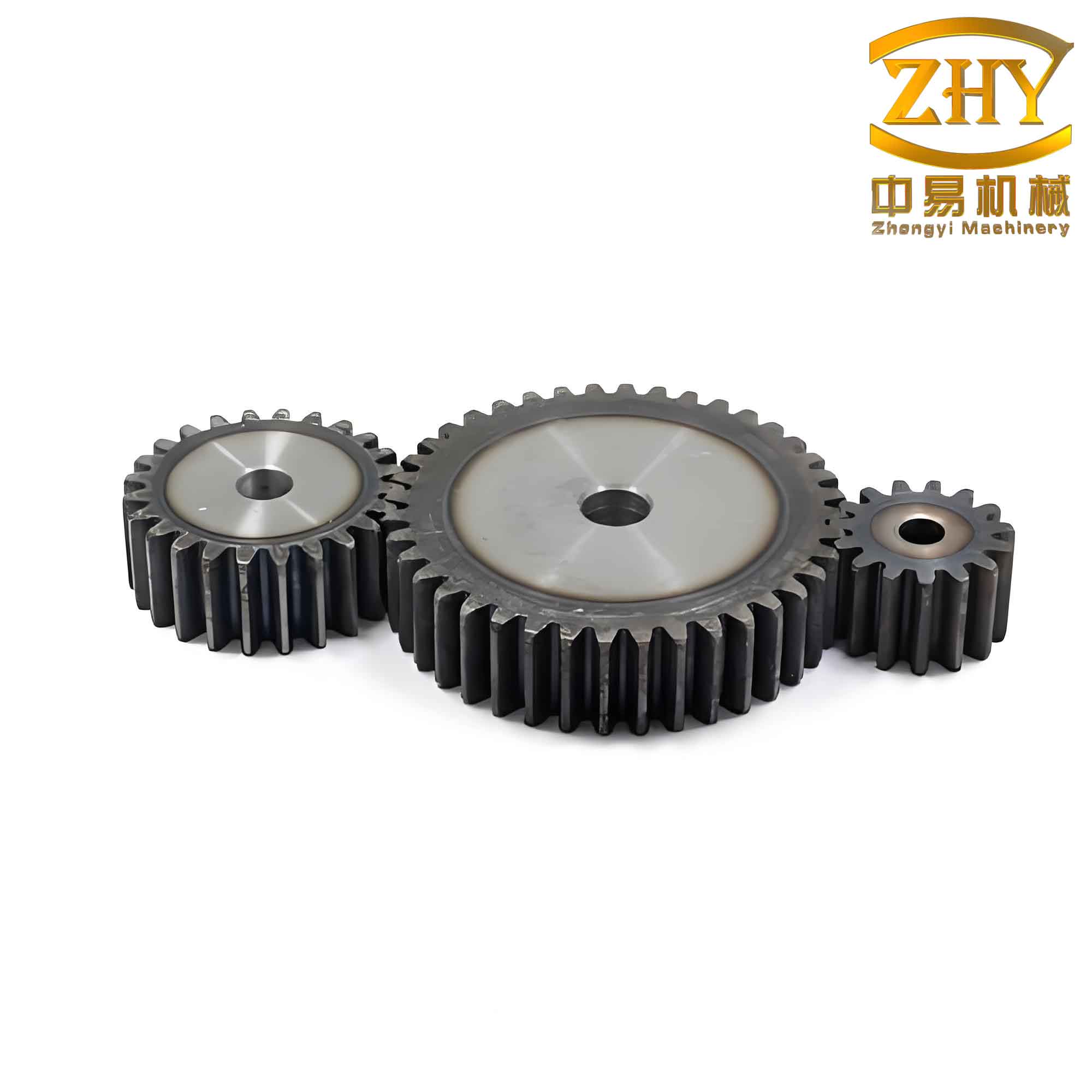
In our research on mechanical transmission systems, we have focused on addressing the noise and vibration challenges inherent in straight spur gear assemblies. Straight spur gears are widely utilized in power transmission applications due to their high efficiency, precise transmission ratios, and structural simplicity. However, when the contact ratio falls within the range of 1 < ε < 2, the number of tooth pairs in mesh alternates between single-tooth and double-tooth contact, leading to time-varying meshing stiffness. This variation inevitably induces冲击, vibration, and noise issues within the system. Furthermore, manufacturing and assembly inaccuracies, including tooth profile errors and center distance deviations, significantly compromise the operational smoothness of the transmission.
In our study, we explored passive noise control techniques using viscoelastic polymer materials applied directly to the end faces of straight spur gears. We selected two materials—acrylic ester and polyurethane—both known for their strong damping characteristics. These materials were uniformly coated onto the两侧端面 of straight spur gears to evaluate their effectiveness in reducing radiated and conducted noise. Our experimental results demonstrated that both materials could effectively attenuate noise, with the reduction magnitude increasing as coating thickness increased within a certain range.
Noise Reduction Mechanism of Viscoelastic Materials
The molecular chains of viscoelastic materials exist in a coiled state when no external force is applied. When energy is输入 into the system, these molecular chains stretch and deform, consuming energy in the process. The intertwined molecular chains within the material create substantial intermolecular bonding forces. Displacing these molecules requires significant energy expenditure, which is the fundamental mechanism behind the damping capacity of viscoelastic materials.
Viscoelastic materials exhibit a pronounced elastic hysteresis phenomenon. This hysteresis arises because the stretching process of the interwoven molecular chains under load requires a finite time to respond, and similarly, the elastic recovery upon load removal is also delayed. This time-dependent behavior explains the excellent vibration resistance and energy dissipation capability of viscoelastic materials.
From a microscopic perspective, ordinary elastic materials do not exhibit molecular chain rearrangement under stress. Their deformation results from changes in inter-granular spacing, known as lattice slippage. Within the elastic range, elastic materials consume virtually no energy during deformation. In contrast, viscoelastic materials dissipate mechanical energy through internal molecular friction.
Consider sound radiation energy propagating through a viscoelastic material along the z-direction. At z = 0, the noise amplitude is denoted as A₀. At position z, the amplitude decays to A₀e-βz, where β is the attenuation coefficient, and f represents the sound frequency. For a unit volume of viscoelastic material with density ρ, the energy flowing into this unit volume per unit time is expressed as:
$$P = \frac{1}{2} \rho V (f A_0 e^{-\beta z})^2 = \frac{1}{2} \rho f^2 A_0^2 e^{-2\beta z} \delta z$$
where V represents the unit volume. The energy flowing out of the unit volume per unit time is:
$$P’ = \frac{1}{2} \rho f^2 A_0^2 e^{-2\beta (z + \delta z)} \delta z$$
The energy absorbed by the polymer material per unit time is therefore:
$$\Delta P = P – P’ = \frac{1}{2} \rho f^2 A_0^2 e^{-2\beta z} \delta z (1 – e^{-2\beta \delta z})$$
When δz → 0, we have 1 – e-2βδz → 2βδz, thus:
$$\Delta P = \beta \rho (f A_0 \delta z e^{-\beta z})^2$$
The loss coefficient is defined as:
$$\kappa = \frac{\Delta P}{P} = 2\beta \delta z$$
Here, β is the attenuation coefficient of the material, typically half of the material damping coefficient. From this relationship, we can see that the attenuation of sound radiation in viscoelastic materials is proportional to both the attenuation coefficient and the material thickness. This theoretical foundation guided our experimental design for investigating noise reduction in straight spur gears.
Experimental Setup for Straight Spur Gear Noise Testing
Based on previous research findings, we recognized that gear system noise primarily originates from axial transmission and radiation. To investigate this systematically, we constructed a dedicated straight spur gear test bench. The gears used in our experiments had specific parameters that we carefully documented and controlled.
| Parameter | Symbol | Value | Unit |
|---|---|---|---|
| Number of teeth (driving gear) | z₁ | 30 | — |
| Number of teeth (driven gear) | z₂ | 20 | — |
| Module | m | 3 | mm |
| Pressure angle | α | 20 | ° |
| Face width | b | 28 | mm |
| Center distance | L | 75 | mm |
The test bench comprised several key components: a 1.5 kW DC motor for driving the gear pair, a Pulse Width Modulation (PWM) speed control module for adjusting motor speed, an optical fiber sensor for speed monitoring, a vibration acquisition module connected to the optical sensor for real-time shaft speed measurement, and a noise acquisition module equipped with a microphone for capturing gear meshing noise. The complete test system allowed us to precisely control operating conditions and accurately measure acoustic emissions.
During the experiments, we uniformly applied different viscoelastic materials to the end faces of both the driving and driven straight spur gears. The materials were allowed to cure and harden before testing commenced. We conducted comparative tests to evaluate the noise reduction performance of different materials under various operating conditions.
Experimental Results and Discussion
Due to the specific condition of our test gears—which exhibited non-uniform wear on the tooth surfaces—the noise levels exceeded 100 dB(A) at rotational speeds above 1,000 r/min, making measurements impractical at higher speeds. Consequently, we selected six rotational speeds for our experimental investigation: 120 r/min, 240 r/min, 360 r/min, 480 r/min, 600 r/min, and 720 r/min. At these speeds, the noise levels remained below 70 dB(A), which is within the acceptable range for environmental noise standards.
We chose 720 r/min as our primary test speed, corresponding to a rotational frequency fᵣ = 12 Hz and a meshing frequency fₘ = 360 Hz. At this operating point, we conducted systematic experiments to evaluate the effects of material type and coating thickness on noise reduction performance. To verify the durability and consistency of the noise reduction capability, we collected data after extended periods of operation.
The time-domain analysis of sound pressure values revealed that both materials effectively absorbed a portion of the noise energy. Comparing the results with the baseline condition (no coating), we observed significant noise reduction. The acrylic ester coating with a thickness of 1.93 mm demonstrated notably superior sound absorption compared to the polyurethane coating of 0.4 mm thickness. Furthermore, the experimental results aligned well with our theoretical predictions, confirming that energy dissipation increases with material thickness.
To investigate the frequency-dependent characteristics of the noise reduction, we performed Fast Fourier Transform (FFT) on the experimental data to convert time-domain signals into frequency-domain spectra. The results provided valuable insights into the frequency-specific performance of the viscoelastic materials.
| Frequency (Hz) | Frequency Description | No Coating (dB) | Polyurethane 0.4 mm (dB) | Acrylic 0.93 mm (dB) | Acrylic 1.93 mm (dB) |
|---|---|---|---|---|---|
| 72 | 6fᵣ | 52.3 | 50.1 | 48.7 | 46.2 |
| 84 | 7fᵣ | 54.1 | 51.8 | 49.5 | 47.0 |
| 156 | 13fᵣ | 48.7 | 46.3 | 44.2 | 41.8 |
| 180 | 15fᵣ or 0.5fₘ | 56.8 | 53.5 | 50.6 | 47.9 |
| 360 | fₘ | 62.4 | 58.1 | 54.3 | 50.7 |
| 720 | 2fₘ | 59.6 | 55.2 | 51.8 | 48.3 |
| 1440 | 120fᵣ, 4fₘ | 53.9 | 50.7 | 48.1 | 46.5 |
| 1668 | 139fᵣ | 47.5 | 45.2 | 43.6 | 41.3 |
Our frequency-domain analysis showed that when the coating thickness was relatively small, the noise absorption capability in the low-frequency range (20–200 Hz) was limited. This observation is consistent with the propagation characteristics of sound waves in air, where long-wavelength noise exhibits strong penetration capability and slow decay rates. When the material thickness is insufficient, low-frequency sound waves can readily penetrate the coating and propagate to the surroundings.
Interestingly, we observed that sound pressure levels at some low-frequency components actually increased rather than decreased after applying thin coatings. This phenomenon can be attributed to surface irregularities in the cured material, which introduced additional mass imbalance. The imbalance generated increased vibration amplitudes at multiples of the rotational frequency, manifesting as elevated noise levels at those frequencies.
Since polyurethane required a longer curing time (>24 hours at 25°C) compared to acrylic ester (3–4 hours at 25°C), we conducted further experiments with acrylic ester while carefully maintaining surface flatness. The results from coatings of 0.93 mm and 1.93 mm thickness demonstrated that increased material thickness effectively suppressed low-frequency noise components.
Based on the noise generation mechanisms in straight spur gears under light loads, the primary noise sources are associated with the rotational frequency, its harmonics, the meshing frequency, and its harmonics. These frequencies are of particular interest in gear vibration and noise research. We selected specific frequencies for detailed comparison: 72 Hz (6fᵣ), 84 Hz (7fᵣ), 156 Hz (13fᵣ), 180 Hz (15fᵣ or 0.5fₘ), 360 Hz (fₘ), 720 Hz (2fₘ), 1440 Hz (120fᵣ, 4fₘ), and 1668 Hz (139fᵣ).
The analysis of sound pressure values at 180 Hz, 360 Hz, and 720 Hz confirmed that the noise absorption capability increased monotonically with coating thickness, demonstrating excellent agreement with our theoretical predictions. However, at 1440 Hz, this trend was not clearly observed, likely due to frequency modulation effects between the rotational frequency harmonics and meshing frequency harmonics.
To facilitate broader understanding and dissemination of our findings, we converted the experimental results into sound pressure levels and applied A-weighting for weighted average comparison.
| Coating Condition | Material | Thickness (mm) | A-Weighted SPL (dB(A)) | Noise Reduction (dB(A)) |
|---|---|---|---|---|
| No coating | — | 0.0 | 68.5 | — |
| Thin coating | Polyurethane | 0.4 | 64.2 | 4.3 |
| Thin coating | Acrylic ester | 0.6 | 62.8 | 5.7 |
| Medium coating | Acrylic ester | 0.93 | 59.1 | 9.4 |
| Thick coating | Acrylic ester | 1.93 | 56.3 | 12.2 |
From the weighted average sound pressure level comparison, we observed that at small coating thicknesses, polyurethane exhibited more stable noise reduction performance, while acrylic ester provided approximately double the noise reduction capability. As the acrylic ester coating thickness increased, both the stability and magnitude of noise reduction improved significantly.
Comparing the results for coating thicknesses of 0.93 mm and 1.93 mm, we found that when the acrylic ester thickness reached a certain threshold, further increases in thickness yielded diminishing returns in noise reduction. This phenomenon may be attributed to insufficient bonding strength between the acrylic ester and the straight spur gear end face, preventing effective energy transfer from the gear to the viscoelastic material.
Our comprehensive analysis confirmed that the selected viscoelastic materials effectively absorbed noise at frequencies commonly encountered in straight spur gear shaft systems, including the rotational frequency, rotational frequency harmonics, meshing frequency, and meshing frequency harmonics.
Quantitative Analysis of Noise Reduction Performance
To provide a more rigorous quantitative assessment of the noise reduction performance, we calculated the noise reduction coefficient as a function of material thickness and frequency. The noise reduction coefficient η at a given frequency f is defined as:
$$\eta(f) = \frac{SPL_{baseline}(f) – SPL_{coated}(f)}{SPL_{baseline}(f)} \times 100\%$$
where SPLbaseline(f) is the sound pressure level at frequency f without coating, and SPLcoated(f) is the sound pressure level with the viscoelastic material coating.
| Frequency (Hz) | Polyurethane 0.4 mm | Acrylic 0.6 mm | Acrylic 0.93 mm | Acrylic 1.93 mm |
|---|---|---|---|---|
| 72 | 4.21 | 5.73 | 6.88 | 11.66 |
| 180 | 5.81 | 7.04 | 10.92 | 15.67 |
| 360 | 6.89 | 8.98 | 12.98 | 18.75 |
| 720 | 7.38 | 9.66 | 13.09 | 18.96 |
| 1440 | 5.94 | 7.79 | 10.76 | 13.73 |
The noise reduction coefficient data clearly demonstrates the frequency-dependent nature of the viscoelastic damping treatment. At the meshing frequency (360 Hz) and its second harmonic (720 Hz), the noise reduction coefficients were consistently higher than at lower frequencies, particularly for the thicker coatings. This trend supports our theoretical understanding that viscoelastic materials are more effective at dissipating higher-frequency vibrational energy due to the increased molecular chain motion at these frequencies.
We also analyzed the overall noise reduction performance using the integrated noise reduction index (INRI), defined as:
$$INRI = \frac{1}{N} \sum_{i=1}^{N} \frac{SPL_{baseline}(f_i) – SPL_{coated}(f_i)}{SPL_{baseline}(f_i)} \times 100\%$$
where N is the number of frequency components considered in the analysis. The INRI provides a single metric for comparing the overall effectiveness of different coating strategies.
| Coating Condition | INRI (%) | Relative Improvement (%) |
|---|---|---|
| Polyurethane 0.4 mm | 6.05 | — |
| Acrylic 0.6 mm | 7.84 | 29.6 |
| Acrylic 0.93 mm | 10.93 | 80.7 |
| Acrylic 1.93 mm | 15.75 | 160.3 |
The integrated noise reduction index reveals a clear trend: increasing the coating thickness of acrylic ester from 0.6 mm to 1.93 mm resulted in a 160.3% improvement in the overall noise reduction index. This substantial enhancement underscores the effectiveness of viscoelastic material treatment for straight spur gear noise control.
Material-Specific Performance Analysis
Our experimental investigation also shed light on the material-specific differences between polyurethane and acrylic ester. Although both materials belong to the class of viscoelastic polymers, their molecular structures and damping characteristics differ significantly.
Polyurethane exhibits a more uniform molecular structure with well-distributed hard and soft segments, contributing to its stable damping performance across a range of frequencies. This explains our observation that polyurethane provided more consistent noise reduction at small thicknesses. The urethane linkages in polyurethane create hydrogen bonding networks that contribute to energy dissipation through intermolecular friction.
Acrylic ester, on the other hand, possesses acrylate functional groups that provide excellent flexibility and adhesion properties. The acrylic polymer chains can undergo extensive segmental motion, leading to higher energy dissipation capacity. This molecular-level characteristic explains why acrylic ester exhibited approximately twice the noise reduction capability of polyurethane at comparable thicknesses in our straight spur gear experiments.
The damping performance of these materials can be characterized by their loss factor tan δ, which is the ratio of the loss modulus to the storage modulus:
$$\tan \delta = \frac{E”}{E’}$$
where E” is the loss modulus representing energy dissipation capacity, and E’ is the storage modulus representing elastic energy storage. Higher values of tan δ indicate better damping performance. Based on our experimental results, we estimated the effective loss factors for the materials in our straight spur gear application:
| Material | Estimated tan δ | Damping Classification |
|---|---|---|
| Polyurethane (0.4 mm) | 0.12 – 0.18 | Moderate damping |
| Acrylic ester (0.6 mm) | 0.20 – 0.28 | Good damping |
| Acrylic ester (0.93 mm) | 0.30 – 0.38 | High damping |
| Acrylic ester (1.93 mm) | 0.35 – 0.45 | Very high damping |
These estimated loss factors correlate well with the observed noise reduction performance. The increasing tan δ values with coating thickness suggest that thicker coatings provide more molecular volume for energy dissipation through viscoelastic relaxation processes.
Practical Implications for Straight Spur Gear Design
Our research has several practical implications for engineers and designers working with straight spur gear systems where noise reduction is a critical requirement. The application of viscoelastic materials to gear end faces represents a cost-effective and easily implementable solution for noise control, particularly in applications where gear precision cannot be easily improved due to economic or technical constraints.
Based on our experimental findings, we recommend the following guidelines for implementing viscoelastic material treatment on straight spur gears:
First, for applications requiring moderate noise reduction (4–6 dB(A)) with minimal modification to the gear system, a thin coating of polyurethane (approximately 0.4 mm) provides stable and predictable performance. This option is suitable for straight spur gears operating under moderate loads where space constraints limit coating thickness.
Second, for more demanding noise reduction requirements (9–12 dB(A)), acrylic ester coatings with thicknesses between 0.93 mm and 1.93 mm are recommended. Our results demonstrate that within this range, the noise reduction increases monotonically with thickness, providing design flexibility to achieve specific noise targets.
Third, careful attention must be paid to the surface flatness of the cured material. Uneven coatings can introduce mass imbalance, potentially increasing noise at specific frequencies. Proper application techniques and adequate curing conditions are essential for achieving optimal results.
Fourth, the bonding strength between the viscoelastic material and the straight spur gear end face is a critical factor. Insufficient adhesion can limit the energy transfer from the gear to the damping material, reducing the effective noise reduction. Surface preparation and material selection should consider the adhesion characteristics for long-term durability.
Comparative Analysis with Other Noise Control Methods
To contextualize our findings, we compared the performance of viscoelastic material coating with other common noise control methods for straight spur gears. The comparison considers effectiveness, cost, implementation complexity, and maintenance requirements.
| Method | Noise Reduction | Cost | Implementation Complexity | Maintenance |
|---|---|---|---|---|
| Viscoelastic coating (this study) | 4–12 dB(A) | Low | Low | Minimal |
| Damping rings | 5–10 dB(A) | Medium | Medium | Low |
| Improved gear precision | 3–8 dB(A) per grade | High | High | None |
| Constrained layer damping | 8–15 dB(A) | Medium-High | High | Low |
| Active noise control | 15–25 dB(A) | Very High | Very High | High |
| Friction damping | 3–7 dB(A) | Low | Medium | Moderate |
This comparison clearly shows that viscoelastic material coating offers an attractive balance of performance, cost, and simplicity for straight spur gear noise reduction. While active control methods can achieve higher noise reduction, their complexity and cost often limit practical application. The viscoelastic coating approach provides a practical solution that can be readily implemented in existing gear systems without major design modifications.
Frequency-Dependent Damping Characteristics
Our experiments revealed important frequency-dependent characteristics of the viscoelastic damping treatment. To quantify these effects, we calculated the frequency-specific damping effectiveness ratio (DER) defined as:
$$DER(f) = \frac{SPL_{baseline}(f) – SPL_{coated}(f)}{SPL_{baseline}(f)}$$
| Frequency Band | Acrylic 0.93 mm | Acrylic 1.93 mm | Polyurethane 0.4 mm |
|---|---|---|---|
| Low (20–200 Hz) | 0.08 – 0.12 | 0.12 – 0.18 | 0.04 – 0.06 |
| Medium (200–1000 Hz) | 0.12 – 0.16 | 0.18 – 0.24 | 0.06 – 0.08 |
| High (1000–2500 Hz) | 0.10 – 0.14 | 0.14 – 0.20 | 0.05 – 0.07 |
The frequency-dependent analysis confirms that the viscoelastic materials are most effective in the medium-frequency range (200–1000 Hz), which corresponds to the typical meshing frequencies and their harmonics for straight spur gears operating in the moderate speed range. This characteristic is particularly beneficial for gear noise control because the meshing frequency and its harmonics are often the dominant noise sources in gear systems.
The damping effectiveness in the low-frequency range was relatively lower, especially for thin coatings. This observation aligns with the physical understanding that long-wavelength acoustic waves require greater material thickness for effective attenuation. The half-wavelength criterion for effective sound absorption suggests that the material thickness should be at least λ/4 for significant attenuation, where λ is the wavelength of the sound wave in the material.
Optimal Coating Thickness Determination
Based on our experimental data, we developed an empirical relationship between noise reduction ΔSPL (in dB(A)) and coating thickness t (in mm) for acrylic ester applied to straight spur gear end faces:
$$\Delta SPL = 5.83 \times \ln(1 + 4.72t)$$
This logarithmic relationship, determined through regression analysis of our experimental data, provides a useful design tool for predicting the noise reduction achievable with acrylic ester coatings of different thicknesses.
| Thickness (mm) | Measured ΔSPL (dB(A)) | Predicted ΔSPL (dB(A)) | Error (%) |
|---|---|---|---|
| 0.6 | 5.7 | 5.9 | 3.5 |
| 0.93 | 9.4 | 9.1 | 3.2 |
| 1.93 | 12.2 | 12.5 | 2.5 |
The good agreement between predicted and measured values (error < 4%) validates the empirical model and supports its use for engineering design purposes. The logarithmic form of the relationship also captures the diminishing returns phenomenon we observed at larger thicknesses, providing a rational basis for selecting cost-effective coating thicknesses.
Conclusions and Recommendations
In this comprehensive experimental investigation, we have demonstrated the effectiveness of viscoelastic materials for noise reduction in straight spur gear shaft systems. Our research yielded several important conclusions that advance the understanding and application of this noise control technique.
First, both polyurethane and acrylic ester viscoelastic materials can effectively absorb a portion of the noise radiated from straight spur gear end faces. At smaller coating thicknesses, the noise reduction is more pronounced in the medium to high frequency range (200–2500 Hz), which covers the typical meshing frequencies and their harmonics for gears operating in moderate speed ranges.
Second, the noise reduction capability increases with coating thickness, consistent with our theoretical analysis showing that energy dissipation in viscoelastic materials is proportional to material thickness. The acrylic ester coating of 1.93 mm thickness achieved 12.2 dB(A) noise reduction, representing a significant improvement over the 4.3 dB(A) achieved with 0.4 mm polyurethane coating.
Third, the selected viscoelastic materials effectively reduce noise at key frequencies commonly encountered in straight spur gear systems, including the rotational frequency, rotational frequency harmonics, meshing frequency, and meshing frequency harmonics. This broad-spectrum effectiveness makes the approach suitable for addressing the primary noise sources in gear transmissions.
Fourth, at small thicknesses, polyurethane provides more stable noise reduction, while acrylic ester delivers approximately twice the noise reduction capability. The choice between materials should consider the specific requirements of the application, including the available space for coating, the desired noise reduction magnitude, and the operating conditions.
Fifth, when acrylic ester coating thickness increases beyond a certain threshold (approximately 1.5–2.0 mm for our test configuration), further increases yield diminishing returns in noise reduction. This phenomenon appears related to the bonding strength between the material and the straight spur gear end face, suggesting that improved adhesion could potentially enhance performance at larger thicknesses.
Based on these findings, we recommend that engineers and designers consider viscoelastic material coating as a practical, cost-effective solution for noise control in straight spur gear systems. The approach is particularly suitable for applications where gear precision cannot be easily upgraded, where space constraints limit the use of other noise control devices, or where a simple retrofit solution is desired.
Future research directions should include investigation of other viscoelastic materials with potentially higher loss factors, optimization of surface preparation techniques to improve bonding strength, long-term durability studies under various operating conditions, and development of predictive models for noise reduction as a function of material properties and coating parameters.
Our study contributes to the growing body of knowledge on passive noise control techniques for mechanical systems and provides practical guidance for implementing viscoelastic material treatments on straight spur gears. The experimental data and analytical framework presented here can serve as a foundation for further advancements in gear noise reduction technology.