
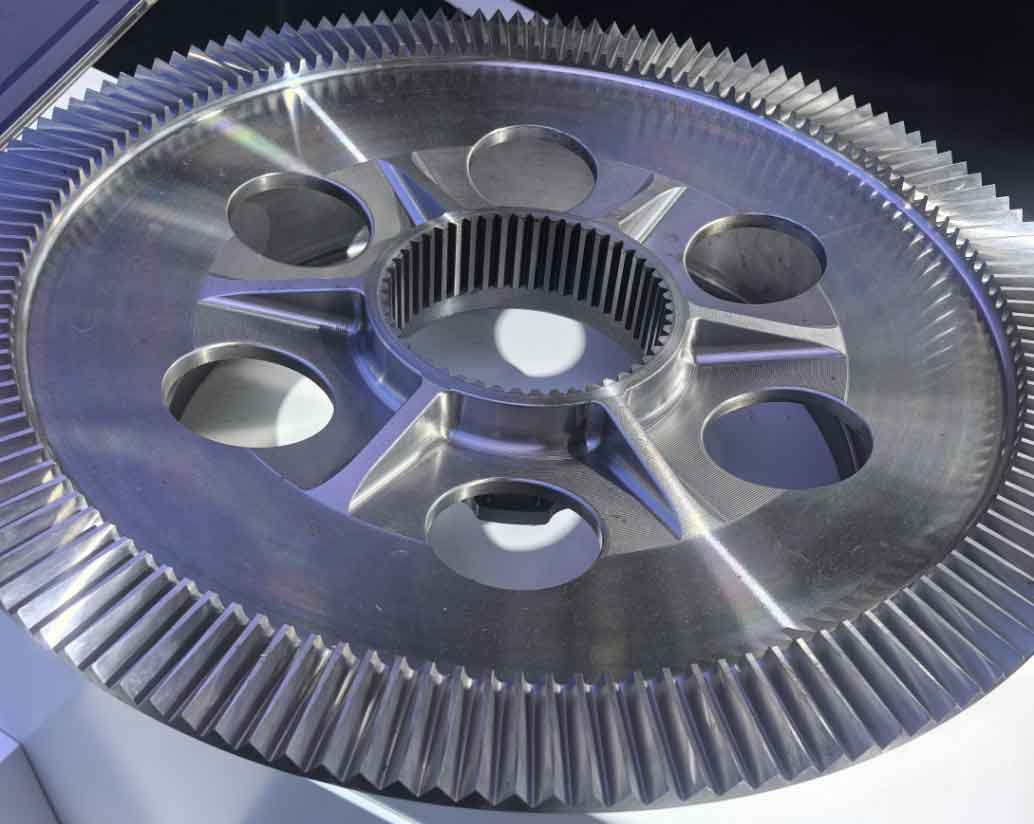
This work presents a breakthrough in face gear manufacturing using skiving methodology—a high-efficiency continuous generating process adapted from cylindrical gear production. We establish a comprehensive mathematical framework for cutting angle dynamics and force prediction, validated through multi-physics simulations that optimize gear technology performance.
Kinematic Model of Skiving Process
Skiving operates on crossed-axis gear principles where tool-workpiece dynamics follow coordinate transformations. Define spatial frames: $S_p(O_p-X_pY_pZ_p)$ (workpiece-fixed), $S_o(O_o-X_oY_oZ_o)$ (tool-fixed), $S_s$ (tool-rotating), $S_2$ (workpiece-rotating). Transformation matrices govern position vectors:
$$ \begin{bmatrix} X_s \\ Y_s \\ Z_s \\ 1 \end{bmatrix} = \mathbf{M_{s2}} \begin{bmatrix} X_2 \\ Y_2 \\ Z_2 \\ 1 \end{bmatrix} $$
where $\mathbf{M_{s2}} = \mathbf{M_{so}} \cdot \mathbf{M_{oq}} \cdot \mathbf{M_{qp}} \cdot \mathbf{M_{p2}}$ with sub-matrices:
| Transformation | Matrix |
|---|---|
| $\mathbf{M_{so}}$ | $\begin{bmatrix} \cos\phi_s & -\sin\phi_s & 0 & 0 \\ \sin\phi_s & \cos\phi_s & 0 & 0 \\ 0 & 0 & 1 & 0 \\ 0 & 0 & 0 & 1 \end{bmatrix}$ |
| $\mathbf{M_{oq}}$ | $\begin{bmatrix} \cos\Sigma & 0 & -\sin\Sigma & 0 \\ 0 & 1 & 0 & 0 \\ \sin\Sigma & 0 & \cos\Sigma & 0 \\ 0 & 0 & 0 & 1 \end{bmatrix}$ |
| $\mathbf{M_{qp}}$ | $\begin{bmatrix} 1 & 0 & 0 & 0 \\ 0 & 0 & -1 & 0 \\ 0 & 1 & 0 & a \\ 0 & 0 & 0 & 1 \end{bmatrix}$ |
Relative cutting velocity at engagement point $M(x,y,z)$ derives from angular velocities $\omega_s$, $\omega_2$ and axial feed $v_{s1}$:
$$ \mathbf{v_{s2}} = \begin{bmatrix} \omega_s y – (\omega_2 z + a\omega_2 \cos\Sigma) – v_{s1}\sin\Sigma \\ -\omega_s x \\ \omega_s x + (\omega_2 z + a\omega_2 \sin\Sigma) + v_{s1}\cos\Sigma \end{bmatrix} $$
Tool Design for Gear Technology Optimization
Skiving cutter geometry combines modified helical gear profiles with optimized rake/flank surfaces. Rake face design prevents negative cutting angles through:
- Primary rake plane inclined at $\beta = 23^\circ$ (helix angle)
- Secondary inclination $\gamma = 3^\circ$ for positive top-edge clearance
- Asymmetric bowl profile with $\beta_1=5^\circ$ (entering edge), $\beta_2=70^\circ$ (exiting edge)
Flank surfaces comprise conical clearance faces and dual-helix flank faces preventing workpiece interference—critical for precision gear technology applications.
Cutting Angle Dynamics
Define tool angles in orthogonal plane $P_o$ containing cutting velocity $\mathbf{V}$. Rake angle $\gamma_0$ and clearance $\alpha_0$ follow vector relations:
$$ \gamma_0 = \arccos\left( \frac{ \mathbf{a_1} \cdot \mathbf{a_2} }{ \|\mathbf{a_1}\| \|\mathbf{a_2}\| } \right) \quad \alpha_0 = \arccos\left( \frac{ \mathbf{a_3} \cdot \mathbf{a_4} }{ \|\mathbf{a_3}\| \|\mathbf{a_4}\| } \right) $$
where $\mathbf{a_1} = -\mathbf{N_s}$, $\mathbf{a_2} = \mathbf{N_o} \times \mathbf{N_q}$, $\mathbf{a_3} = \mathbf{N_o} \times \mathbf{N_h}$, $\mathbf{a_4} = -\mathbf{V}$. Normal vectors derive from:
- Rake face: $\mathbf{N_q} = (-\sin\beta, \tan\gamma, \cos\beta)$
- Cutting plane: $\mathbf{N_s} = \mathbf{V} \times \mathbf{q}$ ($\mathbf{q} = \mathbf{N_q} \times \mathbf{N_h}$)
- Orthogonal plane: $\mathbf{N_o} = \mathbf{N_s} \times \mathbf{V}$
Parameter studies reveal cutting angle evolution during engagement (Table 1):
| Tool Position | Entering Edge $\gamma_0$ | Exiting Edge $\gamma_0$ |
|---|---|---|
| Tooth root | 8.2° → 12.7° | 15.3° → 6.8° |
| Tooth middle | 10.5° → 14.1° | 18.2° → 9.4° |
| Tooth tip | 13.1° → 8.9° | 21.7° → 3.2° |
$\beta$ angles critically influence angle stability—$\beta_1 > 8^\circ$ or $\beta_2 < 65^\circ$ induce negative rake angles, degrading gear technology performance.
Simulation Framework
VERICUT models (Table 2 parameters) validate tooth generation:
| Parameter | Symbol | Value |
|---|---|---|
| Module | $m$ | 5 mm |
| Pressure angle | $\alpha$ | 20° |
| Helix angle | $\beta$ | 23° |
| Shaft angle | $\Sigma$ | 23° |
| Face gear teeth | $N_2$ | 100 |
| Skiving teeth | $N_s$ | 70 |
DEFORM simulations predict cutting forces $F_x, F_y, F_z$ with $\Delta t = 0.01s$. Force evolution shows peak radial load ($F_y$):
$$ F_{y_{avg}} = \frac{1}{n}\sum_{i=80}^{n} F_y(i) \approx 3247 \text{N} $$
Process Parameter Optimization
Gear technology efficiency depends on parameter sensitivity:
Feed rate effect ($v_s$ = 10 r/s):
$$ \begin{bmatrix} f (\text{mm/rev}) \\ F_y (\text{N}) \end{bmatrix} = \begin{bmatrix} 0.05 & 0.10 & 0.15 & 0.20 & 0.25 \\ 1862 & 2249 & 2783 & 3247 & 3715 \end{bmatrix} $$
Linear regression: $F_y = 7400f + 1523$ ($R^2=0.98$)
Rotational speed effect ($f$ = 0.05 mm/rev):
$$ \begin{bmatrix} v_s (\text{r/s}) \\ F_y (\text{N}) \end{bmatrix} = \begin{bmatrix} 10 & 11 & 12 & 13 & 14 \\ 1862 & 1735 & 1628 & 1541 & 1489 \end{bmatrix} $$
Power fit: $F_y = 2127 v_s^{-0.33}$
Conclusions and Gear Technology Outlook
This research establishes skiving as a viable high-efficiency process for face gears, demonstrating:
- Cutting angles remain positive through optimized $\beta_1/\beta_2$ design
- Radial force $F_y$ dominates cutting loads, minimized at $v_s > 12$ r/s
- 0.05mm geometric deviation stems from rake face simplification
Future gear technology developments should address modular cutter designs for cost reduction and hardened material skiving mechanics. This advancement in gear technology enables new applications in aerospace power transmission systems requiring high throughput and precision.