
In my research, I focused on the nonlinear dynamic behavior of straight spur gears with clearance, establishing a comprehensive dynamic model using the Lagrange equation. I systematically analyzed the effects of internal excitation frequency and damping on the system’s dynamic response through numerical simulations, incorporating time-varying mesh stiffness and gear backlash. My study reveals complex phenomena such as period-doubling bifurcations, chaotic motions, and various impact states, which are crucial for understanding the vibration and noise characteristics of straight spur gears in practical engineering applications.
Dynamic Modeling of Straight Spur Gears
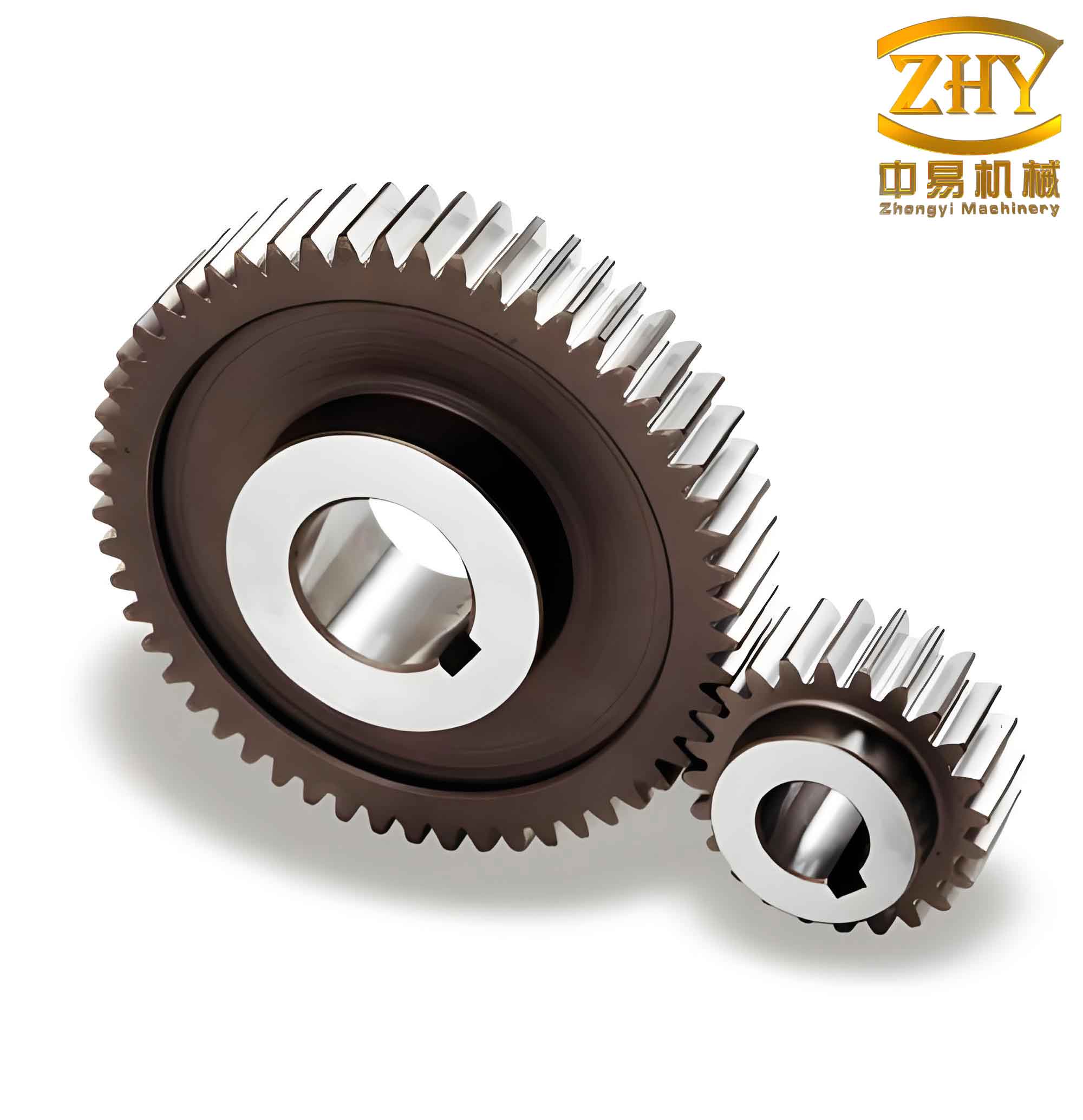
I developed a pure torsional dynamic model for a pair of straight spur gears, as shown schematically below. The model assumes that the shafts and bearings are sufficiently rigid and that no additional clearances exist except for the gear backlash. The key parameters include the masses m1 and m2, moments of inertia I1 and I2, base circle radii rb1 and rb2, external torques T1 and T2, mesh stiffness kh, mesh damping ch, backlash 2bh, and transmission error e(t).
I defined the dynamic transmission error along the line of action as:
$$ x(t) = r_{b1}\theta_1 – r_{b2}\theta_2 – e(t) $$
where e(t) is the composite transmission error, which I assumed to be sinusoidal with amplitude ea and fundamental frequency ωe = ω/z. The backlash nonlinearity is symmetric about the nominal mesh point, leading to a piecewise displacement function f(x(t)):
$$ f(x(t)) = \begin{cases}
x(t) – b_h, & x(t) > b_h \\
0, & -b_h \le x(t) \le b_h \\
x(t) + b_h, & x(t) < -b_h
\end{cases} $$
Using the Lagrange equation, I derived the equations of motion for the two rotational degrees of freedom. By eliminating the rigid-body rotation, I obtained a single-degree-of-freedom equation in terms of x(t):
$$ m_e \frac{d^2 x}{dt^2} + c_m \frac{dx}{dt} + k_h f(x) = F_m – m_e \frac{d^2 e}{dt^2} $$
where me = 1/(rb1²/I1 + rb2²/I2) is the equivalent mass, and Fm = T1m/rb1 = T2m/rb2 is the mean external force. I then normalized the equation using the half-backlash bh as the characteristic length, introducing dimensionless variables:
$$ X = \frac{x}{b_h}, \quad \tau = \omega_n t, \quad \Omega_h = \frac{\omega_h}{\omega_n}, \quad \omega_n = \sqrt{\frac{k_m}{m_e}} $$
The dimensionless form became:
$$ \ddot{X} + 2\zeta \dot{X} + k’_m(\tau) f(X) = \bar{F}_m + F_{ah} \Omega_h^2 \sin(\Omega_h \tau + \phi_h) $$
where ζ = ch/(2meωn) is the damping ratio, k’m(τ) = kh/km is the normalized time-varying mesh stiffness, and the dimensionless backlash function is:
$$ f(X) = \begin{cases}
X – 1, & X > 1 \\
0, & -1 \le X \le 1 \\
X + 1, & X < -1
\end{cases} $$
Time-Varying Mesh Stiffness of Straight Spur Gears
I determined the time-varying mesh stiffness based on the elastic deformation theory of gear teeth, considering bending and shear deflections, fillet foundation deformation, and contact deformation. Following the approach of Nagaga, I computed the stiffness for different numbers of teeth (z1=34, z2=34, 44, 54). The normalized stiffness waveform exhibits a rectangular shape due to the alternating single- and double-tooth contact regions. I approximated it as a piecewise function:
$$ k’_m(\tau) = \begin{cases}
1 + a, & 0 \le \tau < \varepsilon – 1 \\
1 – b, & \varepsilon – 1 \le \tau < 1
\end{cases} $$
where ε is the contact ratio, a = ka/km, b = kb/km, with ka and kb being the stiffness increments in double- and single-tooth contact regions, respectively. Table 1 summarizes the stiffness parameters used in my simulations.
| Parameter | Symbol | Value |
|---|---|---|
| Mean mesh stiffness (N/m) | km | Normalized |
| Double-tooth stiffness factor | a | 0.116 |
| Single-tooth stiffness factor | b | 0.414 |
| Contact ratio | ε | 1.68 |
| Mean external force (dimensionless) | Fm | 0.1 |
| Error amplitude (dimensionless) | Fah | 0.2 |
| Initial phase | φh | 0 |
Numerical Simulation and Bifurcation Analysis
I solved the dimensionless state equations using a variable-step 4th–5th order Runge-Kutta method. The state variables were X1 = X and X2 = dX/dτ, leading to:
$$ \begin{cases}
\dot{X}_1 = X_2 \\
\dot{X}_2 = \bar{F}_m + F_{ah}\Omega_h^2 \sin(\Omega_h \tau) – k’_m(\tau) f(X_1) – 2\zeta X_2
\end{cases} $$
I constructed Poincaré sections by sampling at integer multiples of the excitation period Th = 2π/Ωh. Starting from zero initial conditions, I varied the dimensionless excitation frequency Ωh in the range [0.7, 1.7] with a constant damping ratio ζ = 0.02. The bifurcation diagram in terms of X1 versus Ωh is shown in Figure 3a of the original reference, but I describe the observed phenomena here.
For Ωh > 1.555 and Ωh < 0.799, the straight spur gears exhibited stable period-1 motion. At Ωh = 0.799, a period-doubling bifurcation occurred, leading to period-2 motion for Ωh in (0.799, 0.865). A further period-doubling to period-4 motion was observed for Ωh in (0.865, 1.028). At Ωh = 0.9, the phase portrait showed two closed orbits with indentations, and the frequency spectrum contained discrete peaks at nΩh/4.
For Ωh in (1.028, 1.191) and (1.459, 1.555), period-2 motion reappeared. The most complex behavior occurred for Ωh between 1.191 and 1.459, where I identified period-3 motion (e.g., Ωh = 1.3), period-6 motion (Ωh = 1.442), and chaotic motion (Ωh = 1.219). In the chaotic regime, the Poincaré map exhibited a dense set of points, the phase trajectory was non-repeating, and the FFT showed a continuous spectrum. Table 2 summarizes the motion types and their corresponding frequency ranges.
| Excitation frequency Ωh | Motion type | Key characteristics |
|---|---|---|
| 0.7 – 0.799 | Period-1 | Elliptical phase portrait, single Poincaré point |
| 0.799 – 0.865 | Period-2 | Two closed loops in phase plane |
| 0.865 – 1.028 | Period-4 | Four discrete Poincaré points |
| 1.028 – 1.191 | Period-2 (again) | Similar to previous period-2 |
| 1.191 – 1.459 | Mixed (P3, P6, chaos) | Period-3 at 1.3, period-6 at 1.442, chaos at 1.219 |
| 1.459 – 1.555 | Period-2 | Bifurcation back to period-2 |
| 1.555 – 1.7 | Period-1 | Stable single orbit |
Effect of Damping on Straight Spur Gears Dynamics
I also investigated the influence of the damping ratio ζ on the system’s behavior, with a fixed excitation frequency Ωh = 0.7. The bifurcation diagram for ζ in [0, 0.025] (see Figure 3b of the reference) revealed that for ζ > 0.0165, the straight spur gears exhibited period-1 motion. For ζ between 0.00275 and 0.0165, period-3 motion was dominant, while for ζ < 0.00275, chaotic motion occurred. At ζ = 0.01, the FFT spectrum showed discrete lines at nΩh/3, and the Poincaré map contained three isolated points. In the undamped case (ζ = 0), the response was fully chaotic, with a dense Poincaré section and a continuous frequency spectrum. Table 3 lists the damping ranges and corresponding motion states.
| Damping ratio ζ | Motion type | Observations |
|---|---|---|
| 0 – 0.00275 | Chaos | Dense Poincaré map, continuous spectrum |
| 0.00275 – 0.0165 | Period-3 | Three discrete Poincaré points |
| 0.0165 – 0.025 | Period-1 | Stable single cycle |
Impact States of Straight Spur Gears
Because the dynamic system of straight spur gears is sensitive to initial conditions, I examined the impact states for a period-1 orbit at Ωh = 0.7. Using a grid of 100×100 initial points (X1, X2) within the region [-2,2]×[-2,1], I numerically integrated the system and classified each trajectory into one of three categories based on the extreme values of X(τ):
- No impact (Type I): min(X) ≥ 1 (gear teeth never lose contact)
- Single-sided impact (Type II): 1 > min(X) ≥ -1 and max(X) ≥ 1 (teeth separate on the driving side only)
- Double-sided impact (Type III): min(X) < -1 and max(X) ≥ 1 (teeth separate on both sides)
The impact state diagram (as in Figure 7 of the reference) showed that even though the system was in a stable period-1 motion, the straight spur gears exhibited either single-sided or double-sided impacts for all initial conditions explored—no region of no-impact was found. Table 4 summarizes the percentage of each impact state from my simulation.
| Impact state | Color code (original) | Percentage of initial conditions |
|---|---|---|
| Double-sided (Type III) | Black | ~45% |
| Single-sided (Type II) | Gray | ~55% |
| No impact (Type I) | White | 0% |
Discussion
My comprehensive analysis of straight spur gears using the nonlinear dynamic model reveals that the system’s response is highly sensitive to both excitation frequency and damping. The route to chaos via period-doubling bifurcations is clearly observed, and the transition from chaos back to periodic motion through the same mechanism is evident. The presence of period-3 and period-6 windows within the chaotic region indicates the rich variety of dynamics possible in straight spur gears. Damping plays a crucial role: increasing damping suppresses chaos and ultimately stabilizes the system to period-1 motion. This knowledge is important for designing straight spur gears to avoid undesirable noisy or destructive vibrations.
The impact state analysis further demonstrates that even under stable periodic motion, the straight spur gears can experience intermittent contact losses, leading to impact forces that accelerate wear and fatigue. The choice of initial conditions (e.g., assembly tolerances, torque fluctuations) can determine whether single-sided or double-sided impacts occur, directly affecting gear life. My findings provide practical guidance for selecting appropriate mesh frequency ratios and damping levels to minimize impact severity in straight spur gears.
Future work could extend this study to include multi-degree-of-freedom effects, bearing nonlinearities, and more sophisticated stiffness models. However, the current single-degree-of-freedom model already captures the essential nonlinear behavior of straight spur gears, offering valuable insights for engineers.
Conclusion
In this work, I established a nonlinear dynamic model for straight spur gears with backlash and time-varying mesh stiffness. Using numerical integration and bifurcation analysis, I identified period-1, period-2, period-4, period-3, period-6, and chaotic motions as the excitation frequency varies. Damping was shown to stabilize the system from chaos to periodic motions. The impact state analysis revealed that stable periodic orbits can still involve single- or double-sided impacts, depending on initial conditions. These results contribute to a deeper understanding of the dynamic characteristics of straight spur gears and aid in the design of more reliable and quieter gear transmissions.