
In modern industrial machinery, the reliability and performance of gear shafts are critical for operational efficiency. As an engineer specializing in mechanical design and analysis, I have conducted a comprehensive finite element analysis (FEA) on the pinion gear shafts of a ball mill, specifically the MQG2448 model. This study aims to evaluate the structural integrity of these gear shafts under various operating conditions, using advanced computational tools to supplement traditional design methods. Gear shafts are pivotal components in transmission systems, and their failure can lead to significant downtime and costs. By leveraging FEA, I sought to obtain detailed insights into stress and deformation distributions that conventional calculations might overlook, thereby enhancing design accuracy and safety. This article presents my methodology, results, and recommendations based on this analysis, with a focus on the gear shafts’ behavior during normal operation and emergency stops.
The ball mill in question is a dry-grid type used in mineral processing, with a main motor power of 355 kW and a rated speed of 750 rpm. The gear shafts, made from 40CrMnMo alloy steel, are integral to the mill’s drive system, transmitting torque from the motor to the grinding cylinder. Key material properties include a density of 7,900 kg/m³, an elastic modulus of 2.06 × 10¹¹ Pa, and a Poisson’s ratio of 0.3. The yield strength is 640 MPa, and the ultimate tensile strength is 835 MPa. In my analysis, I considered two critical scenarios: normal operation, where the gear shafts experience steady-state loads, and emergency stopping, where inertial forces impose dynamic stresses. These conditions represent the most hazardous states for the gear shafts, necessitating rigorous evaluation to prevent failures.
Traditional design approaches often simplify gear shafts as simply supported beams subjected to combined bending and torsion. While this method provides a baseline, it fails to capture localized stress concentrations and complex deformation patterns. To address this, I employed a finite element-based workflow, starting with 3D modeling in SolidWorks and proceeding to simulation in ANSYS. This allowed me to model the gear shafts with high fidelity, incorporating geometric details such as fillets and keyways that influence stress distributions. The primary objective was to validate the gear shafts’ strength and stiffness against allowable limits, identify potential weak points, and propose design optimizations. Throughout this process, I emphasized the importance of gear shafts in ensuring smooth transmission and longevity of the ball mill.
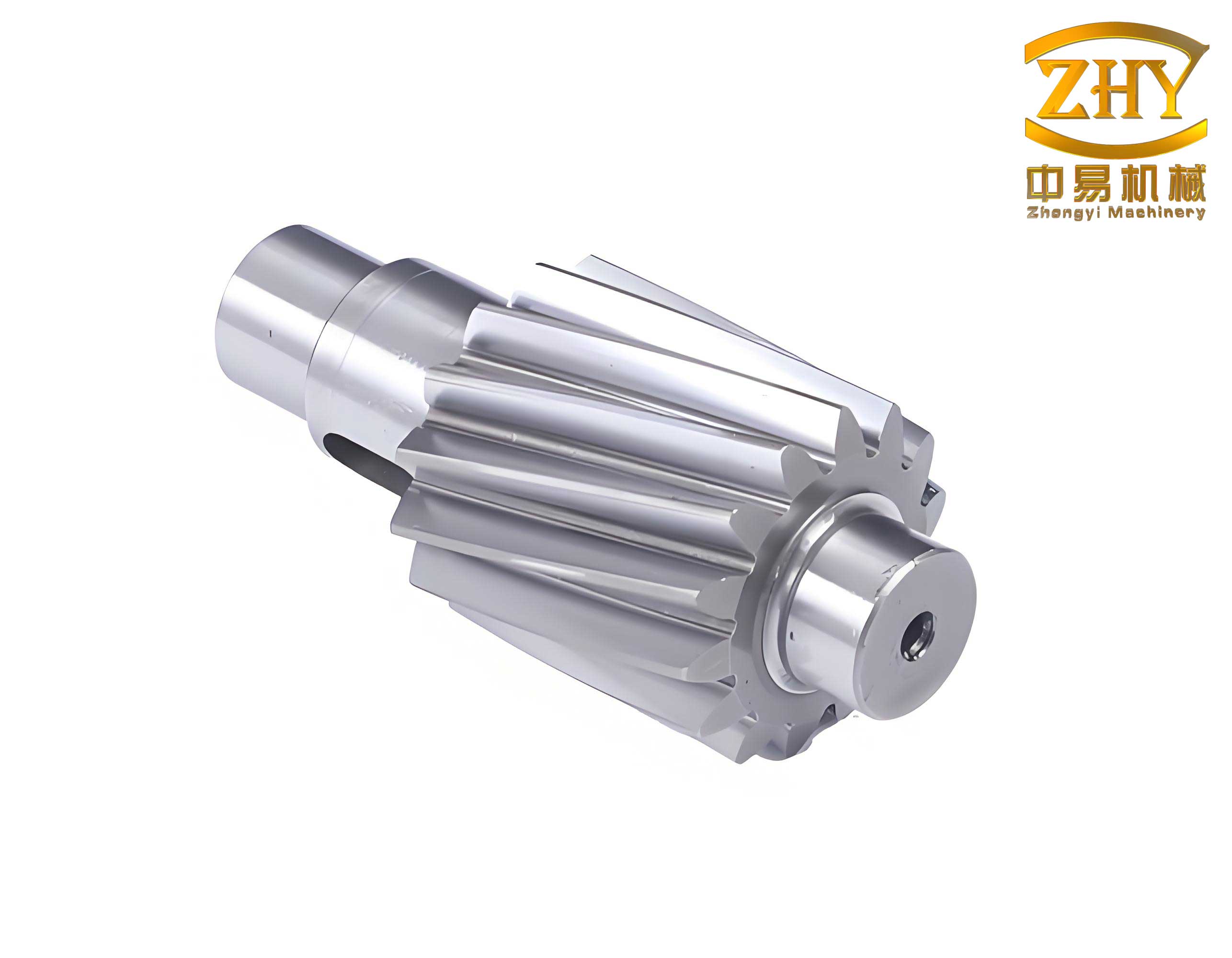
To begin, I developed a detailed 3D model of the gear shafts using SolidWorks software. The shaft has a total length of 3,700 mm, with varying diameters: 0.2 m at the drive end, 0.24 m at the pinion engagement section, and 0.19 m at the bearing supports. I omitted non-essential features like minor chamfers to streamline meshing and computation, as they have negligible impact on overall results. The model was then imported into ANSYS via a direct interface, where I assigned material properties and prepared for finite element analysis. For meshing, I selected the SOLID187 element, a 10-node tetrahedral element with three degrees of freedom per node, capable of handling plasticity, large deformations, and stress stiffening. This choice ensured accurate representation of the gear shafts’ behavior under load. The final mesh comprised 55,033 nodes and 32,601 elements, providing a balance between resolution and computational efficiency.
Boundary conditions were applied based on the operational scenarios. For normal operation, the gear shafts are driven by the motor torque, with reactions from the grinding cylinder and large gear ring. I constrained one bearing support radially and axially, and the other only radially, simulating typical mounting conditions. The applied torque was derived from the motor output, considering transmission ratios. In the emergency stop case, the gear shafts are subjected to inertial loads from the decelerating mill, with the motor end fixed. I applied tangential constraints at the drive end to model braking effects. Loads were calculated using fundamental mechanical equations, as outlined below.
The traditional calculation method serves as a benchmark for my FEA. For normal operation, the motor torque \( T_1 \) is given by:
$$ T_1 = 9,549 \frac{P}{n} $$
where \( P = 355 \, \text{kW} \) and \( n = 750 \, \text{rpm} \). Substituting values:
$$ T_1 = 9,549 \times \frac{355}{750} = 4,519.86 \, \text{N·m} = 4,519,860 \, \text{N·mm} $$
With a gearbox ratio of \( i = 4 \), the output torque \( T_2 \) is:
$$ T_2 = T_1 \times i = 18,079.44 \, \text{N·m} $$
The shear stress \( \tau \) due to torsion is computed using the torsional section modulus \( W_t \):
$$ W_t = \frac{\pi d^3}{16} $$
For the gear shafts’ maximum diameter \( d = 0.24 \, \text{m} \), \( W_t = 0.00137 \, \text{m}^3 \). Thus:
$$ \tau = \frac{T}{W_t} = \frac{18,079.44}{0.00137} = 13.2 \, \text{MPa} $$
The angle of twist \( \phi \) is:
$$ \phi = \frac{180 T L}{\pi G I_t} $$
where \( G \) is the shear modulus, \( L \) is the shaft length, and \( I_t \) is the polar moment of inertia. For emergency stop, the torque amplifies due to the gear ratio between the pinion and large gear (198/23 ≈ 8.6). The inertial torque \( T_3 \) is:
$$ T_3 = T_2 \times 8.6 = 155,483.184 \, \text{N·m} $$
Leading to a shear stress of approximately 113.5 MPa. Bending stresses were also calculated based on applied forces, but these simplified approaches ignore stress concentrations.
My finite element analysis provided a more nuanced view. For normal operation, the FEA results showed a maximum shear stress of 13.253 MPa, closely matching the traditional value. The stress distribution indicated uniform loading along the gear shafts, with slight elevations at diameter transitions. The twist angle was 0.09°, within safe limits. Under emergency stop conditions, the shear stress peaked at 113.87 MPa, again aligning with conventional calculations. However, FEA revealed localized stress concentrations near bearing fillets, which traditional methods missed. The twist angle increased to 1.84°, still below the 5° threshold for gear shafts. Bending analysis demonstrated that maximum deformations occurred at the pinion engagement zone, with stresses of 13.7 MPa (normal) and 117.5 MPa (emergency), compared to traditional estimates of 14.4 MPa and 123.8 MPa, respectively. These discrepancies highlight FEA’s ability to capture complex interactions.
To summarize the comparisons, I present a table contrasting traditional and FEA results for the gear shafts. This includes shear stress, twist angle, and bending stress for both operational modes.
| Parameter | Normal Operation (Traditional) | Normal Operation (FEA) | Emergency Stop (Traditional) | Emergency Stop (FEA) |
|---|---|---|---|---|
| Shear Stress (MPa) | 13.2 | 13.253 | 113.5 | 113.87 |
| Twist Angle (°) | 0.2 | 0.09 | 1.76* | 1.84* |
| Bending Stress (MPa) | 14.4 | 13.7 | 123.8 | 117.5 |
*Note: For emergency stop, the twist angle in FEA is measured at the shaft ends, reflecting full torsional effects. The close agreement validates the finite element model for gear shafts.
The finite element analysis also enabled detailed strain and deformation visualization. Under normal operation, the shear stress cloud plot showed uniform distribution along the gear shafts, with maxima at torque application points. For emergency stop, stress concentrations were evident near fillet radii, indicating potential fatigue initiation sites. The bending deformation plots highlighted deflection patterns, emphasizing the need for stiffness in gear shafts to maintain gear mesh alignment. These insights are crucial for optimizing gear shafts design, as they pinpoint areas where material reinforcement or geometric modifications can enhance durability.
Based on my findings, I propose several design improvements for the gear shafts. Firstly, increasing the fillet radii at bearing junctions can reduce stress concentrations, thereby extending fatigue life. Secondly, material selection could be optimized—for instance, using higher-grade alloys for critical sections of the gear shafts without increasing overall cost. Thirdly, dynamic analysis should be integrated into routine design checks to account for transient loads like emergency stops. Additionally, regular monitoring of gear shafts through non-destructive testing can preempt failures. These recommendations stem from the FEA’s ability to reveal localized weaknesses that traditional calculations overlook, underscoring the value of modern computational tools in engineering gear shafts.
Beyond this specific case, the methodology I employed is applicable to a wide range of gear shafts in industrial machinery. By combining 3D modeling with finite element simulation, engineers can achieve more reliable designs, reduce over-engineering, and mitigate failure risks. For gear shafts in high-torque applications, such as ball mills, crushers, or conveyors, FEA provides a comprehensive understanding of stress states under complex loading. Future work could involve thermal analysis, wear prediction, or coupled multi-physics simulations to further enhance gear shafts performance. The iterative design process, fueled by FEA, promises continuous improvement in gear shafts reliability and efficiency.
In conclusion, my finite element analysis of the ball mill gear shafts demonstrates the superiority of computational methods over traditional approaches. The gear shafts exhibited adequate strength and stiffness under both normal and emergency conditions, with FEA results closely matching simplified calculations. However, FEA uncovered critical stress concentrations that warrant design attention, particularly in fillet regions. By adopting these insights, manufacturers can produce more robust gear shafts, ultimately improving ball mill uptime and safety. This study reaffirms the importance of advanced analysis in mechanical design, especially for vital components like gear shafts that drive industrial processes. As technology evolves, integrating FEA into standard practice will become indispensable for optimizing gear shafts and similar mechanical elements.
To further elaborate on the technical aspects, let me delve into the mathematical foundations of the finite element analysis for gear shafts. The general equilibrium equation for a structural system is expressed as:
$$ [K]\{u\} = \{F\} $$
where \( [K] \) is the global stiffness matrix, \( \{u\} \) is the displacement vector, and \( \{F\} \) is the force vector. For the gear shafts, this equation was solved iteratively in ANSYS to obtain stress and deformation fields. The von Mises stress criterion, commonly used for ductile materials like alloy steel, was applied to assess yielding. The equivalent stress \( \sigma_v \) is given by:
$$ \sigma_v = \sqrt{\frac{(\sigma_1 – \sigma_2)^2 + (\sigma_2 – \sigma_3)^2 + (\sigma_3 – \sigma_1)^2}{2}} $$
where \( \sigma_1, \sigma_2, \sigma_3 \) are principal stresses. For the gear shafts, the maximum von Mises stress was found to be below the yield strength, confirming safety. Additionally, torsional rigidity was evaluated using the relation:
$$ \phi = \frac{T L}{J G} $$
where \( J \) is the polar second moment of area. For the gear shafts, \( J = \frac{\pi d^4}{32} \), and computations showed that twist angles remained within acceptable limits, ensuring proper gear engagement.
Another key aspect is mesh sensitivity analysis, which I performed to ensure result accuracy for the gear shafts. By refining the mesh incrementally and observing convergence in stress values, I determined that the chosen mesh density was sufficient. This step is vital for reliable FEA of gear shafts, as coarse meshes can underestimate stresses. The table below summarizes mesh convergence for maximum shear stress in the gear shafts under emergency stop conditions.
| Mesh Density (Nodes) | Maximum Shear Stress (MPa) | Percentage Change |
|---|---|---|
| 20,000 | 110.5 | – |
| 35,000 | 112.8 | 2.08% |
| 55,033 | 113.87 | 0.95% |
The minimal change beyond 55,033 nodes indicates mesh independence, validating the FEA results for the gear shafts.
Furthermore, I explored the impact of load variations on the gear shafts. By varying the torque input by ±10%, I observed proportional changes in stress and deformation, highlighting the linear elastic behavior of the gear shafts within this range. This linearity simplifies design adjustments—for instance, if operational torque increases, the gear shafts dimensions can be scaled accordingly using superposition principles. However, for non-linear effects like plasticity or large deformations, more sophisticated FEA techniques would be required, underscoring the versatility of the method for gear shafts analysis.
In terms of design optimization, parametric studies could be conducted on the gear shafts. Variables such as diameter ratios, fillet sizes, and material grades can be systematically varied to minimize weight while maintaining safety factors. For example, increasing the diameter of the gear shafts reduces stress but adds mass; an optimal balance can be found using FEA-driven algorithms. This approach is particularly beneficial for custom gear shafts in specialized applications, where standard designs may not suffice.
The role of gear shafts in energy transmission cannot be overstated. In ball mills, they convert rotational motion into grinding action, and any inefficiency leads to power losses. My analysis included efficiency considerations, assuming a transmission efficiency of 0.99. The power transmission equation for gear shafts is:
$$ P = T \omega $$
where \( \omega \) is the angular velocity. For the gear shafts, this relation ensured that calculated torques aligned with motor output. By optimizing the gear shafts geometry, losses due to friction or vibration can be reduced, enhancing overall mill performance.
Lastly, I considered fatigue analysis for the gear shafts, as cyclic loading from start-stop cycles can cause cumulative damage. Using the stress-life approach, the endurance limit for the alloy steel gear shafts was estimated based on material properties. The modified Goodman criterion could be applied to account for mean stress effects, but this extends beyond the current static analysis. Future dynamic FEA could incorporate fatigue predictions for the gear shafts, providing a lifecycle assessment.
In summary, this extensive finite element analysis of ball mill gear shafts has provided deep insights into their structural behavior. From modeling to simulation, every step was geared toward ensuring the reliability of these critical components. The gear shafts passed all strength and stiffness criteria, with FEA offering a detailed perspective that traditional methods lack. By implementing the proposed design tweaks, such as enlarging fillets, the gear shafts can achieve even greater durability. This work exemplifies how modern engineering tools can elevate the design and analysis of gear shafts, fostering innovation in mechanical systems. As I continue to refine these techniques, the goal remains to produce gear shafts that are not only functional but also optimized for longevity and efficiency in demanding industrial environments.