
In our gear manufacturing operations, we consistently encounter the economic challenges associated with producing small batches of bevel gears. Specifically, when customers request custom bevel gears that must be machined from solid material without pre-processing, traditional dedicated machinery often proves inefficient. To address this, we have adopted advanced grinding technologies, notably utilizing specialized grinding wheels, to achieve cost-effective deep grinding for small batch bevel gear production. This approach has significantly enhanced our productivity and economic viability.
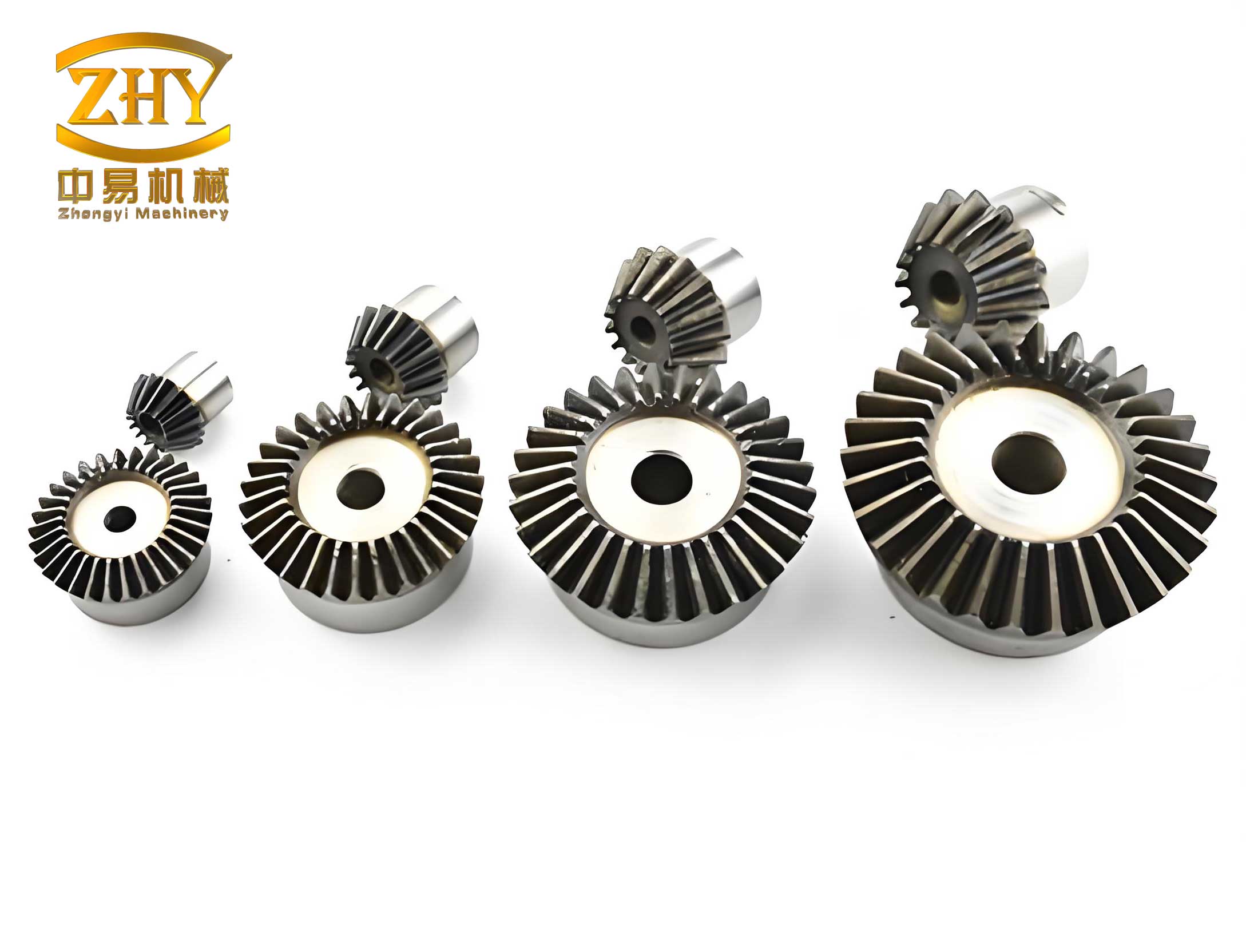
The core of our strategy lies in implementing deep grinding processes for bevel gears, which allows for complete machining from solid blanks in a single setup. This is particularly advantageous for batches ranging from 1 to 200 pieces, where investing in dedicated milling tools is not economically justifiable. By integrating deep grinding, we can perform both pre-grinding and final finishing operations, thereby streamlining the entire manufacturing chain for bevel gears. Our process begins with the machining of bevel gear blanks, followed by heat treatment, and culminates in precision grinding on specialized bevel gear grinding machines. The use of advanced grinding wheels has been pivotal in reducing setup times and extending tool life, which directly translates to lower production costs for small batch bevel gears.
From a technical perspective, deep grinding of bevel gears involves high material removal rates while maintaining stringent quality standards. The key parameters include immersion feed rates, spindle speeds, and cutting velocities, which we optimize to minimize wear and maximize efficiency. For instance, the cutting velocity \( v_c \) in grinding can be expressed as:
$$ v_c = \frac{\pi \times d \times n}{1000} $$
where \( v_c \) is the cutting speed in m/min, \( d \) is the grinding wheel diameter in mm, and \( n \) is the spindle speed in rpm. This formula is critical for setting optimal conditions during bevel gear grinding. Additionally, the depth of cut \( a_e \) and feed per tooth \( f_z \) influence the surface finish and tool life. We often use the following relationship to balance these factors:
$$ Q_w = a_e \times f_z \times v_c $$
where \( Q_w \) represents the material removal rate in mm³/min. By optimizing these parameters, we achieve efficient deep grinding for bevel gears with minimal thermal damage and high precision.
To illustrate the effectiveness of our approach, we conducted comparative trials using different grinding wheels for bevel gear production. The table below summarizes the performance data from these trials, focusing on key metrics such as immersion feed rate, spindle speed, and grinding time. This comparison highlights the advantages of using ceramic-bonded grinding wheels over conventional diamond wheels for small batch bevel gear machining.
| Parameter | Competitor’s Diamond Grinding Wheel | Ceramic-Bonded Grinding Wheel (Cubitron 11 Type) |
|---|---|---|
| Immersion Feed Rate [mm/min] | 15 | 80 |
| Spindle Speed [°/s] | 5 | 3 |
| Cutting Speed [m/min] | 25 | 27 |
| Adjustment Value [mm] | 1.005 | 0.5 |
| Number of Bevel Gear Flutes Machined per Setup | 3 | 26 (initial setup only) |
| Adjustment Feed Rate [mm/min] | 300 | 400 |
| Grinding Time [min:s] | 45:00 | 17:00 |
| Workpiece Material | 16MnCr5 (used on a G27 type bevel gear grinding machine) | |
The data clearly shows that the ceramic-bonded grinding wheel enables significantly higher immersion feed rates and reduces grinding time by over 60%, which is crucial for economic small batch bevel gear production. Moreover, the number of bevel gear flutes machined per setup increases dramatically, reducing the frequency of adjustments and enhancing overall equipment effectiveness. This aligns with our goal of minimizing non-productive time in bevel gear manufacturing.
Further optimization of the deep grinding process for bevel gears involves precise control over pre-grinding geometry. We ensure that the tooth root profile of the bevel gear is accurately formed during pre-grinding, and the grinding wheel maintains stability at the top. This minimizes burr formation, which otherwise requires additional deburring steps. The grinding wheel composition must also avoid excessive loading on dressing rollers and prevent sparking during operation. We achieve this by using grinding wheels with precision-shaped grain structures, which provide sharp cutting edges and efficient heat dissipation through chip evacuation. The wear resistance of these wheels is described by the following empirical formula for tool life \( T \):
$$ T = C \times v_c^{-k} \times a_e^{-m} $$
where \( C \), \( k \), and \( m \) are constants dependent on the grinding wheel material and workpiece properties. For bevel gear grinding, we typically observe \( k \approx 1.5 \) and \( m \approx 0.8 \) for ceramic-bonded wheels, indicating superior longevity compared to diamond wheels.
In practice, the deep grinding sequence for bevel gears starts with immersing the workpiece into the grinding wheel at a controlled feed rate. We often increase the immersion feed by 5 to 8 times, up to 80 mm/min, until the entire bevel gear profile is engaged. The rolling feed during grinding is set at approximately 3° per second, ensuring uniform material removal across the convex and concave sides of the bevel gear teeth. This process is repeated for multiple bevel gears in a batch, with consistent results. The surface roughness achieved after pre-grinding is critical for final quality; we typically obtain values around 28 μm for the tooth root and 17 μm for the tooth flank, leaving adequate allowance for finish grinding. The final grinding step on the same machine further refines these values to meet quality standards of Grade 7 or better for bevel gears.
To quantify the economic benefits, we analyze the cost per bevel gear produced using deep grinding. The total cost \( C_{total} \) can be modeled as:
$$ C_{total} = C_{machine} + C_{tool} + C_{labor} + C_{material} $$
where \( C_{machine} \) is the machine hour rate, \( C_{tool} \) is the grinding wheel cost per piece, \( C_{labor} \) is the operator cost, and \( C_{material} \) is the raw material cost. For small batch bevel gear production, \( C_{tool} \) and \( C_{machine} \) are dominant factors. By extending grinding wheel life and reducing grinding time, we lower \( C_{tool} \) and \( C_{machine} \). For instance, if a grinding wheel costs $500 and lasts for 100 bevel gears, the tool cost per bevel gear is $5. With optimization, we can increase wheel life to 150 bevel gears, reducing the cost to $3.33 per bevel gear. Similarly, reducing grinding time from 45 minutes to 17 minutes per bevel gear cuts machine time by over 60%, significantly lowering \( C_{machine} \). These savings are substantial for small batches, where fixed costs are spread over fewer units.
Another aspect of our optimization involves adaptive control systems for bevel gear grinding. We monitor real-time parameters such as spindle power and acoustic emissions to adjust feed rates dynamically. This prevents overloading and ensures consistent quality across all bevel gears in a batch. The adaptive control algorithm can be expressed as:
$$ f_{adjusted} = f_{nominal} \times \left(1 – \alpha \times \frac{P – P_{target}}{P_{target}}\right) $$
where \( f_{adjusted} \) is the adjusted feed rate, \( f_{nominal} \) is the nominal feed rate, \( P \) is the measured spindle power, \( P_{target} \) is the target power, and \( \alpha \) is a damping coefficient. This approach minimizes tool wear and maintains precision in bevel gear tooth geometry.
We also emphasize the importance of coolant selection in deep grinding of bevel gears. Proper coolant application reduces thermal stress and improves surface integrity. We use synthetic coolants with high lubricity, which can be modeled for heat dissipation efficiency \( \eta \) as:
$$ \eta = \frac{q_{coolant}}{q_{total}} \times 100\% $$
where \( q_{coolant} \) is the heat removed by coolant and \( q_{total} \) is the total heat generated during grinding. For bevel gear grinding, we aim for \( \eta > 70\% \) to prevent micro-cracks and hardening issues.
In terms of quality assurance, we perform post-grinding inspections on bevel gears using coordinate measuring machines (CMMs) and gear analyzers. Key metrics include tooth profile deviation, pitch error, and surface roughness. We often apply statistical process control (SPC) charts to monitor these parameters over multiple batches of bevel gears. For example, the control limits for surface roughness \( R_a \) are calculated as:
$$ UCL = \bar{R_a} + 3\sigma, \quad LCL = \bar{R_a} – 3\sigma $$
where \( \bar{R_a} \) is the mean roughness and \( \sigma \) is the standard deviation. This ensures that all bevel gears meet customer specifications consistently.
The versatility of deep grinding for bevel gears extends to various materials, including alloy steels, stainless steels, and even hardened alloys. We have successfully machined bevel gears from materials like 42CrMo4 and 100Cr6, adapting grinding parameters accordingly. The table below summarizes recommended parameters for different materials in small batch bevel gear production.
| Material | Recommended Cutting Speed \( v_c \) [m/min] | Feed per Tooth \( f_z \) [mm] | Depth of Cut \( a_e \) [mm] |
|---|---|---|---|
| 16MnCr5 | 25-30 | 0.05-0.10 | 0.2-0.5 |
| 42CrMo4 | 20-25 | 0.04-0.08 | 0.1-0.3 |
| 100Cr6 | 15-20 | 0.03-0.06 | 0.1-0.2 |
| Stainless Steel (304) | 18-22 | 0.04-0.07 | 0.2-0.4 |
These parameters are fine-tuned based on batch size and bevel gear geometry. For instance, smaller bevel gears with module less than 3 mm require lower depths of cut to avoid deflection, while larger bevel gears can tolerate more aggressive settings.
Looking ahead, we are exploring additive manufacturing integration for bevel gear blanks, which could further reduce material waste and lead times for small batches. By combining 3D-printed near-net-shape blanks with deep grinding, we aim to achieve even greater economies. The potential cost savings can be estimated using a hybrid model:
$$ C_{hybrid} = C_{AM} + C_{grinding} $$
where \( C_{AM} \) is the additive manufacturing cost per blank and \( C_{grinding} \) is the deep grinding cost. Preliminary analyses suggest that for batches under 50 bevel gears, this approach may reduce total cost by 20-30% compared to traditional machining from solid billets.
In conclusion, our experience demonstrates that economic small batch bevel gear manufacturing is achievable through optimized deep grinding processes. By leveraging advanced grinding wheels, adaptive controls, and rigorous process monitoring, we have reduced costs, improved quality, and enhanced flexibility. The key lies in minimizing setup times, extending tool life, and maintaining precision across all bevel gears produced. As demand for customized bevel gears grows, such strategies will become increasingly vital for competitive manufacturing. We continue to refine our methods, exploring new technologies and materials to push the boundaries of bevel gear production efficiency.
To summarize the technical insights, we present a comprehensive formula for overall equipment effectiveness (OEE) in bevel gear grinding, which integrates availability, performance, and quality:
$$ OEE = A \times P \times Q $$
where \( A \) is availability (ratio of operating time to planned production time), \( P \) is performance (ratio of actual output to maximum output), and \( Q \) is quality (ratio of good bevel gears to total bevel gears produced). Through deep grinding optimization, we have achieved OEE values exceeding 85% for small batch bevel gear production, a significant improvement over conventional methods. This holistic approach ensures that every aspect of the manufacturing process contributes to economic viability and customer satisfaction for bevel gears.