
In the modern manufacturing landscape, the demand for high-precision, small-module gears is continuously rising, driven by advancements in industrial automation and precision engineering. High-speed gear shaping machines, which are specialized equipment for producing such gears, face increasing pressure to enhance both productivity and accuracy. The core component of these machines, the hydrostatic spindle, plays a pivotal role in determining overall performance. Traditional spindles often suffer from issues like dry friction and seizure under high-stroke conditions, limiting their efficiency. Hydrostatic spindles, known for their high stiffness, stability, low friction, and minimal wear, offer a promising solution. However, even with hydrostatic systems, challenges such as local friction and wear persist during continuous high-speed stroking operations in gear shaping. This study aims to address these challenges by investigating the influence of axial groove structures on the performance of hydrostatic spindles in high-speed gear shaping applications. Through theoretical analysis, numerical simulation, and experimental validation, we explore how axial grooves affect key parameters like oil film load capacity, stiffness, viscous resistance, thermal effects, and sleeve deformation. Our findings provide insights for optimizing spindle design to improve the reliability and efficiency of gear shaping processes.
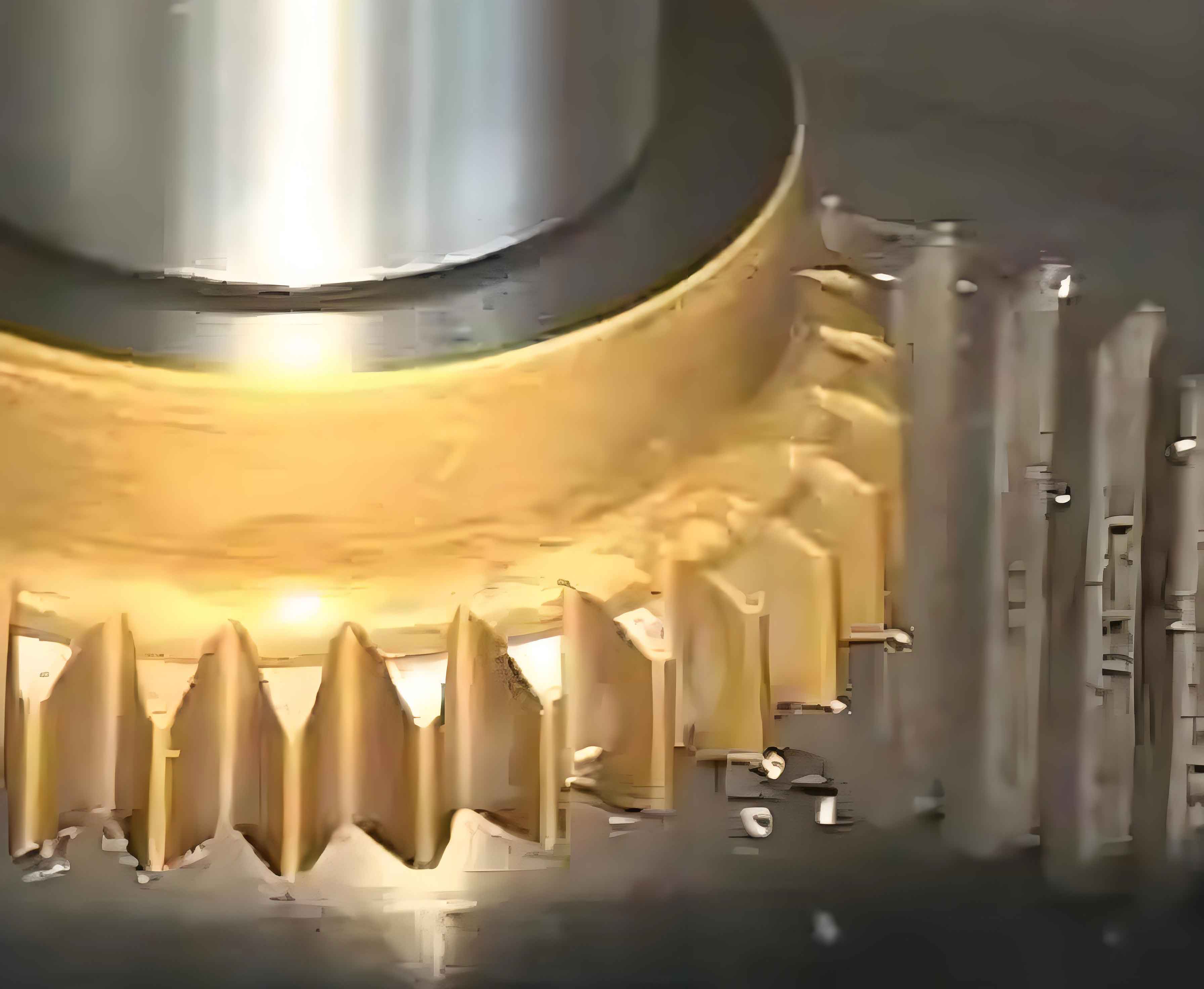
The performance of a hydrostatic spindle in gear shaping is fundamentally governed by tribological and hydrodynamic principles. The spindle operates under a combination of high-speed reciprocating stroking motion and slow rotational movement, but for analysis purposes, the slow rotation can often be neglected, simplifying the system to a high-speed cylindrical hydrostatic guide. Under cutting loads, the spindle shaft experiences radial forces, leading to eccentric displacement between the shaft and sleeve. This results in uneven oil film thickness, with pressurized regions generating opposing support forces to prevent direct contact. The pressure distribution in the oil film is critical for load-bearing capacity. Based on hydrodynamic theory, the pressure in a hydrostatic bearing can be expressed as:
$$p = \frac{p_s}{1 + \lambda_0 (h/h_0)^3}$$
where \(p_s\) is the supply pressure, \(h_0\) is the initial oil film thickness, \(h\) is the minimum oil film thickness, and \(\lambda_0\) is the initial fluid resistance ratio. The eccentricity ratio \(\epsilon\) is defined as:
$$\epsilon = \frac{e}{h_0} = 1 – \frac{h}{h_0}$$
Here, \(e\) represents the relative displacement between the shaft and sleeve under radial load. The load capacity \(F\) of the oil film is then:
$$F = p A_e = \frac{p_s A_e}{1 + \lambda_0 (h/h_0)^3} = \frac{p_s A_e}{1 + \lambda_0 (1 – \epsilon)^3}$$
where \(A_e\) is the effective bearing area of the oil cavity. The oil film stiffness \(j\), a measure of resistance to deformation under load, is derived as:
$$j = \frac{\partial F}{-\partial h} = \frac{p_s A_e (3 \lambda_0 (1 – \epsilon)^2)}{h_0 (1 + \lambda_0 (1 – \epsilon)^3)^2}$$
As eccentricity increases, the minimum oil film thickness decreases, causing fluctuations in stiffness. In gear shaping operations, the primary motion resistance arises from viscous drag due to the high-speed stroking. The viscous force \(F_n\) can be approximated by:
$$F_n = \mu A_F \frac{v}{h} + \mu A_Y \frac{v}{H}$$
where \(\mu\) is the oil viscosity, \(A_F\) is the area of the sealing land, \(A_Y\) is the area of the oil cavity, \(v\) is the oil flow velocity, and \(H\) is the depth of the oil cavity. The average linear velocity \(V\) of the spindle is related to the stroking frequency \(n\) (in strokes per minute) and stroke length \(L\) (0.05 m in our case) by:
$$V = \frac{2 L n}{60}$$
For this study, we focus on a typical gear shaping condition with an average unilateral velocity of 2 m/s. These equations form the theoretical foundation for analyzing spindle performance, particularly in the context of gear shaping where high speeds and loads are common.
To investigate the effects of axial grooves, we developed finite element models for the hydrostatic spindle oil film, both with and without axial grooves. The models simulate the fluid behavior under actual operating conditions, using parameters representative of high-speed gear shaping machines. Key model parameters are summarized in Table 1 below, which includes dimensions, fluid properties, and operational settings. The spindle shaft diameter is 90 mm, with an initial oil film thickness of 0.02 mm. The oil cavities have axial and circumferential dimensions of 100 mm and 51 mm, respectively, with sealing lands of 10 mm axially and 19 mm circumferentially. The oil cavity spans an angle of 60 degrees, and the cavity depth is 2 mm. The lubricant used has a density of 880 kg/m³, a viscosity of 0.045 Pa·s, a specific heat capacity of 1884 J/(kg·K), and a thermal conductivity of 0.132 W/(m·K). The supply pressure is set at 2 MPa, and the outlet is defined as a pressure outlet. These parameters ensure the models closely replicate real-world gear shaping scenarios.
| Parameter / Unit | Value |
|---|---|
| Shaft diameter \(d\) / mm | 90 |
| Initial oil film thickness \(h_0\) / mm | 0.02 |
| Oil cavity axial length \(L\) / mm | 100 |
| Axial sealing land length \(l\) / mm | 10 |
| Oil density \(\rho\) / kg/m³ | 880 |
| Oil specific heat capacity \(C\) / J/(kg·K) | 1884 |
| Oil cavity circumferential width \(B\) / mm | 51 |
| Circumferential sealing land width \(b\) / mm | 19 |
| Oil cavity angle \(\theta\) / degrees | 60 |
| Oil cavity depth \(H\) / mm | 2 |
| Oil viscosity \(\mu\) / Pa·s | 0.045 |
| Thermal conductivity \(K\) / W/(m·K) | 0.132 |
The simulation models account for eccentricity ratios ranging from 0 to 0.5, representing varying radial loads during gear shaping. We performed steady-state simulations to evaluate load capacity, stiffness, and viscous forces, and transient simulations to analyze temperature changes over multiple stroking cycles. Additionally, fluid-structure coupling models were established to assess sleeve deformation under pressure. The axial groove, when present, is integrated into the circumferential sealing land to enhance oil flow and pressure distribution. This approach allows for a comprehensive comparison of spindle performance with and without grooves, directly relevant to improving gear shaping machine efficiency.
The results from our simulations reveal significant differences in performance due to the axial groove structure. For load capacity, as shown in Figure 1 (simulated data), the oil film with an axial groove consistently outperforms the groove-less design. At low eccentricity (\(\epsilon = 0.1\)), the grooved configuration provides approximately 1.5 times the load capacity of the non-grooved one. As eccentricity increases to 0.5, this advantage moderates to about 1.3 times. This enhancement stems from the groove’s ability to concentrate pressure within the oil cavity, reducing pressure dissipation across the sealing lands. In gear shaping, where intermittent radial loads are common, this increased load capacity ensures better support during cutting operations, reducing the risk of deflection and improving gear accuracy. The pressure distribution patterns confirm that without grooves, pressure spreads into the sealing lands, whereas grooves localize it effectively, optimizing the bearing effect.
Oil film stiffness, however, shows a different trend. Stiffness decreases with increasing eccentricity for both configurations, but the non-grooved design maintains higher stiffness values across all eccentricities. At \(\epsilon = 0.1\), the stiffness difference is most pronounced, with the grooved design being about 20% lower. This suggests that while grooves boost load capacity, they may slightly compromise rigidity under light loads. Nevertheless, in high-load gear shaping scenarios (\(\epsilon > 0.3\)), the difference diminishes, making grooves favorable for overall performance. The stiffness behavior can be summarized by the derived formula, where higher eccentricity reduces the denominator term, leading to lower stiffness. This trade-off between load capacity and stiffness is crucial for spindle design in gear shaping, where both parameters affect machining precision and stability.
Viscous resistance, a key factor in energy consumption and heat generation during high-speed stroking, is also influenced by axial grooves. The viscous shear force distribution indicates that grooves reduce the effective area of the sealing lands, thereby lowering overall viscous drag. At a velocity of 2 m/s, the grooved design shows about 15% less viscous resistance compared to the non-grooved design. This reduction is beneficial for gear shaping machines, as it minimizes power losses and reduces thermal input. Flow monitoring at the sealing lands reveals that grooves promote more uniform oil flow, particularly on the side opposite the stroking direction. This improves lubrication and prevents oil starvation, a common issue in high-speed reciprocating systems like gear shaping. The flow rate data, extracted from simulation planes, is summarized in Table 2, highlighting the flow disparities between grooved and non-grooved configurations.
| Configuration | Flow Rate at Stroking-Side Land (mm³/s) | Flow Rate at Opposite-Side Land (mm³/s) | Total Flow Rate (mm³/s) |
|---|---|---|---|
| Without Axial Groove | 850 | 320 | 1170 |
| With Axial Groove | 920 | 450 | 1370 |
Thermal effects are critical in high-speed gear shaping, as viscous heating can lead to temperature rise, affecting oil viscosity and spindle accuracy. Transient simulations over ten stroking cycles show that the grooved design maintains a more stable average oil film temperature around 28°C, with minor fluctuations. In contrast, the non-grooved design exhibits a gradual temperature increase, reaching up to 32°C after ten cycles. This stability is attributed to the groove’s role in enhancing oil circulation and heat dissipation. The temperature distribution maps indicate that hotspots occur primarily on the sealing lands, especially on the side opposite the stroking direction. Grooves reduce these hotspots by facilitating oil movement, thereby mitigating thermal accumulation. For gear shaping operations involving prolonged high-speed stroking, this thermal management is essential to prevent thermal distortion and maintain consistent machining quality.
Sleeve deformation under load is another vital aspect, as excessive deformation can lead to oil film thinning and lubrication failure. Fluid-structure coupling simulations demonstrate that the axial groove alters the deformation pattern. Without grooves, maximum deformation occurs at the circumferential sealing lands at low eccentricity, shifting to the oil cavity center at high eccentricity. With grooves, deformation is consistently concentrated at the oil cavity center. Quantitatively, at low eccentricity (\(\epsilon < 0.3\)), the non-grooved sleeve experiences up to 40% more deformation than the grooved one. At high eccentricity (\(\epsilon > 0.3\)), the grooved sleeve shows about 15% more deformation. This indicates that grooves are advantageous under light loads but may slightly increase deformation under heavy loads. However, the overall deformation levels remain within acceptable limits for gear shaping applications. The deformation data for various eccentricities are presented in Table 3, providing a clear comparison.
| Eccentricity \(\epsilon\) | Without Axial Groove | With Axial Groove |
|---|---|---|
| 0.1 | 12.5 | 7.5 |
| 0.2 | 14.0 | 10.0 |
| 0.3 | 15.0 | 13.0 |
| 0.4 | 16.0 | 17.5 |
| 0.5 | 17.0 | 19.5 |
Beyond the presence of grooves, their shape also impacts spindle performance. We investigated four groove shapes—rectangular, circular, triangular, and trapezoidal—with equal projected areas. The load capacity variations are minimal, with rectangular grooves performing best at high eccentricity and triangular grooves at low eccentricity. For stiffness, the influence is more pronounced at specific eccentricities. At \(\epsilon = 0.1\), triangular grooves yield the highest stiffness, about 10% above circular grooves. At \(\epsilon = 0.3\), trapezoidal grooves lead, while at \(\epsilon = 0.5\), rectangular grooves are superior. These findings suggest that groove shape optimization can be tailored to specific gear shaping conditions, such as expected load ranges. The stiffness data are summarized in Table 4, highlighting the shape-dependent effects.
| Groove Shape | \(\epsilon = 0.1\) | \(\epsilon = 0.3\) | \(\epsilon = 0.5\) |
|---|---|---|---|
| Rectangular | 185 | 165 | 150 |
| Circular | 170 | 160 | 145 |
| Triangular | 190 | 155 | 140 |
| Trapezoidal | 180 | 170 | 148 |
To validate our simulation models, we compared results with experimental data from a cylindrical hydrostatic guide test platform, analogous to the spindle in gear shaping. The experimental setup involved a load of 150 kg, measuring vertical stiffness. Our simulation-derived stiffness value was 163.4 N/µm, closely matching the experimental measurement of 160 N/µm and theoretical calculation of 166.4 N/µm. The error is within 2%, confirming the accuracy of our finite element approach. This validation strengthens the credibility of our findings for gear shaping applications, where precise spindle behavior is paramount.
In conclusion, the integration of axial grooves into hydrostatic spindles for high-speed gear shaping machines offers substantial benefits. Grooves enhance load capacity by up to 1.5 times, reduce viscous resistance, stabilize thermal conditions, and improve oil flow distribution. While stiffness may slightly decrease under light loads, the overall performance gains in terms of load support and thermal management are significant. The shape of the groove further allows for customization based on operational eccentricity ranges. These insights provide a foundation for optimizing spindle design, ultimately contributing to higher efficiency, accuracy, and longevity in gear shaping processes. Future work could explore dynamic effects, such as the interplay between stroking and rotational motions, and investigate advanced groove geometries or materials to further push the boundaries of gear shaping technology.
The implications of this study extend beyond gear shaping to other high-precision machining applications where hydrostatic spindles are employed. By understanding the role of axial grooves, engineers can design more robust and efficient systems, reducing downtime and maintenance costs. As the demand for precision gears continues to grow, advancements in spindle technology will play a crucial role in meeting industry needs. We hope this research encourages further exploration into hydrodynamic optimizations, driving innovation in manufacturing and solidifying the importance of gear shaping in modern industrial ecosystems.