
In the field of precision machinery and robotics, the RV reducer plays a crucial role due to its compact design, high torque capacity, and excellent durability. As a key component in industrial robots, machine tools, and medical equipment, the RV reducer combines cycloidal pin gear and planetary gear transmission mechanisms to achieve high reduction ratios with minimal backlash. In this paper, I will delve into the structural analysis and 3D modeling design of the RV reducer, focusing on its transmission principles, component parameters, and assembly processes. By utilizing formulas and tables, I aim to provide a comprehensive understanding that aids in the digital modeling and further research of RV reducer dynamics and error analysis.
The RV reducer is a novel transmission device developed from traditional cycloidal pin gear and planetary gear systems. It typically consists of a two-stage reduction: the first stage involves a planetary gear train, and the second stage employs a cycloidal drive. This design allows the RV reducer to offer advantages such as high rigidity, shock resistance, and longevity, making it preferable over harmonic drives in many heavy-duty applications. The increasing demand for precision in automation has driven the need for in-depth study of RV reducer components, including their geometric parameters and assembly techniques. Through 3D modeling and simulation, we can optimize the design and manufacturing processes, ultimately enhancing the performance of RV reducers in various industries.
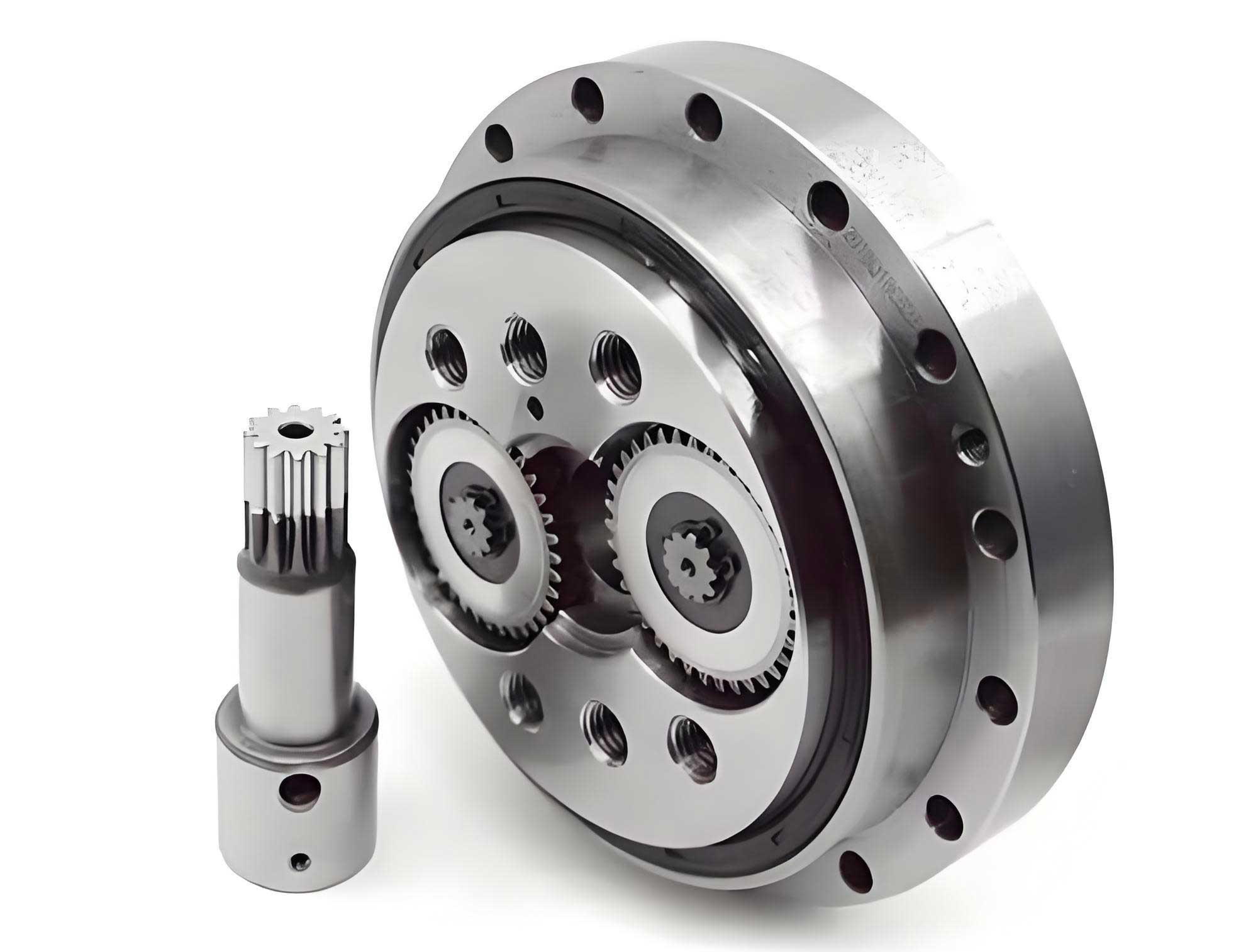
The transmission principle of the RV reducer is based on a combination of planetary and cycloidal motions. As shown in the figure, the input shaft drives a sun gear (center wheel), which engages with multiple planetary gears evenly distributed around it. These planetary gears are fixed to crankshafts that rotate and cause the cycloidal gears (RV gears) to orbit. The cycloidal gears then mesh with pin teeth fixed in a housing, resulting in a reduced output rotation. To analyze this, I apply the general method for planetary gear trains by imposing a reverse rotation equal to the output speed. For the first stage, the sun gear and planetary gears form a fixed-axis gear train, with the transmission ratio given by:
$$ i_{612} = \frac{n_1 – n_6}{n_2 – n_6} = -\frac{z_2}{z_1} $$
where \( n_1 \) is the speed of the sun gear, \( n_2 \) is the speed of the planetary gear, \( n_6 \) is the speed of the output wheel (which acts as the planet carrier), \( z_1 \) is the number of teeth on the sun gear, and \( z_2 \) is the number of teeth on the planetary gear. The negative sign indicates opposite rotation directions. For the second stage, involving the cycloidal gear and pin teeth, I impose a reverse speed equal to the planetary gear speed to fix the crankshaft axes. The transmission ratio between the cycloidal gear and the pin housing is:
$$ i_{647} = \frac{n_4 – n_2}{n_7 – n_2} = -\frac{z_7}{z_4} $$
Here, \( n_4 \) is the speed of the cycloidal gear, \( n_7 \) is the speed of the pin housing (which is stationary, so \( n_7 = 0 \)), \( z_4 \) is the number of teeth on the cycloidal gear, and \( z_7 \) is the number of teeth on the pin housing. Typically, the RV reducer is designed with a tooth difference of one, i.e., \( z_4 = z_7 – 1 \), leading to:
$$ n_6 = n_4 = \frac{n_2}{1 – z_7} $$
By substituting this into the first equation, the overall transmission ratio of the RV reducer can be derived as:
$$ i_{16} = \frac{n_1}{n_6} = 1 + \frac{z_2}{z_1} \cdot z_7 $$
This formula highlights the high reduction capability of the RV reducer, which is essential for applications requiring precise motion control. To better understand the parameters involved, Table 1 summarizes the key variables and their descriptions in the transmission analysis of the RV reducer.
| Symbol | Description | Typical Values or Units |
|---|---|---|
| \( n_1 \) | Speed of sun gear (input) | RPM (revolutions per minute) |
| \( n_2 \) | Speed of planetary gear | RPM |
| \( n_4 \) | Speed of cycloidal gear | RPM |
| \( n_6 \) | Speed of output wheel | RPM |
| \( n_7 \) | Speed of pin housing | 0 (stationary) |
| \( z_1 \) | Number of teeth on sun gear | e.g., 20-30 |
| \( z_2 \) | Number of teeth on planetary gear | e.g., 40-50 |
| \( z_4 \) | Number of teeth on cycloidal gear | e.g., 39 (if \( z_7 = 40 \)) |
| \( z_7 \) | Number of teeth on pin housing | e.g., 40-50 |
| \( i_{16} \) | Overall transmission ratio | Typically 30-200 |
The main components of the RV reducer include the sun gear, planetary gears, crankshafts, cycloidal gears, pin housing, and output wheel. Each part must be precisely designed to ensure efficient power transmission and minimal wear. The sun gear is usually an involute gear mounted on the input shaft, while the planetary gears are attached to crankshafts and distributed symmetrically to balance radial forces. The crankshaft is a critical element that connects the planetary gear to the cycloidal gears; it has eccentric sections to drive the cycloidal motion. The cycloidal gears, often referred to as RV gears, are the core of the RV reducer, with tooth profiles generated from cycloidal curves. Two identical cycloidal gears are typically used, offset by 180° to cancel out radial forces. The pin housing contains fixed pin teeth that engage with the cycloidal gears, and the output wheel serves as the planet carrier in the planetary stage. Table 2 lists the primary components and their functions in the RV reducer assembly.
| Component | Function | Key Design Features |
|---|---|---|
| Sun Gear | Transmits input motion to planetary gears | Involute tooth profile, often integrated with input shaft |
| Planetary Gears | Engage with sun gear and drive crankshafts | Multiple gears (2-3) for load distribution |
| Crankshaft | Converts planetary rotation to cycloidal motion | Eccentric sections for offset, bearings for support |
| Cycloidal Gears (RV Gears) | Mesh with pin teeth to reduce speed | Cycloidal tooth profile, two gears for balance |
| Pin Housing | Houses fixed pin teeth for cycloidal engagement | Precision-machined holes for pin placement |
| Output Wheel | Acts as planet carrier and provides output rotation | Connected to crankshafts and support bearings |
| Bearings and Fasteners | Support and secure components | Standard parts like roller bearings, bolts, nuts |
The cycloidal gear’s tooth profile is defined by a parametric equation that ensures smooth engagement with the pin teeth. The standard parametric equations for the cycloidal gear in an RV reducer are given by:
$$ X = (r_p – r_{rp} s^{-1/2}) \cos[(1 – i^H) \phi] – \frac{a}{r_p} (r_p – z_p r_{rp} s^{-1/2}) \cos(i^H \phi) $$
$$ Y = (r_p – r_{rp} s^{-1/2}) \sin[(1 – i^H) \phi] – \frac{a}{r_p} (r_p – z_p r_{rp} s^{-1/2}) \sin(i^H \phi) $$
$$ s = 1 + k^2 – 2k \cos \phi $$
where \( X \) and \( Y \) are the coordinates of the tooth profile, \( r_p \) is the radius of the pin center circle, \( r_{rp} \) is the radius of the pin circle, \( s \) is the amplitude coefficient, \( i^H \) is the relative transmission ratio between the cycloidal gear and pin wheel (\( i^H = z_p / z_c \), with \( z_p \) as the number of pin teeth and \( z_c \) as the number of cycloidal gear teeth), \( a \) is the eccentricity between the cycloidal gear and pin wheel, \( \phi \) is the meshing phase angle, and \( k \) is the shortening coefficient (\( k = a z_p / r_p \)). These parameters must be carefully calculated to achieve optimal performance in the RV reducer. Table 3 explains each symbol in the cycloidal gear parametric equations, which is essential for accurate 3D modeling.
| Symbol | Description | Role in Tooth Profile Generation |
|---|---|---|
| \( X, Y \) | Coordinates of cycloidal tooth profile | Define the shape of each tooth for meshing |
| \( r_p \) | Radius of pin center circle | Determines the distribution circle for pin teeth |
| \( r_{rp} \) | Radius of pin circle | Affects the clearance and contact stress |
| \( s \) | Amplitude coefficient | Influences the curvature of the cycloid |
| \( i^H \) | Relative transmission ratio | Relates to the speed reduction in cycloidal stage |
| \( \phi \) | Meshing phase angle | Parameter that varies to generate the entire profile |
| \( a \) | Eccentricity | Key for creating the cycloidal motion path |
| \( k \) | Shortening coefficient | Adjusts the profile for reduced sliding friction |
| \( z_p \) | Number of pin teeth | Usually one more than cycloidal gear teeth |
| \( z_c \) | Number of cycloidal gear teeth | Designed based on reduction ratio requirements |
For 3D modeling of the RV reducer, I use parametric design approaches in CAD software like SolidWorks. The process begins with defining basic parameters such as module, number of teeth, pressure angle, and gear width for the involute gears (sun and planetary gears). The cycloidal gear requires generating the tooth profile using the parametric equations above. By inputting the equations into the software, I can create a sketch of the tooth轮廓 and then use mirroring and patterning to form the complete gear. Similarly, the crankshaft can be modeled with simple extrude and revolve features, considering the eccentric sections for cycloidal gear mounting. To ensure accuracy, I often create parameter tables that link dimensions, allowing easy modifications for different RV reducer specifications. Table 4 outlines the steps for parameterized 3D modeling of key RV reducer components.
| Step | Component | Modeling Technique | Key Parameters |
|---|---|---|---|
| 1 | Sun Gear | Involute gear generation via equations or toolbox | Module \( m \), teeth \( z_1 \), pressure angle \( \alpha \) |
| 2 | Planetary Gears | Similar to sun gear, with multiple instances | Teeth \( z_2 \), same module as sun gear |
| 3 | Crankshaft | Extrude and revolve with eccentric offsets | Eccentricity \( a \), bearing seat diameters |
| 4 | Cycloidal Gears | Parametric curve from equations, then extrude | \( r_p \), \( r_{rp} \), \( a \), \( z_c \), \( \phi \) range |
| 5 | Pin Housing | Sketch pin circles on eccentric circle, extrude pins | Pin diameter, number of pins \( z_p \), \( r_p \) |
| 6 | Output Wheel | Revolve for basic shape, add holes for crankshafts | Bore diameter, flange thickness |
| 7 | Bearings and Fasteners | Import from standard parts library | Bearing type (e.g., roller), bolt size |
Assembly of the RV reducer is performed in a bottom-up manner, starting with sub-assemblies and then combining them into a complete unit. First, I assemble the pin housing with pin teeth using coaxial and coincident constraints. Next, the crankshaft sub-assembly is created by mounting bearings onto the crankshaft sections, ensuring proper alignment for the cycloidal gears. The input support sub-assembly includes the planet carrier (input flange) and bearings, while the output sub-assembly consists of the output flange and seals. Then, I import these sub-assemblies into a main assembly file, beginning with the input support as a reference. The crankshaft sub-assemblies are added, followed by the cycloidal gears, which are mated to the crankshaft eccentric sections. The pin housing sub-assembly is then positioned to engage the cycloidal gears, and finally, the output sub-assembly is attached. Throughout this process, constraints such as concentric and distance mates are applied to simulate real-world assembly conditions. Table 5 summarizes the sub-assemblies and their constraints in the RV reducer assembly process.
| Sub-Assembly | Components Included | Key Constraints Applied |
|---|---|---|
| Pin Housing Assembly | Pin housing, pin teeth | Coaxial (pins to holes), coincident (end faces) |
| Crankshaft Assembly | Crankshaft, bearings (4 per shaft) | Coaxial (bearings to shafts), coincident (shoulders) |
| Input Support Assembly | Planet carrier, bearings, seals | Coaxial for bearing seats, coincident for flanges |
| Output Assembly | Output flange, bearings, seals | Similar to input support, with output shaft alignment |
| Cycloidal Gear Placement | Two cycloidal gears on crankshafts | Coaxial to eccentric sections, angular offset of 180° |
| Main Assembly | All sub-assemblies, bolts, nuts | Multiple concentric and coincident mates for integration |
To enhance the analysis, I incorporate formulas for evaluating the performance of the RV reducer. For instance, the contact ratio between the cycloidal gear and pin teeth can be approximated using the following equation, which affects the smoothness of operation:
$$ \varepsilon = \frac{z_p}{2\pi} \sqrt{ \left( \frac{r_p}{a} \right)^2 – 1 } $$
where \( \varepsilon \) is the contact ratio. A higher contact ratio generally indicates better load distribution and reduced noise in the RV reducer. Additionally, the torque capacity of the RV reducer can be estimated based on the material properties and geometry. The maximum transmitted torque \( T_{max} \) is given by:
$$ T_{max} = \frac{\sigma_b \cdot J \cdot z_c}{K \cdot r_p} $$
Here, \( \sigma_b \) is the allowable bending stress of the cycloidal gear material, \( J \) is the polar moment of inertia of the gear cross-section, \( z_c \) is the number of cycloidal gear teeth, \( K \) is a safety factor, and \( r_p \) is the pin center circle radius. These formulas are useful for optimizing the design of the RV reducer for specific applications. Table 6 provides a summary of performance-related formulas for the RV reducer.
| Parameter | Formula | Description |
|---|---|---|
| Contact Ratio \( \varepsilon \) | \( \varepsilon = \frac{z_p}{2\pi} \sqrt{ \left( \frac{r_p}{a} \right)^2 – 1 } \) | Indicates number of teeth in contact during meshing |
| Max Torque \( T_{max} \) | \( T_{max} = \frac{\sigma_b \cdot J \cdot z_c}{K \cdot r_p} \) | Estimates torque capacity based on gear strength |
| Bending Stress \( \sigma_b \) | \( \sigma_b = \frac{F_t \cdot m}{b \cdot Y} \) | Calculates stress from tangential force \( F_t \), module \( m \), face width \( b \), form factor \( Y \) |
| Efficiency \( \eta \) | \( \eta = \frac{1}{1 + \mu \cdot \frac{z_p}{z_c}} \) | Approximate efficiency considering friction coefficient \( \mu \) |
| Critical Speed \( n_c \) | \( n_c = \frac{60}{2\pi} \sqrt{ \frac{k}{m} } \) | For vibration analysis, with stiffness \( k \) and mass \( m \) |
In conclusion, the RV reducer is a complex yet highly efficient transmission device that requires meticulous design and assembly. Through structural analysis, I have detailed the transmission principles, key components, and parametric equations for the cycloidal gear. The 3D modeling and assembly processes, supported by tables and formulas, provide a digital foundation for further research into transmission errors and dynamics under rated conditions. By repeatedly emphasizing the term RV reducer throughout this discussion, I underscore its importance in advanced robotics and machinery. The integration of CAD modeling allows for virtual testing and optimization, ultimately contributing to the development of more reliable and high-performance RV reducers for industrial applications. Future work may involve finite element analysis for stress distribution and dynamic simulation for life prediction, all building on the digital models established here.