
In the design of herringbone gear transmissions, the gap width (also known as the relief groove or chip pocket) is critical for ensuring proper clearance for the hob during cutting. Many existing standards provide only approximate values based on module and helix angle, ignoring important factors such as hob diameter, hob length, and the possibility of shifting the hob along its axis (hob shifting). Through rigorous analysis and computational simulation, we have developed a precise method to determine the minimum required gap width for herringbone gears. This article presents the calculation methodology, the derived practical data tables, and the usage instructions based on our work.
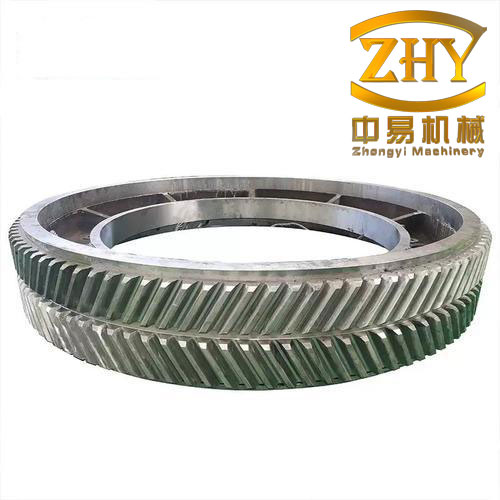
Our study focuses on two typical cutting scenarios: (1) the inner end face of a single helical gear (half of the herringbone gear) is tangent to the outer cylindrical surface of the hob, and (2) the inner end face intersects the exit end face of the hob. The actual minimum gap width is determined by the more critical of these two cases. Furthermore, we consider the effect of hob shifting — a common practice to evenly distribute wear and extend tool life. By optimizing the position of the cutting node on the hob, the required gap width can be significantly reduced, which is particularly beneficial for large-module herringbone gears where weight saving is important.
Calculation Method and Procedure
The geometry of the cutting process is described using two coordinate systems: a fixed gear coordinate system \(O-\xi\eta\) and a moving hob coordinate system \(O’-\xi’\eta’\). The hob installation angle \(\Sigma\) equals the sum (or difference) of the gear helix angle \(\beta\) and the hob lead angle \(\lambda\), depending on the helix directions. The equations for the inner end face circle of the single helical gear and the hob outer cylindrical surface are formulated. The point of tangency or intersection is found by solving a system of nonlinear transcendental equations:
$$
\begin{cases}
f_1(x,y,z) = 0 \\
f_2(x,y,z) = 0 \\
f_3(x,y,z) = 0
\end{cases}
$$
where \(f_1\) represents the gear end face circle, \(f_2\) the hob cylinder, and \(f_3\) the relationship between the two coordinate systems. Newton’s iteration method is employed to obtain the numerical solution. The minimum gap width \(W\) is then computed from the coordinates of the critical point.
Additionally, to ensure complete tooth cutting, a sufficient length of the hob exit end must be provided. This minimum length \(L_{\text{min}}\) is derived by finding the intersection of the hob addendum line with the meshing line. The calculation also incorporates a small safety margin.
Based on this method, we programmed a computer algorithm and performed extensive calculations for a wide range of gear and hob parameters. The hobs considered include both integral (solid) hobs complying with standard JB 2495-78 and inserted-blade hobs from reference literature. Tables 1 through 4 below present the minimum gap widths for herringbone gears under two conditions: with the cutting node at the hob midpoint (no hob shift), and with maximum permissible hob shift.
| Module \(m_n\) (mm) | Number of Teeth \(z\) | Helix Angle \(\beta\) (°) | Gap Width \(W\) (mm) |
|---|---|---|---|
| 2 | 20 | 15 | 10.46 |
| 2 | 40 | 15 | 11.03 |
| 3 | 30 | 20 | 14.07 |
| 4 | 25 | 25 | 18.32 |
| 5 | 40 | 20 | 22.15 |
| 6 | 50 | 15 | 26.78 |
| 8 | 60 | 10 | 34.90 |
| 10 | 80 | 12 | 42.56 |
| Module \(m_n\) (mm) | Number of Teeth \(z\) | Helix Angle \(\beta\) (°) | Gap Width \(W\) (mm) |
|---|---|---|---|
| 2.5 | 20 | 18 | 12.38 |
| 3 | 30 | 22 | 15.72 |
| 4 | 35 | 25 | 19.54 |
| 5 | 40 | 20 | 23.87 |
| 6 | 50 | 16 | 28.41 |
| 8 | 60 | 14 | 36.12 |
| 10 | 80 | 10 | 44.68 |
When hob shifting is applied, the cutting node moves closer to the exit end of the hob, which reduces the required gap. The maximum allowable shift is limited by the need to maintain complete tooth cutting. Tables 3 and 4 provide the minimum gap widths under maximum hob shift conditions for integral and inserted-blade hobs, respectively.
| Module \(m_n\) (mm) | Number of Teeth \(z\) | Helix Angle \(\beta\) (°) | Gap Width \(W\) (mm) |
|---|---|---|---|
| 2 | 20 | 15 | 8.12 |
| 2 | 40 | 15 | 8.70 |
| 3 | 30 | 20 | 11.46 |
| 4 | 25 | 25 | 15.08 |
| 5 | 40 | 20 | 18.75 |
| 6 | 50 | 15 | 22.93 |
| 8 | 60 | 10 | 30.26 |
| 10 | 80 | 12 | 37.40 |
| Module \(m_n\) (mm) | Number of Teeth \(z\) | Helix Angle \(\beta\) (°) | Gap Width \(W\) (mm) |
|---|---|---|---|
| 2.5 | 20 | 18 | 9.84 |
| 3 | 30 | 22 | 12.67 |
| 4 | 35 | 25 | 15.93 |
| 5 | 40 | 20 | 19.71 |
| 6 | 50 | 16 | 23.60 |
| 8 | 60 | 14 | 30.55 |
| 10 | 80 | 10 | 38.02 |
In addition to the gap width, the minimum required length of the hob exit end \(L_{\text{min}}\) must be considered to ensure complete tooth cutting. Table 5 gives typical values of \(L_{\text{min}}\) for different modules and helix angles, including a safety margin of approximately 2 mm.
| Module \(m_n\) (mm) | Helix Angle \(\beta\) (°) | \(L_{\text{min}}\) (mm) |
|---|---|---|
| 2 | 15 | 12.5 |
| 3 | 20 | 16.8 |
| 4 | 25 | 21.4 |
| 5 | 20 | 25.9 |
| 6 | 15 | 30.2 |
| 8 | 10 | 38.7 |
| 10 | 12 | 47.1 |
Usage Instructions
The tables above are calculated for standard involute gears with normal tooth proportions. For herringbone gears with double-circular-arc tooth profiles (e.g., double-arc gears), the cutting depth is usually smaller than that of involute gears, while the hob dimensions are similar. Therefore, the gap widths from the tables can be safely applied to double-circular-arc herringbone gears, with a slight additional margin.
When selecting a gap width, first determine the hob type (integral or inserted-blade) and whether hob shifting will be used. If maximum weight reduction is desired and the machine allows hob shifting, the values from Tables 3 and 4 should be used. For standard designs without hob shift, Tables 1 and 2 provide adequate dimensions. The minimum hob exit length \(L_{\text{min}}\) from Table 5 must be checked to ensure the hob can fully cut the tooth profile without interference.
In practice, the gap width for a herringbone gear should not be smaller than the values listed, as this may cause incomplete tooth cutting or excessive hob wear. Conversely, making the gap larger than necessary increases the axial space and adds weight. The presented tables offer an optimal balance between manufacturability and compact design.
Conclusion
Through systematic calculation and data analysis, we have established practical tables for the minimum gap width of herringbone gears machined with both integral and inserted-blade hobs. The effect of hob shifting is quantified, showing that significant reductions in gap width are achievable, especially for large modules. The application of these tables in the design of a large rolling mill double-arc herringbone gear (outer diameter ~600 mm, normal module 8 mm) resulted in a gap width of only 30 mm instead of the previously recommended 50 mm, saving approximately 1 ton of gear weight. This demonstrates the practical value of the refined calculation method.
We recommend that designers of herringbone gear transmissions adopt the data provided in this article, combined with the consideration of hob shifting, to achieve more compact and lightweight gear designs without compromising cutting quality.