
The relentless pursuit of higher power density, improved efficiency, and reduced carbon footprint in modern mechanical systems places immense importance on the performance of core transmission components like gears. Among these, hyperboloidal gears offer significant advantages for compact, high-ratio power transmission due to their crossed-axis configuration and the ability to achieve large speed reductions in a single stage. However, the complex topological geometry of their tooth flanks, essential for achieving favorable contact conditions under load, presents substantial challenges for accurate performance modeling. In particular, the detailed analysis of friction losses and meshing efficiency for high-reduction hyperboloidal gears remains a complex task, hindered by the coupled nature of geometric design, contact mechanics, and tribological conditions at the highly curved and sliding interface.
This work focuses on addressing this gap by developing an integrated analytical framework for the friction power loss analysis of high-reduction hyperboloidal gears. The core of the methodology lies in seamlessly connecting geometric generation, Loaded Tooth Contact Analysis (LTCA), and mixed Elasto-Hydrodynamic Lubrication (mEHL) models through a differential element approach along the contact lines.
Geometric Modeling and Ease-off Topology
The foundation of any accurate contact analysis is a precise mathematical model of the tooth surfaces. For hyperboloidal gears, we employ a dual generation philosophy based on the equi-tangent conjugate principle. This method constructs the pinion tooth surface as the envelope of a virtual crown gear (cutter) that is conjugate to both the gear and the desired pinion, ensuring theoretical point contact after ease-off modification.
The coordinate systems for this generation are established as shown in the derivations. The transformation from the pinion coordinate system \(S_1(O_1-x_1y_1z_1)\) to the fixed assembly system \(S_f\) is given by:
$$
\mathbf{M}_{1f} = \begin{bmatrix}
1 & 0 & 0 \\
0 & \sin\phi_1 & \cos\phi_1 \\
0 & -\cos\phi_1 & \sin\phi_1
\end{bmatrix}
$$
The meshing condition between the pinion and the generating crown gear, which governs the contact on the theoretical conjugate surface \(\mathbf{r}_c^1\), is expressed as:
$$
U \cos\phi_g – V \sin\phi_g = W
$$
where \(U\), \(V\), and \(W\) are functions of the cutter geometry, machine settings, and the speed ratio \(m_{g1} = \omega_1 / \omega_g = z_2 / z_1\). Solving this equation for the cradle angle \(\phi_g\) and applying the series of coordinate transformations \(\mathbf{M}_{1m}\) yields the theoretical conjugate pinion surface \(\mathbf{r}_c^1(u, \theta, \phi_g)\).
The actual pinion surface \(\mathbf{r}^1(u_1, \theta_1)\) is manufactured with modified machine settings to introduce a controlled ease-off topography, ensuring localized contact and favorable load distribution. The ease-off surface, representing the intentional deviation between the theoretical conjugate surface and the actual manufactured surface, is defined at each point on the gear flank as the normal distance:
$$
z_d(u_2, \theta_2) = (\mathbf{r}_c^1 – \mathbf{r}^1) \cdot \mathbf{n}_c^1
$$
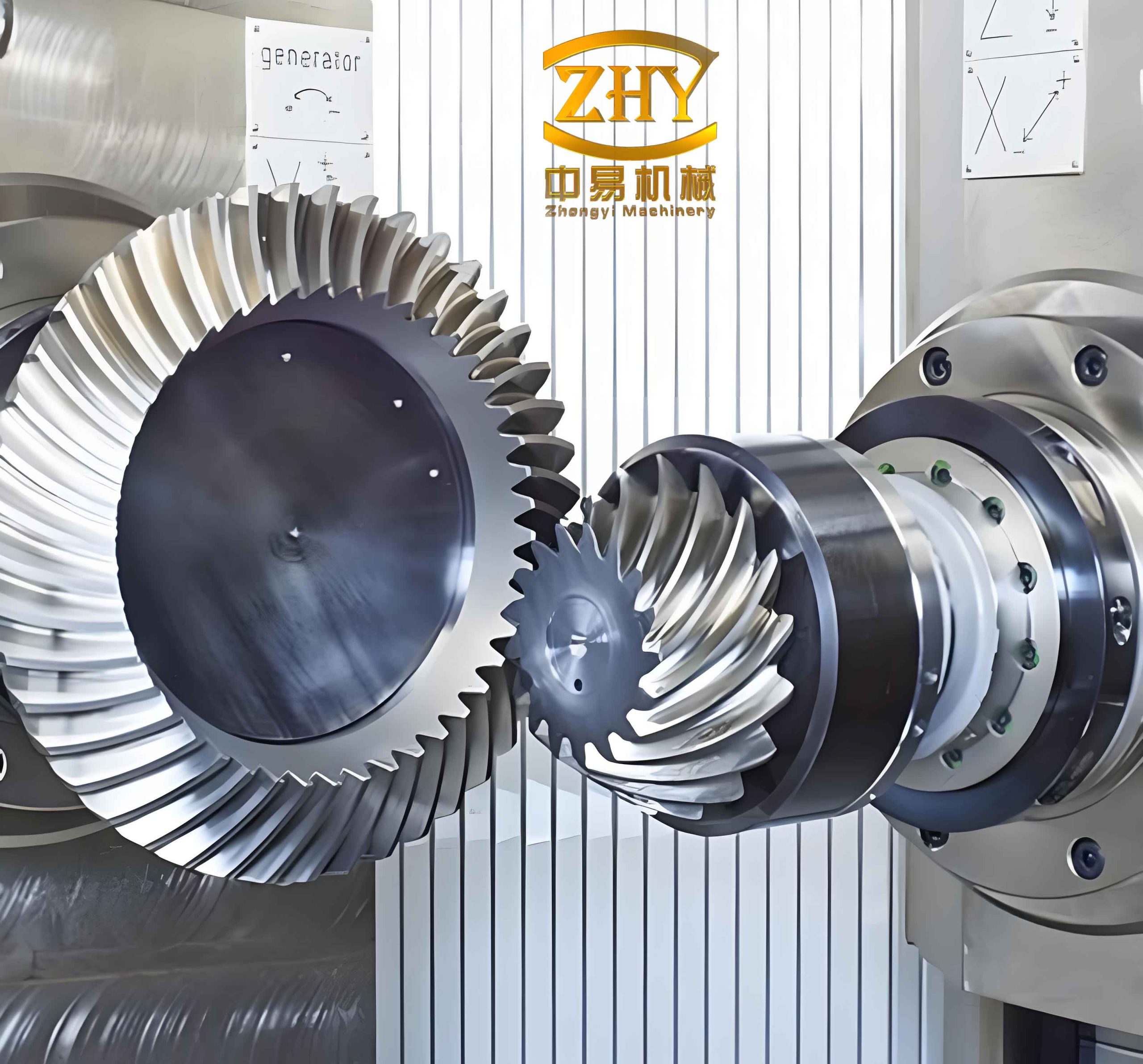
This ease-off topography is fundamental for hyperboloidal gears as it directly controls the transmission error (TE) and the shape of the contact path under no-load conditions. The mapping of all potential contact points and their ease-off values allows for the prediction of unloaded contact patterns and the TE curve, which for high-reduction hyperboloidal gears often exhibits a multi-pair contact characteristic with high contact ratio, as simulated in the analysis.
Kinematic and Geometric Contact Parameters
Prior to load analysis, the kinematic conditions and local geometry at the contact point must be determined. The gear tooth surface, often generated by a formate or continuous generating process, can be described by \(\mathbf{r}^2(u, \theta)\). For a surface generated by a circular cutter, the principal curvatures in the tool coordinate directions can be directly obtained.
The critical parameters for contact mechanics and lubrication are the effective radii of curvature in the two principal directions of the contact ellipse. One principal direction (\(t\)) is tangent to the instantaneous contact line. The other principal direction (\(p\)) is perpendicular to \(t\) and lies in the common tangent plane (\(p = t \times n\), where \(n\) is the unit normal).
The induced normal curvature in the \(p\)-direction, \(K_{sp}\), is calculated using second-order kinematics. When combined with the curvature of the ease-off surface in the same direction, \(K_{op}\), the total effective curvature governing contact deformation in that direction is:
$$
K_p = K_{sp} + K_{op}
$$
The effective radius of curvature is then \(R = 1/K_p\). For hyperboloidal gears, this radius typically varies along the contact line, being smaller near the toe and root, and larger near the heel and tip.
The kinematic velocities are vital for lubrication analysis. The surface velocities of the pinion and gear at the contact point are \(\mathbf{v}_1 = \boldsymbol{\omega}_1 \times \mathbf{r}_1\) and \(\mathbf{v}_2 = \boldsymbol{\omega}_2 \times \mathbf{r}_2\), respectively. Their components along the \(p\)-direction are \(u_1 = \mathbf{v}_1 \cdot \mathbf{p}\) and \(u_2 = \mathbf{v}_2 \cdot \mathbf{p}\). The essential lubrication parameters are then:
- Sliding Velocity: \(v_s = |u_1 – u_2|\)
- Entrainment (Rolling) Velocity: \(v_e = \frac{|u_1 + u_2|}{2}\)
- Slide-to-Roll Ratio (SRR): \(\Sigma = v_s / v_e\)
A characteristic of hyperboloidal gears is that the sliding velocity is significant across the entire flank, leading to an SRR distribution that is relatively uniform compared to other gear types, a factor that heavily influences their friction behavior.
Loaded Tooth Contact Analysis (LTCA) via Differential Elements
Predicting the actual load distribution under operating torque requires a Loaded Tooth Contact Analysis (LTCA). The unloaded ease-off \(z_d\) defines the initial gap between surfaces. Under a load \(F\), the teeth deflect. Let \(\delta_i\) be the total normal approach (deformation) at the master point on the \(i\)-th contact line. For any discrete element \(j\) on that line, the contact condition is \(\delta_i \ge z_d^{(i,j)}\). The load on that element is proportional to its deflection beyond the gap and its stiffness:
$$
f^{(i,j)} = D^{(i,j)} \left( \delta_i – z_d^{(i,j)} \right)
$$
where \(D^{(i,j)}\) is the stiffness influence coefficient for that element, which can be derived from semi-analytical formulas or finite element-based compliance matrices.
The total load must be balanced across all \(m\) contacting elements on potentially several tooth pairs (\(n\)):
$$
\sum_{i=1}^{n} \sum_{j=1}^{m} D^{(i,j)} \left( \delta_i – z_d^{(i,j)} \right) = F
$$
Solving this system for the unknowns \(\delta_i\) and the active set of elements (where \(\delta_i > z_d^{(i,j)}\)) yields the load distribution \(f^{(i,j)}\). This distribution typically shows higher loads in the central region of the tooth flank for well-designed hyperboloidal gears.
With the distributed load known, the contact stress must be calculated. The contact zone at each element is highly elliptical. To handle edge contact and non-Hertzian conditions near the boundaries of the finite gear flank, a differential element approach is adopted. The contact zone along the line is discretized into thin slices of width \(\Delta l\), each approximated as a cylinder-on-plane contact. The load per unit length on element \(j\) is \(q_j = f_j / \Delta l\). The maximum Hertzian contact pressure at the centerline of this strip contact is:
$$
\sigma_{h,j} = 182.38 \sqrt{\frac{q_j}{R_j}}
$$
where \(R_j\) is the effective radius of curvature in the \(p\)-direction at element \(j\). The semi-half width of the contact strip is \(b_j = 3.33 \sqrt{q_j R_j}\). The pressure distribution across this strip follows the elliptical form \(\sigma_p = \sigma_{h,j} \sqrt{1 – p^2/b_j^2}\). Aggregating results from all active elements provides the complete, instantaneous contact pressure field over the entire mesh of hyperboloidal gears.
Elasto-Hydrodynamic Lubrication (EHL) and Friction Analysis
The lubrication regime in the highly stressed contact of hyperboloidal gears is typically mixed or full-film EHL. The key parameter is the central or minimum film thickness. For line contact, the classical Dowson-Hamrock formula is applied to each differential element \(j\) along the contact line, treating it as an independent line contact problem with its own local conditions:
$$
h_{0,j} = 3.06 \, \alpha^{0.56} \, \eta_0^{0.69} \, v_{e,j}^{0.69} \, E^{‘\,-0.03} \, R_j^{0.41} \, q_j^{-0.10}
$$
where \(\alpha\) is the pressure-viscosity coefficient, \(\eta_0\) is the dynamic viscosity at ambient conditions, and \(E^{‘}\) is the effective elastic modulus. The film thickness distribution for hyperboloidal gears is often quite uniform across the central contact region, with increases at the edges due to lower pressure.
The coefficient of friction is highly dependent on the lubrication regime, identified by the film thickness ratio \(\lambda = h_0 / S_c\), where \(S_c = \sqrt{\sigma_1^2 + \sigma_2^2}\) is the composite root-mean-square surface roughness. Empirical regression formulas, validated for gear contacts, are used to calculate the friction coefficient \(\mu\) for each discrete element based on its local conditions.
These formulas have different forms for the three regimes:
- Boundary Lubrication (\(\lambda \le 1\)): \(\mu = f(\Sigma, H, G, S_q, \lambda)\)
- Mixed EHL (\(1 < \lambda \le 3\)): \(\mu = f(\Sigma, U, G, H, S_q, \lambda)\)
- Full-Film EHL (\(\lambda > 3\)): \(\mu = f(\Sigma, U, G, H, S_q, \lambda)\)
where \(H = \sigma_h/E^{‘}\) (dimensionless pressure), \(U = \eta_0 v_e/(E^{‘}R)\) (dimensionless speed), and \(G = \alpha E^{‘}\) (dimensionless material parameter). The coefficients in these functions are derived from extensive numerical EHL simulations. For hyperboloidal gears, since pure rolling points are rare, the friction coefficient tends to be higher in the middle of the contact line where sliding is prominent, decreasing towards the ends.
Friction Power Loss and Mesh Efficiency Calculation
The instantaneous friction power loss for a single differential element \(j\) is the product of the friction force and the sliding velocity:
$$
W_j = \mu_j \cdot f_j \cdot v_{s,j}
$$
The total power loss at a given meshing position (pinion rotation angle \(\phi\)) is the sum over all active elements on all contacting tooth pairs \(n\):
$$
W_{\phi} = \sum_{i=1}^{n} \sum_{j=1}^{m} W^{(i,j)}
$$
Due to the high contact ratio of hyperboloidal gears, the total power loss \(W_{\phi}\) typically exhibits very low fluctuation over a mesh cycle. The mesh efficiency for a given operating condition (torque \(T\), speed \(\omega\)) is then calculated as:
$$
\eta_{mesh} = 1 – \frac{\overline{W}_{\phi}}{T_1 \omega_1}
$$
where \(\overline{W}_{\phi}\) is the average friction power loss over one mesh cycle, and \(T_1 \omega_1\) is the input power.
The following table summarizes the key parameters and their typical ranges or characteristics during the analysis of high-reduction hyperboloidal gears.
| Parameter Category | Key Variables | Typical Characteristics for High-Ratio Hyperboloidal Gears |
|---|---|---|
| Geometry & Kinematics | Effective Radius \(R\), Entrainment Velocity \(v_e\), Slide-to-Roll Ratio \(\Sigma\) | \(R\) varies significantly along contact line (smaller at toe/root). \(\Sigma\) is relatively high and uniform across the flank due to dominant sliding. |
| Loaded Contact (LTCA) | Element Load \(f_j\), Max. Hertz Pressure \(\sigma_h\), Contact Semi-Width \(b\) | Load concentrates in central flank region. \(\sigma_h\) can exceed 1 GPa. Contact zone often distorted at edges (non-Hertzian). |
| Lubrication (EHL) | Film Thickness \(h_0\), Film Ratio \(\lambda\), Friction Coeff. \(\mu\) | \(h_0\) often in 0.4-0.5 μm range, fairly uniform centrally. Operation often in mixed EHL regime (\(1<\lambda<3\)). \(\mu\) higher in mid-contact line. |
| Performance | Friction Power \(W_{\phi}\), Mesh Efficiency \(\eta_{mesh}\) | Power loss fluctuation is small due to high contact ratio. Mesh efficiency highly dependent on load and speed. |
Efficiency Test Validation
To validate the integrated LTCA-mEHL friction model, an experimental efficiency test was conducted on a manufactured high-reduction hyperboloidal gear pair (3:60 ratio). The gearset was first inspected via rolling test to confirm the contact pattern aligned with the ease-off design, showing a well-centered elliptical pattern.
The efficiency test rig was equipped with high-precision input and output torque sensors. Tests were run at various input speeds (\(n_1 = 1500, 1800, 2400\) rpm) and output torques (\(T_2 = 83\) to \(295\) N·m). The overall transmission efficiency \(\eta_{trans}\) was measured. The following table compares the trends from theoretical mesh efficiency calculations against the experimental results for a sample condition.
| Operating Condition | Theoretical Mesh Efficiency \(\eta_{mesh}\) | Experimental Transmission Efficiency \(\eta_{trans}\) | Notes |
|---|---|---|---|
| Low Load, High Speed | Higher (Optimistic for pure mesh) | Lower than theory | Windage/churning losses become significant. |
| Medium Load, Medium Speed | ~79.6% (Average) | ~79.4% (Average) | Best agreement. Mesh loss dominates. |
| High Load, Low Speed | Lower (Boundary effects) | Slightly higher than theory | Sensor error & non-mesh losses proportionally smaller. |
The results showed a strong correlation between the theoretical predictions and experimental measurements. The average calculated mesh efficiency across the tested range was 79.65%, while the average measured transmission efficiency was 79.45%, yielding a discrepancy of only 0.2%. The maximum observed error was 2.8%, which is within an acceptable range considering test rig losses (bearings, seals, windage) and instrument accuracy. The trend of efficiency increasing with speed and decreasing with load was correctly predicted by the model, validating the underlying analysis of the EHL conditions in hyperboloidal gears.
Conclusion
This work presents a comprehensive methodology for analyzing friction power loss and predicting mesh efficiency in high-reduction hyperboloidal gears. By integrating geometric ease-off analysis, a differential element-based Loaded Tooth Contact Analysis (LTCA), and mixed Elasto-Hydrodynamic Lubrication (mEHL) friction models, the complex, coupled physics of the highly sliding and curved tooth contact is effectively addressed.
The key contributions of the framework are: 1) The use of ease-off topography to accurately define unloaded contact conditions and tooth stiffness variations. 2) The application of a differential element discretization along the contact line to solve the load distribution problem and handle non-Hertzian edge contact conditions. 3) The local calculation of EHL parameters (film thickness, friction coefficient) for each element, capturing the significant variations across the flank of hyperboloidal gears.
The methodology was successfully validated through efficiency tests on a 3:60 ratio hyperboloidal gearset, with measured efficiency trends and values showing excellent agreement with theoretical predictions. This analytical approach provides a valuable tool for the design and performance optimization of hyperboloidal gears, enabling engineers to target higher efficiency and lower operating temperatures by tailoring ease-off topography and operating conditions to favorably influence the tribological state of the mesh.