
In the realm of advanced manufacturing, precision forging stands out as a transformative technology, particularly for components like spur and pinion gears. The ability to produce net-shape or near-net-shape gear teeth through plastic deformation, eliminating or drastically reducing subsequent machining, represents a significant leap in efficiency, material savings, and product quality. This article delves into my comprehensive investigation of the precision forging process for a specific spur and pinion gear, employing a combination of experimental analysis and advanced numerical simulation. The focus is on unraveling the intricate metal flow patterns, optimizing process parameters, and validating the findings through physical trials. The ultimate goal is to contribute to the broader understanding and industrial application of this promising technique for manufacturing critical power transmission components like spur and pinion gears.
The journey into precision forging of spur and pinion gears begins with acknowledging the inherent challenges. Traditional forging of gears often requires draft angles and leaves difficult-to-fill corners in the tooth cavity. The final forging stages can impose excessively high pressures, jeopardizing模具寿命. To circumvent these issues, my research adopted the principle of a movable, or floating, die container. This innovative approach fundamentally alters the friction conditions during forming. In a conventional fixed-die setup, friction opposes metal flow into the die cavities. However, in a floating die system, the entire container moves with the workpiece during the final stages. This motion reorients the friction forces on the container walls to act in the same direction as the metal flow toward the die extremities. This “positive friction” effect, coupled with inertial forces in the upper cavity, significantly enhances the filling of the tooth profile, especially at the corners, which are critical for the functional performance of spur and pinion gears.
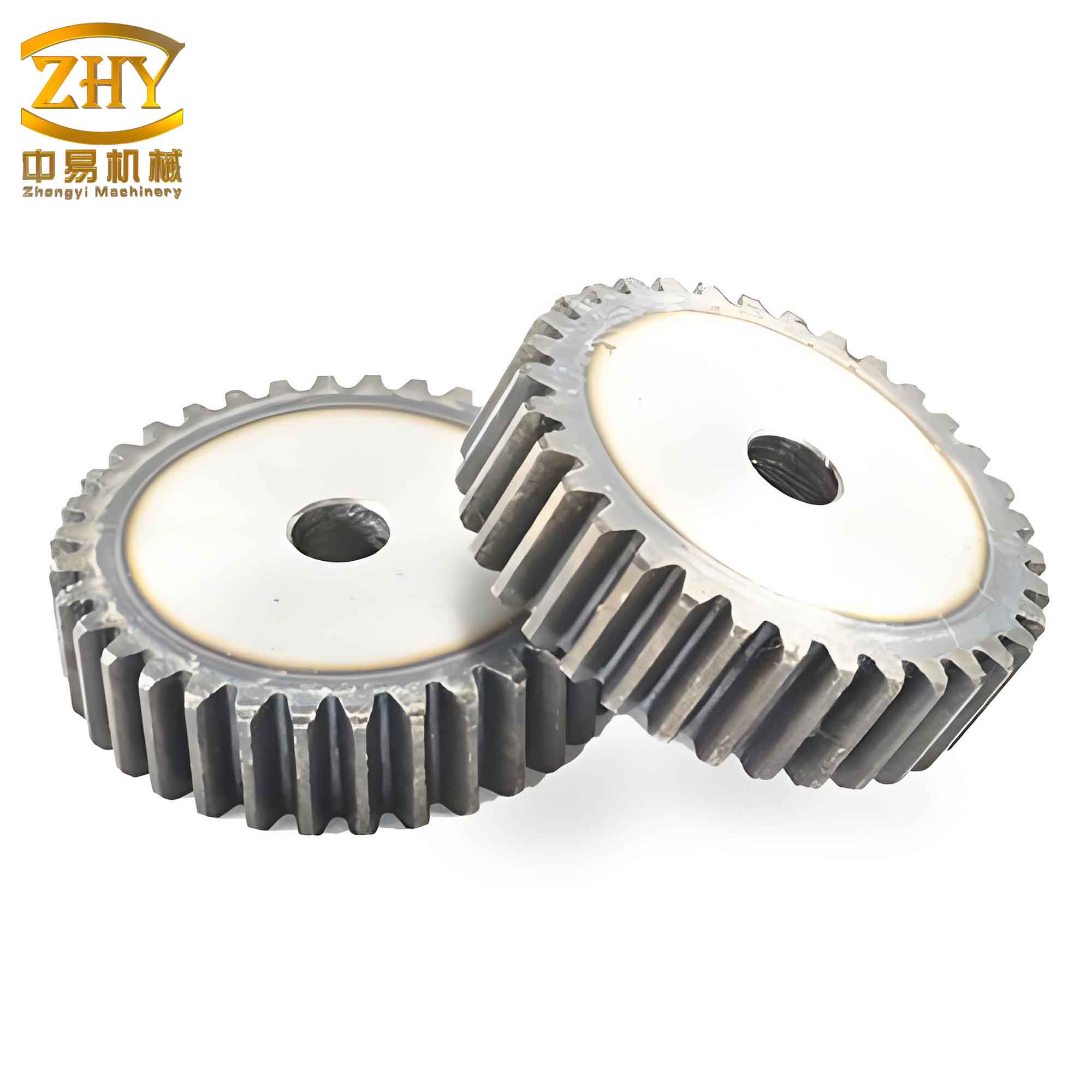
The specific component under investigation is a small spur and pinion gear, integral to reduction assemblies. The gear has 18 teeth, a module of 2.5 mm, and features a central hole. The target was to produce a forged gear requiring minimal finishing on the tooth flanks. The initial part design was adapted for forging by adding machining allowances and defining the flash and web geometry. A pivotal aspect of the process design for such a forged spur and pinion gear with a central hole is the positioning of the internal web, or punch-through point. The web’s location profoundly influences material flow symmetry and filling behavior. I devised four distinct processing schemes by systematically varying the web’s position along the gear height, designated as Scheme 1 through Scheme 4. In all cases, a flat web with a constant thickness was maintained to isolate the effect of vertical placement. The die design incorporated the floating container principle, where a shouldered punch first performs a piercing/upsetting operation and subsequently drives the entire container downward to facilitate complete filling.
To model this complex three-dimensional deformation process, I turned to the finite element method (FEM). Using DEFORM-3D, a powerful software for simulating metal forming, I constructed a detailed virtual model. Given the cyclic symmetry of the spur and pinion gear, I modeled only one-eighteenth of the full geometry to conserve computational resources while capturing all essential physics. The workpiece was modeled as a deformable body, initially a solid cylinder with dimensions calculated based on volume constancy and the gear’s root diameter. The dies (punch and container) were treated as rigid bodies. The material model was crucial for accuracy. For the experimental phase, industrial pure lead was used as a model material due to its room-temperature plasticity and similarity in flow stress trends to hot steel. Its constitutive behavior was described by a flow stress equation and integrated into the software’s database. The equation governing the material’s response is expressed as:
$$ \sigma = 11.3 + 3.35 \varepsilon^{0.5} \, \text{(MPa)} $$
where \( \sigma \) is the flow stress and \( \varepsilon \) is the true strain. Simulation parameters such as initial temperature (20°C), tool speed (0.2 mm/s for both punch and container in the floating stage), and friction were carefully defined. A shear friction model with a factor of 0.4 was initially employed. The simulation tracked the entire process, from initial contact to final die closure, recording metal flow, stress distribution, and most importantly, the forming load. The stages of deformation for the spur and pinion gear were clearly identifiable: an initial piercing/upsetting stage where the punch penetrates the billet, a combined piercing-upsetting-filling stage where the tooth cavities form, and a final coining stage where the last corners are filled under high pressure.
Parallel to the simulation work, I conducted physical experiments using a dedicated die set mounted on a servo-hydraulic testing machine. The die assembly allowed for the interchange of inserts to replicate the four different web positions defined in the simulation schemes. Lead billets were cast and machined to precise dimensions. The experimental procedure mirrored the simulated process, and the forming force versus displacement was recorded for direct comparison. The visual inspection of the forged spur and pinion gear specimens provided critical qualitative data on tooth filling.
The synergy between simulation and experiment yielded profound insights. The most immediate observation was the dramatic effect of web position on the filling quality of the spur and pinion gear teeth. The results are summarized in the table below, which contrasts the filling performance across the four schemes.
| Processing Scheme | Web Position (Relative to height) | Tooth Filling Observation | Primary Metal Flow Characteristic |
|---|---|---|---|
| Scheme 1 | Lower Section | Poor upper tooth filling, significant top corner underfill. | Metal flows preferentially downward, starving the upper cavity. |
| Scheme 2 | Lower-Mid Section | Severe underfill in upper tooth corners; lower teeth fill better. | Positive friction aids lower fill, but punch position still biases flow downward. |
| Scheme 3 | Upper-Mid Section | Optimal and symmetrical filling in both upper and lower tooth corners. | Punch position in upper-mid promotes upward flow, balanced by positive friction aiding lower fill. |
| Scheme 4 | Upper Section | Excessive flash formation at top in experiments; simulation showed faster upper corner fill. | Metal flows preferentially upward; in practice, leads to flash if die alignment isn’t perfect. |
As evident, Scheme 3, with the web positioned in the upper-mid section of the spur and pinion gear preform, resulted in the most complete and symmetrical filling. This finding is crucial for process designers aiming to forge high-quality spur and pinion gears. The numerical simulation accurately predicted this trend, showing a clear correlation between punch location and the velocity fields within the deforming material. The force analysis further corroborated these findings. The forming load curves from both simulation and experiment for Scheme 3 showed remarkable agreement, validating the FEM model. The load progression followed the three-stage pattern, culminating in a sharp load increase during the final coining stage to fill the last corners—a characteristic signature of precision forging processes for complex shapes like spur and pinion gears.
A detailed comparative analysis of the maximum forming force across the schemes revealed an interesting non-linear relationship with web position. While Scheme 2 exhibited the lowest forming force, it produced the worst filling. Scheme 3, offering the best fill, required a higher but acceptable forming force. This trade-off between forming load and fill quality is central to optimizing the forging of spur and pinion gears. To delve deeper into factors affecting the forming load—a key determinant of press capacity and die life—I performed a series of parametric studies using the validated model of Scheme 3. The influence of friction factor, punch speed, and punch corner radius was systematically investigated. The results are quantitatively summarized in the following table.
| Process Parameter | Range Studied | Effect on Maximum Forming Force | Approximate % Change in Force | Implication for Spur and Pinion Gear Forging |
|---|---|---|---|---|
| Friction Factor (m) | 0.2 to 1.0 | Force increases monotonically with friction. | ~37% increase from m=0.2 to m=1.0 | Effective lubrication is vital to reduce force and wear. |
| Punch Speed (mm/s) | 5 to 35 | Force increases with speed due to higher strain rates. | ~18% increase from 5 to 35 mm/s | Selection must balance productivity with force/equipment limits. |
| Punch Corner Radius (mm) | 1 to 6 | Force decreases significantly with larger radius. | >20% reduction from R=3mm to R=6mm | Generous radii ease metal flow and reduce stress concentration. |
The mathematical relationship for the flow stress was central to these simulations. However, the forming load itself can be conceptually related to these parameters through a simplified workability equation. The total work done during forging is the integral of stress over volume and strain. While a full analytical solution is intractable for a complex spur and pinion gear shape, the influence of friction can be conceptually framed. The increased force due to friction can be related to the additional shear work required at the die-workpiece interface. A simplified expression considering an average pressure \( p_{avg} \) needed for deformation might be augmented by a friction-dependent term:
$$ p_{total} \approx Y_f \left(1 + \alpha \frac{m \cdot D}{h}\right) $$
where \( Y_f \) is the material’s flow stress (from our constitutive equation), \( m \) is the friction factor, \( D \) is a characteristic diameter (like the gear’s root circle), \( h \) is the instantaneous height, and \( \alpha \) is a geometric constant. This illustrates why higher friction \( m \) directly increases the required pressure and thus the forming force for the spur and pinion gear. Similarly, a larger punch corner radius \( R_p \) reduces stress concentration and effectively decreases the geometric factor, lowering the force. The strain rate sensitivity, though not explicitly defined in the lead model at room temperature, becomes a factor at higher speeds for many metals, explaining the speed-force relationship observed.
The experimental validation was not without its lessons. For instance, in Scheme 4, the physical trial produced large flash at the top of the spur and pinion gear, a phenomenon less pronounced in the simulation. This discrepancy highlighted the sensitivity of the process to real-world conditions like slight misalignments or spring force imbalances in the floating die mechanism—factors that are challenging to model perfectly. This underscores the indispensable role of physical trials in complementing simulation for robust process design of critical components like spur and pinion gears.
Beyond the core parameters, the study opens avenues for further exploration. The initial billet geometry, such as using a preform instead of a simple cylinder, could be optimized to distribute material more favorably, potentially lowering forces and improving fill for the spur and pinion gear. Different lubrication strategies and their impact on the friction factor across the complex tooth profile warrant detailed study. Furthermore, scaling the process from model lead to actual engineering materials like steels at elevated temperatures involves accounting for thermal effects, phase transformations, and different constitutive behaviors. The simulation framework established here, however, provides a solid foundation for such studies. Advanced damage prediction models could also be integrated to assess the potential for internal defects during the forging of spur and pinion gears.
In conclusion, this integrated investigation, combining finite element simulation based on DEFORM-3D and experimental trials, has successfully decoded key aspects of the precision forging process for a spur and pinion gear using a floating die concept. The optimal positioning of the internal web was identified to be in the upper-middle section of the gear height, ensuring balanced metal flow and complete tooth cavity filling. The numerical model demonstrated high reliability in predicting both metal flow patterns and forming loads. The parametric studies quantified the significant influence of friction, punch speed, and tool geometry on the required forming force. These insights form a valuable knowledge base for process engineers. The successful forging of a spur and pinion gear with complete teeth and minimal draft exemplifies the potential of this technology to revolutionize gear manufacturing, offering a sustainable, efficient, and high-quality alternative to traditional cutting methods. The journey from simulation to physical part reinforces the paradigm that modern manufacturing of complex components like spur and pinion gears increasingly relies on the powerful synergy between computational prediction and empirical validation.