
In modern automotive engineering, the demand for high-performance, reliable, and durable transmission components is ever-increasing. Among these, bevel gears play a critical role in rear axle systems, transmitting torque and motion at right angles. The failure of bevel gears, often through bending fatigue at the tooth root or surface pitting, can lead to catastrophic system breakdowns, emphasizing the need for enhanced material properties and processing techniques. In this study, we investigate the effects of alloy element optimization and heat treatment modifications on the performance of rear axle bevel gears, focusing on extending their service life under rigorous testing conditions.
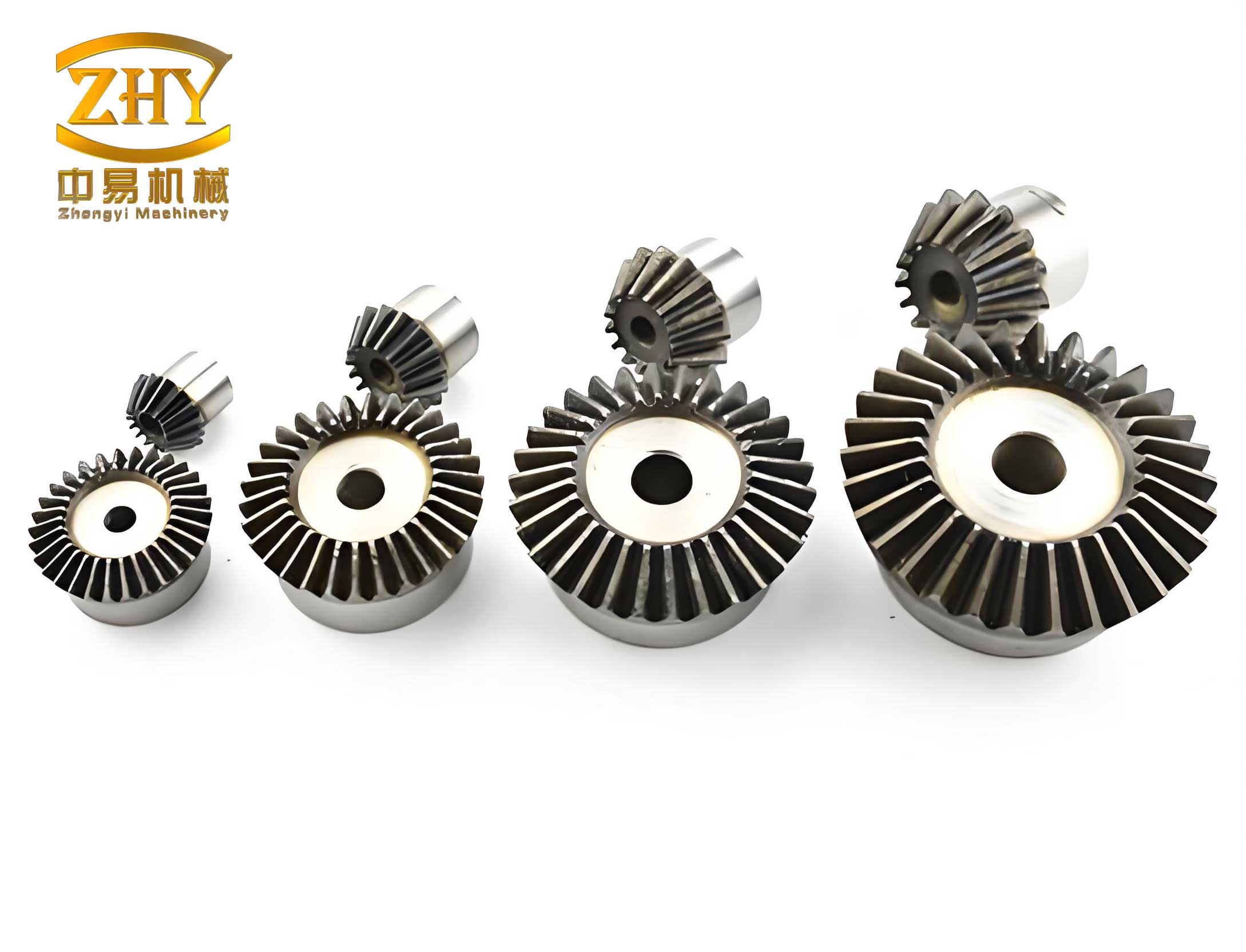
Our initial experiments involved bevel gears manufactured from two alloy steels: 20CrNi3 for the active bevel gears and 22CrMoH for the driven bevel gears. These bevel gears underwent conventional carburizing, quenching, and tempering processes. The chemical compositions of the as-received materials are summarized in Table 1. The bevel gears were subjected to bench testing, simulating real-world operational stresses. After 250,000 cycles, the active bevel gears exhibited bending fatigue fractures at the tooth roots, with magnetic particle inspection revealing fatigue cracks in all teeth. This premature failure prompted a detailed analysis of the material and heat treatment parameters.
| Material | C | Si | Mn | P | S | Cr | Ni | Mo |
|---|---|---|---|---|---|---|---|---|
| 20CrNi3 (Active Bevel Gear) | 0.185 | 0.291 | 0.441 | 0.017 | 0.015 | 0.704 | 2.936 | 0.019 |
| 22CrMoH (Driven Bevel Gear) | 0.249 | 0.279 | 0.846 | 0.013 | 0.004 | 1.242 | 0.046 | 0.370 |
The post-heat-treatment properties of the bevel gears were evaluated, as shown in Table 2. The driven bevel gears met all technical specifications, but the active bevel gears displayed deficiencies: lower surface hardness (56.6-57 HRC versus required 58-62 HRC), lower core hardness (30 HRC versus required 35-42 HRC), shallow case depth at the root (0.85 mm versus required ≥1.0 mm), and an excessive non-martensite surface layer (0.03 mm versus allowed ≤0.02 mm). These shortcomings directly contributed to the bending fatigue failure of the active bevel gears. The non-martensite layer, in particular, reduces surface wear resistance and fatigue strength, while insufficient core hardness and case depth diminish load-bearing capacity at the tooth root.
| Property | Active Bevel Gear | Driven Bevel Gear | Technical Requirement |
|---|---|---|---|
| Surface Hardness (HRC) | 56.6, 56.5, 57 | 60, 60.5, 61.5 | 58-62 |
| Core Hardness (HRC) | 30 | 40 | 35-42 |
| Case Depth at Pitch Circle (mm) | 1.33 | 1.27 | 1.2-1.5 |
| Case Depth at Root (mm) | 0.85 | 1.02 | ≥1.0 |
| Martensite Grade | 5 | 4 | 1-5 |
| Retained Austenite Grade | 1 | 4 | 1-5 |
| Carbide Grade at Tooth Tip | 1 | 1 | 1-5 |
| Non-Martensite Surface Layer (mm) | 0.03 | 0.0175 | ≤0.02 |
To address these issues, we focused on two primary avenues: optimization of the alloy composition for the active bevel gears and refinement of the heat treatment process. The performance of bevel gears is heavily influenced by their chemical makeup. Carbon content governs base hardness and hardenability, while alloying elements like Mn, Cr, Ni, and Mo enhance hardenability by stabilizing undercooled austenite, thus lowering the critical cooling rate. For bevel gears, a balanced composition is crucial to achieve a high surface carbon concentration with a gradual gradient, ensuring both hardness and toughness.
We prioritized the chemical composition for the 20CrNi3 steel used in active bevel gears, as outlined in Table 3. The selected ranges aim to improve hardenability and optimize the carbon concentration profile during carburizing. Nickel, a non-carbide former, reduces surface carbon concentration but flattens the gradient, beneficial for fatigue resistance. Chromium, a carbide former, increases surface carbon but can create steep gradients. The adjusted ranges for C, Mn, Cr, and Ni seek a synergistic effect for superior bevel gear performance.
| Element | Preferred Range | Acceptable Range |
|---|---|---|
| C | 0.21-0.23 | 0.17-0.23 |
| Si | 0.20-0.37 | 0.17-0.37 |
| Mn | 0.45-0.65 | 0.30-0.65 |
| P, S | ≤0.035 | ≤0.035 |
| Cr | 0.70-0.95 | 0.60-0.95 |
| Ni | 2.90-3.25 | 2.70-3.25 |
Concurrently, we revised the heat treatment process for the bevel gears. The standard process involved carburizing, quenching, and tempering, but we enhanced it by increasing carbon potential in all zones, raising the quenching temperature, and using KR118 fast-quenching oil at a lower temperature. The improved process, depicted in Figure 1, extends the cycle time from 30 to 40 minutes, allowing for better carbon diffusion and microstructure control. The carburizing process aims to enrich the surface with carbon, following diffusion principles described by Fick’s law. The carbon concentration profile can be modeled as:
$$C(x,t) = C_s – (C_s – C_0) \text{erf}\left(\frac{x}{2\sqrt{Dt}}\right)$$
where \(C(x,t)\) is the carbon concentration at depth \(x\) and time \(t\), \(C_s\) is the surface carbon concentration (controlled by carbon potential), \(C_0\) is the initial carbon content, \(D\) is the diffusion coefficient, and \(\text{erf}\) is the error function. By increasing carbon potential (\(C_s\)) and time (\(t\)), we achieve a deeper and more uniform case depth, essential for bevel gears subjected to high bending stresses.
The quenching step is critical for forming martensite. The hardness of martensite is primarily a function of carbon content, approximated by:
$$H \approx 60 + 200\sqrt{C}$$
where \(H\) is the Vickers hardness (HV) and \(C\) is the carbon mass fraction. Higher carbon content leads to higher hardness, but excessive carbon can promote retained austenite and carbides. By optimizing the quenching temperature and cooling rate, we aim to maximize martensite transformation while minimizing non-martensitic phases. The use of KR118 oil ensures a rapid yet controlled cooling, reducing the formation of non-martensite surface layers.
After tempering, the bevel gears underwent shot peening using a QZJ083C rotary shot peening machine. Shot peening induces compressive residual stresses on the surface, which significantly enhances fatigue resistance by inhibiting crack initiation. The Almen intensity, measured as arc height, was increased from 15 to over 20 (0.15 mm to 0.20 mm), providing better surface integrity for the bevel gears.
We then manufactured new active bevel gears using the optimized 20CrNi3 composition and applied the improved heat treatment process. The properties of these enhanced bevel gears are summarized in Table 4. All parameters now meet or exceed technical requirements. The surface hardness increased to 59-60 HRC, core hardness to 38 HRC, and case depth at the root to 1.05 mm. The non-martensite layer was reduced to 0.015 mm. Microstructural examination revealed a fine martensite structure (grade 4), minimal retained austenite (grade 1), and no excessive carbides, indicating a well-balanced microstructure for high-performance bevel gears.
| Property | Result | Technical Requirement |
|---|---|---|
| Surface Hardness (HRC) | 59, 59.5, 60 | 58-62 |
| Core Hardness (HRC) | 38 | 35-42 |
| Case Depth at Pitch Circle (mm) | 1.45 | 1.2-1.5 |
| Case Depth at Root (mm) | 1.05 | ≥1.0 |
| Martensite Grade | 4 | 1-5 |
| Retained Austenite Grade | 1 | 1-5 |
| Carbide Grade at Tooth Tip | 1 | 1-5 |
| Non-Martensite Surface Layer (mm) | 0.015 | ≤0.02 |
The enhanced bevel gears, both active and driven, were subjected to extended bench testing. Remarkably, after 500,000 cycles, no fractures or significant wear were observed in the bevel gears. Even at 750,000 cycles, the bevel gears continued to operate normally, demonstrating a substantial improvement in fatigue life. This success underscores the critical role of alloy element selection and heat treatment precision in bevel gear performance. The optimized composition provides better hardenability and microstructural stability, while the refined heat treatment ensures adequate surface hardness, core strength, and case depth.
To further elucidate the relationships, we can derive key formulas governing bevel gear performance. The bending fatigue strength (\(\sigma_f\)) of bevel gear teeth is influenced by surface hardness (\(H_s\)), core hardness (\(H_c\)), and case depth (\(d\)). An empirical relationship can be expressed as:
$$\sigma_f = k_1 H_s^{a} + k_2 H_c^{b} – k_3 \frac{1}{d^{c}}$$
where \(k_1\), \(k_2\), \(k_3\), \(a\), \(b\), and \(c\) are material constants. For carburized bevel gears, increasing \(H_s\) and \(d\) while maintaining a tough core (\(H_c\)) enhances \(\sigma_f\). Our optimizations directly target these parameters.
Additionally, the effect of shot peening on fatigue life can be modeled using the residual stress (\(\sigma_r\)) induced. The modified fatigue limit (\(\sigma_e’\)) is given by:
$$\sigma_e’ = \sigma_e + \alpha \sigma_r$$
where \(\sigma_e\) is the original fatigue limit and \(\alpha\) is a factor dependent on material and geometry. For bevel gears, shot peening adds compressive \(\sigma_r\), effectively raising \(\sigma_e’\) and delaying crack initiation.
In conclusion, the performance of rear axle bevel gears is profoundly affected by alloy element composition and heat treatment工艺. Through systematic optimization of carbon and alloying element ranges—specifically carbon, manganese, chromium, and nickel—in 20CrNi3 steel, coupled with enhanced carburizing, quenching, and tempering parameters, we achieved a dramatic improvement in the fatigue life of bevel gears. The bench test results, exceeding 750,000 cycles without failure, validate our approach. These findings highlight the importance of tailored material science and thermal processing in developing durable and reliable bevel gears for automotive applications. Future work may explore advanced surface engineering techniques and computational modeling to further push the limits of bevel gear performance.
The integration of these improvements into manufacturing processes can lead to bevel gears that withstand higher loads and longer service intervals, contributing to safer and more efficient vehicles. As automotive technology evolves, continuous refinement of alloy systems and heat treatment strategies for bevel gears will remain a key focus area for engineers and researchers alike.