
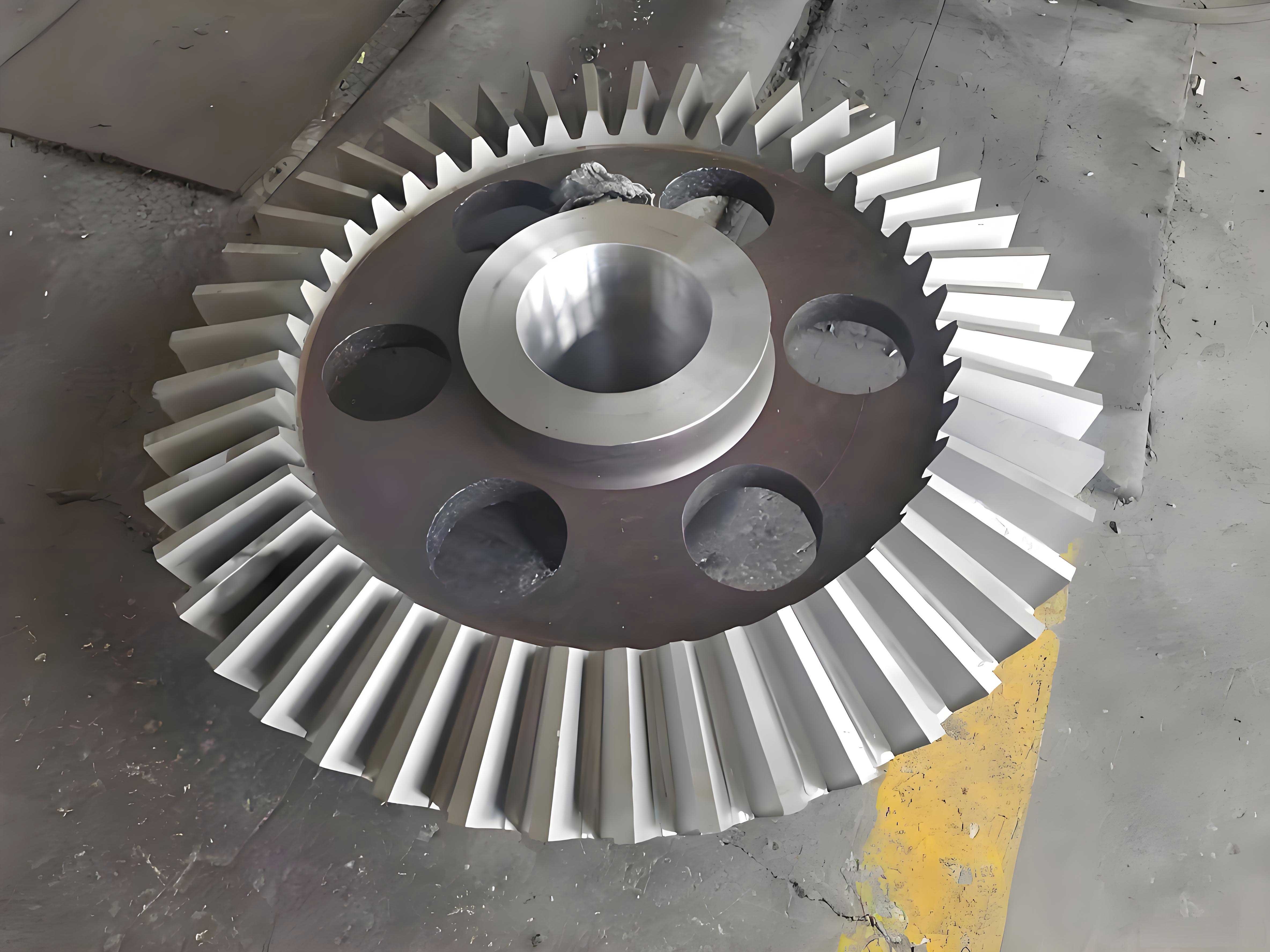
In this study, I focus on the isothermal forging process of aluminum alloy miter gears, which are critical components in various mechanical systems due to their ability to transmit motion between intersecting shafts at right angles. The use of aluminum alloys for miter gears offers significant advantages, including weight reduction, improved corrosion resistance, and enhanced thermal conductivity, making them ideal for applications in automotive and aerospace industries where efficiency and performance are paramount. However, forging miter gears from aluminum alloys presents challenges such as achieving precise tooth geometry without defects like folds or cracks, while minimizing forming loads to extend模具寿命. To address these issues, I employ numerical simulation techniques coupled with parameter optimization to develop an efficient isothermal forging process. This approach allows for a detailed analysis of metal flow, forming loads, and the influence of key工艺 parameters, ultimately leading to optimized conditions that ensure defect-free miter gear production with reduced energy consumption. The miter gear, as a type of bevel gear with a 1:1 ratio and perpendicular shafts, is particularly suited for this investigation due to its symmetrical design and common use in differential systems. Throughout this article, I will frequently refer to the miter gear to emphasize its importance in this context.
To begin, I established the basic parameters of the miter gear under consideration. The gear has specific dimensions and characteristics that are essential for the forging process. Below is a table summarizing these parameters:
| Parameter | Value |
|---|---|
| Number of Teeth | 11 |
| Module | 7.55 mm |
| Pressure Angle | 30° |
| Pitch Circle Thickness | 14.35 mm |
| Mean Module | 5.85 mm |
| Mean Pitch Diameter | 64.36 mm |
| Mean Cone Length | 56.80 mm |
| Addendum Modification Coefficient | 1.67 |
Based on these parameters, I designed the forging process using open-die forging with a flash to control material flow and reduce forming loads. The miter gear’s geometry requires careful consideration of the die design, including the tooth cavity and back taper. I utilized UG software to create three-dimensional models of the forging dies and the billet, which were then imported into Deform-3D for finite element analysis (FEA). To save computational resources, I simulated only one tooth segment due to the rotational symmetry of the miter gear. The finite element model consists of the upper die, lower die (containing the tooth cavity), and the billet, all assembled as shown below:
The material selected for the miter gear is 7075 aluminum alloy, known for its good forgeability and high strength. The constitutive behavior of this alloy during isothermal forging can be described by a flow stress model, often expressed as:
$$\sigma = K \epsilon^n \dot{\epsilon}^m$$
where $\sigma$ is the flow stress, $\epsilon$ is the strain, $\dot{\epsilon}$ is the strain rate, $K$ is the strength coefficient, $n$ is the strain hardening exponent, and $m$ is the strain rate sensitivity exponent. For 7075 aluminum alloy at elevated temperatures, these parameters vary, and I incorporated temperature-dependent data into the simulation to accurately capture material response.
For the initial simulation, I set the following process parameters based on preliminary analysis:
| Parameter | Value |
|---|---|
| Temperature | 475°C |
| Web Thickness | 8 mm |
| Web Height | 19 mm |
| Fillet Radius | 3 mm |
| Flash Thickness | 1.2 mm |
| Upper Die Velocity | 0.01 mm/s |
| Friction Coefficient | 0.25 |
The simulation results revealed the metal flow pattern and forming load evolution during the isothermal forging of the miter gear. Initially, the billet undergoes upsetting, followed by deformation similar to an H-shaped cross-section. As the dies close, material flows into the tooth cavity, and eventually, a flash forms at the parting line. The forming load remains relatively low during the early stages but increases significantly as the tooth cavity fills and the flash thickens. In the initial simulation, the final forming load reached approximately 73 kN, and folding defects were observed in the gear tooth region. This indicates the need for parameter optimization to eliminate defects and reduce loads.
To optimize the process, I identified key parameters that influence the forging outcome: temperature (A), web thickness (B), web height (C), fillet radius (D), and flash thickness (E). I employed an orthogonal experimental design to systematically evaluate these factors. Each parameter was assigned four levels, and I used an L16(4^5) orthogonal array, resulting in 16 simulation runs. The orthogonal table and the corresponding parameter levels are as follows:
| Experiment No. | A: Temperature (°C) | B: Web Thickness (mm) | C: Web Height (mm) | D: Fillet Radius (mm) | E: Flash Thickness (mm) |
|---|---|---|---|---|---|
| 1 | 400 | 6 | 19 | 1 | 0.6 |
| 2 | 400 | 7 | 20 | 2 | 0.8 |
| 3 | 400 | 8 | 21 | 3 | 1.0 |
| 4 | 400 | 9 | 22 | 4 | 1.2 |
| 5 | 425 | 6 | 20 | 3 | 1.2 |
| 6 | 425 | 7 | 19 | 4 | 1.0 |
| 7 | 425 | 8 | 22 | 1 | 0.8 |
| 8 | 425 | 9 | 21 | 2 | 0.6 |
| 9 | 450 | 6 | 21 | 4 | 0.8 |
| 10 | 450 | 7 | 22 | 3 | 0.6 |
| 11 | 450 | 8 | 19 | 2 | 1.2 |
| 12 | 450 | 9 | 20 | 1 | 1.0 |
| 13 | 475 | 6 | 22 | 2 | 1.0 |
| 14 | 475 | 7 | 21 | 1 | 1.2 |
| 15 | 475 | 8 | 20 | 4 | 0.6 |
| 16 | 475 | 9 | 19 | 3 | 0.8 |
For each experiment, I recorded the forming load and assessed the filling condition of the miter gear tooth. The results are summarized in the table below, which includes the forming load in kilonewtons (kN) and notes on defects such as folding or cracking.
| Experiment No. | Forming Load (kN) | Filling Condition |
|---|---|---|
| 1 | 21.9 | Folding, full fill |
| 2 | 159.0 | Folding, full fill |
| 3 | 140.0 | No folding, full fill |
| 4 | 126.0 | Folding, full fill |
| 5 | 84.1 | Folding, full fill |
| 6 | 122.0 | No folding, full fill |
| 7 | 138.0 | Folding, full fill |
| 8 | 100.0 | No folding, full fill |
| 9 | 107.0 | Folding, full fill |
| 10 | 123.0 | No folding, full fill |
| 11 | 57.6 | Folding, full fill |
| 12 | 101.0 | Folding, full fill |
| 13 | 77.1 | No folding, cracking, full fill |
| 14 | 63.2 | No folding, cracking, full fill |
| 15 | 86.4 | Folding, full fill |
| 16 | 97.7 | No folding, full fill |
To analyze the orthogonal experiment results, I calculated the average forming load for each level of every parameter. Let $K_{ij}$ represent the average load for parameter $i$ at level $j$. For example, for temperature (A), $K_{A1}$ is the average load for experiments at 400°C, computed as:
$$K_{A1} = \frac{21.9 + 159.0 + 140.0 + 126.0}{4} = 111.725 \text{ kN}$$
Similarly, I computed averages for all parameters. The range $R_i$ for each parameter is the difference between the maximum and minimum $K_{ij}$ values, indicating the parameter’s influence on forming load. The results are tabulated below:
| Parameter | Level Averages (kN) | Range R (kN) | Rank of Influence |
|---|---|---|---|
| A: Temperature | K_A1=111.7, K_A2=111.0, K_A3=97.2, K_A4=81.1 | 30.6 | 1 |
| B: Web Thickness | K_B1=72.3, K_B2=116.8, K_B3=105.5, K_B4=106.2 | 44.5 | 4 |
| C: Web Height | K_C1=74.2, K_C2=107.6, K_C3=102.6, K_C4=116.0 | 41.8 | 5 |
| D: Fillet Radius | K_D1=81.0, K_D2=98.4, K_D3=111.0, K_D4=110.0 | 30.0 | 3 |
| E: Flash Thickness | K_E1=82.7, K_E2=125.4, K_E3=114.0, K_E4=97.2 | 42.7 | 2 |
From this analysis, the order of influence on forming load is: temperature (A) > flash thickness (E) > fillet radius (D) > web thickness (B) > web height (C). This ranking helps prioritize parameters for optimization. The optimal parameter combination based on minimizing load is A4, B3, C3, D2, E4, corresponding to temperature 475°C, web thickness 8 mm, web height 21 mm, fillet radius 2 mm, and flash thickness 1.2 mm. However, upon verifying this combination via simulation, I observed folding defects in the miter gear tooth. Therefore, I revisited the orthogonal results and selected experiment 16, which showed no folding and full filling with a load of 97.7 kN, as a baseline. I then conducted single-variable optimization around this point, adjusting parameters according to their influence rank.
Starting from experiment 16 parameters (A4, B4, C1, D3, E2: temperature 475°C, web thickness 9 mm, web height 19 mm, fillet radius 3 mm, flash thickness 0.8 mm), I varied each parameter to the optimal level from the orthogonal analysis while keeping others constant. After iterative simulations, I arrived at an improved combination: A4, B4, C1, D3, E4 (temperature 475°C, web thickness 9 mm, web height 19 mm, fillet radius 3 mm, flash thickness 1.2 mm). This yielded a forming load of 56 kN with no defects, representing a significant reduction from the initial 73 kN. To further refine the process, I optimized two additional parameters: upper die velocity and friction coefficient, which were not included in the orthogonal design due to their secondary effects but still impact forming quality.
For upper die velocity, I tested values of 0.005 mm/s, 0.01 mm/s, and 0.015 mm/s while holding other parameters constant at the improved combination. The forming loads and filling conditions were as follows:
| Upper Die Velocity (mm/s) | Forming Load (kN) | Filling Condition |
|---|---|---|
| 0.005 | 58.2 | No defects, full fill |
| 0.01 | 56.0 | No defects, full fill |
| 0.015 | 59.5 | Slight folding, full fill |
Thus, an upper die velocity of 0.01 mm/s was selected as optimal. For friction coefficient, I evaluated values of 0.15, 0.25, and 0.35 under the same conditions:
| Friction Coefficient | Forming Load (kN) | Filling Condition |
|---|---|---|
| 0.15 | 54.8 | No defects, full fill |
| 0.25 | 56.0 | No defects, full fill |
| 0.35 | 60.1 | Folding, full fill |
Hence, a friction coefficient of 0.15 was chosen. The final optimized parameters for isothermal forging of the aluminum alloy miter gear are summarized below:
| Parameter | Optimal Value |
|---|---|
| Temperature | 475°C |
| Web Thickness | 9 mm |
| Web Height | 19 mm |
| Fillet Radius | 3 mm |
| Flash Thickness | 1.2 mm |
| Upper Die Velocity | 0.01 mm/s |
| Friction Coefficient | 0.15 |
With these settings, I simulated the forging process again and obtained excellent results: the miter gear tooth was fully filled without any folds or cracks, and the forming load was reduced to approximately 56 kN, which is about 24% lower than the initial load. The metal flow during optimized forging is smooth, with material evenly distributing into the tooth cavity and flash. The forming load curve shows a gradual increase, avoiding sudden peaks that could damage the dies. This optimization not only ensures quality but also enhances模具寿命 by reducing stress.
The success of this optimization hinges on understanding the role of each parameter. Temperature is the most influential because it affects the flow stress of the aluminum alloy, as described by the Arrhenius-type equation:
$$\dot{\epsilon} = A \sigma^n \exp\left(-\frac{Q}{RT}\right)$$
where $\dot{\epsilon}$ is the strain rate, $A$ is a constant, $n$ is the stress exponent, $Q$ is the activation energy, $R$ is the gas constant, and $T$ is the absolute temperature. Higher temperatures reduce flow stress, lowering forming loads, but must be balanced to avoid excessive grain growth or oxidation. Flash thickness controls material constraint; a thicker flash increases resistance, raising loads but improving filling, while a thinner flash may lead to underfilling. Fillet radius affects stress concentration; a larger radius reduces peak stresses and prevents cracking. Web thickness and height influence the initial billet geometry and metal flow into the tooth cavity of the miter gear. Friction and die velocity impact shear forces and strain rate distribution, respectively.
In conclusion, I have demonstrated a comprehensive approach to optimizing the isothermal forging process for aluminum alloy miter gears using numerical simulation and orthogonal experiments. The key findings are: temperature has the greatest effect on forming load, followed by flash thickness, fillet radius, web thickness, and web height. The optimized parameters—temperature 475°C, web thickness 9 mm, web height 19 mm, fillet radius 3 mm, flash thickness 1.2 mm, upper die velocity 0.01 mm/s, and friction coefficient 0.15—produce defect-free miter gears with minimized forming loads. This study underscores the potential of aluminum alloys in gear manufacturing and provides a methodology for process design that can be extended to other complex forging applications. Future work could explore advanced materials, multi-stage forging, or real-time control systems to further enhance the production of high-precision miter gears.